Denel: Inside South Africa’s State-Owned Defence Giant and Its Export Products



Denel is South Africa’s state-owned defence prime, built from five divisions that design and export artillery, air defence missiles, precision-guided munitions, surveillance drones and an indigenous attack helicopter. This profile sets out what each division currently makes, who operates it, and the financial turnaround the company is attempting as of October 2026.
DEFENCE AFRICA | Company profile and product gallery | Data as of October 2026
Denel was assembled from the state armaments industry that South Africa built under the apartheid-era arms embargo, and it remains wholly owned by the South African government through the Department of Public Enterprises. Unlike Paramount Group or Milkor, which grew as private exporters, Denel carries the legacy engineering of the G5/G6 artillery programme, the Rooivalk attack helicopter and the Cheetah fighter upgrade, alongside the financial strain of two decades of state-owned enterprise mismanagement.
The company’s 2025/26 results, presented to Parliament in Pretoria, showed revenue rising 15.8per cent to roughly R1.473 billion from R1.272 billion the year before, while net profit fell to R156 million from R193 million as most of the gain came from investment income rather than operations, according to the South African Government News Agency (SAnews). Denel says it needs about R4 billion in annual revenue to cover its own costs and has received R3.4 billion from the National Treasury plus R992 million from its Medical Benefit Trust to stay solvent. Cash on hand fell from R3.77 billion in 2023 to R783 million in 2025.
Against that backdrop, Denel points to a R2 billion (US$105.9 million) howitzer upgrade contract for Oman as evidence that its export business still functions: every scheduled milestone has been met on time since May 2025, SAnews reported in September 2026, even though a R350 million advance payment is currently tied up as bank collateral. The products below are the divisions’ current catalogue, each checked against operator and contract data rather than marketing claims.
Key facts
- Denel is 100 per cent South African state-owned, overseen by the Department of Public Enterprises
- FY2025/26 revenue: approximately R1.473 billion, up 15.8 per cent year-on-year (SAnews, September 2026)
- Oman G6 howitzer upgrade contract: R2 billion / US$105.9 million, on schedule since May 2025 (SAnews)
- Al Tariq precision-guided bomb kits: 600 units delivered to the UAE by 2023, the type’s only confirmed export customer (EDR Magazine, Denel Dynamics annual report)
- Rheinmetall Denel Munition: 51 per cent Rheinmetall / 49 per cent Denel since 2008 (Rheinmetall company page)
1. G5/G6 155mm Howitzer Family — operational in three air forces, upgrade under way for Oman
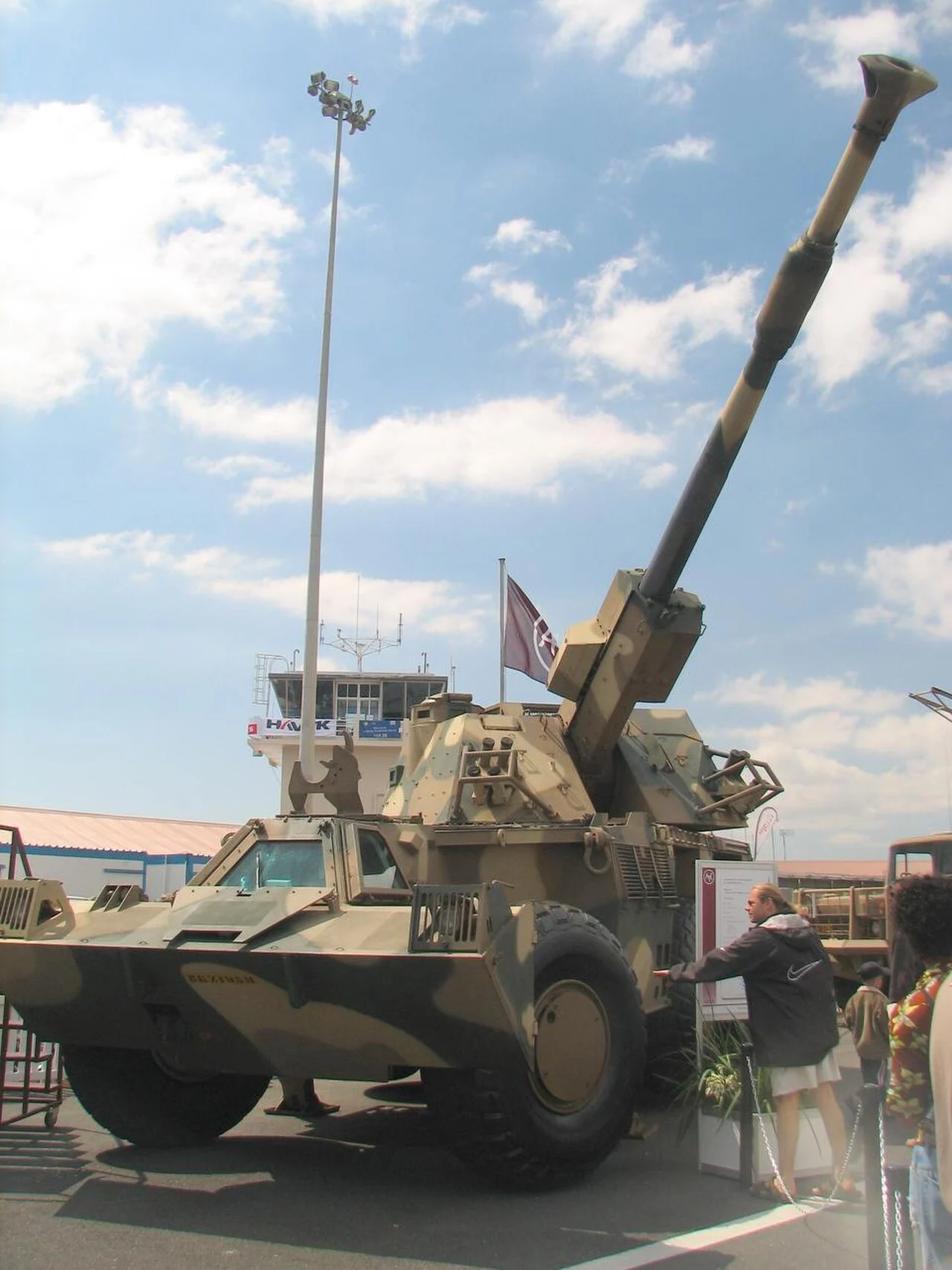
Denel Land Systems still builds and supports the G5 towed howitzer and its self-propelled derivative, the G6, both chambered for the 155mm ammunition family the company pioneered in the 1980s to beat UN sanctions-era resupply problems. South Africa’s own Army operates both types (status: operational), and Oman and the UAE bought G6s in the 1990s and remain the type’s only confirmed export operators alongside South Africa, though published fleet totals vary by source. Denel has since upgraded six G5 towed howitzers for the UAE, according to Janes, and is 18 months into a R2 billion (US$105.9 million) upgrade contract for Oman’s G6 fleet (status: contracted), with design reviews signed off, technical training delivered, and in-country facility construction under way, SAnews reported in September 2026. The 155mm ammunition family ranges from roughly 30km with standard high-explosive rounds to over 50km with extended-range projectiles, depending on the specific round and barrel length; Rheinmetall Denel Munition’s Assegai 155mm rounds were verified against the SANDF’s G5/G6 in live firings in November 2025. The Oman contract is the clearest current evidence that Denel’s artillery business can still win and execute an export deal on schedule.
2. Umkhonto Naval Surface-to-Air Missile — in service with three navies
Denel Dynamics’ Umkhonto is a vertically launched, infrared-homing surface-to-air missile designed to give frigates and corvettes point defence against aircraft and anti-ship missiles without a dedicated fire-control radar for every round. The South African Navy fits the Umkhonto-IR Block II to its four Valour-class frigates (status: operational). Finland selected the missile in 2002 for its Hamina-class fast attack craft and later its Hämeenmaa-class minelayers, and continues to operate it (status: operational), according to naval-technology.com. Algeria ordered the system in 2012 for the two MEKO A200-AN frigates built by ThyssenKrupp Marine Systems, with Denel’s 2016 annual report putting the value of missiles, fire-control equipment, integration and testing at roughly US$61 million; Algeria has since tested the system aboard its frigates (status: operational), Quwa reported. Published range figures vary between roughly 20km for the baseline Umkhonto-IR and 30km-plus for the extended-range IR variant; a radar-guided Umkhonto-R with a longer reach has been described by Denel as a future development rather than a fielded system. Umkhonto remains Denel Dynamics’ only naval missile with multiple non-African export customers, making it the company’s strongest claim to a defence-industrial foothold outside Africa.
3. Al Tariq Precision-Guided Bomb Kits — the UAE’s only confirmed customer
Al Tariq began in 2012 as a joint venture in which Denel held 49per cent and an Abu Dhabi-based partner held 51per cent; that partner was restructured first as Tawazun Dynamics and then absorbed into EDGE Group’s missiles and weapons cluster, where Al Tariq now sits. The kits strap onto Mk81, Mk82 and Mk83 general-purpose bombs to give them GPS/INS guidance, with the standard-range Al Tariq S reaching roughly 30-45km when released at altitude and the winged, long-range Al Tariq LR exceeding 120km, according to EDR Magazine. The UAE remains the type’s only confirmed operator (status: operational): Denel Dynamics’ own annual report recorded 600 Al Tariq kits delivered by 2023, and the UAE has used them operationally on Mirage 2000-9 aircraft. No other country has a confirmed Al Tariq contract; reports that Egyptian F-16s and Mirage 2000s have carried similar UAE-supplied munitions remain unconfirmed inferences rather than a disclosed transfer. For Denel, Al Tariq illustrates how its weapons technology now reaches export markets mainly through a UAE-controlled joint venture rather than direct South African sales.
4. Seeker 400 Tactical UAV — South African service, periodic UAE orders
The Seeker family of medium-altitude surveillance drones has been in South African Air Force service since the 1980s in earlier Seeker I/II form, with the Seeker 400 as the current production standard (status: operational in South Africa). The UAE has been a repeat customer: Military Africa reported in 2020 that the UAE Armed Forces placed a follow-on order worth more than R109 million for additional Seeker 400 airframes (status: ordered for that tranche), after earlier Seeker II deliveries in the late 1990s. Denel has also described an armed variant carrying two laser-guided missiles, though South Africa’s own air force has kept its Seeker 400s in the unarmed intelligence, surveillance and reconnaissance role. Seeker’s three-decade production run makes it one of the few African-designed UAV families with a verified multi-decade export relationship, rather than a single trade-show order.
5. Rooivalk Attack Helicopter — South Africa’s only operator, Mk1.1 upgrade pitched
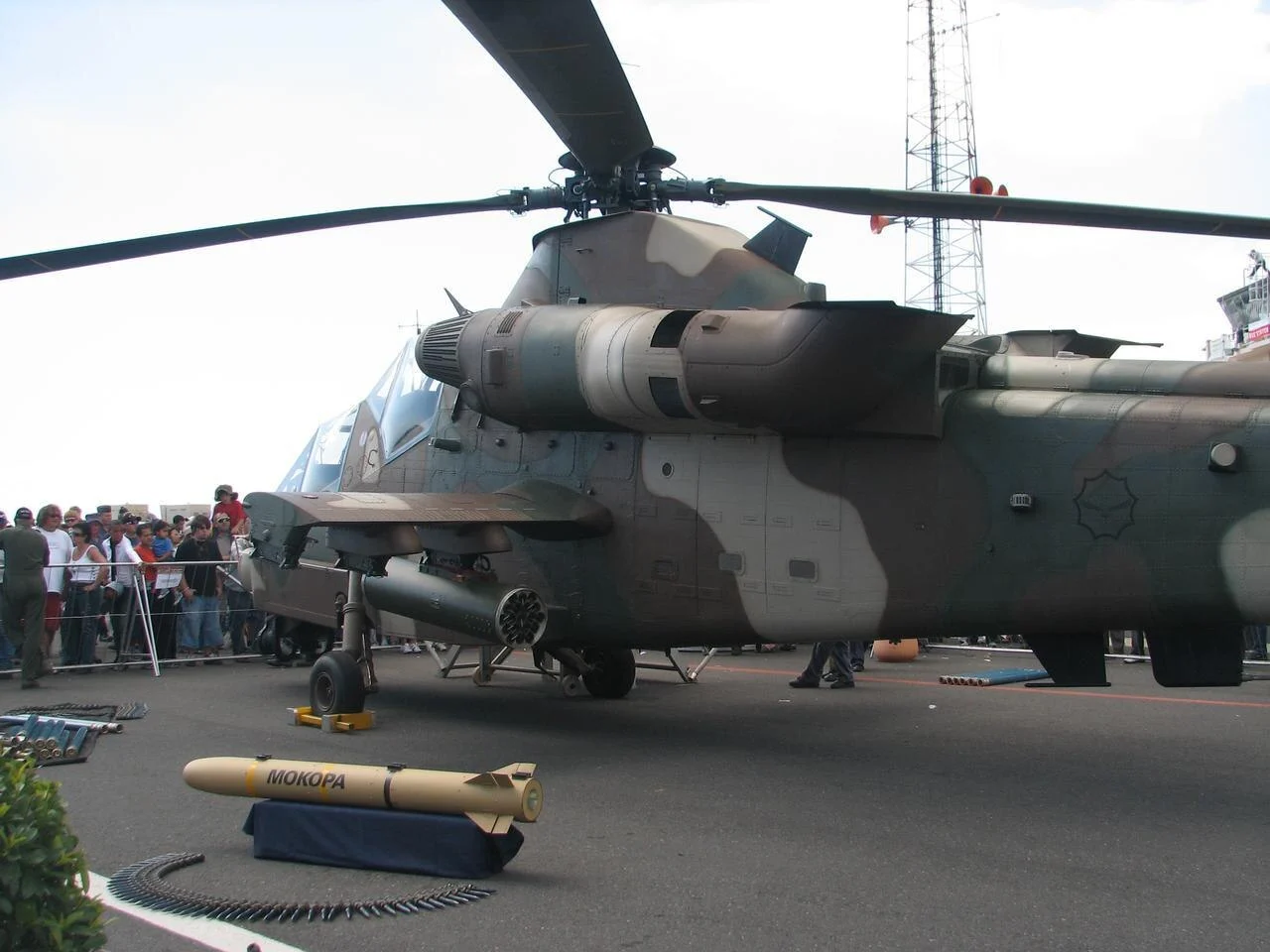
The AH-2 Rooivalk is South Africa’s indigenously designed attack helicopter, built by Denel Aeronautics and fielded only by the South African Air Force (status: operational), which took delivery of its 12-airframe fleet by the mid-2000s. The type never secured an export order, and its production line was mothballed after the SAAF batch was completed. As our earlier coverage of Denel Aeronautics’ pitch for a Rooivalk Mk1.1 upgrade detailed, the division is now proposing a sensor and weapons refresh for the existing fleet rather than a clean-sheet Mk2 that would need a large launch order to be viable (status: reportedly under negotiation). Fleet sustainment has been uneven: a lapsed Denel maintenance contract with the Department of Defence drew public criticism in 2024 for its effect on helicopter availability for SANDF peace-support deployments, before Denel’s broader turnaround plan took hold. Rooivalk remains the clearest example of Denel Aeronautics building a capability South Africa’s own air force needed, without the export volume that would make the programme self-sustaining.
6. Badger Infantry Combat Vehicle — contracted, deliveries still pending
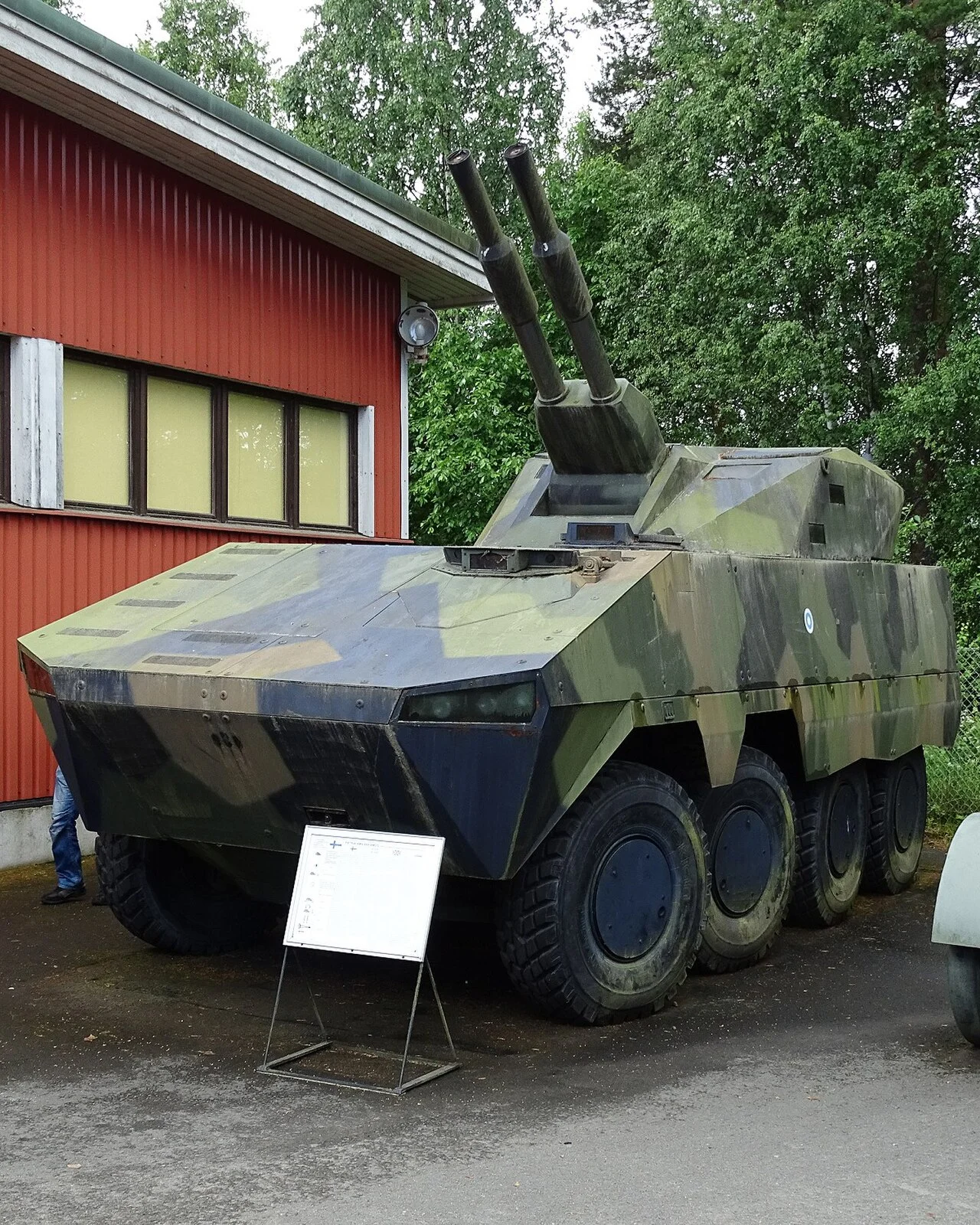
Denel Land Systems builds the Badger infantry combat vehicle under licence from Finland’s Patria, based on the AMV 8×8 platform, to replace the SANDF’s ageing Ratel wheeled fighting vehicles under the Armscor-run Project Hoefyster. Denel and Patria signed their cooperation agreement in 2013 covering a contract later reduced to 238 vehicles across six variants, after cost growth cut the original order from 264 (status: contracted), according to Shephard Media. Delivery has slipped repeatedly from an original 2019 target; defenceWeb’s tracking of the programme shows Denel now aiming to complete product baseline development of the six main Badger variants only by the end of 2027, with series deliveries to follow after that. Project Hoefyster has become the clearest illustration inside Denel Land Systems of the gap between a signed contract and a fielded vehicle, and it is the programme most frequently cited when Armscor and Parliament question Denel’s execution capacity.
7. Rheinmetall Denel Munition and PMP — the export ammunition business
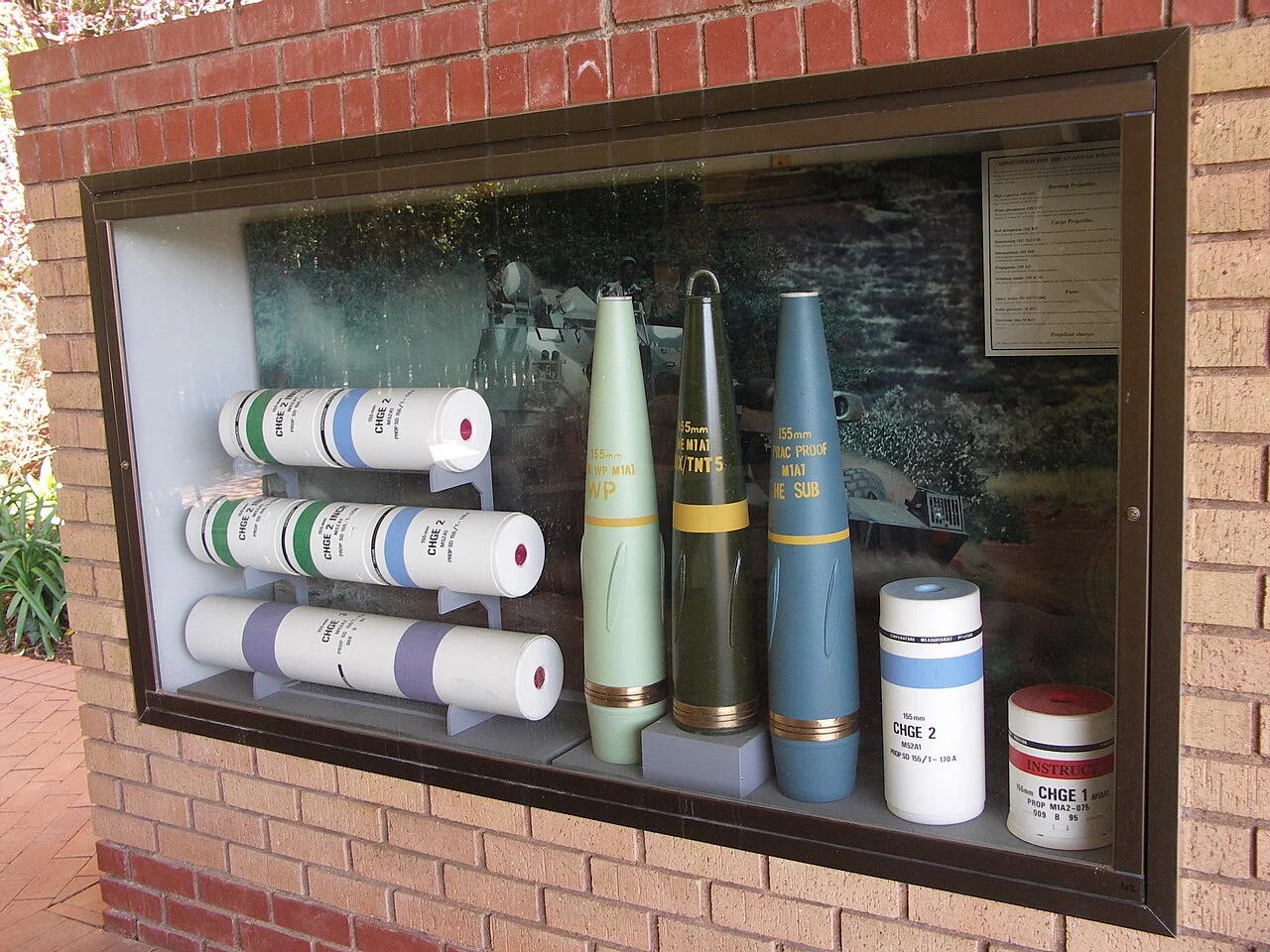
Denel’s ammunition manufacturing sits in two separate entities. Rheinmetall Denel Munition (RDM) has been majority-owned by Germany’s Rheinmetall (51per cent) since 2008, with Denel holding the remaining 49per cent, and makes medium- and large-calibre ammunition including the 155mm Assegai family for both South African and export customers (status: operational), according to Rheinmetall’s own company page. Denel’s wholly owned Pretoria Metal Pressings (PMP) plant, by contrast, makes small- and medium-calibre ammunition and has struggled commercially: Business Day reported in July 2026 that Denel is seeking private investors to revive PMP after it lost ground in both domestic and export markets. Munitions remain South Africa’s single largest defence export category by value, but most of that trade now runs through the Rheinmetall-controlled joint venture rather than Denel’s own PMP operation, a split that matters for how much of South Africa’s ammunition export revenue actually reaches the state-owned company.
| Division | Flagship product | Confirmed operators | Status |
|---|---|---|---|
| Denel Land Systems | G5/G6 155mm howitzer | South Africa, UAE, Oman | Operational; Oman upgrade contracted |
| Denel Dynamics | Umkhonto naval SAM | South Africa, Finland, Algeria | Operational |
| Denel Dynamics / EDGE JV | Al Tariq bomb kits | UAE | Operational |
| Denel Dynamics | Seeker 400 UAV | South Africa, UAE | Operational / ordered |
| Denel Aeronautics | AH-2 Rooivalk | South Africa | Operational; Mk1.1 under negotiation |
| Denel Land Systems / Patria | Badger ICV | South Africa | Contracted, deliveries pending |
| Rheinmetall Denel Munition / PMP | 155mm and small-calibre ammunition | South Africa + export | Operational |
Why it matters for Africa
Denel is the clearest test of whether a wholly state-owned African defence manufacturer can keep exporting once it loses the guaranteed domestic budgets that built it. Its artillery and missile lines show that the underlying engineering still competes: the Oman G6 upgrade and the Finnish and Algerian Umkhonto contracts are genuine export wins, not announcements. But the Badger programme shows the other side of state ownership, where a signed Armscor contract has not translated into fielded vehicles after more than a decade, and PMP shows a once-strong ammunition line losing export share to a joint venture it does not control outright. For African procurement officials watching Denel as a benchmark, the lesson is that a state manufacturer’s product list can remain technically credible even while its balance sheet depends on repeated Treasury bailouts, and that local assembly or technology-transfer deals with South Africa carry real execution risk alongside real engineering pedigree. Denel’s divisions also illustrate the limits of self-sufficiency doctrine: nearly every current export success, from the Oman howitzer deal to the UAE-controlled Al Tariq joint venture, now depends on a foreign partner’s capital, ownership stake or market access rather than Denel selling independently on its own balance sheet.
Sources
- SAnews — Denel records 15.8% increase in revenue
- SAnews — President Ramaphosa visits Denel as turnaround plan takes root
- Janes — Denel looking for T5-52 howitzer sale in Asia
- Naval Technology — Umkhonto surface-to-air missile
- Quwa — Integration of Umkhonto SAM to Algerian MEKO A200 frigate
- EDR Magazine — Inside EDGE: Al Tariq modular precision-guided munitions
- Military Africa — UAE orders additional Seeker UAV from Denel
- Shephard Media — Denel, Patria sign South African Badger agreement
- defenceWeb — Badger programme coverage
- Rheinmetall — Rheinmetall Denel Munition subsidiary page
- Business Day — Denel seeks investors to revive Africa’s largest ammunition maker