Czech firearms manufacturer CZ (Česká zbrojovka) is exploring South Africa as a potential regional production and support hub for the Southern African Development Community (SADC) market, the company has told defenceWeb, building on a permanent Gauteng office and a BREN rifle line already in service with South African forces.
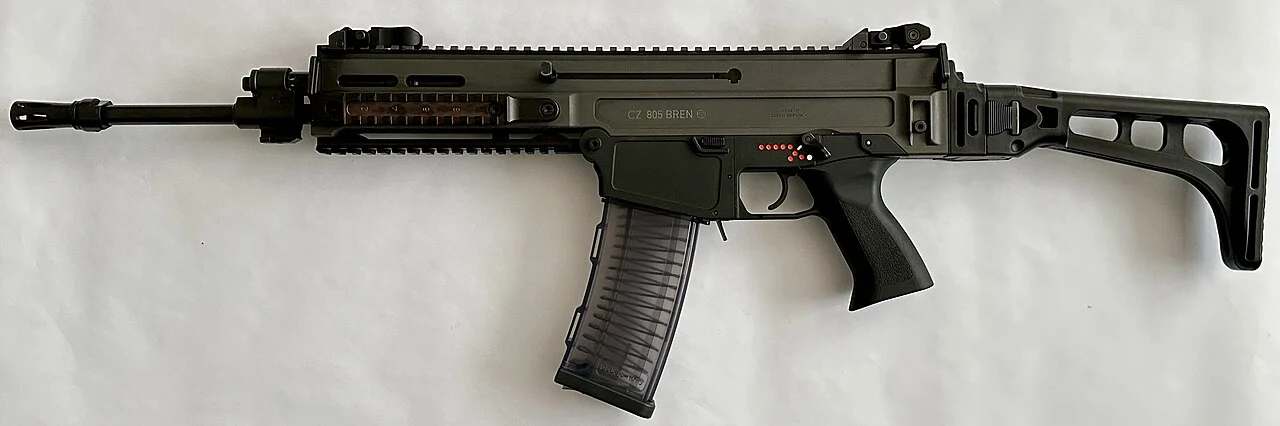
Photo: The CZ 805 BREN A1, forerunner of the BREN 2 and BREN 3 rifles CZ is offering across Africa. Credit: Land68, CC BY-SA 4.0, via Wikimedia Commons
CZ, a member of the publicly listed Colt CZ Group, exports small arms to nearly 100 countries and has built its African pitch around ageing inventories and fragmented equipment fleets across the continent. According to defenceWeb, the company said discussions are now moving toward "the practical structure of localisation, industrial cooperation and long-term support" in South Africa, though no formal agreement, partner entity or financial figure has been disclosed.
A Rifle Already in the Country
CZ’s pitch rests on products already in local hands. The BREN 2, offered in 5.56×45mm and 7.62×39mm, and the newer BREN 3 are said to be in service with unnamed South African military and law-enforcement units, giving the company an installed base to argue from rather than a cold-start sales pitch. CZ frames its offer around lifecycle support — armourer training, maintenance, spare parts — and has floated buyback programmes for obsolete weapons to help offset the cost of modernisation for cash-constrained SADC militaries and police services.
The approach mirrors a playbook CZ has used before. The company has a standing agreement with Ukraine’s state defence conglomerate, Ukroboronprom, to assemble BREN 2 rifles domestically rather than ship complete weapons, a model built to meet local-content rules and reduce lead times during wartime demand. A South African line would let CZ make a similar case to SADC governments that increasingly tie defence contracts to local industrial participation.
Why South Africa
South Africa is an unusually self-sufficient choice of hub by African standards. The country already hosts an established small-arms and ammunition industry, including state-owned Denel and private manufacturers, along with the regulatory and export-control infrastructure — the National Conventional Arms Control Committee (NCACC) — needed to license onward sales to third countries, an advantage over SADC neighbours without a comparable arms-control framework. South African defence exports nearly tripled to more than R10 billion in 2025, according to NCACC figures, evidence of spare industrial capacity and an export licensing system already handling a growing volume of shipments.
A South African assembly line would also let CZ compete more directly with the roster of foreign suppliers already using the country as an entry point into the SADC security market, including the Hytera, Sinovatio and ProtaTech lines distributed regionally through Pamodzi, and the locally built armoured vehicles and small arms that make up much of the South African Army’s own indigenous arsenal.
What Is Not Yet Confirmed
CZ’s statement to defenceWeb stops short of naming a South African industrial partner, a factory location, an investment figure or a timeline for when local assembly might begin. No South African government department has publicly confirmed talks with the company, and no production-sharing or licensing agreement has been filed with the NCACC as of this report. The story should be read as an early-stage exploration of a hub model CZ has already deployed elsewhere, not a signed localisation deal.
Why It Matters for Africa
If it advances, a CZ assembly line would add South Africa to a short list of African countries hosting licensed small-arms production for a foreign manufacturer, alongside more limited precedents elsewhere on the continent, and would give SADC militaries a regional source of BREN-pattern rifles, spares and armourer training without routing every order through Europe. It would also reinforce South Africa’s pitch, underlined by its own 2025 export numbers, as the continent’s most credible location for foreign defence primes to localise production rather than simply sell into the market from outside.