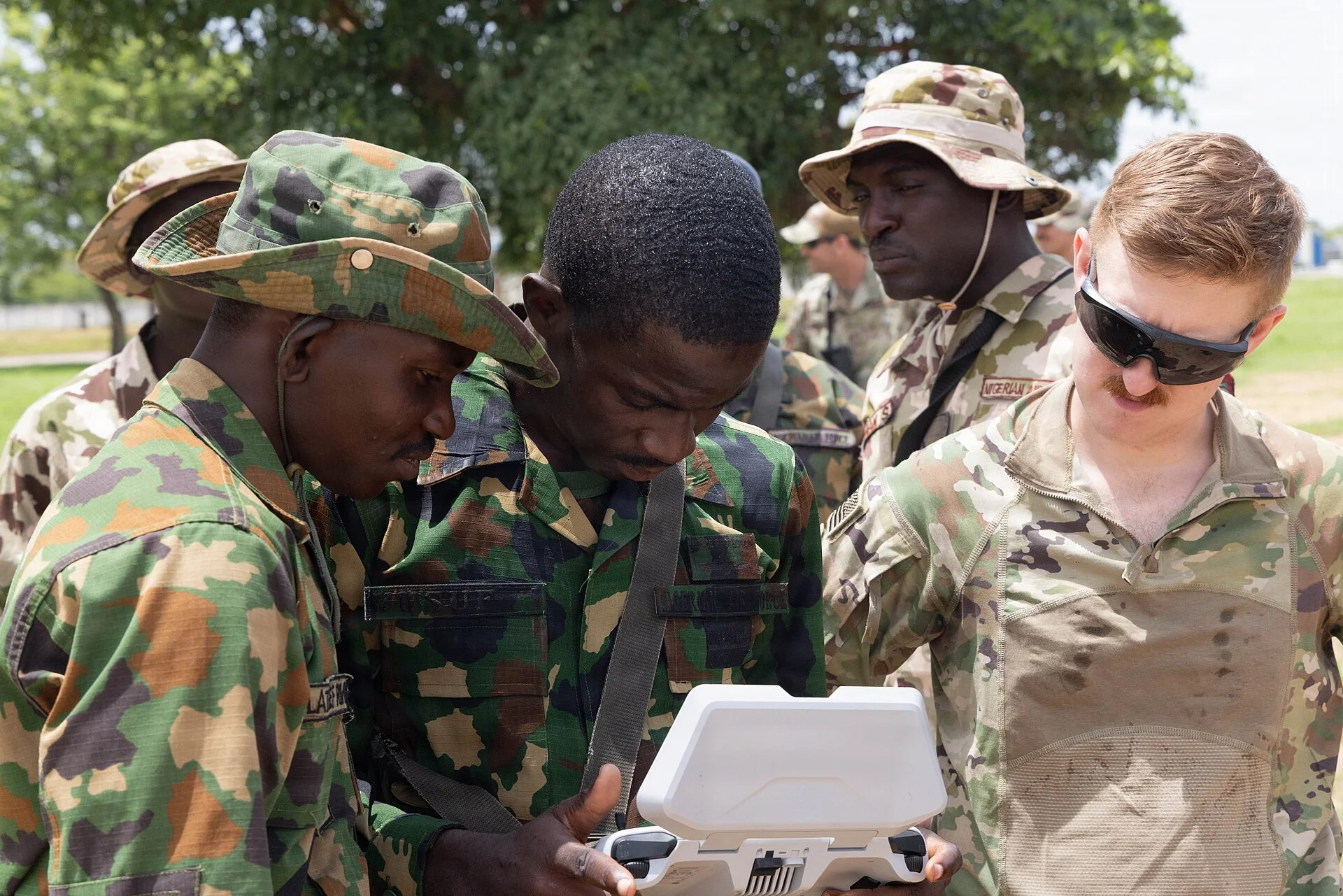
Nigeria now flies one of the most mixed drone fleets in Africa – 43 Turkish Bayraktar TB2s on order, around a dozen Chinese Wing Loong II and CH-3A/CH-4B strike drones already delivered, UAE tactical UAVs, and a first homegrown attack drone from Briech UAS. Here is what is confirmed, what is still a reported figure, and how the Turkish and Chinese halves of the fleet compare.
The short answer: the Nigerian Air Force and Army have spent the past four years building a two-supplier drone force built around Turkey and China, with smaller Emirati and domestic additions. Turkey’s Bayraktar TB2 is the largest single order – 43 airframes under the December 2024 “Project Guardian” programme – but China’s Wing Loong II and CH-3A/CH-4B family arrived earlier and have flown longer against Boko Haram and ISWAP in the north-east. A small tactical layer of Turkish TOGAN and BAHA mini-UAVs, delivered in August 2023, and two UAE-made Yabhon Flash-20s round out the imported side. Nigeria’s own Gulma, Tsaigumi and UNIKAM programmes, plus a new Briech UAS attack drone unveiled in 2025, remain at prototype or low-rate stage.
| Largest single order | 43 Bayraktar TB2 (Turkey), “Project Guardian”, announced December 2024 |
| Confirmed delivered strike/ISR drones | ~5 Wing Loong II, ~6 CH-3A/CH-4B (China); initial TB2 batch (2023) |
| Tactical mini-UAVs delivered | TOGAN & BAHA (Turkey, August 2023); Yabhon Flash-20 x2 (UAE) |
| Domestic programmes | Gulma, Tsaigumi, UNIKAM (prototype); Briech UAS attack drone (unveiled 2025) |
| Main operators | Nigerian Air Force (strike/ISR); Nigerian Army (Project Guardian, tactical) |
| Main roles | Counter-insurgency strikes (Boko Haram/ISWAP, north-east), anti-banditry (north-west), border/maritime ISR |
| Latest cooperation deal | Turkey-Nigeria Military Cooperation Protocol, signed Ankara, 27-28 January 2026 |
Turkey’s drones: Bayraktar TB2 and the tactical layer
The Bayraktar TB2 is Nigeria’s single largest drone commitment. Discussions date to 2022, when 46 Nigerian Army personnel – 14 pilots, seven mission operators and 23 engineers and technicians – trained in Turkey on the type between May and September that year. The programme was formally unveiled as “Project Guardian” in December 2024, covering 43 TB2s aimed primarily at the north-west theatre, with an initial batch already delivered and the balance of the order still moving through the pipeline into 2026. Alongside the TB2, Turkey has delivered two much smaller tactical systems: the STM TOGAN rotary-wing mini-UAV and the Havelsan BAHA fixed-wing mini-UAV, both received in August 2023 for short-range reconnaissance. Reports of Turkish Songar armed quadcopters in Nigerian service persist but have not been recently reconfirmed by a tracked delivery.
| System | Origin | Quantity | Status | Source |
|---|---|---|---|---|
| Bayraktar TB2 | Turkey (Baykar) | 43 ordered (“Project Guardian”, announced Dec 2024); initial batch delivered 2023 | Delivered (partial) / On contract | DefenseMirror, Military Africa, Army Recognition |
| TOGAN | Turkey (STM) | Undisclosed, small tactical batch | Delivered (Aug 2023) | Overt Defense, Army Recognition |
| BAHA | Turkey (Havelsan) | Undisclosed, small tactical batch | Delivered (Aug 2023) | Army Recognition |
| Songar armed quadcopter | Turkey (Asisguard) | Small numbers reported | Reported (unconfirmed) | Military Africa |
China’s drones: Wing Loong II and the CH-3A/CH-4B family
China’s drones reached Nigeria first and have flown the most combat hours. The air force’s five Wing Loong II medium-altitude strike drones, carrying tail codes NAF 141 through NAF 145, have been used against Boko Haram in the north-east since their delivery, and a smaller CH-3A/CH-4B batch – most open sources put it at around two CH-3Bs and four CH-4Bs – has been in service even longer, with Nigeria’s Chinese-made strike drones dating back to the mid-2010s, well before the Turkish order was placed. These aircraft, together with locally based ISR types, cover the states most exposed to banditry: Zamfara, Sokoto, Kebbi, Katsina and parts of Kaduna.
| System | Origin | Quantity | Status | Source |
|---|---|---|---|---|
| Wing Loong II | China (AVIC) | 5 (NAF 141–145) | Operational | Eurasian Times, Military Africa |
| CH-4B | China (CASC) | ~4 | Operational | Military Africa, DefenseMirror |
| CH-3A/CH-3B | China (CASC) | ~2–3 | Operational | Military Africa, Oryx |
The rest of the fleet: UAE’s Yabhon Flash-20 and homegrown drones
Outside the two main suppliers, Nigeria holds two UAE-made Yabhon Flash-20 tactical UAVs for short-range surveillance – a minor addition rather than a strategic one. More significant for the long term is Nigeria’s own drone industry. The Defence Industries Corporation of Nigeria and the Air Force Research and Development Centre have run the Gulma, Tsaigumi and UNIKAM programmes for several years, but all three remain at prototype or low-rate stage with no confirmed fielded numbers. In April 2025, the Nigerian military and Abuja-based manufacturer Briech UAS unveiled the country’s first domestically produced attack drone and guided bombs, with Chief of Defence Staff General Christopher Musa calling it a step toward reducing reliance on imports; no technical specifications or production numbers have been released, and the system has not yet appeared in confirmed operational use.
| System | Origin | Quantity | Status | Source |
|---|---|---|---|---|
| Yabhon Flash-20 | UAE | 2 | Delivered | Army Recognition |
| Gulma / Tsaigumi / UNIKAM | Nigeria (DICON / AFRDC) | Prototype batches, no confirmed fielded total | Under development | Military Africa |
| Briech UAS attack drone & guided bombs | Nigeria (Briech UAS / EIB Group) | Unveiled, specifications undisclosed | Reported (unconfirmed operational status) | ADF Magazine, Nigerian News Agency |
Türkiye vs China: how the two suppliers compare
Nigeria is running the same Turkish-Chinese dual-sourcing pattern Envanter Medya has tracked across several African drone fleets, and the two relationships look different in practice rather than one simply outperforming the other. China’s drones arrived first and fastest, with no public training commitment attached and few political strings, which suited Nigeria’s urgent 2014-15 need to get strike drones over Boko Haram-held territory. Turkey’s TB2 programme took longer to mature – training began in 2022, the order was only named in 2024 – but it came bundled with a pilot and technician pipeline, and that relationship has since deepened: during President Tinubu’s 27-28 January 2026 state visit to Ankara, Nigeria and Turkey signed nine agreements including a Military Cooperation Protocol covering counter-terrorism support, training, intelligence sharing and defence-industry collaboration, with Turkey agreeing to train 200 Nigerian special forces personnel. Talks with ASELSAN over radar and counter-UAS systems, reported in September 2025, remain unsigned. Neither supplier has published export-financing or munitions-package terms in enough detail for a reliable cost comparison, and this article does not claim either drone is operationally superior on the battlefield – only that the political and training relationship built around the TB2 has grown faster than the one around the Wing Loong/CH family.
| Türkiye | China | |
|---|---|---|
| Lead systems | Bayraktar TB2, TOGAN, BAHA | Wing Loong II, CH-3A/CH-4B |
| First Nigerian deliveries | 2023 (training from 2022) | Mid-2010s |
| Training/cooperation package | 46 personnel trained 2022; Jan 2026 protocol adds 200 special forces trainees, intelligence sharing | No comparable public training agreement identified |
| Follow-on deals in discussion | ASELSAN radar/counter-UAS (talks since Sep 2025, unsigned) | None publicly reported |
| Political exposure | Low – Turkey positions itself as a non-aligned security partner | Low – sales handled commercially, little public conditionality |
What the drones are actually used for
Nigeria’s drones fly two overlapping missions. In the north-east, the air force has used Wing Loong II and CH-4B strikes against Boko Haram and ISWAP for close to a decade; the first days of January 2026 saw intensified, intelligence-led airstrikes against both groups’ logistics and movement networks. In the north-west and north-central states, the newer TB2s and supporting ISR aircraft target banditry and kidnapping gangs – a strike on 9-10 May 2026 hit gathering points in Katerma, Bokko, Kusasu and Kuduru in Niger State’s Shiroro district after intelligence indicated an attack was being planned. The other side of the picture is defensive: Boko Haram and ISWAP have increasingly weaponised cheap commercial drones of their own, which is part of why the armed forces describe counter-UAS work, not just strike capability, as a growing priority.
What is changing?
Three things are moving at once. First, the TB2 order is still being filled – the December 2024 announcement covered 43 airframes, and deliveries against that total continue. Second, the January 2026 Ankara agreements point toward a broader Turkish role beyond hardware: special-forces training and intelligence sharing, not just airframes. Third, Nigeria’s own industry is trying to get off the ground, with the Briech UAS attack drone the most visible result so far, though it remains unproven in service. None of these points yet to a specific new drone order; all three point to deeper reliance on Turkey and a slow, uncertain push toward a domestic alternative.
What arrived in the past year
| Date | Event | Value | Status |
|---|---|---|---|
| September 2025 | Talks with Turkey’s ASELSAN over radar and counter-UAS systems | Undisclosed | Reported (unconfirmed, unsigned) |
| 2025 | Briech UAS unveils Nigeria’s first domestically produced attack drone and guided bombs | Specifications undisclosed | Reported (unconfirmed operational status) |
| 27–28 January 2026 | Turkey-Nigeria Military Cooperation Protocol signed in Ankara, covering counter-terrorism support, training and defence-industry collaboration | 200 Nigerian special-forces trainees | Signed |
| 2026 | Bayraktar TB2 deliveries continue against the December 2024 “Project Guardian” order | 43 TB2 ordered | On contract / partial delivered |
How many drones does Nigeria have? FAQ
How many drones does Nigeria have in total?
Nigeria’s confirmed drone inventory is modest next to the fleet it is assembling. Open sources count roughly five Wing Loong II and about six CH-3A/CH-4B Chinese strike drones in service, an initial batch of Turkish Bayraktar TB2s delivered against a 43-aircraft order, two UAE Yabhon Flash-20 tactical UAVs, and an undisclosed small batch of Turkish TOGAN and BAHA mini-UAVs. Nigeria’s own Gulma, Tsaigumi and UNIKAM programmes, plus the Briech UAS attack drone, remain at prototype stage and are not counted in operational totals. There is no single confirmed total because the Ministry of Defence has not published a consolidated order of battle.
How many Bayraktar TB2 drones does Nigeria have?
Nigeria has ordered 43 Bayraktar TB2s from Turkey’s Baykar under the “Project Guardian” programme announced in December 2024 – the single largest drone commitment in its fleet. An initial batch was delivered by 2023 following pilot and technician training that began in Turkey in 2022, but deliveries against the full 43-aircraft order were still continuing into 2026, so the current in-service total is lower than the order figure.
How many Wing Loong II drones does the Nigerian Air Force have?
The Nigerian Air Force operates around five Wing Loong II medium-altitude strike drones from China’s AVIC, carrying tail codes NAF 141 through NAF 145. They have flown strikes against Boko Haram and ISWAP in the north-east since delivery and remain the backbone of Nigeria’s Chinese-origin strike fleet alongside a smaller batch of roughly six CH-3A/CH-4B drones.
Who makes Nigeria’s military drones?
Nigeria’s drones come mainly from Turkey’s Baykar (Bayraktar TB2), China’s AVIC and CASC (Wing Loong II, CH-3A/CH-4B) and the UAE (Yabhon Flash-20), with smaller Turkish tactical systems from STM (TOGAN) and Havelsan (BAHA). Nigeria is also building its own industry: the Defence Industries Corporation of Nigeria and the Air Force Research and Development Centre run the Gulma, Tsaigumi and UNIKAM programmes, and Abuja-based Briech UAS unveiled the country’s first domestically produced attack drone in 2025.
Does Nigeria have a locally made military drone?
Yes, though not yet a fielded one. In 2025, the Nigerian military and manufacturer Briech UAS unveiled the country’s first domestically produced attack drone and guided bombs, which Chief of Defence Staff General Christopher Musa described as a step toward reducing reliance on imports. No specifications or production numbers have been released, and the system has not been confirmed in operational service. Nigeria’s older Gulma, Tsaigumi and UNIKAM programmes remain at prototype or low-rate stage as well.
How Nigeria’s drone fleet compares
Nigeria’s Turkish-Chinese dual-sourcing pattern has echoes elsewhere in West Africa and the Sahel. Mali has built a comparable fleet around Turkish and other suppliers (see DefenceMENA’s look at why Mali expanded its drone fleet), while Chad has leaned on Turkish Anka and Aksungur systems (why Chad bought the Anka and Aksungur drones). For the wider forces these drones support, see DefenceMENA’s Nigerian Army weapons and equipment list and Nigerian Air Force aircraft inventory, and the full Nigeria military profile for how the drone fleet fits into the country’s broader order of battle.
A note on the numbers
Nigeria’s Ministry of Defence does not publish a drone-by-drone order of battle, so the figures above are built from specialist defence outlets (Military Africa, Army Recognition, DefenseMirror, Overt Defense), open-source trackers (Oryx) and Nigerian state media, cross-checked against DefenceMENA’s own Nigeria military profile. Ordered, delivered and operational are treated as different things throughout: the 43-TB2 figure is an order total, not a confirmed in-service count, and the Briech UAS drone is unveiled but not confirmed operational.
Sources
- Defense Mirror – Nigeria procures 43 Bayraktar TB2 drones to boost north-west security
- The Eurasian Times – Nigeria’s Wing Loong II deliveries
- Army Recognition – Nigeria acquires Turkish BAHA and TOGAN UAVs
- Overt Defense – Nigeria receives TOGAN UAVs from Turkey
- Oryx – A guide to Nigeria’s military drones
- ADF Magazine – Nigeria debuts domestically produced attack drone
- Atalayar – Turkey seals strategic alliance with Nigeria (January 2026)
- Voice of Nigeria – Military chiefs accompany President Tinubu to Türkiye
- AllAfrica – Nigerian Air Force intensifies airstrikes in north-east, north-west
- TimesLIVE – Nigerian Army on May 2026 Shiroro-area airstrikes
- DefenceMENA – Nigeria’s Military Strength in 2026