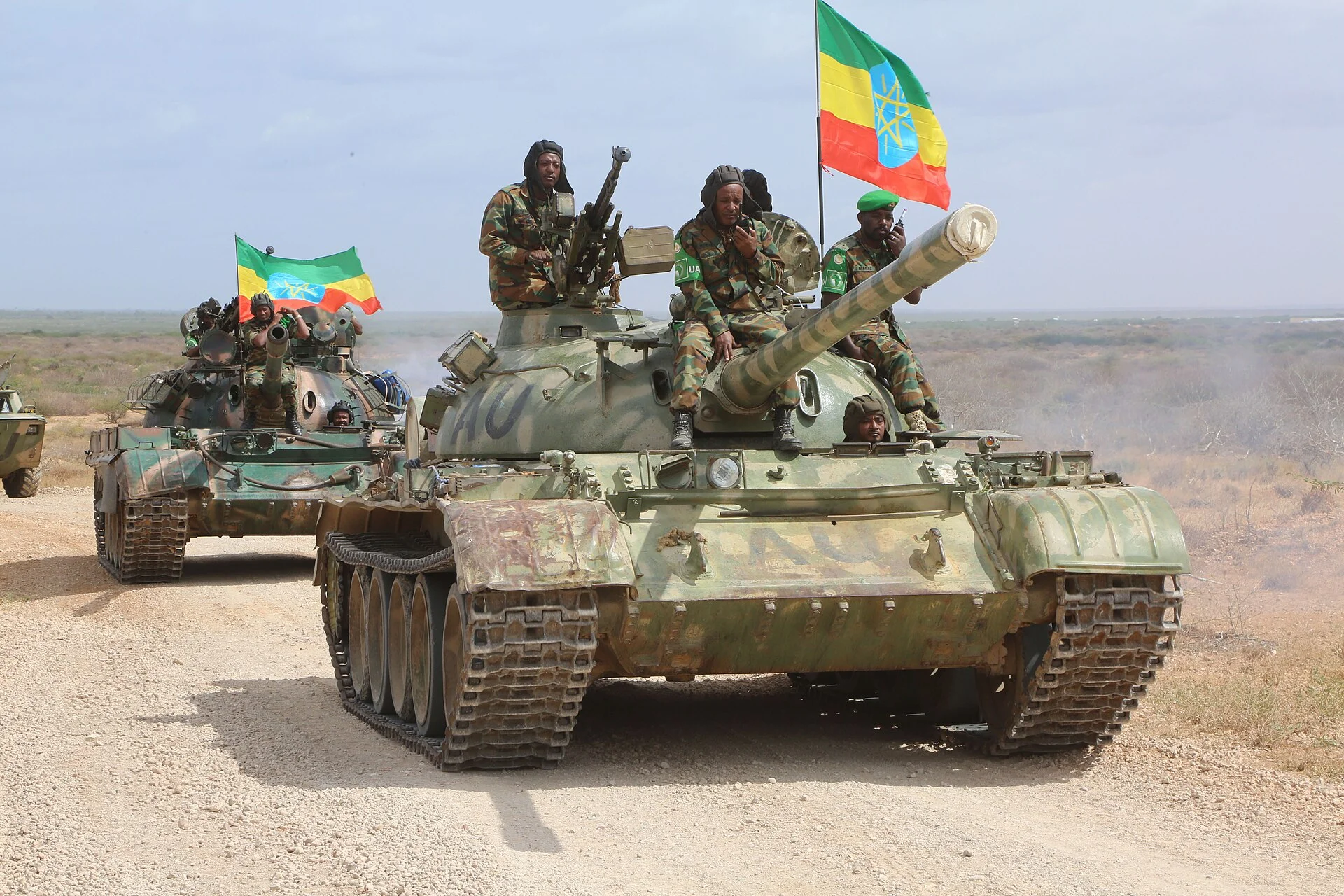
Ethiopia’s army is a layered inheritance: Cold War Soviet armour that never fully left service, an upgraded Ukrainian T-72 fleet bought to replace it, and a 2020s wave of Chinese heavy artillery, long-range rockets and Emirati armoured trucks bought to fight counter-insurgency and border wars instead of a conventional front. This is the 2026 system-by-system list of what the Ethiopian National Defense Force’s ground forces actually hold and who built it.
In short: Ethiopia’s confirmed, individually-sourced tank fleet runs to roughly 260 T-72s — about 60 bought secondhand from Yemen in 2003 and more than 200 upgraded examples bought from Ukraine from 2011 — sitting alongside an unknown number of older Soviet-era T-54/T-55s whose operational status nobody publishes with confidence. The three suppliers that dominate the army’s current re-equipment are China (artillery, rocket systems and armoured personnel carriers), Russia (the historic Cold War base plus the 2019 Pantsir-S1 air-defence buy) and the United Arab Emirates (hundreds of Calidus MCAV-20 light armoured vehicles delivered since mid-2024). Large aggregator indexes claim Ethiopia fields over 1,500 main battle tanks in total; DefenceMENA treats that figure as unverified and well above what any individually sourced delivery adds up to, and does not use it as a headline number on this page.
| Origin | Main systems | Share of listed inventory | Era |
|---|---|---|---|
| Soviet Union / Russia | T-54/T-55 MBT, BMP-1 IFV, BTR-60 APC, D-30 122mm howitzer, BM-21 Grad MLRS, Pantsir-S1 air defence | The historic bulk of the fleet by raw item count, though much of the oldest armour is of unconfirmed operational status | 1977–1991 Cold War bloc supply, revived by the 2019 Pantsir-S1 air-defence contract |
| Ukraine | Upgraded T-72 / T-72UA1 main battle tank | The larger and better-documented half of the confirmed tank fleet | Ordered 2011 ($100m, Ukrspetsexport), delivered from November 2013 |
| China | WZ-551 (Type-92A) APC, SH-15 (PCL-181) 155mm self-propelled howitzer, PHL-03 300mm MLRS, A-200 guided rocket artillery, M-20 short-range ballistic missile | The newest and highest-value layer of firepower added since 2016, expanding fastest since 2023 | 2016–2026, accelerating after the 2020–2022 Tigray war |
| United Arab Emirates (Calidus) | MCAV-20 4×4 armoured vehicle | Hundreds of units across at least three identified shipments; the fastest-growing single vehicle family in the fleet | July 2024 first deliveries, continuing batches into early 2026 |
| Yemen (secondhand transfer) | T-72 main battle tank | A smaller slice of the tank fleet, roughly a quarter of the confirmed T-72 total | 2003 surplus purchase |
Main battle tanks
Ethiopia’s armoured force is built around two tank generations that never fully replaced each other. The T-54/T-55 family arrived during the Cold War alliance with the Soviet Union and Eastern Bloc states and still appears in parades and reserve formations, but no current source publishes a confirmed operational count; much of the fleet is widely assumed to be in storage or non-operational after five decades of service and the 2020–2022 Tigray war, during which large quantities of Ethiopian armour were documented captured or destroyed by Tigrayan forces. The T-72 is the clearer, better-documented modern fleet: roughly 60 were bought secondhand from Yemeni army surplus in 2003, and a further batch of more than 200 upgraded T-72/T-72UA1s — fitted with a new engine, explosive reactive armour and 9K120 Svir gun-launched anti-tank missiles — were ordered from Ukraine’s state exporter Ukrspetsexport in a 2011 contract worth roughly $100 million, with the first group of 16 tanks arriving via the port of Djibouti from November 2013.
| System | Origin (country + manufacturer) | Quantity | Status | Source |
|---|---|---|---|---|
| T-72 / T-72UA1 (upgraded) | Ukraine, Ukrspetsexport (Soviet-design hull) | More than 200 on contract | Delivered from November 2013 | Defence-Update; DefenceTalk; Army Technology |
| T-72 (ex-Yemen) | Soviet-design, via Yemeni army surplus | Estimated ~60 | Operational, older standard | Defence-Update (background on 2011 order) |
| T-54 / T-55 family | Soviet Union | Estimated several hundred, precise figure unpublished | Reported — operational status of most of the fleet is unconfirmed | Oryx Spioenkop (Tigray war documentation); GlobalSecurity.org |
The Tigray war is the main reason Ethiopia’s real, current tank strength is harder to state with confidence than its 2010s totals would suggest. Oryx’s visually-confirmed-loss project documented Tigrayan forces fielding dozens of tanks and heavier equipment captured from federal and allied forces after November 2020, including an estimated 86 or more tanks identified through photo and video evidence alone — a reminder that any Ethiopian Army equipment count after 2020 should be read as a snapshot of a fleet that has already been fought over once.
Armoured personnel carriers, IFVs and protected vehicles
Ethiopia’s wheeled and tracked troop-carrier fleet mixes Cold War Soviet hulls with a fast-growing Emirati light-armour family bought specifically for internal security and border-protection missions rather than conventional war. The newest and most visible addition is the Calidus MCAV-20, a UAE-built 4×4 that can mount a 30mm cannon, a 7.62mm machine gun or a 40mm grenade launcher: at least 28 were filmed moving by rail in July 2024, followed by a reported delivery of “hundreds” of units later that month, and a further batch was observed moving from the port of Djibouti toward Addis Ababa in March 2026. Field Marshal Birhanu Jula, the ENDF’s Chief of General Staff, framed the programme in February 2026 as part of a wider push to build a more mobile force and replace ageing Soviet-era transport.
| System | Origin (country + manufacturer) | Quantity | Status | Source |
|---|---|---|---|---|
| Calidus MCAV-20 | United Arab Emirates, Calidus | Hundreds, across at least three shipments since July 2024 | Delivered, additional batches ongoing into 2026 | Military Africa; Jane’s; Army Recognition |
| WZ-551 / Type-92A | China, Norinco | Estimated several dozen | Operational; a number converted into improvised self-propelled guns (see artillery) | Military Africa; Jane’s |
| BMP-1 | Soviet Union | Estimated, low confidence | Reported, legacy fleet | GlobalSecurity.org |
| BTR-60 | Soviet Union | Estimated, low confidence | Reported, legacy fleet, largely superseded in new procurement | GlobalSecurity.org |
| Gaia Thunder / Ze’ev light armoured vehicle | Reported, unconfirmed manufacturer attribution | Reported ~75 each | Reported (unconfirmed) — DefenceMENA could not independently verify these holdings against a named primary source | Open-source equipment trackers (unverified) |
The small arms picture is a one-line summary rather than a system-by-system list: Ethiopia’s state-owned Gafat Armament Engineering Complex, in Bishoftu, has produced AK-47 pattern rifles and PK machine guns domestically since the 1980s under original Soviet and North Korean assistance, and the Homicho Ammunition Engineering Complex supplies small-arms and artillery ammunition. Ethiopian officials said in 2025–2026 reporting that the country is now self-reliant for AK-47, DShK and artillery ammunition production and has begun exporting ammunition, though DefenceMENA has not independently verified the export figures cited in that reporting.
Artillery and rocket systems
Artillery is where Ethiopia’s re-equipment with Chinese systems is most visible, and where the army has improvised as well as imported. Since 2016, Ethiopian forces have mounted Soviet-design D-30 122mm towed howitzers directly onto the troop compartments of Chinese WZ-551 APCs, creating a crude self-propelled gun with frontal armour for the crew; the conversion resurfaced publicly again in 2024, suggesting the programme has continued rather than been a one-off wartime fix. Alongside it, Ethiopia bought at least 32 Chinese-made SH-15 (PCL-181) 155mm truck-mounted self-propelled howitzers, which first arrived at Harar Meda Military Airport on 18–19 January 2023 at a reported unit price of roughly $2.1 million each; the 52-calibre gun can reach around 50km with rocket-assisted ammunition and is compatible with standard 155mm NATO rounds as well as China’s own GP1/GP155 precision-guided shells.
| System | Origin (country + manufacturer) | Quantity | Status | Source |
|---|---|---|---|---|
| SH-15 / PCL-181 155mm self-propelled howitzer | China, Norinco | At least 32 | Delivered January 2023, in service | Military Africa; Army Recognition; Jane’s |
| D-30 122mm towed howitzer | Soviet Union | Estimated, low confidence; a number converted to WZ-551-mounted self-propelled configuration | Operational / Reported for the converted batch | Military Africa; Jane’s (WZ-551 conversion reporting) |
| BM-21 Grad 122mm MLRS | Soviet Union | Estimated, low confidence; some older launchers rebuilt onto new truck chassis | Reported, partially refurbished | GlobalSecurity.org; open-source equipment trackers |
| PHL-03 300mm MLRS | China, Norinco | Reported “half a dozen” | Reported (unconfirmed exact date) | Military Africa |
| A-200 guided rocket artillery / M-20 short-range ballistic missile | China (M-20 is the export variant of the DF-12 SRBM) | Reported “half a dozen” launchers each | Reported (unconfirmed) — if accurate, the most capable ballistic-missile-range system any DefenceMENA Sub-Saharan Africa arsenal page has documented to date | Military Africa |
In September 2026, Indian trade press reported that Ethiopia was discussing procurement of Indian-made artillery systems, specifically to replace its ageing Soviet-era towed guns, with talks linked to Ethiopian participation in that year’s BRICS summit. No contract has been confirmed, and DefenceMENA lists it here as Reported rather than On contract.
Anti-tank and air defence systems
Ethiopia’s confirmed modern air-defence acquisition is Russian: Moscow supplied Pantsir-S1 (NATO: SA-22 Greyhound) combined gun-missile systems, first displayed publicly at an Ethiopian Defense Day event in February 2019 and reported complete by November 2019, reportedly comprising around four launch vehicles and roughly 100 57E6 missiles from a 2018 order. Ethiopia’s anti-tank capability at brigade level rests on legacy Soviet-era systems, most notably the 9K113 Konkurs, typically carried on BMP-1 infantry fighting vehicles; DefenceMENA has found no confirmed reporting of a newer Western or Chinese ATGM type entering ENDF ground-forces service to replace it.
DefenceMENA has found no confirmed Turkish land systems — no Kirpi, Hizir or similar armoured vehicle, and no ASELSAN ground sensor — in Ethiopian Army service. The Bayraktar TB2 and other Turkish-linked drones reported in the 2020–2022 Tigray war belong to the Ethiopian Air Force’s UAV fleet, covered in DefenceMENA’s separate Ethiopia war drones piece, not to the Army’s ground order of battle on this page. The munition those TB2s have carried, ROKETSAN’s MAM-L, is tracked by operator on DefenceMENA’s ROKETSAN in Africa page.
How the arsenal was built
Ethiopia’s ground forces inherited their base equipment from the Soviet-aligned Derg period (1977–1991), when Moscow and allied Eastern Bloc states supplied the bulk of the tanks, APCs, artillery and rocket systems that still anchor the army’s paper strength today. After the Cold War, Addis Ababa topped up that ageing fleet opportunistically rather than replacing it wholesale: roughly 60 secondhand T-72s from Yemeni army stocks in 2003, then the larger 2011 Ukrainian order for upgraded T-72s delivered from 2013 as the more credible modern tank fleet. The 2020–2022 Tigray war was the clearest stress test of this inherited force, with large quantities of federal and allied armour documented captured or destroyed by Tigrayan forces, and it appears to have accelerated the shift toward the current, more diversified supplier base.
Since roughly 2016, and especially since 2023, China has become the dominant source of new heavy firepower: the WZ-551/D-30 self-propelled conversion, the SH-15 155mm truck howitzer, and reported PHL-03 MLRS, A-200 rocket artillery and M-20 ballistic-missile-range systems collectively represent the most capable additions to the army’s indirect-fire arsenal in decades, even where exact numbers remain Reported rather than confirmed. Running in parallel since mid-2024, the United Arab Emirates has become the main supplier of new protected mobility through the Calidus MCAV-20 programme, aimed squarely at motorised infantry and border-security units rather than at replacing the tank fleet. Russia remains present mainly through its 2018–2019 Pantsir-S1 air-defence sale and the legacy Soviet equipment base, rather than through new post-2020 contracts identified in open sources.
What arrived in the last 12 months
| Date | Event | Value | Status |
|---|---|---|---|
| February 2026 | Field Marshal Birhanu Jula publicly frames Calidus MCAV-20 induction and wider force modernisation as a core ENDF reform pillar | Not disclosed | Reported (policy statement) |
| March 2026 | Additional Calidus MCAV-20 batch and heavy logistics trucks observed moving by rail from the Port of Djibouti toward Addis Ababa | Not disclosed | Delivered |
| September 2026 | Indian trade press reports Ethiopia discussing procurement of Indian artillery to replace ageing Soviet-era towed guns, linked to BRICS summit talks | Not disclosed | Reported (unconfirmed) |
How many tanks does Ethiopia have?
How many tanks does Ethiopia have in total?
Ethiopia’s confirmed, individually-sourced tank fleet is roughly 260 T-72s: about 60 bought as secondhand Yemeni army surplus in 2003, plus more than 200 upgraded T-72/T-72UA1s bought from Ukraine in 2011 and delivered from 2013. On top of that sits an unknown number of older Soviet-era T-54/T-55 tanks whose current operational status is not published by any primary source; DefenceMENA treats that older fleet as Estimated and does not add it to a single confident total.
How many tanks does Ethiopia have 2025?
No official 2025 or 2026 Ethiopian government disclosure gives a precise, single tank total. Open-source aggregators that publish figures above 1,500 main battle tanks for Ethiopia are not corroborated by any individual delivery DefenceMENA could verify and are treated on this page as an unverified, GFP-style index figure rather than a reported count.
Does Ethiopia have ballistic missiles?
Possibly. Military Africa has reported that Ethiopia acquired a small number — “half a dozen” — of Chinese M-20 short-range ballistic missiles together with their A-200 launcher vehicles, alongside PHL-03 300mm rocket launchers. DefenceMENA lists this as Reported rather than Confirmed, since no other outlet in this page’s source list independently corroborates the acquisition.
What is Ethiopia’s newest army equipment?
The most recently delivered major systems are the UAE’s Calidus MCAV-20 4×4 armoured vehicles, arriving in multiple batches from July 2024 through at least March 2026, and the Chinese SH-15 155mm self-propelled howitzers delivered from January 2023. Reported Chinese PHL-03 rocket launchers and M-20 ballistic-missile systems would be newer still if confirmed.
Does Ethiopia manufacture its own military equipment?
Ethiopia produces small arms and ammunition domestically through the state-owned Gafat Armament Engineering Complex and Homicho Ammunition Engineering Complex, both originally built with Soviet and North Korean assistance, and officials have said the country is now self-sufficient in AK-47, DShK and artillery ammunition production. It does not manufacture tanks, armoured vehicles or artillery pieces domestically; every tracked and major gun system on this page was imported.
How Ethiopia compares
A full Ethiopia military strength profile is planned separately on DefenceMENA as this series continues. In the meantime, DefenceMENA’s existing Drones in the Ethiopia War piece covers the Air Force’s UAV fleet in more depth than this Army-focused page, and the continent-wide Africa’s Largest Main Battle Tank Fleets, Ranked, Artillery for African Armies and Strongest Militaries in Africa pieces place Ethiopia’s ground-forces arsenal against its neighbours. African Defence Budgets Ranked covers the spending context behind this procurement wave, and Military Drones Operated Across Africa and Which African Countries Operate the Wing Loong Drone? cover the Wing Loong and other UAV types Ethiopia used during the Tigray war.
A note on the numbers
This page deliberately avoids a single confident “total main battle tanks” figure. Individually sourced deliveries (the 2003 Yemeni T-72 purchase, the 2011 Ukrainian T-72 order) add up to roughly 260 tanks; aggregator sites that publish totals above 1,500 are not supported by any delivery this page could independently verify and are excluded as a headline number, consistent with this page’s treatment of Global Firepower-style indexes elsewhere in this series. Several holdings — the BMP-1 and BTR-60 fleets, the Gaia Thunder/Ze’ev light vehicles, the PHL-03/A-200/M-20 rocket and missile systems — are marked Estimated or Reported because DefenceMENA could not find a primary military, manufacturer or named-correspondent source giving a precise current figure; these should be read as indicative rather than official. The Tigray war (2020–2022) is also a reason any pre-2023 figure for Ethiopia’s tank and artillery strength may no longer reflect what remains in service today. This page was published on 5 October 2026 and will be updated as better sourcing, an IISS Military Balance edition, or new Ethiopian Ministry of Defence disclosures become available.
Sources
- Military Africa, Ethiopia receives additional Calidus MCAV-20 armoured vehicles from UAE
- Military Africa, Ethiopian Army receives hundreds of Calidus MCAV-20 armoured vehicles from UAE
- Jane’s, Ethiopia takes delivery of Calidus MCAV-20 armoured vehicles
- Defense Update, Ethiopia Orders 200 Upgraded T-72s from Ukraine
- Military Africa, Ethiopia converts Chinese WZ-551 APC to self-propelled artillery
- Army Recognition, Ethiopian Army puts Chinese SH-15 155mm self-propelled howitzers into service
- Military Africa, reporting on Ethiopian PHL-03, A-200 and M-20 acquisitions
- Defence Blog, Russian Pantsir-S1 anti-aircraft defence systems spotted in Ethiopia
- Oryx Spioenkop, Mobilised For War: Ethiopia’s Tigray-era equipment documentation
- Horn Review, Ethiopia’s Defense Modernization: Strategic Power and Sovereignty
- GlobalSecurity.org, The Ethiopian Army
- Indian Defense News, Ethiopia Plans Indian Artillery Procurement to Replace Ageing Soviet Systems