Global Firepower’s 2026 index again places Egypt first among African militaries, with Algeria, Nigeria and South Africa close behind. But the index measures a composite score built from more than 60 indicators, not combat performance, and it disagrees in places with what SIPRI’s spending data and open-source force trackers show. This piece sets out the 2026 ranking, the budget and personnel figures behind it, and where the index and the underlying reality pull apart.
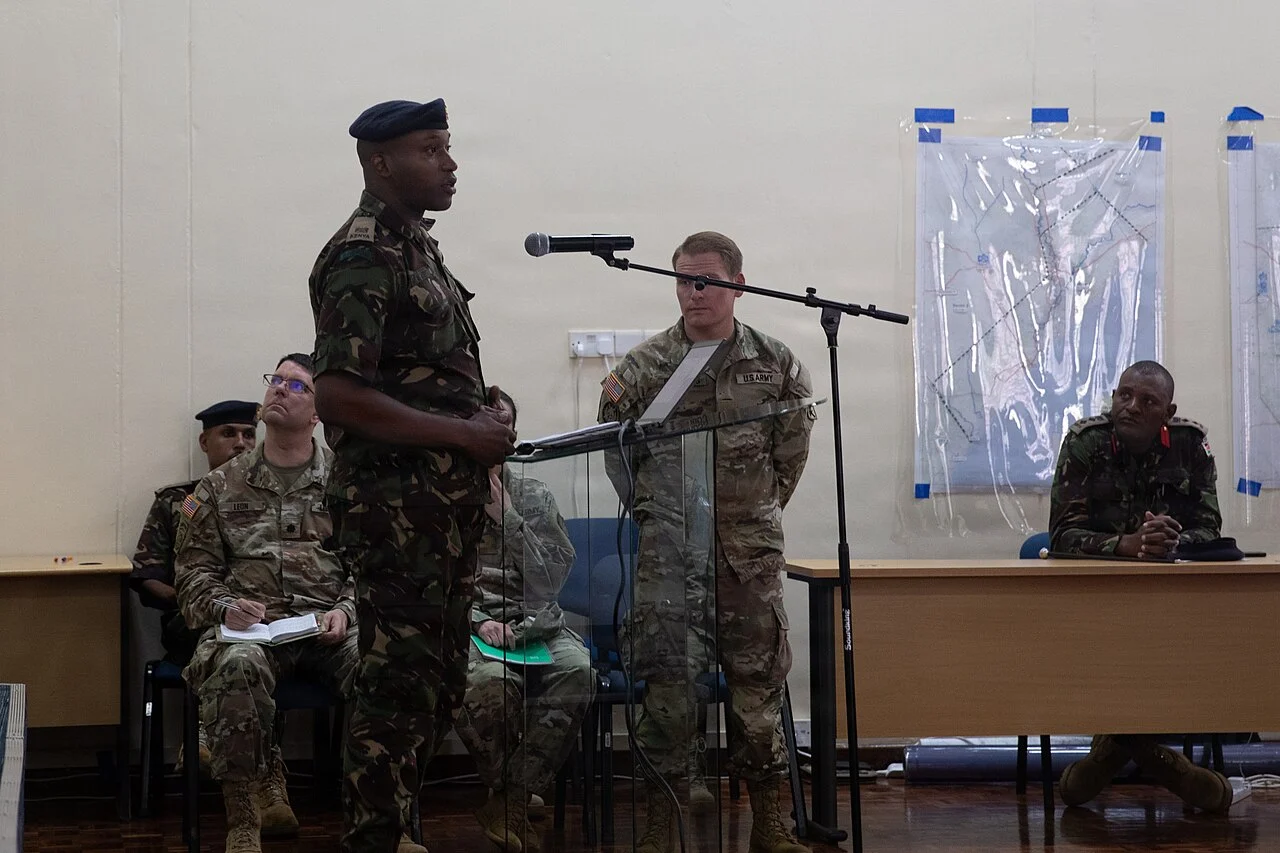
Photo: A Kenya Defence Forces officer briefs visitors during the Justified Accord 2026 multinational exercise in Nairobi, March 2026. Credit: U.S. Army photo by Spc. John Garcia, public domain, via Wikimedia Commons.
According to the 2026 Global Firepower index, Egypt is Africa’s strongest military, ranked 19th out of 145 countries worldwide with a PowerIndex score of 0.3651 (a lower score means a stronger rating in GFP’s system). Algeria is second on the continent and 27th globally, Nigeria third and 33rd globally, and South Africa fourth. That order has barely moved since 2025: the only changes are Tunisia entering the continental top 10 in place of Libya, and Morocco overtaking Angola for sixth place. GFP’s own methodology note says the index uses over 60 individual data points covering manpower, equipment, financial reserves, logistics, geography and natural resources; it does not claim to measure readiness, training, morale or how a force would actually perform in a fight, and DefenceMENA treats it as one data point among several, not as an objective ranking of military strength.
| Rank in Africa | Country | Global rank | GFP PowerIndex (lower = stronger) | 2025 defence budget | Source |
|---|---|---|---|---|---|
| 1 | Egypt | 19th | 0.3651 | US$2.5 billion (SIPRI estimate; state budget bundles defence with security spending) | Global Firepower 2026; SIPRI |
| 2 | Algeria | 27th | 0.4849 | US$25.4 billion, +11% on 2024 | Global Firepower 2026; SIPRI, April 2026 |
| 3 | Nigeria | 33rd | 0.6097 | US$2.1 billion, +55% on 2024 | Global Firepower 2026; SIPRI, April 2026 |
| 4 | South Africa | 40th | 0.6843 | US$3.2 billion, −1.2% on 2024 | Global Firepower 2026; SIPRI, April 2026 |
| 5 | Ethiopia | 47th | 0.8525 | Not broken out in SIPRI’s public 2025 fact sheet | Global Firepower 2026 |
| 6 | Morocco | 56th | 1.0368 | US$6.3 billion, +6.6% on 2024 | Global Firepower 2026; SIPRI, April 2026 |
| 7 | Angola | 59th | 1.1045 | Not broken out in SIPRI’s public 2025 fact sheet | Global Firepower 2026 |
| 8 | DR Congo | 64th | 1.3051 | US$1.2 billion, +20% on 2024 (M23 conflict) | Global Firepower 2026; SIPRI, April 2026 |
| 9 | Sudan | 66th | 1.3563 | Not disclosed; ongoing civil war since April 2023 makes any figure unreliable | Global Firepower 2026 |
| 10 | Tunisia | 79th | 1.7823 | Not broken out in SIPRI’s public 2025 fact sheet | Global Firepower 2026 |
What the Global Firepower ranking is actually measuring
Global Firepower’s PowerIndex is a composite score, not a measurement of combat power. It rewards raw totals – personnel counts, vehicle numbers, airport counts, coastline length, and so on – more than the age, readiness or integration of that equipment, and it has no reliable way to score training, doctrine, morale or command quality. That structural bias is well documented and explains some of GFP’s more debated placements worldwide. It is also why Egypt’s number one spot is not simply a story about spending: Egypt fields the continent’s largest and most diverse inventory (more combat aircraft, submarines and modern surface combatants than any other African navy or air force, detailed in DefenceMENA’s Egypt military strength profile), while Algeria, ranked second by GFP, spends far more on defence in absolute dollar terms. DefenceMENA uses GFP’s ranking only as a discovery tool and a widely cited reference point; every figure in the tables below that GFP does not itself disclose in detail – personnel, equipment and budget – is drawn from SIPRI, IISS-derived open-source trackers, or national and manufacturer statements, each labelled by source.
Personnel and equipment: what sits behind the top four
Egypt’s advantage is depth across every service. The IISS Military Balance figure of 438,500 active personnel, reproduced by GFP and most other trackers, breaks down into roughly 310,000 in the Army, 18,500 in the Navy, 30,000 in the Air Force and 80,000 in the Air Defence Forces, with 479,000 reserves on top. Its air force alone flies about 330 combat aircraft – F-16s, Rafales, MiG-29M/M2s and Mirage 2000s – and its navy operates eight submarines, two helicopter carriers and seven modern frigates. Full detail on the fleet is in the Egypt military strength profile.
Algeria’s force is smaller in personnel – open-source trackers put active strength at around 130,000 – but its equipment holdings are the largest on the continent by most counts: close to 1,500 main battle tanks (the largest fleet in Africa, tracked in DefenceMENA’s largest tank fleets ranking), roughly 600 military aircraft including more than 100 fighters, and a navy that includes six Kilo-class submarines, the largest submarine force in Africa alongside Egypt’s. All of it is bought almost entirely from Russia, financed by hydrocarbon revenue; SIPRI’s April 2026 fact sheet put Algeria’s 2025 spending at US$25.4 billion, up 11% on 2024, and noted that military spending absorbs 25% of Algeria’s public expenditure – the second-highest share of any country in the world after Ukraine.
Nigeria’s personnel numbers, estimated at 200,000–230,000 active across the three services by open-source trackers (Nigeria does not publish an official figure), are comparable to Algeria’s, but its equipment inventories are far thinner: around 330 tanks against Algeria’s near-1,500, and a combat aircraft fleet built around a smaller mix of fighters and light-attack types, detailed in DefenceMENA’s fighter aircraft in African air forces file. What moved Nigeria up GFP’s table and into this piece is less its inventory than its budget trajectory: SIPRI recorded a 55% jump in Nigerian military spending in 2025, to US$2.1 billion, which it links directly to worsening insurgency and banditry violence rather than to a force-modernisation programme.
South Africa sits fourth despite a defence budget that fell 1.2% in 2025 to US$3.2 billion and a force whose equipment has aged for two decades under tight budgets; GFP’s index rewards South Africa’s industrial base, geography and the residual scale of the South African National Defence Force, which DefenceMENA’s South African Army weapons list and Nigeria vs South Africa comparison cover in more detail than a composite index can.
What the money says: SIPRI’s 2025 picture
SIPRI’s April 2026 fact sheet on world military expenditure put total African defence spending at US$58.2 billion in 2025, up 8.5% on 2024 and 45% higher than in 2016. The regional split is heavily skewed to the north: North Africa accounted for US$35 billion of that total, or 60% of the continental figure, up 9.3% on 2024 and 67% higher than 2016, driven overwhelmingly by Algeria and Morocco. Sub-Saharan Africa spent US$23.3 billion, up 7.4% on 2024 and 21% higher than 2016.
| Country | 2025 spending | Change on 2024 | Driver |
|---|---|---|---|
| Algeria | US$25.4 billion | +11% | Hydrocarbon-financed build-up against Morocco/Western Sahara tensions |
| Morocco | US$6.3 billion | +6.6% | Same regional rivalry, from the other side |
| South Africa | US$3.2 billion | −1.2% | Continued fiscal constraint |
| Egypt | US$2.5 billion (SIPRI estimate) | +4.3% | IMF-supervised budget; large off-budget and export-credit financed purchases not captured here |
| Nigeria | US$2.1 billion | +55% | Insurgency and banditry violence |
| DR Congo | US$1.2 billion | +20% | M23 conflict intensified in H1 2025 before a July ceasefire |
Two figures deserve a caution. Egypt’s SIPRI estimate captures only the visible state budget line; it excludes the military’s own commercial revenue, US Foreign Military Financing (US$1.3 billion a year), and the export-credit financing behind large European contracts such as the French Rafale deal, all detailed in DefenceMENA’s Egypt profile. And SIPRI’s public fact sheet, unlike its full paid database, does not break out individual 2025 figures for Ethiopia, Angola, Tunisia or Sudan; where those are missing from the table above, this piece leaves them blank rather than substituting an estimate DefenceMENA cannot verify.
Where the index and reality pull apart
Composite strength does not track with who is actually fighting or under strain. Sudan, ranked ninth by GFP, has been fractured by civil war between the Sudanese Armed Forces and the Rapid Support Forces since April 2023; any single figure for its remaining force structure is unverifiable and this profile treats Sudan’s ranking as indicative only. The Democratic Republic of Congo, ranked eighth, spent 2025 fighting an M23 offensive that took large parts of North and South Kivu before a July ceasefire, a campaign that GFP’s static inventory count does not capture at all. Nigeria’s forces have spent years engaged against Boko Haram and Islamic State West Africa Province in the northeast and banditry in the northwest, and Ethiopia’s index position sits against a backdrop of the 2020–22 Tigray war and continuing instability in Amhara and Oromia that has not been resolved as of 2026. A composite index built on inventories and demographics says little about any of this.
The counter-insurgency and border-security missions that dominate actual African force employment are also driving a procurement shift the GFP ranking does not register: armed drones. Egypt, Nigeria and several Sahel states now fly Turkish Bayraktar and Chinese Wing Loong and CH-series systems operationally on borders and in counter-insurgency campaigns, a pattern tracked across DefenceMENA’s supplier coverage, including who supplies Africa’s weapons and the continent’s Turkish defence systems desk. None of that shows up as a line item in GFP’s methodology, yet it is arguably a better indicator of which militaries are actually adapting to the wars they are fighting.
Methodology and definitions
This ranking uses the 2026 Global Firepower PowerIndex as its ordering, because it is the most widely cited composite ranking and the one readers are searching for; DefenceMENA reproduces GFP’s ranking and rank order only, never its underlying inventory or personnel counts, which GFP does not source and which this profile cross-checks separately against SIPRI, IISS-derived open trackers and national statements. Budget figures are SIPRI’s constant-price estimates for calendar year 2025, published in SIPRI’s Trends in International Arms Transfers and world military expenditure fact sheets of March and April 2026; SIPRI’s Arms Transfer Indicator (TIV) values, where cited elsewhere on this site, are not directly comparable to these dollar expenditure figures. Personnel and equipment figures are labelled Estimated where no government has published an official count, which is the case for most African militaries; where a figure is disputed between sources, the higher and lower ends are both given. “Strongest” in this piece follows GFP’s own usage and should be read as composite scale and reach, not predicted combat outcome.
Frequently asked questions
Which country has the strongest military in Africa in 2026?
By Global Firepower’s 2026 composite index, Egypt, ranked 19th globally and first in Africa. By total defence spending, Algeria is well ahead of Egypt, at US$25.4 billion against US$2.5 billion in SIPRI’s 2025 estimate.
Is Algeria’s military stronger than Egypt’s?
Algeria has the larger tank fleet and spends roughly ten times as much on defence, but Egypt fields more combat aircraft, more submarines, and a more diverse arsenal across more suppliers; GFP’s index ranks Egypt first and Algeria second based on its own weighting of these factors.
Which African country spends the most on defence?
Algeria, at US$25.4 billion in 2025 according to SIPRI, roughly four times Morocco’s US$6.3 billion, the next-largest spender on the continent.
How is the Global Firepower ranking calculated?
GFP combines more than 60 indicators covering manpower, equipment totals, financial and logistical capacity, geography and natural resources into a single PowerIndex score, where a lower score indicates a stronger rating. It does not independently verify country-level inventory data and does not score training, readiness or combat experience.
Why is Nigeria ranked below South Africa despite a larger and more combat-experienced army?
GFP’s index weights equipment totals, financial reserves and logistics alongside personnel; South Africa’s broader industrial and naval base and larger reserve of major equipment types outweigh Nigeria’s larger active force and recent combat tempo in GFP’s own methodology. Reasonable analysts differ on how much weight combat experience should carry, which is why DefenceMENA treats the GFP order as one reference point rather than a verdict.
Does having nuclear weapons or being an African Union member affect the ranking?
No African state holds nuclear weapons, so that GFP category does not differentiate the continent’s rankings. AU membership is not a GFP input.
A note on the numbers: Global Firepower publishes a rank order and composite score but does not disclose the underlying personnel and equipment counts behind each country’s 2026 score in a form DefenceMENA can independently verify; this profile therefore uses GFP for ranking only and sources every personnel, equipment and budget figure separately, from SIPRI, IISS-derived open-source trackers, or national and manufacturer statements as cited. Where DefenceMENA has published a full country profile, such as Egypt’s, that profile’s figures take precedence over any general open-source estimate used here. This page was published on 28 September 2026 and will be updated when SIPRI, GFP or national sources publish new editions.
For how military strength translates into national budgets, see DefenceMENA’s ranking of African defence budgets.
Sources
- Global Firepower, African Military Strength (2026)
- Ecofin Agency, Global Firepower Index 2026: Egypt, Algeria, Nigeria lead Africa’s military rankings
- Legit.ng, Nigeria ranks 3rd strongest military in Africa, 2026 Global Firepower Index
- SIPRI Fact Sheet, Trends in World Military Expenditure 2025 (April 2026)
- Ecofin Agency, Persistent tensions drive Africa’s military spending up 8.5% to $58 billion
- Morocco World News, Algeria continues to lead Africa in arms spending, Morocco in second place
- Atalayar, Algeria had the world’s second-highest share of public spending on arms in 2025
- SIPRI, Trends in International Arms Transfers 2025 (March 2026)
- Militarydex, Nigeria vs Algeria military comparison 2026
- DefenceMENA, How strong is Egypt’s military in 2026?
Related on DefenceMENA: Strongest Militaries in West Africa in 2026: How the Sahel Bloc Compares | Which African Country Has the Biggest Army? Active-Personnel Ranking