Largest Armies in Africa: Top 10 by Active Personnel



The largest armies in Africa are led by Ethiopia and Egypt, with Morocco, Eritrea and Sudan next, when ranked by active-duty personnel in the latest Global Firepower edition. This guide uses that single published dataset, sets it against a second public compilation and flags where the two disagree by a wide margin. Headcounts in this field are estimates, not audited returns, so the gaps matter as much as the order. Nigeria’s presidency is the only government source found that gives a figure for its own force: about 250,000 personnel.
Largest Armies in Africa: Methodology and Data Sources
The ranking counts active-duty personnel only, meaning full-time soldiers, sailors and airmen. Reservists and paramilitary forces are shown in a separate column because they are not comparable. Conscripts serving full time are counted where the source counts them.
The main source is the Global Firepower (GFP) active manpower list, whose 2026 edition was published in January. GFP states that where real-world values are unavailable its totals may be estimated, and it draws partly on the CIA World Factbook for some countries. The second source is a public ranking of active troops that does not name its own source. The World Bank series, which is based on IISS Military Balance data and includes paramilitary forces, gives a 2019 baseline that is now dated.
No African ministry of defence publishes a full, audited headcount. Where a government has stated a number, it is used and labelled. GFP’s Africa table covers 38 countries, so states it omits, such as Rwanda and Burundi, are outside this ranking.
Africa’s Largest Armies: Ranking Table
| Rank | Country | Active, GFP | Second compilation | Total with reserves and paramilitary, GFP estimate | Active as share of population |
|---|---|---|---|---|---|
| 1 | Ethiopia | 503,000 | 503,000 | 641,000 | 0.4% |
| 2 | Egypt | 438,500 | 438,500 | 1,217,500 | 0.4% |
| 3 | Morocco | 400,000 | 195,800 | 700,000 | 1.1% |
| 4 | Eritrea | 350,000 | 301,750 | 1,030,000 | 5.5% |
| 5 | Sudan | 300,000 | 104,300 | 517,500 | 0.6% |
| 6 | Nigeria | 230,000 | 143,000 | 280,000 | 0.1% |
| 7 | South Sudan | 185,000 | 185,000 | 185,000 | 1.5% |
| 8 | DR Congo | 166,580 | 134,250 | 207,380 | 0.1% |
| 9 | Algeria | 130,000 | 130,000 | 430,000 | 0.3% |
| 10 | Angola | 107,000 | 107,000 | 117,000 | 0.3% |
The top ten account for about 79% of the active personnel counted across the 38 African countries in the GFP table, by simple addition of its published figures. Six of the ten entries match or nearly match in both sources. The four that do not are Morocco, Sudan, Nigeria and DR Congo.
Top Entries Explained
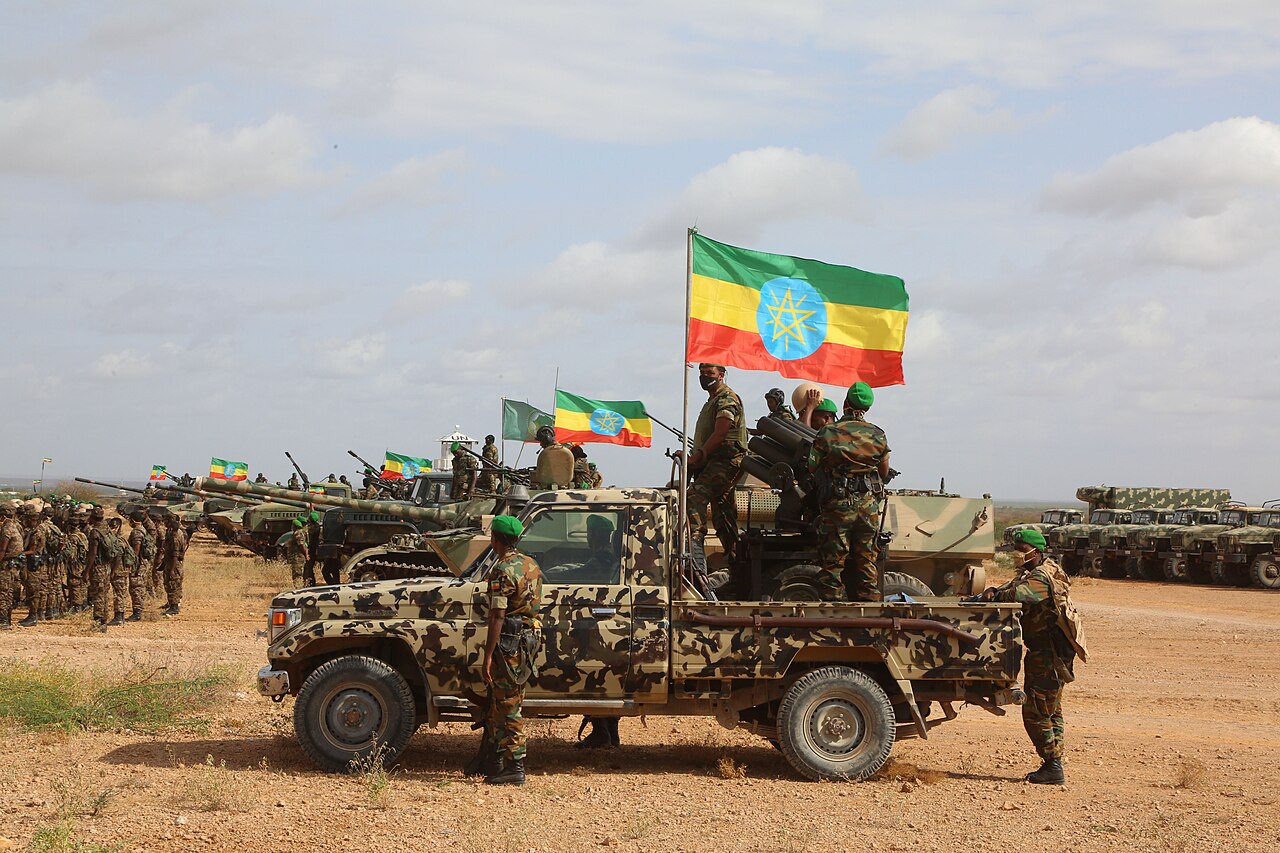
Ethiopia heads the table with 503,000 active personnel, 138,000 reservists and no paramilitary force, on a population of about 118.6 million. The 138,000 figure is also what the World Bank series recorded for Ethiopia’s armed forces in 2019, which suggests the active count has been revised sharply upward. The GFP page does not explain the change, and its branch figures do not reconcile with the total. No official headcount from Addis Ababa was found. The country’s air arm is covered in our tracker on the Su-35 programme.
Egypt’s 438,500 active personnel are the best-corroborated number in the table, since both compilations agree. GFP adds 479,000 reservists and 300,000 paramilitary, for an estimated 1,217,500 in total, the largest of any African state once those groups are counted. Egypt’s equipment side is set out in the Egypt military strength profile.
Morocco and Eritrea show the widest method effects. GFP gives Morocco 400,000 active, 250,000 reservists and 50,000 paramilitary, while the other compilation lists 195,800. Eritrea’s 350,000 equals 5.5% of its population of about 6.3 million, the highest share in the table, and GFP’s total of 1,030,000 would be 16.2% of residents.
Sudan carries the most uncertainty. GFP lists 300,000 active and 200,000 reservists in its January 2026 edition, against 104,300 in the second compilation. Neither figure shows the Rapid Support Forces, which fight the army in a war that began in April 2023, according to the EU Agency for Asylum country report. Sudan’s budget side is in our report on Sudan’s defence spending.
Lower in the table the sources converge. South Sudan’s 185,000 and Angola’s 107,000 are identical in both compilations. Algeria’s GFP page lists 130,000 active, 150,000 reservists and 150,000 paramilitary, an estimated 430,000 in total, so its wider force is more than three times its active strength. DR Congo’s 166,580 active compares with 134,250 in the other table, and GFP’s own branch lines for the country sum to only 112,250, so they cannot settle the gap.
Regional Patterns and Trends
Seven of the ten entries sit in North Africa or the Horn and Nile basin: Egypt, Morocco, Algeria, Ethiopia, Eritrea, Sudan and South Sudan. West Africa appears only through Nigeria, Central Africa through DR Congo and Southern Africa through Angola. South Africa, with 68,731 active personnel in the GFP list, ranks 12th among African countries by that measure.
Among the largest armies in Africa, size and ranking track different things. Nigeria has the sixth-largest active force on a population of about 237 million, or 0.1%, while South Sudan and Eritrea field proportionally far larger forces. Ethiopia, Eritrea and Sudan all sit in the top five.
Recent Changes
Nigeria is the clearest case of change. In July 2026 the Presidency announced an expansion of the Army from eight to 12 divisions and the recruitment of 28,000 additional personnel. New divisions are planned at Makurdi, Ilorin, Jalingo and Benin City, with the first three due by September 2026 and the fourth by December 2026 (Nairametrics).
The Presidency’s statement on the armed forces pay rise also puts the number of personnel benefiting at about 250,000 (State House). That is 20,000 above the GFP active figure, and the statement does not separate active from other personnel. The pay detail is in our guide to Nigerian Army pay.
Elsewhere the changes are in the data rather than in announced policy. Ethiopia’s rise from 138,000 to 503,000 and Sudan’s wartime figures are revisions that no government has explained publicly.
What the Numbers Do Not Show
A headcount does not measure capability, even among the largest armies in Africa. Equipment, training, logistics and air power matter as much as numbers, and the air dimension is covered in our ranking of Africa’s strongest air forces. GFP’s own branch lines for Nigeria, Algeria and Ethiopia do not add up to the active total.
Definitions also differ. Some sources include paramilitary gendarmeries, others exclude them. Conscripts, militias, front-line attrition and units that exist only on paper can all distort a count, and none of these is visible in a ranking by headcount. Readers who need a defensible number should quote the source and the edition, not only the figure.
Frequently Asked Questions
Which country has the largest army in Africa?
By active personnel, Ethiopia ranks first with 503,000 in the latest Global Firepower edition, ahead of Egypt with 438,500. Egypt leads when reserves and paramilitary are added, at an estimated 1,217,500. Ethiopia’s figure is a recent upward revision and no government count has been published to confirm it.
How many soldiers does Egypt have?
Egypt has 438,500 active personnel, 479,000 reservists and 300,000 paramilitary, according to Global Firepower, which makes about 1,217,500 in total. A second compilation also gives 438,500 active, so this is the most consistent number in the table. Egypt’s government does not publish an audited breakdown.
Is Nigeria’s army among the largest in Africa?
Nigeria ranks sixth with 230,000 active personnel in Global Firepower, or 143,000 in the second compilation. The Presidency cites about 250,000 armed forces personnel. A planned expansion to 12 Army divisions and 28,000 extra recruits should raise the figure, but no new total has been published.
Why do sources give different army sizes?
Sources define personnel differently, covering active troops, reserves, paramilitary and conscripts in different mixes, and many figures are estimates. Morocco, for example, appears as 400,000 in one table and 195,800 in another. Always check the edition, the definition and whether the number comes from a government.
Sources
- Global Firepower: active military manpower by country
- Global Firepower: Ethiopia military strength
- Global Firepower: Egypt military strength
- Global Firepower: Morocco military strength
- Global Firepower: Eritrea military strength
- Global Firepower: Nigeria military strength
- Ecofin Agency: Global Firepower index, Egypt, Algeria and Nigeria lead Africa
- GlobalMilitary.net: active military personnel in Africa
- World Bank via IndexMundi: armed forces personnel, total
- State House: President Tinubu approves salary increases for armed forces personnel
- Nairametrics: Tinubu expands Nigerian Army to 12 divisions
- EUAA: major state and non-state armed groups in Sudan