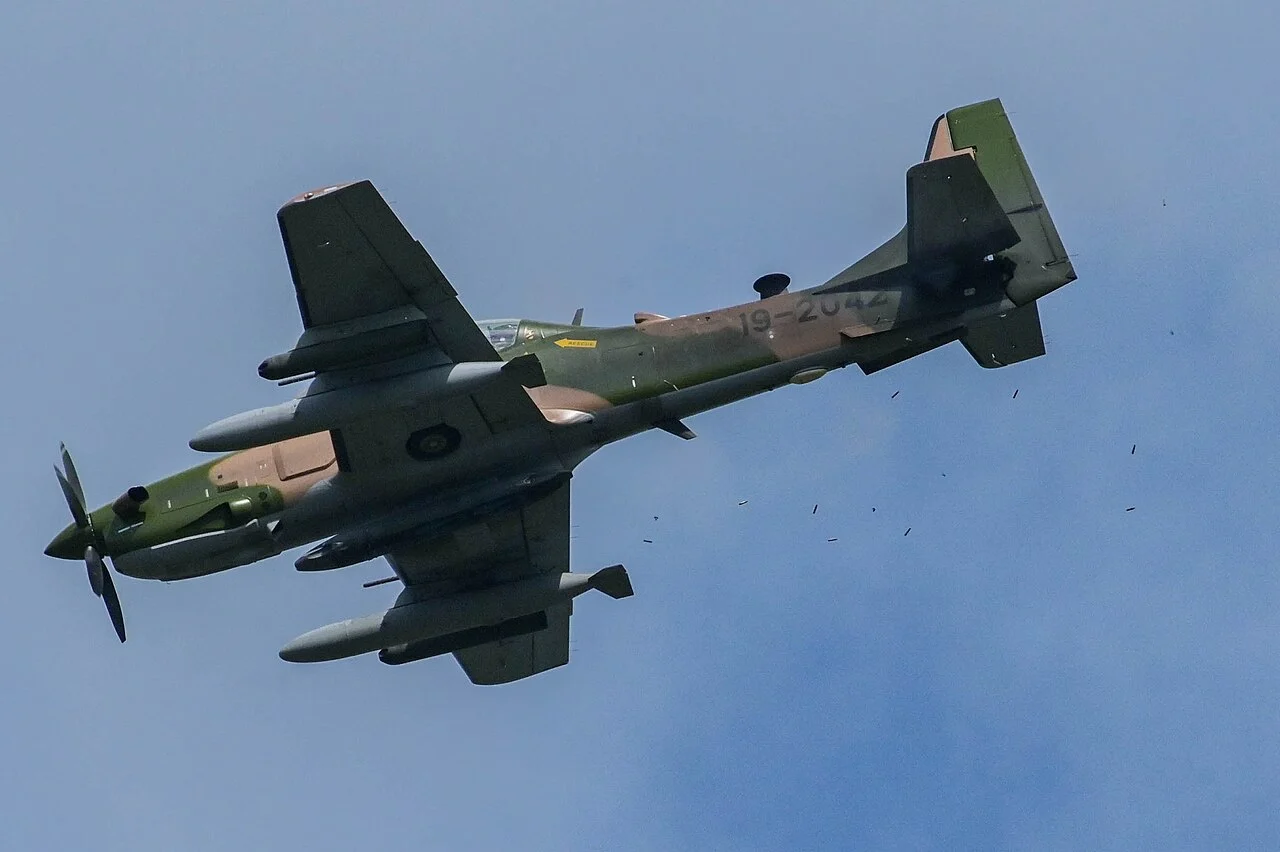
Nigeria bought twelve A-29 Super Tucanos because its air force needed a precision-strike aircraft to replace ageing Alpha Jets in the fight against Boko Haram and ISWAP, and because the United States, after holding the sale for about two years, finally agreed to release it together with the guided weapons, training and base infrastructure that made the aircraft useful. The deal was signed as a government-to-government Foreign Military Sale, not an open competition. Nigeria paid about $496 million from its Excess Crude Account, took delivery of all twelve aircraft between July and September 2021, and by August 2024 had flown them 10,000 hours.
Photo: A Nigerian Air Force A-29 pilot fires the aircraft’s .50-calibre guns at Grand Bay range near Moody Air Force Base, Georgia, 1 September 2021. Credit: U.S. Air Force / Senior Airman Rebeckah Medeiros (public domain).
This explainer follows one question: why did this African customer choose this system? The answer below comes from official notifications, contract announcements, Nigerian government statements and named reporting. Where the record is silent, this article says so rather than filling the gap with a plausible motive.
| Item | What the record shows | Status |
|---|---|---|
| Customer | Nigerian Air Force (NAF) | Confirmed |
| System | A-29 Super Tucano light-attack turboprop (Embraer design, Sierra Nevada Corporation as US prime) | Confirmed |
| Quantity | 12; six with a forward-looking infrared (FLIR) sensor | Delivered 2021 |
| Route | US Foreign Military Sales (FMS), government to government | Confirmed |
| US approval ceiling | $593 million (notified 2 August 2017) | Ceiling, not price paid |
| Nigerian payment disclosed | $496 million withdrawn from the Excess Crude Account (President Buhari’s April 2018 letter to the National Assembly) | Nigerian official disclosure |
| Aircraft contract | $329,076,750 undefinitized, not-to-exceed $344,727,439, awarded 28 November 2018 | US DoD announcement |
| Base | Kainji Air Force Base, Niger State | Operational |
| Local production | None documented | — |
What capability did Nigeria need?
The requirement was counter-insurgency in the north-east and, later, against armed groups in the north-west: a platform that could loiter over rough terrain, use precision weapons and fly from forward bases. The US notification of the sale described the aircraft as offering “improved targeting capabilities” that would let Nigeria “more effectively lead the fight against Boko Haram and the ISIS West Africa branch, while also potentially reducing risks of collateral damage and civilian casualties” (as quoted by Defense News). That is Washington’s stated rationale; it is consistent with, but not a substitute for, Nigeria’s own account.
On the Nigerian side, Military Africa reports that the NAF settled on the A-29 in 2015 as the replacement for its ageing Alpha Jet fleet. The Chief of Air Staff at the time, Air Marshal Sadique Abubakar, appealed to the manufacturer in 2018 to deliver at least two aircraft early for use in ongoing counter-insurgency operations, according to The Defense Post.
What did the Air Force operate before?
The NAF’s strike work was carried by 1980s-era Alpha Jets, refurbished L-39s and, from the mid-2010s, Russian Mi-35M gunships, alongside Chinese-supplied drones and Pakistani-supplied trainers and JF-17s, per defenceWeb editor Guy Martin. None of these was a modern, sensor-equipped, precision-weapon light-attack aircraft in the class the A-29 occupies. For the current fleet, see our Nigerian Air Force aircraft inventory.
Procurement timeline
| Stage | Date | What happened | Source |
|---|---|---|---|
| Requirement / request | 2015 | NAF selects the A-29 to replace Alpha Jets; Nigeria seeks US approval | Military Africa; Defense News |
| US hold | 17 Jan 2017 | Obama administration halts the notification after the Nigerian Air Force mistakenly bombs a displaced-persons camp at Rann, killing more than 100 people | The Defense Post |
| Reactivation | Apr 2017 | Trump administration revives the sale | The Defense Post |
| Selection / approval | 2 Aug 2017 | Congress notified of a possible $593 million FMS for 12 aircraft | Defense News; DSCA notification |
| Offer | 27 Dec 2017 | Letters of Offer and Acceptance presented in Abuja | The Defense Post |
| Nigerian objections | Jan 2018 | Defence Minister Mansur Dan Ali voices concern over training restrictions and transfer timelines | The Defense Post |
| Payment | 2017–Apr 2018 | $496 million drawn from the Excess Crude Account; President Buhari discloses this to the National Assembly in April 2018 | Nigerian press reporting of the presidential letter |
| Contract | 28 Nov 2018 | US DoD awards Sierra Nevada Corporation $329.08 million (undefinitized) | US DoD; The Defense Post |
| First flight | 17 Apr 2020 | First Nigerian-configured A-29 flies | Military Africa |
| Training | 2020–2021 | Nigerian pilots and maintainers train with the US Air Force’s 81st Fighter Squadron at Moody AFB, Georgia | US Air Force / AFRICOM; ICIR |
| First delivery | 22 Jul 2021 | First six aircraft arrive at Kano | US Embassy Nigeria; ICIR |
| Full delivery | Jul–Sep 2021 | All 12 delivered to Kainji | Africa Defense Forum |
| Infrastructure handover | 27 Apr 2023 | $36.1 million US Army Corps of Engineers works at Kainji celebrated | US Air Force |
| Additional A-29 order | — | None found for Nigeria | Unknown |
Two things stand out. First, the gating step was not price or a competitive evaluation but US political clearance, which took roughly two years from Nigeria’s request. Second, the delay itself carried a cost the NAF said it felt: the Chief of Air Staff’s 2018 plea for early delivery came while the campaign was still underway.
What was purchased?
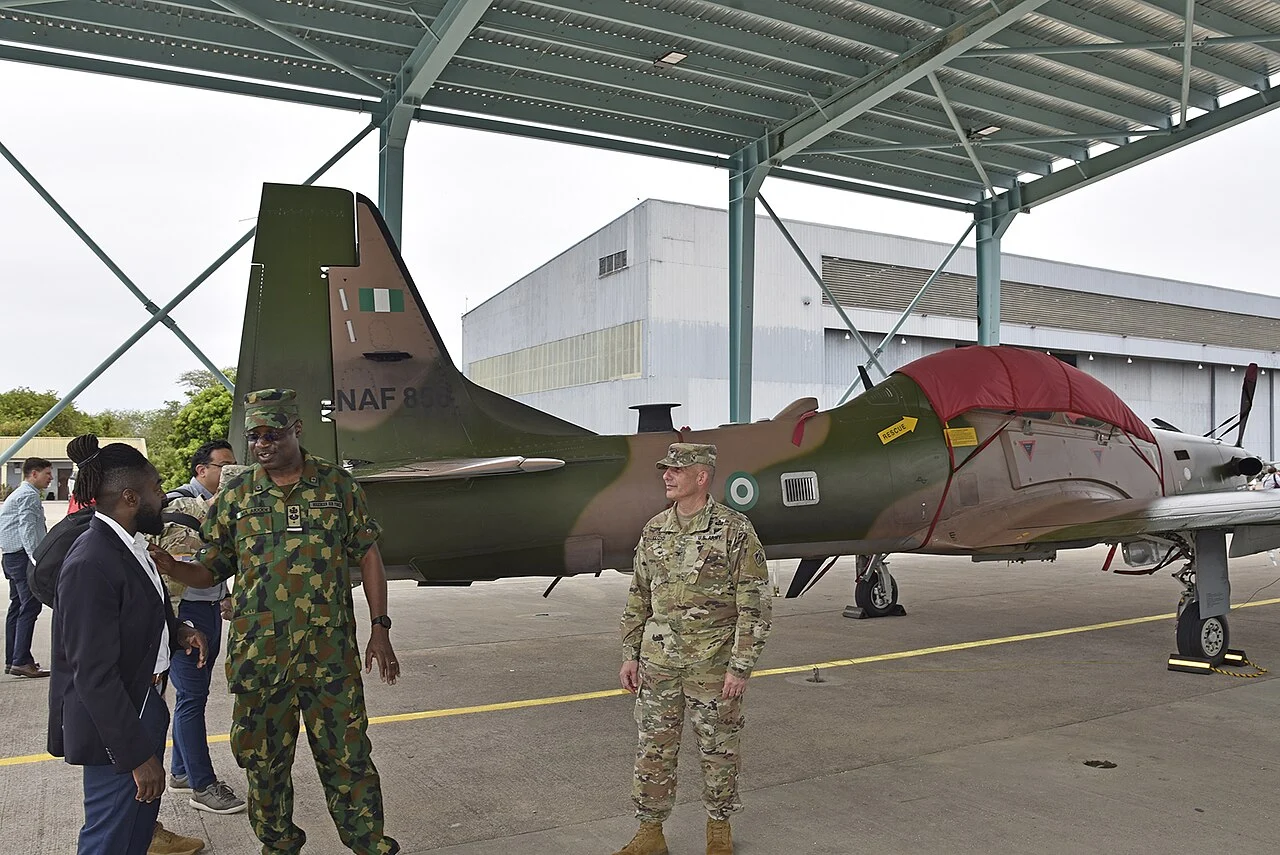
Reporting on the US notification and contract puts the package as follows: 12 A-29s, FLIR sensors for six of them, ground training devices and mission-planning systems, spare parts and ground-support equipment, and five field service representatives for three years (The Defense Post). The approved weapons were 5,000 Hydra 70 rockets, 400 laser-guided APKWS rockets, 200 Paveway II bomb tail kits and 2,000 Mk-81 bombs, along with facilities and infrastructure. Nigerian and US descriptions of the delivered aircraft add wing-mounted .50-calibre machine guns.
What did it cost?
| Figure | What it is | Source |
|---|---|---|
| $593 million | Maximum value in the August 2017 US congressional notification, covering aircraft, weapons, training, spares, facilities and infrastructure | Defense News; The Defense Post |
| $496 million | Amount the Buhari government said it withdrew from the Excess Crude Account | Nigerian press citing the presidential letter (April 2018) |
| About $500 million | Rounded figure used by US-linked outlets for the whole FMS deal | Africa Defense Forum; Daily Trust |
| $329.08 million (NTE $344.73 million) | Undefinitized DoD contract action for the aircraft, 28 November 2018 | US DoD |
| $15.65 million | Reported figure for FLIR sensors on six aircraft | Military Africa |
| $36.1 million | US Army Corps of Engineers contract for Kainji infrastructure | US Air Force |
These figures measure different things and should not be added together or divided by twelve. The package composition beyond the items above is not fully public, so no reliable unit price for the aircraft alone can be derived. The payment also became a domestic controversy: Nigerian reporting says the money was released without prior National Assembly approval, and the president then asked the National Assembly to include the sum in the 2018 appropriation bill.
Why was the system selected?
| Factor | Evidence | Strength |
|---|---|---|
| Replace ageing Alpha Jets | NAF decision in 2015 (Military Africa) | Reported, secondary source |
| Precision and reduced civilian harm | US notification language; US training emphasis on law of armed conflict and civilian-casualty mitigation (US Embassy / AFRICOM) | Official, but the US government’s framing |
| Package: weapons, training, base works | FMS notification lists all three; USACE built Kainji facilities | Documented |
| Access to US precision weapons | APKWS and Paveway II are in the approved package | Documented |
| Price | No published comparison with other aircraft | Unknown |
| Local production or technology transfer | None documented | Not a factor on the record |
| Financing | Paid in cash from the Excess Crude Account, no loan reported | Nigerian disclosure |
No public Nigerian evaluation report explains why the A-29 beat other candidates on cost or performance. Nigerian officials have described the aircraft in terms of counter-insurgency need, not a comparative assessment.
Were alternatives considered?
| Category | Aircraft | Evidence |
|---|---|---|
| Confirmed competitor | None found | No public tender or head-to-head evaluation located |
| Reported alternative | Continued Alpha Jet refurbishment | Nigeria did refurbish Alpha Jets and L-39s in parallel (defenceWeb); this is a fleet-management fallback, not a bid |
| Theoretical same-class alternatives | Other light-attack or advanced-trainer types | Same broad role; no evidence Nigeria evaluated them for this requirement |
| Later purchase in a similar role | Leonardo M-346FA, 24 on order | Bought years afterwards; see our inventory page |
It would be wrong to say Nigeria “chose the A-29 over” any named competitor. The record shows a requirement, a US-approved solution and a long approval delay.
Training and support
According to US Air Force and AFRICOM material, Nigerian pilots and maintainers trained with the 81st Fighter Squadron at Moody Air Force Base; one account puts the number at 64 pilots and maintainers, another at about 100 military personnel and contractors, so the exact figure is not settled. Training reportedly included the law of armed conflict and civilian-harm mitigation. Five US field service representatives were contracted for three years. The Kainji base received US-funded infrastructure, completed in 2023 (US Air Force).
Delivery and operational service
The first six aircraft reached Kano on 22 July 2021, and the last six followed by September, per the US Embassy in Nigeria and Africa Defense Forum. The fleet is based at Kainji, Niger State. By August 2024 it had logged 10,000 flight hours, which the Chief of Air Staff called “no small feat”; Africa Defense Forum, a US Africa Command publication, reported no major incident over that period.
| Claim | Who made it | Grade |
|---|---|---|
| 10,000 flight hours by August 2024 | NAF Chief of Air Staff, via Africa Defense Forum | Official claim |
| Strikes in the Sambisa Forest area, August 2022 | Africa Defense Forum; Nigerian media | Official / media; casualties unverified |
| Scores of militants killed, February–March 2023 | Defence Media Operations, per defenceWeb | Unverified battlefield claim |
| Operating cost of about $1,000 per flight hour | defenceWeb | Unsourced estimate, not an official NAF figure |
Casualty figures for Super Tucano strikes come from military officials or regional analysts and have not been independently confirmed. More broadly, Nigerian air strikes have continued to be linked to civilian deaths in media reporting, for example a Christmas 2024 strike reported by The Intercept; that report describes a Nigerian military aircraft and should not be read as naming the A-29 specifically.
Industrial cooperation
None is documented in Nigeria. The aircraft were built by Embraer in the Embraer/Sierra Nevada Corporation programme, and the DoD contract states work would be performed in Jacksonville, Florida. US contractors, not a Nigerian facility, provide the described support. The 2023 Kainji works are base infrastructure, not an assembly line or a maintenance-repair-overhaul centre. Any claim that Nigeria “produces” or “maintains” the A-29 domestically goes beyond the record.
Was it a good fit? Documented trade-offs
| Dimension | Evidence in favour | Trade-off or open question |
|---|---|---|
| Mission | Designed for armed reconnaissance and light attack; matches the counter-insurgency requirement | Twelve airframes is a small fleet for a theatre spanning north-east and north-west (DefenceMENA analysis) |
| Environment | Reinforced airframe, self-sealing fuel tanks, operation from unpaved strips (defenceWeb) | Rainy-season and bush-strip performance in Nigerian service is not publicly documented |
| Weapons | APKWS and Paveway II provide precision options | Depends on US approval for resupply; stock levels not public |
| Training and maintenance | US-standard training, FSRs, infrastructure at Kainji | Support contracts were time-limited; long-term sustainment arrangements not public |
| Political | Opened a US FMS channel; a US-approved AH-1Z sale was notified later | The approval process took about two years and imposed conditions Nigeria publicly questioned |
How it compares with same-class alternatives
A strict specification comparison would mislead, because Nigeria did not publish one and the aircraft below serve different roles in the NAF. What can be said from the record: the Alpha Jet is the 1980s jet the A-29 was meant to replace, with roughly eight of the original fleet airworthy plus 12 ex-French airframes acquired in December 2024; the M-346FA is a jet light-attack aircraft, 24 on order in four batches of six, with the first batch completing factory acceptance testing in mid-2026; and the Mi-35M is a helicopter gunship serving a different tactical niche. The A-29 is the only turboprop light-attack type in the fleet. Operating-cost comparisons are not established in public sources.
Africa-wide consequence
The A-29 was not new to Africa: Burkina Faso took three in 2011, Mauritania two in 2012, Angola six from 2013 and Mali four in 2018. Nigeria’s order was the largest so far on the continent and, according to defenceWeb reporting, the largest FMS programme in sub-Saharan Africa. In 2026 Togo announced an order for four aircraft valued at $82 million, and Africa Defense Forum cites the Nigerian fleet as precedent. Nothing in the available sources shows that Nigeria’s decision caused these later orders, so the link should be treated as context, not proven influence. What Nigeria did establish was a US-supported support and training model for the A-29 in West Africa.
What happened next
Nigeria did not reorder Super Tucanos. It diversified into other air-power buys, including a 24-aircraft Leonardo M-346FA order, 12 Bell AH-1Z Vipers and Turkish-built T129 and Bayraktar systems. Our earlier reporting covers the AH-1Z in Nigeria’s first AH-1Z enters production and the helicopter side in the NAF’s Leonardo and Airbus helicopter expansion.
FAQ
Why did Nigeria buy the Super Tucano?
To give its air force a precision light-attack aircraft for the fight against Boko Haram and ISWAP, replacing Alpha Jets, according to Military Africa and the US notification of the sale.
How much did the Nigeria Super Tucano deal cost?
The US approval ceiling was $593 million; Nigeria said it withdrew $496 million; the aircraft contract was $329.08 million. These figures cover different scopes.
Why was the deal delayed?
The Obama administration held it in January 2017 after the Rann camp bombing. It was revived in 2017 and the aircraft were delivered in 2021.
Was there a competition?
No public competition or named competitor has been found.
Does Nigeria assemble or maintain the A-29 locally?
No such arrangement is documented.
How many Super Tucanos does Nigeria have?
Twelve, all delivered by September 2021, at Kainji Air Force Base.
Related reading
- Nigeria’s military strength in 2026 (country inventory)
- Nigerian Air Force aircraft inventory (operator page)
- Nigeria vs South Africa military power (comparison)
- Military equipment database
- AH-1Z Viper deal (another US procurement)
Sources
- Defense News, US approves A-29 Super Tucano sale to Nigeria (3 August 2017)
- The Defense Post, Nigeria says U.S. agrees sale of 12 A-29 aircraft (28 December 2017)
- The Defense Post, Nigeria A-29 contract finally lands (29 November 2018)
- Defense.info, Nigeria, the Super Tucano and the Cobra (July 2021)
- Military Africa, Nigerian Air Force A-29 Super Tucano: all you need to know
- AFRICOM, A-29 Super Tucano inducted into the Nigerian Air Force
- US Embassy Nigeria, arrival of the A-29 Super Tucanos
- US Air Force, Nigerian Air Force receives new facilities for A-29 Super Tucano fleet (2023)
- Africa Defense Forum, Nigerian Super Tucanos reach flight-hour milestone
- defenceWeb, Insurgents scatter as Nigeria rules the air
- Africa Defense Forum, Super Tucano aircraft to help Togo address terror threats (May 2026)
- ICIR, Nigeria receives six of 12 Super Tucano aircraft from US
- The Intercept, Nigeria’s military gets billions in US aid (January 2025)