Egypt operates the largest Rafale fleet outside France, and it is not finished buying. Two contracts since 2015 have put roughly 50 jets in Egyptian Air Force service, a third batch is being delivered through 2026, and Cairo has now asked Dassault for 24 more.
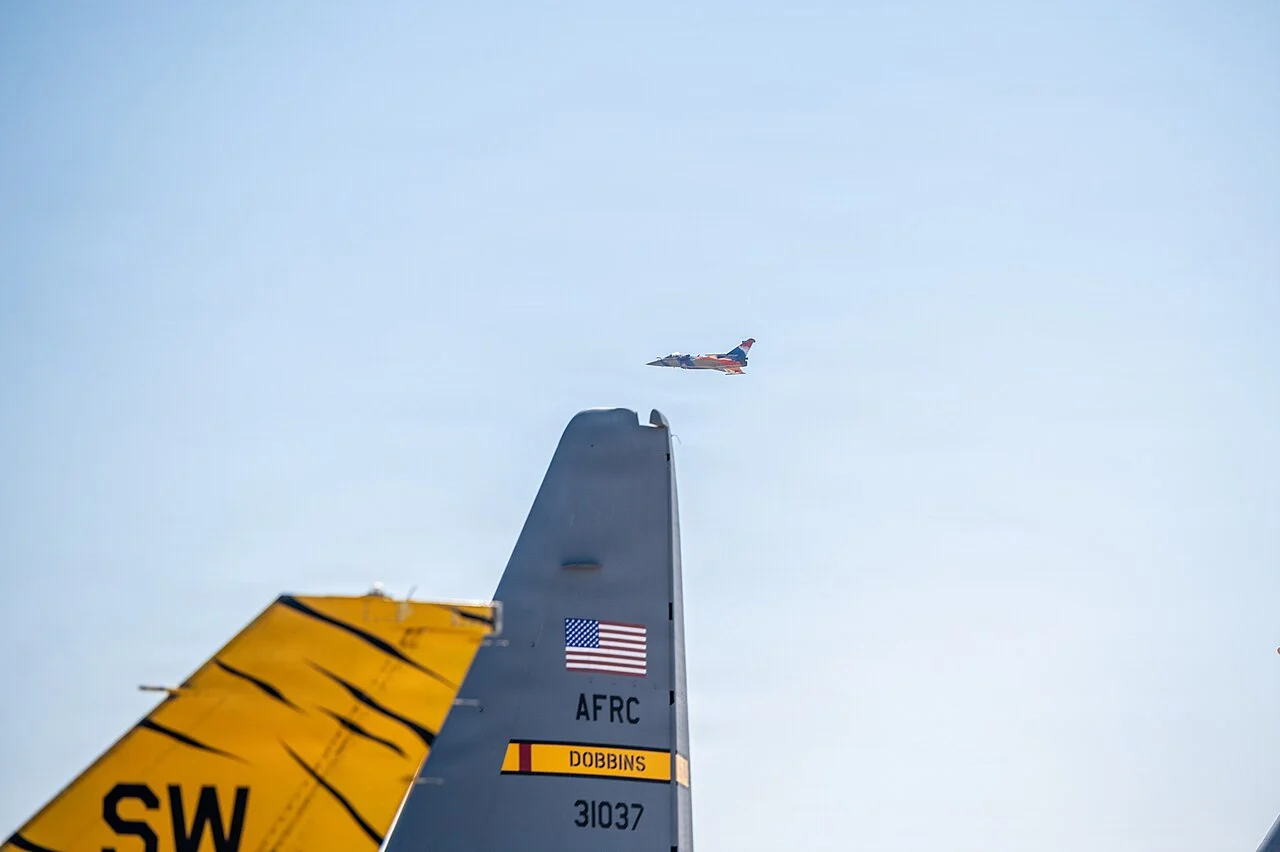
Photo: A Rafale performs at the Egypt International Airshow, El Alamein, 8 September 2026. Credit: U.S. Air Force / Staff Sgt. Christopher Tam, Public domain, via Wikimedia Commons.
Egypt is a confirmed Rafale operator, in service and operational since 2017, with a third contract currently under delivery and a possible fourth order at the request-for-proposal stage. The Egyptian Air Force was the aircraft’s first export customer, signing in February 2015 for 24 jets, then ordering 30 more in 2021. By the Egyptian government’s own account it expects 54 Rafales in service by the end of 2026, and on 2 September 2026 Cairo sent Dassault Aviation a request for proposal covering 24 additional aircraft that would take the fleet to 78 — more than any other export customer has ever ordered. That fourth batch is a request, not a contract, and this file treats it accordingly. It is one part of a fighter fleet that also includes American F-16s and Russian MiG-29M/M2s, set out in full in DefenceMENA’s Egypt military strength profile.
| Country | Egypt |
| System | Dassault Rafale |
| Manufacturer | Dassault Aviation (France) |
| Origin | France |
| Variant | Rafale DM (two-seat) and EM (single-seat), F3R standard |
| Quantity | 54 on contract (24 + 30); 24 more requested (RFP, unconfirmed) |
| Order year | 2015 (first batch), 2021 (second batch) |
| Delivery | First batch complete 2017; second batch delivering 2024–2026 |
| Service status | In service / operational (54 on contract); third batch not confirmed |
| Reported contract value | ~€5.2bn (2015, package); ~€3.75bn (2021, aircraft only) |
What is the Rafale?
The Rafale is a French twin-engine, delta-wing multirole fighter built by Dassault Aviation, designed to fly air superiority, deep strike, reconnaissance, anti-ship and nuclear deterrence missions from the same airframe. It carries the Thales RBE2 active electronically scanned array (AESA) radar, the SPECTRA electronic warfare and self-protection suite, and 14 hardpoints for a mixed weapons load that includes the Meteor beyond-visual-range missile, SCALP-EG cruise missile and AASM precision-guided bombs. Egypt’s aircraft are built to the F3R standard, the configuration that added Meteor integration and other upgrades that were still being rolled out to early export customers when Cairo placed its first order.
Why did Egypt acquire the Rafale?
The purchase followed a specific rupture. After the Egyptian military’s 2013 removal of President Mohamed Morsi, the Obama administration froze major arms deliveries to Cairo, including F-16s, Apache helicopters and M1A1 Abrams components, for roughly two years. The freeze did not end the US-Egypt relationship, but it convinced Cairo that a single supplier was a strategic liability. Egypt signed the Rafale contract in February 2015, becoming the aircraft’s first export customer, and followed it with warships and satellites from France, a relationship traced in detail in DefenceMENA’s supplier profile on France’s arms sales to Egypt. Open-source trade data shows the effect: US arms made up about 47% of Egyptian imports before 2013 and roughly 14% in 2015–2020, while France displaced the United States as Egypt’s top supplier for several years in the same period, part of a wider pattern covered in Has Egypt Really Diversified Its Defence Suppliers?. The Rafale deal was as much about supplier diversification and freedom of action as about the aircraft’s specific capabilities, though Cairo’s own statements also cited the need to replace ageing Mirage 2000 and early-block F-16 airframes.
When did Egypt order it, and what happened next?
| Date | Event | Value | Status | Source |
|---|---|---|---|---|
| 16 Feb 2015 | First contract signed: 24 Rafale (16 DM, 8 EM), plus a FREMM frigate and MBDA missiles in the same package | ~€5.2bn (package) | Contracted | France 24, Dassault Aviation |
| Jul 2015–Nov 2017 | First batch delivered; Egypt becomes the first Rafale export operator | — | Delivered | Dassault Aviation press kits |
| 4 May 2021 | Second contract announced: 30 more Rafale, F3R standard | ~€3.75bn (aircraft); ~€240m separate Safran/MBDA equipment package | Contracted | Defense News, Al Jazeera, Military Africa |
| 15 Nov 2021 | Second contract enters into force, financed via a French bank loan with an 85% state export-credit guarantee over roughly ten years | — | Under contract | Dassault Aviation, Reuters reporting |
| Late 2024–2026 | Second-batch deliveries proceed in tranches; further airframes delivered Oct–Nov 2025 | — | Delivered / delivering | The Aviationist, Army Recognition, Military Africa |
| 2 Sep 2026 | Egypt reportedly sends Dassault a request for proposal for 24 more Rafale, which would take the fleet to 78 | Not disclosed | Proposed / unconfirmed (single-source report at time of writing) | La Tribune via The Defense Post, Army Recognition |
How many Rafales does Egypt operate?
Two contracts cover 54 aircraft (24 from 2015, 30 from 2021). World Air Forces directories and 2026 tracking put 46–50 airframes actually in Egyptian Air Force service as of mid-2026, with the balance of the 54-aircraft total due by the end of the year as second-batch deliveries continue. The reported September 2026 request for 24 more is not part of that count: it is a proposal, and DefenceMENA treats ordered, delivered and in-service numbers as three separate figures rather than one headline total.
How much did the Rafale cost Egypt?
The two confirmed contracts are not directly comparable, because they cover different scopes. The 2015 deal, worth about €5.2 billion, bundled 24 Rafale with a FREMM multipurpose frigate and an MBDA missile package, so no public unit price for the aircraft alone exists from that figure. The 2021 contract, worth about €3.75 billion for 30 aircraft, was reported alongside a separate roughly €240 million equipment and munitions package from Safran and MBDA, and it was financed through a loan repayable over about ten years with an 85% guarantee from the French state export-credit agency. Dividing either total by the number of aircraft would invent a unit price that includes support, weapons, training or financing costs not broken out publicly; no reliable source publishes a bare per-jet price for either Egyptian contract. Contract value for the reported 2026 request has not been disclosed and may not exist yet, since it remains a proposal rather than a signed deal.
Which variant does Egypt fly?
Egypt’s Rafales are the two-seat DM and single-seat EM export variants, broadly equivalent to the French Air Force’s B and C models, built to the F3R standard rather than the newer F4 standard that UAE and Indonesia ordered later. F3R added full integration of the Meteor missile and other sensor and targeting updates over the earlier F3 configuration that Egypt’s first batch initially received before being brought up to standard.
Technical characteristics
| Parameter | Value | Source |
|---|---|---|
| Crew | 1 (EM) or 2 (DM) | Dassault Aviation |
| Max speed | Mach 1.8 | Dassault Aviation (manufacturer figure) |
| Combat radius | Over 1,000 km, mission-dependent | Dassault Aviation |
| Hardpoints | 14, external load up to 9,500 kg | Dassault Aviation |
| Radar | Thales RBE2 AESA, reported detection range around 200 km | Thales (manufacturer figure) |
| Electronic warfare | Thales/MBDA SPECTRA integrated self-protection suite | Thales |
| Principal air-to-air missile (F3R standard) | MBDA Meteor, no-escape zone reported over 60 km; whether Meteor has actually been cleared for Egypt’s aircraft is unconfirmed | MBDA (manufacturer figure); clearance status per open-source reporting |
| Standard | F3R | Dassault Aviation, Egyptian contract reporting |
How long has it been in service, and how has it performed?
Egypt has flown the Rafale since 2017, close to a decade. Manufacturer and official statements describe the type as fully integrated into the 203rd Tactical Fighter Wing at Gebel El Basur air base. Verified combat record: no independently confirmed reports place Egyptian Rafales in air-to-ground combat operations. The February 2015 Egyptian airstrikes against Islamic State positions near Derna, Libya, which followed the beheading of 21 Egyptian Copts, are documented as F-16 strikes rather than Rafale missions, and no later Egyptian government or independent reporting confirms Rafale involvement in Libya or Sinai operations. Media reports and exercises: Egyptian Rafales have flown in the biennial Bright Star exercise with US forces and in the Egypt International Airshow, most recently at El Alamein in September 2026. Beyond training, exercise and air-defence roles, there is no verified operational record to report, and this file does not infer combat performance from the aircraft’s use elsewhere.
Is the Rafale suited to Egypt’s operating environment?
The clearest evidence comes from the French Air Force’s own use of the same aircraft, rather than from Egypt-specific trials. Rafales flying from Chad and other Sahel bases during Operations Serval and Barkhane (2013–2022) flew extended missions of several hours with multiple aerial refuellings over hot, dusty and infrastructure-poor terrain broadly comparable to Egypt’s Western Desert and Sinai. That record supports the aircraft’s suitability for sustained desert operations, though it documents French, not Egyptian, maintenance and basing conditions. No public Egyptian Air Force data on Rafale sortie generation rates, maintenance burden or sand/dust-specific modifications is available, and DefenceMENA has not identified an official Egyptian source addressing this specifically.
Strengths
- Sensor integration: AESA radar and SPECTRA self-protection give Egypt a detection and survivability standard its F-16 and MiG-29M/M2 fleets do not match; open sources are divided on whether Meteor has actually been cleared for the Egyptian fleet, so this file does not count it as a confirmed Egyptian capability.
- Multirole flexibility: the same airframe covers air superiority, strike, reconnaissance and maritime strike, reducing the number of dedicated types Egypt needs to maintain.
- Export-friendly terms: unlike US-origin equipment, French systems carry no ITAR-style third-country transfer restrictions, which matters to a country that has been through one US arms freeze already.
- Established production line and repeat orders: two completed contracts and a reported third request show Dassault has sustained a working support and delivery relationship with Cairo for a decade.
Limitations
- Cost relative to fleet size: at roughly €125–140 million per aircraft implied by the bundled contract totals (not a confirmed unit price; see above), the Rafale is markedly more expensive to acquire than the F-16s and MiG-29M/M2s that make up most of Egypt’s fighter fleet.
- Fleet fragmentation: Rafale is now Egypt’s fourth fast-jet type after F-16, MiG-29M/M2 and Mirage 2000, adding a separate logistics, training and spares chain rather than consolidating the fleet.
- No confirmed local industrial content: unlike Egypt’s US and, more recently, Chinese and Turkish defence relationships, no public Rafale-linked technology transfer or local production agreement has been identified.
- Delivery pace tied to a single supplier’s production line: Egypt now competes for Dassault’s build slots with India, Indonesia, the UAE and others, which affects how quickly any future order could be filled.
What do neighbouring and regional countries operate?
| Country | System | Variant | Status | Approx. quantity | Supplier | Order year | Delivery status |
|---|---|---|---|---|---|---|---|
| Egypt | Rafale | DM/EM, F3R | In service | 46–50 (54 on contract) | France | 2015, 2021 | Delivering (second batch) |
| Qatar | Rafale | EQ/DQ, F3R | In service | 36 | France | 2015, 2017 | Delivered (by 2023) |
| UAE | Rafale | F4 | Under contract | 80 on order | France | 2021 | Not yet delivered |
| Algeria | Su-30MKA | MKA | In service | Approx. 60 (Estimated) | Russia | 2006 onward | Delivered |
| Morocco | F-16 | Block 52/72 | In service | Approx. 30–40 (Estimated) | United States | 2008, 2019 | Delivered / delivering |
| Libya | — | — | No fast-jet Rafale-class fleet in service | — | — | — | — |
What are the closest alternatives?
Within the same class of 4.5-generation, twin-engine multirole fighters with AESA radar and BVR missiles, the closest alternatives to the Rafale are the Eurofighter Typhoon (operated regionally by Qatar, Kuwait and Saudi Arabia), the Boeing F-15EX/F-15QA (Qatar, Saudi Arabia), and the Saab Gripen E (South Africa flies the earlier Gripen C/D). Egypt itself illustrates the alternative path most directly: it signed a reported $2 billion contract for 24–26 Sukhoi Su-35 fighters in October 2018, but abandoned the deal by 2020 after the United States threatened sanctions under CAATSA and Egyptian evaluators raised concerns about the Su-35’s radar and engine technology relative to Western alternatives. At least 11 Su-35 airframes built for Egypt were reportedly never delivered. That episode is the clearest public evidence of what Egypt considered and rejected before doubling down on the Rafale.
Is there a Turkish alternative?
Turkey does not currently produce or export a fighter in the Rafale’s class. TUSAŞ’s KAAN (TF-X) fifth-generation fighter, which flew its first prototype sortie in 2024, is a future national programme rather than an available export product, and it has no signed export contracts anywhere in Africa or the Middle East as of this writing. There is no technically comparable Turkish combat aircraft on offer today, and this file does not present KAAN as a current alternative to the Rafale.
What could replace or complement the Rafale in Egypt’s fleet?
Egypt has not announced a Rafale replacement; the reported September 2026 RFP for 24 more aircraft points toward expansion rather than replacement. The more immediate fleet decision facing Cairo concerns its oldest F-16 Block 15, 32 and 40 airframes, delivered between 1982 and 1995, which open-source reporting has linked separately to a proposed US upgrade-kit and NASAMS air-defence package that had not been contracted as of September 2026. Reports of Egyptian interest in the Chinese J-10CE remain unconfirmed and are described in Egyptian and regional media as an option under consideration rather than a decision.
Frequently asked questions
Does Egypt operate the Rafale?
Yes. Egypt has flown the Rafale operationally since 2017 and is the aircraft’s first export customer, with 46–50 in service in 2026 out of 54 on contract.
How many Rafale jets does Egypt have?
Egypt has ordered 54 Rafale across two contracts (24 in 2015, 30 in 2021). Open-source tracking put 46–50 in active service in 2026, with deliveries continuing.
Is Egypt buying more Rafale jets?
Egypt reportedly submitted a request for proposal to Dassault on 2 September 2026 for 24 additional Rafale, which would raise the fleet to 78. As of this writing that is a request, not a signed contract.
How much did Egypt pay for its Rafale jets?
The 2015 contract (24 aircraft plus a frigate and missiles) was worth about €5.2 billion. The 2021 contract (30 aircraft) was worth about €3.75 billion, with a separate roughly €240 million equipment package. Neither figure breaks out a confirmed per-aircraft price.
What missiles does the Egyptian Rafale carry?
The Rafale’s F3R standard is built around the MBDA Meteor beyond-visual-range missile, but open sources conflict on whether Meteor has actually been cleared for delivery to Egypt, and neither MBDA nor Egypt’s Ministry of Defence has confirmed it. Egyptian Rafales do carry other MBDA and Safran-supplied munitions covered in the 2021 equipment package.
Has Egypt used the Rafale in combat?
No independently verified reports confirm Egyptian Rafale combat missions. The best-known Egyptian airstrikes against ISIS in Libya, in 2015, are documented as F-16 operations.
A note on the numbers: fleet totals for Egypt vary between sources because ordered, delivered and operational aircraft are frequently conflated in open reporting. This file separates the three wherever sources allow, and treats the September 2026 request for 24 more Rafale as unconfirmed until a contract is reported. For more on Egypt’s wider procurement, see the DefenceMENA Egypt tag desk.
Sources
- Dassault Aviation, “Rafale contract for Egypt comes into force” (press kit)
- Dassault Aviation, “Egypt acquires 30 additional Rafale fighters” (press kit)
- France 24, “Egypt, France to conclude €5.2 billion deal for Rafale jets,” 16 Feb 2015
- Defense News, “Egypt bumps up its Rafale fleet by 30 new planes,” 4 May 2021
- Al Jazeera, “Egypt to buy Rafale fighter jets worth $4.5bn from France,” 4 May 2021
- The Aviationist, “Egypt Receives More Rafales from Dassault,” 28 Nov 2025
- Military Africa, “Egypt advances Rafale fleet with new F3R deliveries,” Oct 2025
- The Defense Post, “Egypt Seeks Third French Deal for Additional Rafale Jets,” 3 Sep 2026
- Army Recognition, “Egypt sends proposal request to France for 24 additional Rafale fighters,” Sep 2026
- Forecast International Defense Security Monitor, “Egypt Leverages Diversified Arms Suppliers to Escape U.S. Pressure,” 10 Jul 2018
- The Washington Institute, “Understanding the Egyptian Military’s Perspective on the Su-35 Deal”
- Background on the February 2015 Egyptian airstrikes in Libya (cross-checked against contemporary news reporting)
- Background on French Rafale operations in the Sahel, Operations Serval and Barkhane (cross-checked against contemporary reporting)