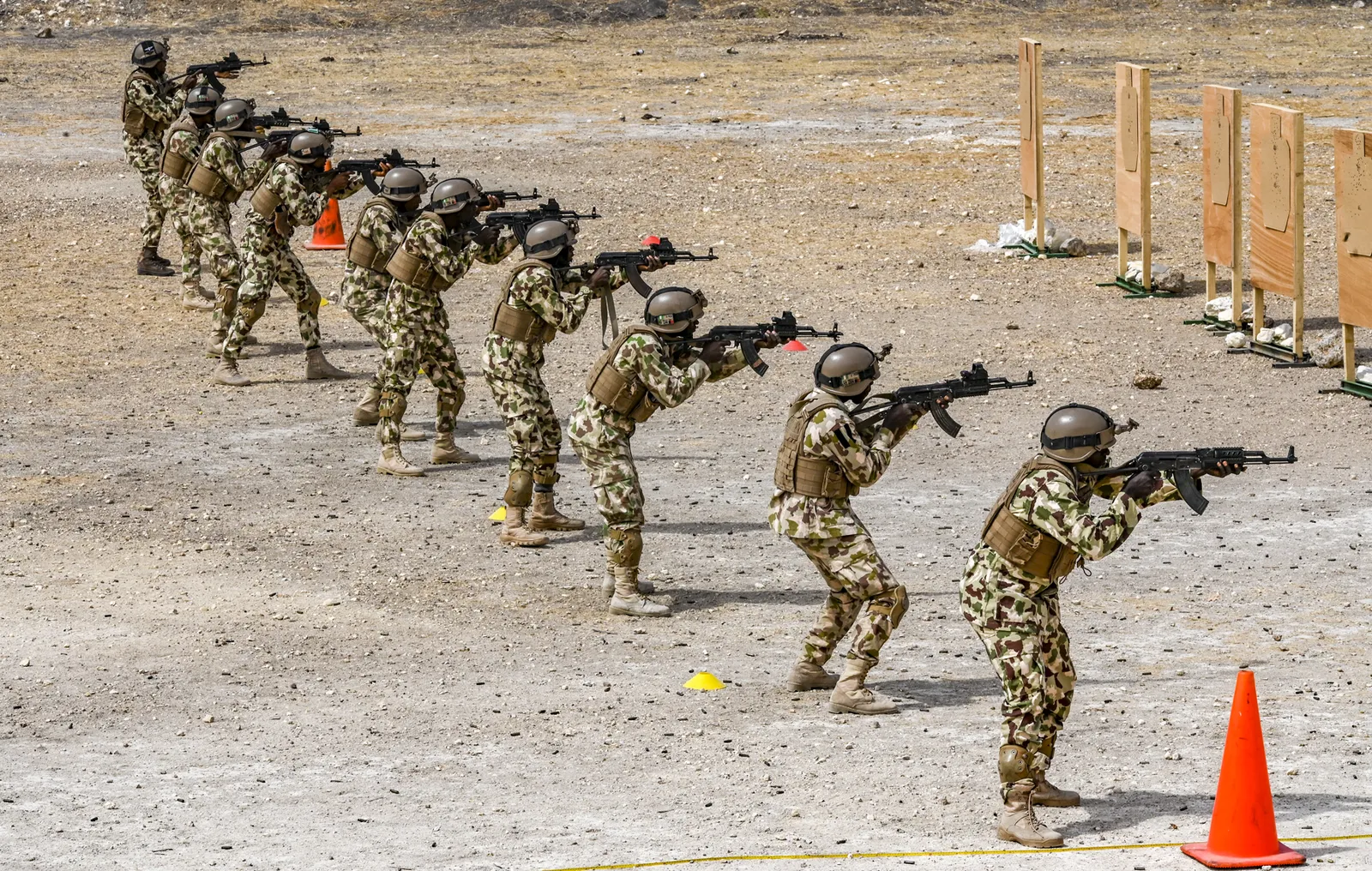
Nigeria fields the largest army by personnel in West Africa and the region’s biggest defence budget, but in 2026 that budget is being eaten alive by inflation and salaries, and the hardware behind the headline numbers is a patchwork: British-era tanks still rated more reliable than newer Chinese ones, a navy waiting years on two delayed Turkish patrol vessels, and a drone fleet that has become the counter-insurgency campaign’s most important weapon. This profile sets out what the Armed Forces of Nigeria actually operate in 2026, what is only on order, and where the open-source numbers disagree.
The short answer: Nigeria is Africa’s third-strongest military by Global Firepower’s composite 2026 index, behind Egypt and Algeria, and by far the largest single arms importer in Sub-Saharan Africa. The longer answer is that most of that spending goes to salaries rather than equipment, procurement is split across at least six supplier countries with little standardisation, and a large share of the inventory — legacy Soviet-era tanks, ageing Roland air defence, a single Cold War-era frigate — predates the current counter-insurgency and Gulf of Guinea security missions it is actually being used for. Every figure below carries a status label: Operational, Delivered, On contract, Ordered, Under modernization, Estimated, Retired or Reported (unconfirmed). An order is not a delivery, and a delivery is not an operational unit.
| Indicator | Figure | Year / source |
|---|---|---|
| Active personnel | Estimated 223,000–230,000 (Army the large majority; Air Force about 18,000); open-source trackers range as low as 143,000 depending on methodology | Global Firepower 2026; Wikipedia/World Bank-derived figures; no recent official Nigerian government breakdown |
| Reserves | Reported at around 80,000; no recent official figure | Open-source trackers, Estimated |
| Conscription | None — voluntary enlistment from age 18 | Nigerian recruitment policy, 2026 |
| Military expenditure | ₦3.16 trillion (about US$2.1bn) for FY2026, approved 31 March 2026; up 2% in naira terms but down about 8.5% in real terms on 2025 after inflation | Vanguard, Military Africa, IISS Military Balance blog, May 2026 |
| Foreign military aid | No grant aid at scale; big-ticket US and Italian buys (AH-1Z Viper, M-346FA) are financed Foreign Military Sales / export-credit deals, not aid, and sit outside the annual MoD vote | US DSCA notifications; Leonardo contract reporting |
| SIPRI importer rank | Not in the global top 40 recipients; largest single recipient in Sub-Saharan Africa in 2021–25 (about 16% of subregional imports); largest African buyer of Turkish arms 2020–24 | SIPRI Arms Transfers fact sheet, March 2026 |
| Main suppliers | China (armour, artillery), Turkey (helicopters, drones, patrol vessels), United Kingdom and former Eastern Bloc states (legacy tanks), Italy and United States (aircraft, helicopters) | SIPRI; DefenceMENA original research |
| Combat aircraft | About 24–33 fast jets and light attack aircraft in service (JF-17, F-7Ni, Alpha Jet, A-29 Super Tucano), plus the first M-346FAs entering service | FlightGlobal World Air Forces 2026; Estimated |
| Main battle tanks | About 325–340 across four types: ~172 Vickers Mk3, 25–41 T-72 variants, ~100 T-55 (status largely unconfirmed), and a growing VT-4 fleet | Army Recognition, DefenceWeb, Shephard Media; Estimated/mixed confidence |
| Submarines / major surface ships | 0 submarines; 1 frigate (NNS Aradu), 2 Centenary-class corvettes, 2 Thunder-class cutters, 2 Turkish OPV-76s in sea trials | Nigerian Navy order of battle, 2026 |
Current military overview
The Armed Forces of Nigeria — Army, Navy and Air Force — are part of DefenceMENA’s West Africa desk and are built almost entirely around internal security rather than a conventional peer conflict: the Boko Haram/ISWAP insurgency in the north-east, banditry and the Lakurawa threat in the north-west and central states, Niger Delta militancy, and piracy and illegal bunkering in the Gulf of Guinea. Human Rights Watch counted more than 6,000 conflict-related deaths in Nigeria in 2025. That mission shapes the inventory: mine-resistant vehicles, attack helicopters and armed drones dominate recent procurement, while genuinely blue-water naval capability and integrated air defence have been left behind. Nigeria’s 2026 defence budget rose in nominal terms for the third year running, but real purchasing power is falling as the naira weakens and inflation erodes the gains from President Bola Tinubu’s 2025 spending uplift.
Defence budget
Nigeria’s National Assembly approved a ₦3.16 trillion (about US$2.1bn) defence and special-operations allocation for FY2026 on 31 March 2026, a 2% nominal increase on 2025’s ₦3.10 trillion. In real terms, after inflation, IISS analysis puts that as an 8.5% cut. The Nigerian Army takes the largest single share at ₦1.504 trillion, followed by the Navy at ₦443.9 billion and the Air Force at ₦407.2 billion. Roughly 76% of the total — about ₦2.39 trillion — goes to pay and allowances, leaving only around ₦464.47 billion (15%) for capital expenditure across the whole ministry. SIPRI’s independent estimate puts Nigerian military spending at US$2.1bn for 2025, a 55% real-terms increase on 2024, which was itself a near-doubling from ₦1.58 trillion (US$1.07bn) in 2024 under Tinubu’s post-2023 reset. None of these figures include the multi-year Foreign Military Sales financing behind the AH-1Z Viper ($997m) or Leonardo M-346FA ($1.4bn) deals, which are serviced outside the annual budget cycle.
Active personnel
There is no recent, reliable official personnel count for the Nigerian Armed Forces. Global Firepower’s 2026 composite index cites a headline figure of around 223,000 active personnel; other open-source trackers range from roughly 143,000 to 230,000 depending on whether reserves, paramilitary formations or historical World Bank data are folded in. The Nigerian Air Force is the one service with a reasonably consistent recent figure, at around 18,000; the Army makes up the large majority of the total, with the Navy in between. Reserves are commonly cited at around 80,000, again without a recent official source. Service is entirely voluntary — Nigeria has no conscription, though the 1999 constitution’s provision for compulsory military training remains on the books and unused.
Army
The Nigerian Army’s armour fleet is a genuine multi-decade patchwork rather than a modern force built around one platform. About 172 British-supplied Vickers Mk3 “Eagle” main battle tanks, delivered 1981–95, remain in service and are rated by Army Recognition as more reliable in practice than some of the newer imports. Sitting alongside them are 25–41 T-72A/AV/M1/B tanks bought via Ukraine, Hungary and the Czech Republic in 2014–15 as an emergency counter-insurgency buy, and an estimated 100 older T-55s whose operational status is largely unconfirmed. China’s NORINCO has become the fastest-growing supplier since 2019: VT-4 main battle tanks arrived in two batches (2020 and 2022, roughly 30 delivered cumulatively), alongside ST-1 tank destroyers and 60 Type-89 armoured personnel carriers ordered in 2021. At least one VT-4 was destroyed by Boko Haram using an RPG in April 2025, a reminder that modern armour is not immune to the insurgency it was bought to fight.
| System | Origin | Quantity | Status | Source |
|---|---|---|---|---|
| Vickers Mk3 “Eagle” MBT | United Kingdom | ~172 | Operational | Army Recognition |
| T-72A/AV/M1/B MBT | Ukraine / Hungary / Czech Republic | 25–41 | Estimated | Army Recognition, Shephard Media |
| T-55 MBT | Legacy (former Eastern Bloc) | ~100 | Reported (unconfirmed) | Wikipedia equipment list, cross-checked |
| VT-4 MBT | China (NORINCO) | ~30 cumulative (2 batches) | Delivered | Shephard Media, Army Recognition |
| ST-1 tank destroyer / Type-89 APC | China | 60 (2021 order) | Delivered | DefenceWeb |
| SH-2 / SH-5 105mm self-propelled howitzer | China | At least 15 | Delivered | Army Recognition |
| MRAP mix (CS/VP3, Dongfeng Mengshi, Typhoon/Warrior/Spartan, Ezugwu, SandCat, Isotrex, Cobra) | China, Canada, UAE, Nigeria (DICON), Israel, Türkiye | Several hundred combined | Delivered / Operational | DefenceWeb, Military Africa |
| MLRS (APR-40 / BM-21 / RM-70) | Legacy, mixed origin | Undisclosed | Reported (unconfirmed) | Open-source equipment lists |
| Konkurs / Fagot-family ATGM | Legacy Soviet-origin | Undisclosed | Reported (unconfirmed) | Open-source equipment lists |
Sustainment is now a visible priority: the Nigerian Army and NORINCO opened a joint Comprehensive Service Centre at Obienu Barracks in Bauchi on 27 August 2026, providing Level 2–4 maintenance and overhaul for VT-4s, ST-1s, SH-5s and other Chinese-supplied vehicles, with Nigerian personnel being trained to eventually run it without Chinese technicians on site. For the full order of battle behind these figures, see DefenceMENA’s Nigerian Army Weapons and Equipment List.
Air Force
The Nigerian Air Force’s fast-jet and light-attack fleet is small relative to the country’s size: roughly three JF-17 Thunders, five F-7Nis, about thirteen Alpha Jets and twelve A-29 Super Tucanos, none of them supported by airborne early warning or air-to-air refuelling assets. The picture is changing at the margins. Leonardo’s M-346FA light fighter-attack programme — 24 aircraft in a roughly $1.4bn deal, structured in four tranches of six for two NAF squadrons — slipped by around eighteen months from its original end-2024 target, but the first three aircraft (tail numbers NAF 01–03) completed factory acceptance testing in Italy between 29 June and 9 July 2026 and are now cleared for delivery; the remaining 21 have no published delivery schedule. On the rotary side, around fifteen Mi-35 attack helicopters remain the mainstay, alongside four of the six ordered Turkish T129 ATAK helicopters confirmed delivered and in service as of a May 2025 NAF statement; the remaining two are unconfirmed. Bell began physical production of the first of twelve AH-1Z Vipers for Nigeria at its Amarillo, Texas plant on 16 September 2026, under a $997m Foreign Military Sale first approved in 2022; Bell expects the full 12-aircraft order to be complete by early 2029.
Navy
The Nigerian Navy’s surface fleet is built for maritime constabulary and anti-piracy work in the Gulf of Guinea rather than blue-water operations, and it shows: a single frigate, NNS Aradu, dating to the Cold War era, two Centenary-class corvettes, two Thunder-class cutters, roughly 31 smaller patrol and missile boats, and no submarines. The most significant modernisation in train is a pair of Turkish-built DEARSAN OPV-76 offshore patrol vessels ordered in a $160m contract signed in Abuja on 3 November 2021. Both hulls have been launched — the first in October 2023, the second in April 2024 — and the second completed sea trials during 2025, but neither vessel’s commissioning into Nigerian Navy service has been confirmed as of September 2026, well past the original 37-month delivery target implied by the contract signing date.
| System | Origin | Quantity | Status | Source |
|---|---|---|---|---|
| NNS Aradu (MEKO 360) frigate | Germany (1981) | 1 | Operational (limited availability) | Nigerian Navy order of battle |
| Centenary-class corvette | China | 2 | Operational | Naval News, open-source |
| Thunder-class cutter | United States (ex-USCG) | 2 | Operational | Open-source |
| Patrol / fast attack / missile boats | Mixed | ~31 | Operational (mixed serviceability) | Estimated |
| DEARSAN OPV-76 | Türkiye | 2 | Sea trials complete; delivery/commissioning Reported (unconfirmed) | Naval News, DefenceWeb, Army Recognition |
| Submarines | — | 0 | None in service | Nigerian Navy order of battle |
UAV and drone fleet
Unmanned systems have become central to Nigeria’s counter-insurgency doctrine faster than any other equipment category. The Nigerian Army confirmed a fleet of 43 Turkish Bayraktar TB2 armed drones in December 2024 under the codename “Project Guardian”, built on an initial 2022 order and first 2023 deliveries; deliveries against the full 43-airframe total continue into 2026. Alongside the TB2s sit Chinese systems — about five Wing Loong II and around seven CH-3A/CH-4B medium-altitude drones — plus smaller numbers of Turkish Songar armed quadcopters. Nigeria is in effect running the Turkish-Chinese dual-sourcing pattern seen across several African drone fleets, a trend Envanter Medya has tracked across the continent. Domestic programmes (Gulma, Tsaigumi, UNIKAM) remain at prototype stage and are not yet fielded in numbers worth counting. A full breakdown of the Turkish, Chinese and homegrown systems, including the January 2026 Turkey-Nigeria training agreement, is in DefenceMENA’s dedicated look at Nigeria’s drone fleet.
Air defence
Nigeria’s air defence is fragmented and skewed almost entirely towards point defence: ageing French Roland systems, Strela-2 and Blowpipe man-portable missiles, ZSU-23-4 self-propelled anti-aircraft guns and 36D6 acquisition radar, most of it Cold War-era or later Soviet-origin equipment with no confirmed medium- or long-range layer. Talks with Turkey’s ASELSAN over radar and counter-UAS systems were reported in September 2025 but remain at the discussion stage, with no contract signed as of this profile.
Missiles and artillery
Beyond the SH-2/SH-5 self-propelled howitzers already listed under the Army, Nigeria’s artillery park includes towed guns and a multiple-launch rocket capability (APR-40/BM-21/RM-70 types) whose exact numbers are not confirmed in recent open sources. Anti-tank capability rests on a legacy Konkurs/Fagot-family ATGM holding that has not been recently reconfirmed by any tracked delivery. There is no confirmed Nigerian holding of longer-range strike or ballistic missile systems.
Defence industry
The Defence Industries Corporation of Nigeria (DICON), based in Kaduna, resumed small-arms ammunition production in 2025, delivering around four million rounds of 7.62mm, and signed a 2025 joint venture with D7G/Gray Insignia for local assembly of armoured vehicles, including BR6 and MRAP-Buffalo variants, with a BMP-2 production line reportedly planned. DICON also builds the Ezugwu mine-resistant vehicle already in Army service. This is a nascent, state-owned base rather than an established export-capable industry, and most of what the Army and Air Force operate is still imported and assembled abroad.
Main defence suppliers
Nigeria does not appear in SIPRI’s list of the world’s top 40 arms importers, but within Sub-Saharan Africa it is the single largest recipient, accounting for roughly 16% of the subregion’s arms imports in 2021–25. Across that subregion, China is the leading supplier (about 22% of subregional imports, supplying 23 African states), followed by Russia (about 12%) and Turkey (about 11%) — and Nigeria specifically was the largest single African buyer of Turkish arms in 2020–24, concentrated in combat helicopters. For Nigeria’s own recent procurement, the practical supplier list is narrower: China for armour and artillery, Turkey for helicopters, drones and patrol vessels, Italy and the United States for fixed- and rotary-wing aircraft, and the United Kingdom and former Eastern Bloc states for legacy tank fleets still in service.
Recent procurement (12-month timeline)
| Date | Event | Value | Status |
|---|---|---|---|
| September 2025 | ASELSAN (Turkey) reported in talks over radar and counter-UAS systems for Nigeria | Undisclosed | Reported (unconfirmed) |
| April 2026 | First Nigerian Leonardo M-346FA flies with complete NAF livery | Part of $1.4bn / 24-aircraft deal | Under modernization |
| 29 June–9 July 2026 | First three M-346FA aircraft complete factory acceptance testing in Italy, cleared for delivery | Part of $1.4bn / 24-aircraft deal | Delivered (cleared) |
| 27 August 2026 | Nigerian Army – NORINCO Comprehensive Service Centre opens in Bauchi for VT-4/ST-1/SH-5 sustainment | Undisclosed | Operational |
| 16 September 2026 | Bell begins production of first AH-1Z Viper attack helicopter for Nigeria at Amarillo, Texas | $997m / 12 aircraft (FMS approved 2022) | On contract / Under production |
Turkish systems in Nigeria
Nigeria is Turkey’s largest African arms customer of the past five years, and the relationship is broader than any single platform.
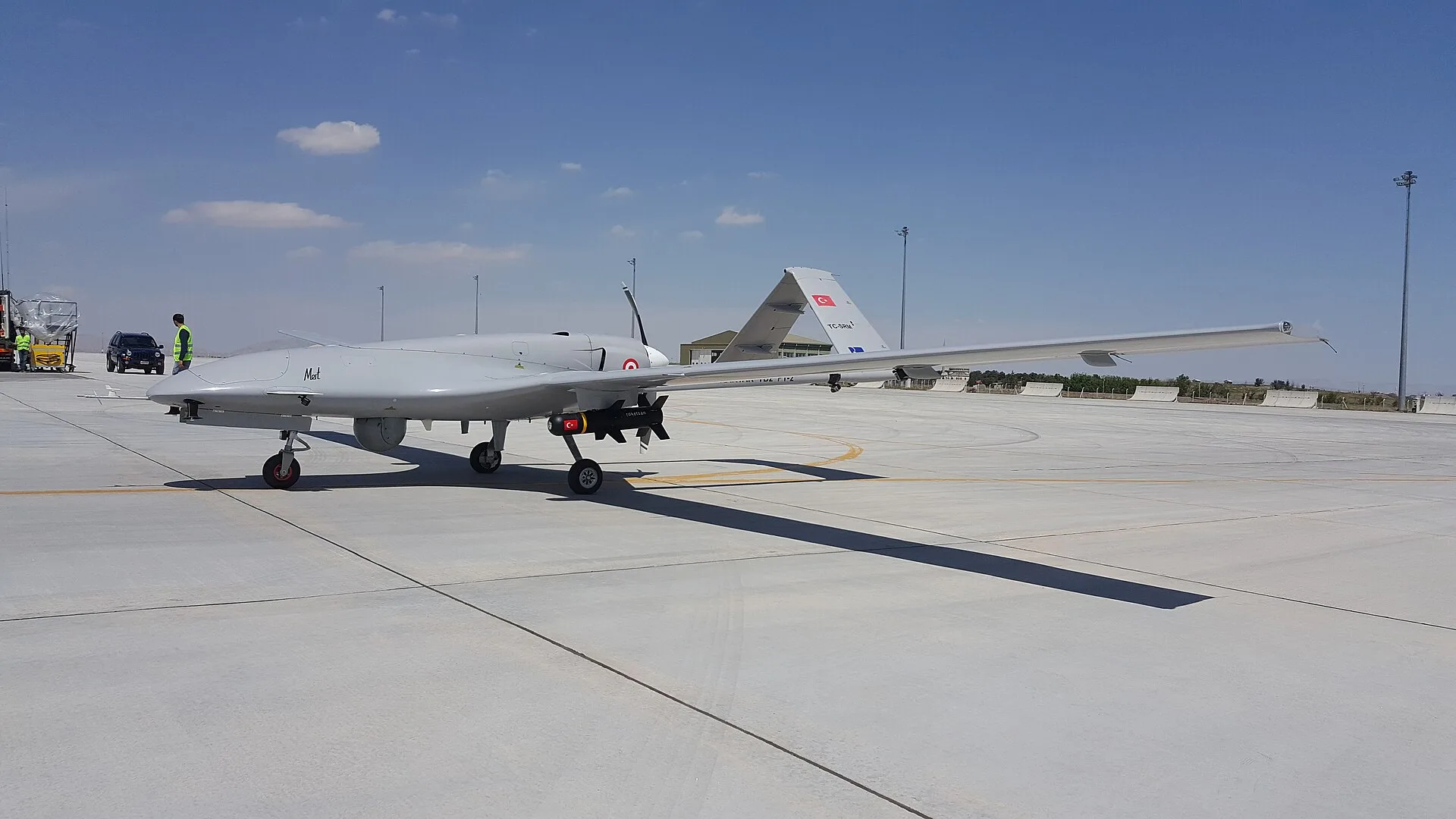
Photo: A Turkish-registered Bayraktar TB2 carrying a Roketsan MAM-L munition, 2016; the same type Nigeria ordered under Project Guardian. Credit: Bayhaluk, CC BY-SA 4.0, via Wikimedia Commons
| System | Role | Status | Source |
|---|---|---|---|
| Bayraktar TB2 | Armed reconnaissance UCAV | 43 ordered (“Project Guardian”), delivered in batches since 2023, deliveries ongoing | DefenseMirror, Türkiye Today, Military Africa |
| T129 ATAK | Attack helicopter | 6 ordered, 4–6 delivered | DefenceMENA original research |
| DEARSAN OPV-76 | Offshore patrol vessel | 2 built, sea trials complete, commissioning unconfirmed | Naval News, DefenceWeb |
| Songar | Armed quadcopter | Delivered, quantity undisclosed | DefenceWeb |
| Otokar Cobra | MRAP / light armoured vehicle | In service, quantity undisclosed | Open-source equipment lists |
| ASELSAN radar / counter-UAS | Air defence sensors | Talks only, not signed (September 2025) | Military Africa |
More on Ankara’s footprint across the continent is on DefenceMENA’s Turkish Defence in Africa desk. The honest assessment is that Turkish systems have won market share in Nigeria for reasons that are visible in the record rather than assumed: the TB2 programme moved from order to operational use inside roughly a year, where the American AH-1Z deal took over four years to reach the start of production after its 2022 approval; Ankara has offered combat helicopters (T129) and armed drones as a bundled package with training, which suited a force fighting an active insurgency with no time to spare; and dealings with Turkish suppliers have carried less of the political conditionality attached to US Foreign Military Sales. That is a genuine and sourced advantage in speed and flexibility — it is not evidence that Turkish equipment is intrinsically superior to the alternatives. China’s NORINCO has answered with a different value proposition: larger-scale armour packages (VT-4, ST-1, Type-89) bundled with in-country sustainment infrastructure, exemplified by the Bauchi service centre that opened in August 2026, and financing reported to be more concessional than Western FMS terms. Russia’s role by contrast has shrunk to legacy Mi-35 helicopter support, with no confirmed recent new-build deliveries.
| Factor | Türkiye | China | Russia |
|---|---|---|---|
| Recent deliveries | TB2 drones, T129 helicopters, Songar, OPV-76s (sea trials) | VT-4, ST-1, Type-89, SH-2/SH-5, MRAPs | Legacy Mi-35 helicopter support only |
| Local production / sustainment | None confirmed in Nigeria | Bauchi service centre (2026), training toward local capacity | None |
| Price & financing | Reported to be commercially competitive, faster contracting | Reported concessional terms on some packages | Not currently active as a new-equipment supplier |
| Munitions / support package | Bundled training and munitions with drone/helicopter sales | Spares and ammunition bundled with armour deals | Legacy spares only, availability uncertain |
| Political exposure | Comparatively low conditionality | Comparatively low conditionality, growing footprint | Constrained by sanctions-related friction on the broader arms market |
What is changing?
Three things are moving at once. First, the money: nominal defence spending keeps rising under Tinubu, but real purchasing power is falling as inflation and naira depreciation outpace the increases, and 76% of the 2026 vote is already committed to salaries before a single new system is bought. Second, the supplier base is diversifying rather than consolidating — China, Turkey, Italy and the United States are all delivering major platforms in the same 12-month window, which spreads political risk but multiplies the logistics and training burden. Third, Nigeria is visibly trying to build sustainment capacity at home rather than relying purely on imports: the NORINCO service centre in Bauchi and DICON’s resumed ammunition production and vehicle-assembly joint venture both point toward reducing turnaround time and foreign dependency, even if the scale remains small next to the size of the fleet being supported. Naval recapitalisation is the clear laggard — the OPV-76 programme is years behind its original schedule and there is still no submarine or modern frigate in the pipeline despite the Gulf of Guinea threat.
How Nigeria compares in Africa
Global Firepower’s 2026 composite index ranks Nigeria 33rd globally and third in Africa, behind Egypt and Algeria and down one place in the ranking from 2025 — a useful indicative snapshot, not an official assessment. By raw personnel numbers Nigeria fields Africa’s largest army; by SIPRI’s arms-transfer data it is comfortably the largest single arms importer in Sub-Saharan Africa. Where it lags its northern and southern peers is air power — no AEW&C or air-to-air refuelling, and a serviceable fast-jet fleet a fraction of Egypt’s or Algeria’s — and blue-water naval capability, where a single ageing frigate and zero submarines compare poorly with South Africa’s frigate and submarine force. DefenceMENA’s Nigeria vs South Africa comparison sets these two forces head to head in more detail, and further coverage of the Nigerian military is tagged on the Nigeria desk.
A note on the numbers
Global Firepower’s country rankings are cited here only as an indicative composite index, not as an official personnel or inventory count, and its underlying methodology is not published in a way that can be independently verified. Personnel figures for Nigeria in particular vary widely across open sources, from roughly 143,000 to 230,000 active personnel, because trackers use different base years and different definitions of what counts as active service; where this profile cannot reconcile the disagreement, it gives a range rather than a single invented number. Ordered, delivered and operational are treated as three different things throughout, and inventory figures for older Soviet- and Eastern Bloc-origin equipment in particular should be read as indicative rather than exact, since Nigeria does not publish a current official order of battle. This profile will be updated as deliveries against the AH-1Z, M-346FA, TB2 and DEARSAN OPV-76 programmes are confirmed.
Sources
- Vanguard, Defence, Special Operations get N3.15trn in 2026 budget
- Military Africa, Nigeria’s Defence Budget Hits Record High, but Inflation Eats the Gains
- SIPRI, Trends in International Arms Transfers 2025 (March 2026)
- Shephard Media, Nigeria takes delivery of first batch of Chinese VT-4s
- Army Recognition, Nigerian Army: old Vickers Mk3 MBTs more reliable than recent T-72M MBTs
- Military Africa, Nigerian Army and NORINCO commence operations in Bauchi
- Military Africa, Nigerian Air Force completes first set of M-346FA jets for delivery
- The Aviationist, First Nigerian M-346FA flies with complete livery
- Army Recognition, Bell starts production of 12 AH-1Z Viper attack helicopters for Nigeria
- DefenceWeb, Second Dearsan offshore patrol vessel launched for Nigerian Navy
- Army Recognition, Nigeria’s second Turkish-made OPV-76 completes sea trials
- DefenseMirror, Nigeria Procures 43 Bayraktar TB2 Drones to Boost North-West Security
- DefenceWeb, Nigeria acquires Songar armed drones from Turkey as UAV fleet grows
- The Defense Post, Nigeria to build armoured vehicles, counter-drone systems locally
- DefenceMENA, Nigerian Army Weapons and Equipment List (2026)