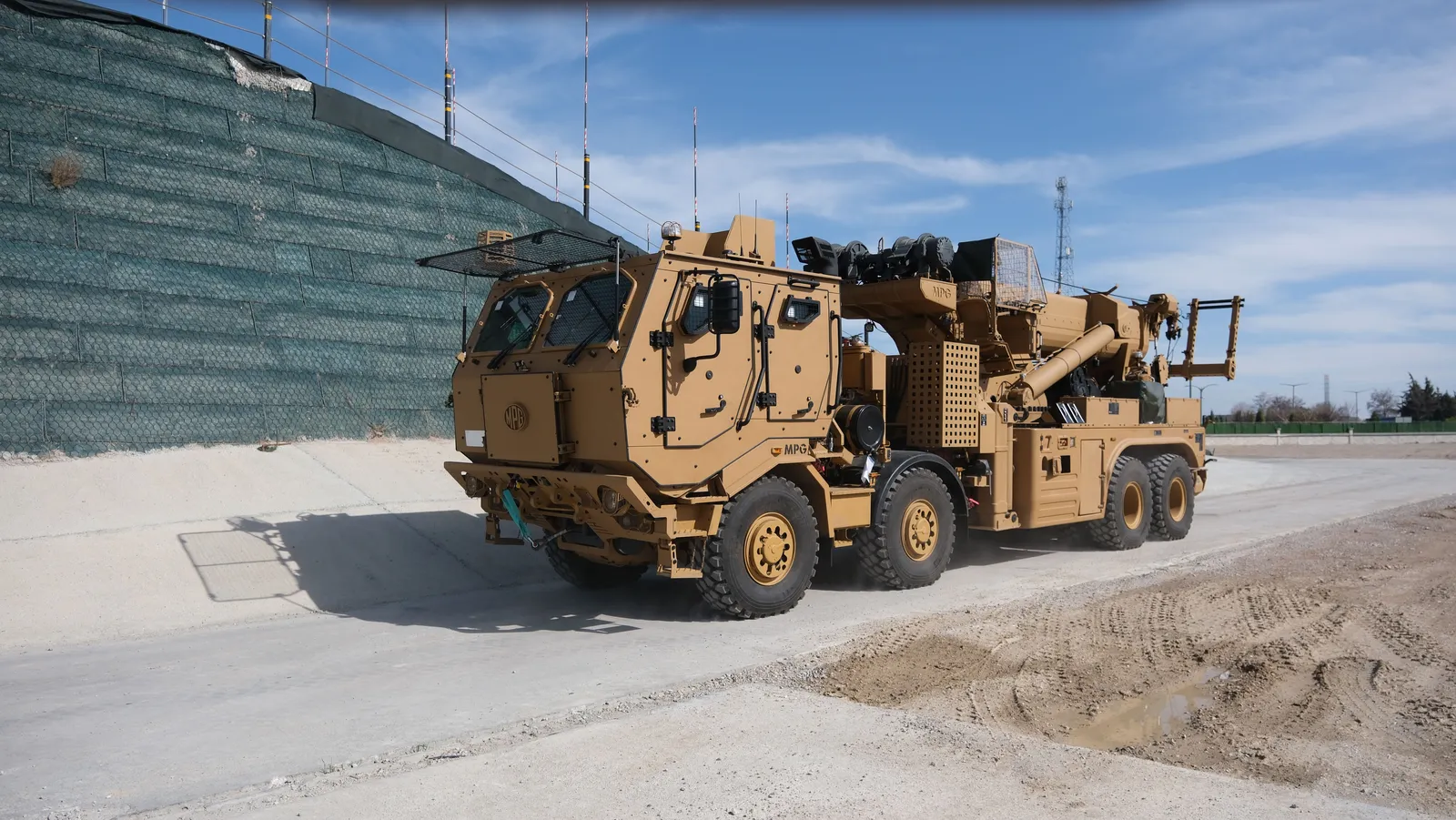
The 8×8 Wheeled Recovery Vehicle built by Konya-based MPG is the Turkish Land Forces’ answer to a problem every army with a large wheeled fleet eventually meets: how to pull a disabled armoured vehicle out of trouble without exposing the recovery crew. Türkiye’s Presidency of Defence Industries (SSB) reports that 33 vehicles have been delivered and that a contract amendment covering 77 more has been signed, which makes this protected crane truck one of the quieter but more consequential programmes in Turkish land logistics.
Photo: Presidency of Defence Industries (SSB), Türkiye.
What is the MPG 8×8 recovery vehicle?
In SSB’s project sheet the vehicle appears simply as the 8×8 Wheeled Recovery Vehicle, and its mission is described in practical terms: recovering the tactical wheeled vehicles in the Land Forces inventory after an accident or breakdown, and providing critical combat service support. MPG markets the same platform as the M4K, a partially mine-protected recovery vehicle. It combines a heavy 8×8 truck chassis, a protected four-seat cab, a hydraulic crane and boom, and winching and towing equipment, so that a single vehicle can lift, drag or suspend-tow a stricken armoured vehicle and clear a route.
The reason such a vehicle matters is the shape of the modern Turkish fleet. Over the past fifteen years the Land Forces and the Gendarmerie have taken thousands of protected 4×4 vehicles into service, from the BMC Kirpi to the Otokar Cobra family and the Nurol Makina Ejder Yalçın. Those vehicles are heavy, high-sided and often operate on poor mountain roads. When one rolls into a ditch or loses a wheel station to a mine, a commercial tow truck is neither strong enough nor safe enough to be sent in. The M4K was built to close that gap with a vehicle that can work in the same threat environment as the fleet it supports.
Key specifications
| Manufacturer | MPG Makine Prodüksiyon Grubu (Konya, Türkiye) |
| Designation | 8×8 Wheeled Recovery Vehicle; marketed as M4K partially mine-protected recovery vehicle |
| Procurement authority | Presidency of Defence Industries (SSB) |
| Turkish user | Turkish Land Forces Command |
| Status (SSB, Sept 2026) | 33 delivered; contract amendment signed for 77 more |
| Lifting capacity | Lifts a 25-tonne vehicle at 7 m (SSB) |
| Crew | 4, in a ballistically protected cab |
| Powertrain | 600 hp engine with automatic transmission |
| Weight / speed | About 46 t; 80 km/h (Daily Sabah, 2020) |
| Protection | Ballistic, mine and IED protection; fire suppression; CBRN protection; jammer |
| Armament | ASELSAN SARP remote weapon station |
| Export status | No export contract announced; MPG reports talks with foreign customers |
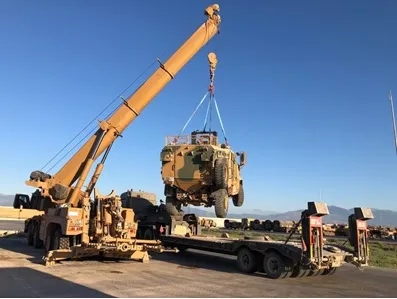
The headline figure in the SSB data is the crane: the vehicle can lift a 25-tonne vehicle at a reach of seven metres. That is a demanding combination, because lifting capacity normally falls quickly as the boom extends. In practice it means the crew can stay on a firm road surface while hoisting a protected 4×4 out of a ravine or off a soft verge. SSB also lists a ballistically protected cab for four people and a 600 hp engine with an automatic transmission, a powertrain chosen so that the vehicle can keep pace with armoured columns and still deliver high torque when winching.
Turkish press coverage at the time of the first deliveries added more detail. Daily Sabah, reporting SSB’s announcement in August 2020, described a 46-tonne 8×8 able to reach 80 km/h, with protection against mines, improvised explosive devices and kinetic-energy rounds, together with fire extinguishing and explosion suppression, CBRN protection, an electronic jammer and an ASELSAN-developed SARP remote weapon station. In other words, the recovery crew gets the same layered protection as a combat vehicle crew, and the vehicle can defend itself while it works.
The SSB programme and Turkish service
The recovery vehicle is a good example of how SSB has widened local content beyond the headline weapons programmes. Instead of importing a foreign armoured wrecker, the Presidency backed a mid-sized Anatolian engineering company that already built heavy cranes and robotic arms, and gave it a qualification route into the armed forces. Qualification tests were completed in January 2020, and the vehicles then entered Land Forces service in batches. In August 2020 SSB announced that all locally produced M4K vehicles under the first order had been delivered.
According to SSB’s September 2026 data, 33 vehicles have now been handed over and a contract amendment has been signed for a further 77 to meet the additional requirement. MPG told GBP at the SAHA 2026 exhibition in Istanbul that the follow-on deliveries are planned by the end of 2027. If those deliveries run to plan, the Land Forces will field around 110 protected 8×8 recovery vehicles, enough to place recovery capacity at brigade level across the wheeled fleet rather than holding a few vehicles at depot level.
The programme also reflects a wider SSB habit of treating support vehicles as part of the combat system. The same project sheet that lists the recovery vehicle also covers new 8×8 tank transporters and next-generation armoured vehicles, and the logic is consistent: a fleet is only as mobile as its ability to move, repair and recover its heaviest elements.
Who operates the M4K?
The confirmed operator is the Turkish Land Forces Command. No export contract has been announced. MPG said at SAHA 2026 that it has not yet sold the vehicle abroad but is in discussions with potential international customers, some of them in the Middle East. DefenceMENA has not found any government statement or trade-press report naming a foreign buyer, so the vehicle should be described as in Turkish service and offered for export.
That status is not unusual for a recovery vehicle. Armies tend to buy recovery assets after the combat fleet, often from the same supplier, and a buyer of Turkish protected vehicles is the natural first customer for a Turkish protected wrecker.
Can the M4K go to Africa?
Africa is arguably the market where a vehicle like this makes the most sense. Many African armies now operate mixed fleets of mine-protected 4x4s bought from several suppliers at once: Turkish Kirpi, Cobra and Ejder Yalçın vehicles sit alongside South African, Emirati, Chinese and Western designs. DefenceMENA’s survey of Turkish systems in African service lists Otokar Cobra users from Ghana and Nigeria to Senegal, Chad and Mauritania, and Nurol Makina’s Ejder Yalçın in Niger, while BMC Kirpi vehicles have a long record on the continent, covered in our Kirpi Africa file. What these fleets often lack is protected recovery.
In counter-insurgency operations in the Lake Chad basin, the central Sahel or northern Mozambique, a disabled vehicle is a target. Convoys that cannot recover a damaged MRAP quickly must either abandon it or leave troops exposed while they improvise. A wrecker that can lift a 25-tonne vehicle from seven metres, carries its own remote weapon station and protects a four-person crew against mines and small arms addresses exactly that scenario. The 8×8 layout and 600 hp powertrain also suit long laterite roads and flooded tracks in the rainy season.
The most logical candidates are countries that already field Turkish protected vehicles and face an IED threat, such as Nigeria, Niger, Chad, Senegal and Ghana, with Kenya and Somalia as further candidates exposed to the same kind of threat. North African armies with large wheeled fleets, such as Morocco, Algeria and Egypt, are another obvious audience, as are contingents deployed on United Nations and African Union missions that must recover their own vehicles far from home. A practical selling point is commonality: a buyer already training on Turkish vehicles can add Turkish recovery equipment without building a second support chain.
How it compares
Protected wreckers on heavy 8×8 chassis are offered by several Western truck makers, and they tend to be large, expensive vehicles bought in small numbers. The MPG design sits in the same class in terms of lift and protection, but it comes out of a Turkish programme that has already funded qualification, built a production line and put the vehicle into service at scale. For African buyers that weigh price, delivery time and political conditions as heavily as specification, that combination is the main argument.
Related: Turkish systems in African service; BMC Kirpi in Africa; ASELSAN company profile.
Frequently asked questions
Who makes the Turkish 8×8 recovery vehicle?
It is built by MPG Makine Prodüksiyon Grubu, a heavy-engineering company based in Konya, Türkiye, under a programme managed by the Presidency of Defence Industries (SSB). MPG markets it as the M4K partially mine-protected recovery vehicle.
How many M4K recovery vehicles has Türkiye ordered?
SSB reports that 33 vehicles have been delivered to the Turkish Land Forces and that a contract amendment has been signed for 77 more, which would bring the fleet to about 110.
What can the M4K lift?
According to SSB, the crane can lift a 25-tonne vehicle at a reach of seven metres, enough to recover the protected 4×4 vehicles that make up most wheeled fleets.
Has the M4K been exported?
No export contract has been announced. MPG said in 2026 that it is in talks with potential international customers, including in the Middle East.
Why would African armies need it?
Many African forces operate mixed fleets of mine-protected vehicles in IED-heavy environments. A protected recovery vehicle lets them retrieve disabled vehicles under threat instead of abandoning them.