Amnesty International says it has documented 34 civilian killings and two drone strikes that killed at least 23 people, including five children, carried out by Malian forces and Russian mercenaries between 2023 and 2025. The report adds new detail to a pattern of attacks on Fulani, Arab and Tuareg communities that has defined Mali’s counter-insurgency campaign since Wagner Group fighters arrived in the country.
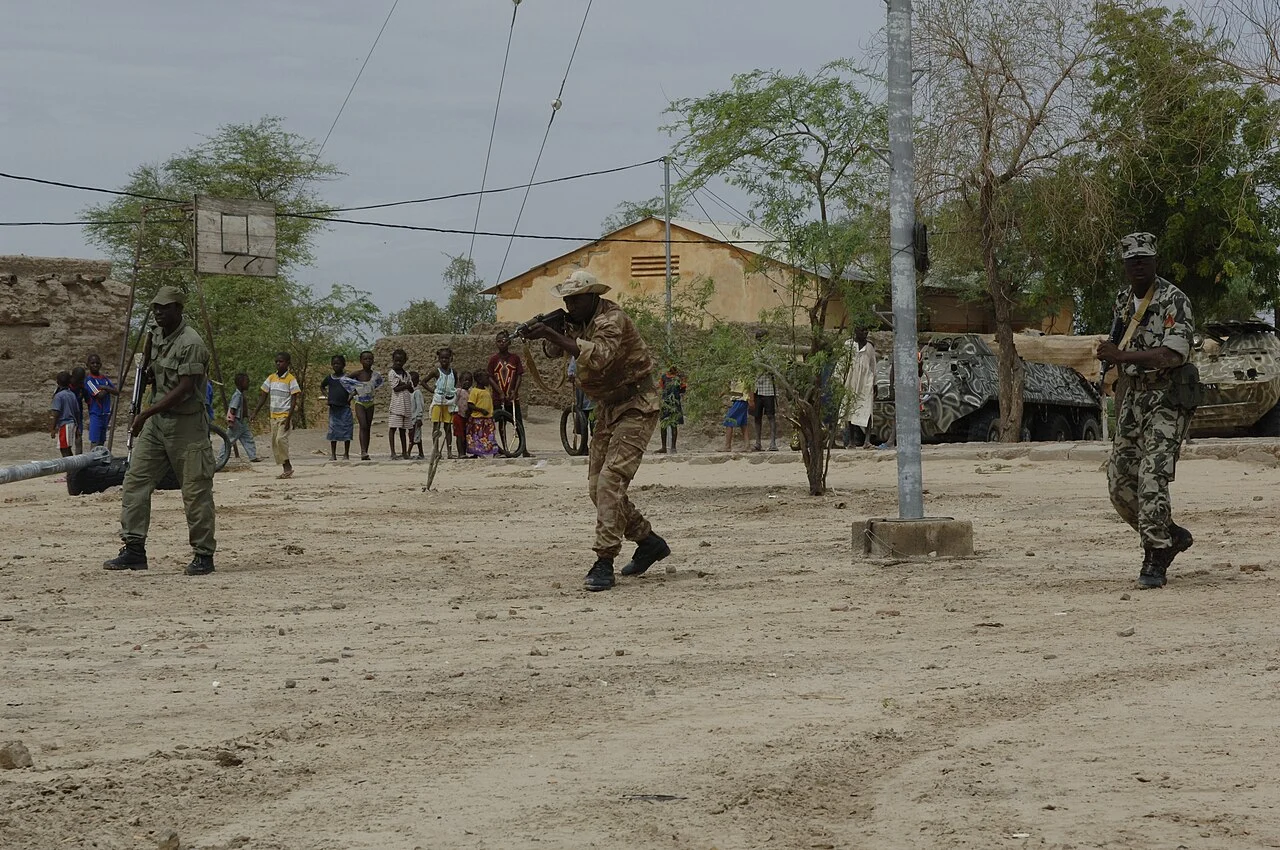
Photo: Malian army soldiers conduct drills during a training exercise in Timbuktu. Credit: Master Sgt. Ken Bergmann, U.S. Air Force, Public domain, via Wikimedia Commons
Amnesty International published a report on October 1 documenting what it calls war crimes committed jointly by the Malian armed forces (FAMa) and Russian mercenaries across seven localities in the Ségou, Mopti and Timbuktu regions between 2023 and 2025. The human rights organisation says it interviewed 119 Malian refugees in neighbouring Mauritania and shared its findings with Mali’s authorities before publication, but received no response.
What Amnesty documented
According to the report, civilians in the seven localities were killed by shooting, throat-cutting and burning during joint patrols by Malian soldiers and Wagner personnel. In the hamlet of Tin Adanda, Amnesty says a joint patrol killed four people; one survivor told researchers that two of his sons and a cousin were detained and then executed.
Separately, Amnesty documented two Malian military drone strikes that it says killed at least 23 people, including five children. One strike hit a market in Ejdeir; the other struck a family home in Tangata. Amnesty says it found no evidence of armed fighters or military targets at either site. The organisation did not name the drone type used, and DefenceMENA has not independently verified it — Mali’s air force has operated Bayraktar TB2 and Akinci systems from Türkiye alongside Chinese-made platforms in its counter-insurgency campaign in recent years.
The report also documents torture: 15 male survivors described being tortured during patrols or in detention, including simulated drowning, electric shocks, beatings and suspension. Amnesty says five detainees died from torture or from conditions in detention, and survivors told researchers that “Wagner personnel carried out most of the torture while Malian soldiers were present or participated.” Most of the victims identified in the report belong to Fulani, Arab and Tuareg herding communities — groups that have repeatedly accused Malian and Russian forces of targeting them on the basis of ethnicity and proximity to armed groups rather than confirmed combatant status.
Wagner’s exit, Africa Corps’ arrival
The incidents documented by Amnesty span the period in which Mali’s Russian military partnership changed hands. Wagner Group deployed to Mali from December 2021 under a contract with the transitional government led by Col. Assimi Goïta, running joint operations with FAMa against jihadist groups linked to al-Qaeda and the Islamic State. Wagner announced its withdrawal in June 2025 after sustained losses, including an ambush near the Algerian border, and its personnel and positions were absorbed into Africa Corps, the Russian defence ministry-run force that has taken over Moscow’s military footprint in Mali, Libya and the Central African Republic. Diplomatic sources told AFP at the time that roughly 2,000 Russian personnel remained in the country under the new structure.
That continuity is central to Amnesty’s findings: the abuses the report documents straddle both the Wagner period and the start of the Africa Corps deployment, suggesting that the change in corporate structure in Moscow has not altered the conduct of Russian personnel operating alongside FAMa in central Mali.
A pattern with prior documentation
Amnesty’s October report builds on, rather than introduces, a documented record of abuses in Mali’s counter-insurgency campaign. A UN human rights report previously found that Malian troops and foreign fighters believed to be Wagner personnel killed more than 500 people, mostly in extrajudicial executions, during a March 2022 operation in Moura. In June 2025, Tuareg civil-society associations from Mali and Burkina Faso filed a complaint with the International Criminal Court against their national armies and Russian forces operating alongside them. Mali’s transitional authorities have consistently rejected accusations against FAMa and Wagner/Africa Corps as, in their framing, propaganda from armed groups or foreign media.
DefenceMENA has not been able to independently verify Amnesty’s casualty figures or the specific circumstances of each incident; the figures in this article are attributed to Amnesty’s published findings and the refugee testimony it gathered, not to DefenceMENA’s own reporting.
Why it matters for Africa
The report lands as Mali, Burkina Faso and Niger — the three Alliance of Sahel States members — continue to deepen security cooperation with Russia while reducing their reliance on French and Western partners who withdrew or were asked to leave over the past four years. Continued, well-documented allegations of civilian killings and ethnically targeted violence complicate that realignment in two ways: they give Western governments and human-rights bodies grounds to maintain sanctions and arms restrictions on Mali’s security forces, and they risk deepening the alienation of Fulani, Arab and Tuareg communities whose cooperation — or at least non-interference — is strategically important in a region where jihadist groups actively recruit from populations that feel targeted by the state. For drone and arms suppliers active in the Sahel, the report is also a reminder that the end-use of hardware sold into active counter-insurgency campaigns is coming under increasing outside scrutiny, even where the supplying country itself faces no formal restriction.
Sources
- The Defense Post: “Amnesty Accuses Malian Forces, Wagner of War Crimes Against Civilians”
- Novaya Gazeta Europe: Wagner Group found to have run secret prisons, tortured civilians in Mali
- Arab News: Wagner Group leaving Mali after heavy losses but Russia’s Africa Corps to remain
- AllAfrica: Tuaregs in Mali and Burkina File ICC Complaint Against Armies, Russian Allies
DefenceMENA has previously examined who supplies Africa’s weapons. For more on the Sahel security crisis, see our coverage tagged Mali and Wagner Group.