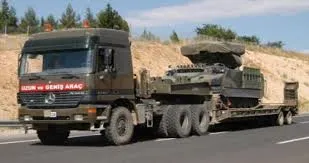
Tanks are fast on paper and slow in practice: every kilometre driven on tracks costs fuel, spare parts and crew fatigue. That is why Türkiye’s Presidency of Defence Industries (SSB) treats the BMC 8×8 tank transporter, known in its programme as TTAR, as a strategic mobility asset rather than a simple truck. SSB’s current project covers 86 8×8 tank transporters with their trailers, 17 low-bed trailers and the development of a domestic 600 hp engine, so that the Turkish Land Forces and Naval Forces can move armour of up to 70 tonnes across the country with the crew protected behind armour.
Photo: Presidency of Defence Industries (SSB), Türkiye.
What is the BMC 8×8 tank transporter?
In SSB’s project sheet the TTAR is defined by its purpose: increasing the mobility of manoeuvre units, providing combat service support and moving tanks at the strategic level. In practical terms it is a heavy 8×8 tractor that pulls a multi-axle semi-trailer carrying a main battle tank, a self-propelled howitzer or a pair of lighter armoured vehicles. A tank that arrives by transporter reaches the assembly area with full fuel, unworn tracks and a rested crew, and it does so without damaging civilian roads.
BMC has built tank transporters for the Turkish armed forces for more than a decade. C4 Defence reported in 2020 that 72 BMC 8×8 tank carriers with a 70-tonne towing capacity were already in Turkish service, powered by a 620 hp diesel with a seven-speed gearbox, able to reach 90 km/h, climb a 60 percent slope and cover 950 km. The same report listed the loads the system was designed for: the Altay main battle tank, M60T Sabra and M60 Patton tanks, the Leopard 1, the T-155 Fırtına self-propelled howitzer and, two at a time, ACV-15 and ACV-19 armoured vehicles.
The TTAR programme takes that experience a step further. Where earlier transporters used commercial-style cabs, the new requirement calls for a ballistically protected cab for four people, reflecting the lesson of recent wars that logistics convoys are targets. BMC showed what such a vehicle looks like at IDEF 2025, when it unveiled the Zeybek 8×8 armoured tank transporter coupled to a trailer from Turkish manufacturer Öztreyler and designed to carry the Altay, M60, Leopard and Fırtına.
Key specifications
| Manufacturer | BMC (Türkiye) |
| Programme | TTAR, 8×8 Wheeled Tank Transporter Vehicle and Trailer |
| Procurement authority | Presidency of Defence Industries (SSB) |
| Turkish users | Land Forces Command; Naval Forces Command |
| Scope (SSB) | 86 TTAR tractors with trailers; 17 low-bed trailers; domestic engine development |
| Payload | Tanks of up to 70 t |
| Cab | Ballistically protected; 4 personnel |
| Powertrain (SSB) | 600 hp engine with automatic transmission |
| Domestic engine | 600 hp Turkish engine to be developed and integrated on a prototype |
| Earlier BMC generation | 72 units in Turkish service; 620 hp; 90 km/h; 950 km range (C4 Defence, 2020) |
| Export | North Macedonia reported as first foreign customer (C4 Defence, 2020) |
SSB lists four headline characteristics: the ability to carry tanks of up to 70 tonnes, a ballistically protected cab, room for four personnel and a 600 hp engine with an automatic transmission. The 70-tonne rating covers every tank in the Turkish inventory, including the Altay, with margin for add-on armour, and it also covers the heaviest Western and Russian-designed tanks in service around the world. The four-seat cab lets the tank crew ride in the tractor under protection, which matters on long road moves where the tank itself is chained down and cannot respond.
The automatic transmission is a choice that pays off over long distances. Moving 100 tonnes or more of combined weight through mountain passes and urban junctions is tiring work, and an automatic gearbox reduces driver workload and protects the driveline. The programme also includes 17 low-bed trailers, which give commanders a flexible option for engineering vehicles and other outsized loads.
The SSB programme and Turkish service
TTAR is one of several SSB projects that put logistics vehicles on the same footing as combat platforms. Its most distinctive element is the engine. According to SSB, a 600 hp domestic engine will be developed and integrated on a prototype vehicle. That is part of a long-running Turkish effort, led by SSB, to end dependence on imported power packs for land vehicles; BMC’s engine subsidiary BMC Power has been developing domestic engine families for tactical vehicles and tanks, and a home-grown engine in the transporter fleet extends that independence to strategic logistics.
The listing of the Naval Forces Command alongside the Land Forces is also worth noting. The Turkish Navy operates an amphibious marine brigade with its own armour, and heavy transporters give that brigade the means to move tanks and armoured vehicles from bases to embarkation ports. With 86 new tractors and trailers on top of the existing fleet, SSB is giving both services the capacity to relocate armoured units over hundreds of kilometres in a single move.
Who operates the BMC tank transporter?
In Türkiye the users are the Land Forces Command and the Naval Forces Command. Abroad, C4 Defence reported in May 2020 that BMC had exported 8×8 tank transporters to a NATO member and that North Macedonia had become the first foreign customer of the vehicle. The quantity was not disclosed. DefenceMENA has not found reports of other export users of the 8×8 tank transporter, and none in Africa, so North Macedonia remains the confirmed foreign operator on the public record.
The NATO sale is a useful reference for other buyers, because it shows that the vehicle meets alliance standards for interoperability, road regulations and support.
Can the BMC tank transporter go to Africa?
Distance is the defining feature of African land warfare. Many armies on the continent operate main battle tanks and heavy tracked vehicles, yet they must cover very long distances between garrisons and potential areas of operation, often on roads that tracked vehicles damage quickly. Egypt, Algeria and Morocco field large tank fleets; Nigeria, Ethiopia, Angola, Sudan and Uganda all operate tanks over vast territories. For each of them, moving armour by road on transporters is cheaper, faster and kinder to equipment than driving it.
The BMC system brings two things that matter in this environment. The first is the 70-tonne rating, which covers everything from Soviet-era T-55s and T-72s to modern Western tanks. The second is the protected cab. In the Sahel, the Lake Chad basin or the Horn of Africa, logistics convoys face ambushes and roadside bombs far behind any front line, and an armoured four-seat cab protects both drivers and the tank crew during long moves. BMC also has an established footprint in Africa through its Kirpi mine-protected vehicles, which our Kirpi Africa file follows, and that gives the company a support base to build on.
The most promising candidates are North African armies with large heavy fleets and long internal distances, notably Morocco, Algeria and Egypt, followed by Nigeria and Angola, which are modernising their armour. East African forces with tanks and long supply routes, such as Ethiopia, Kenya and Uganda, are another natural market. A transporter is also an easier first purchase than a tank: it fits whatever armour the army already owns, regardless of its origin.
How it compares
Heavy equipment transporters from large Western truck makers set the reference in this class and are widely used by NATO armies. The BMC system offers the same 70-tonne class with a protected cab, but backed by a Turkish programme that has already put dozens of vehicles into service and is now adding a domestic engine. For African buyers that want a modern, protected transporter with predictable delivery and fewer political conditions, it is a credible alternative.
Related: Turkish systems in African service; BMC Kirpi in Africa; Türkiye and Qatar arms deals.
Frequently asked questions
What is TTAR?
TTAR is the SSB programme name for BMC’s 8×8 Wheeled Tank Transporter Vehicle and Trailer, used by the Turkish Land Forces and Naval Forces to move tanks at the strategic level.
How many TTAR vehicles is Türkiye buying?
SSB’s project covers 86 8×8 tank transporters with trailers and 17 low-bed trailers, together with the development of a domestic 600 hp engine.
How heavy a tank can the BMC transporter carry?
SSB gives a capacity of up to 70 tonnes, enough for the Altay and for other modern main battle tanks.
Has the BMC tank transporter been exported?
Yes. C4 Defence reported in 2020 that North Macedonia became the first foreign customer. No African customer has been announced.
Why would African armies need tank transporters?
Long distances, limited rail networks and fragile roads make it costly to drive tanks. Transporters move armour faster, save tracks and fuel, and with an armoured cab they protect crews on exposed routes.