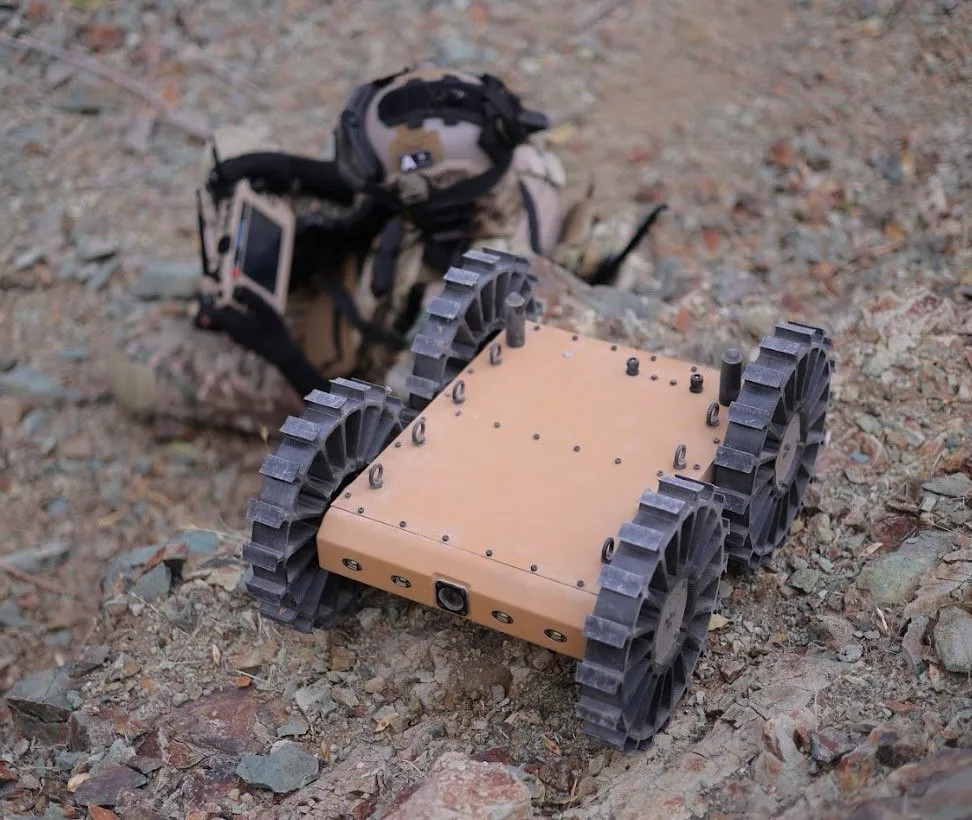
TARIK is a small, expendable unmanned ground vehicle built by the Ankara robotics firm Esetron for one of the most dangerous jobs in counter-insurgency: going first into a cave, tunnel or culvert, looking around, and, if it finds the enemy, destroying the target by remote detonation. Türkiye’s Presidency of Defence Industries (SSB) has completed field trials with 28 vehicles, and on 13 May 2025 the Defence Industry Executive Committee approved procurement of 200 more.
Photo: Presidency of Defence Industries (SSB), Türkiye.
What is the TARIK kamikaze UGV?
In SSB’s terminology, TARIK is a “kamikaze İKA”, a one-way unmanned ground vehicle. The requirement it answers is very specific. Turkish units fighting the PKK in the mountains of south-eastern Türkiye and northern Iraq have spent years clearing cave complexes, bunkers, drainage culverts and dug tunnels, and every one of those entrances is a potential ambush point or booby trap. SSB’s project definition calls for a vehicle that can observe the entrance and exit of a cave, shelter, culvert or tunnel, keep moving into the interior, and, when it meets a threat on the way in, eliminate it by remote detonation. In short, it is sent into places that are hard or dangerous for a soldier to approach, and it is controlled from a safe distance the whole time.
That makes TARIK something different from the larger multi-role UGVs now appearing in many armies. It is not a cargo mule, a weapons carrier or a reusable inspection robot. It is a compact tactical tool, cheap enough to be bought in hundreds and used up when the mission demands it, and simple enough for a small team of infantry, gendarmerie or special forces to carry and launch on the spot.
Key specifications
| Manufacturer | Esetron (Ankara, Türkiye) |
| Type | Kamikaze (one-way) unmanned ground vehicle |
| Procurement authority | Presidency of Defence Industries (SSB) |
| Turkish users | Land Forces Command, Gendarmerie General Command, Special Forces Command |
| Mission | Surveillance and remote-detonation strike in caves, shelters, culverts and tunnels |
| Data link | Wired (cable) communication |
| Control range | 100 m |
| Running gear | Wheeled |
| Mobility | 30% side slope, 60% gradient |
| Status (SSB, Sept 2026) | 28 vehicles field-tested; procurement of 200 approved on 13 May 2025 |
The wired link is the detail that tells you most about the design philosophy. Radio signals fade quickly underground and around rock bends, and they can be jammed or detected. A cable does not care about any of that. Within its 100-metre reach the operator keeps a stable, low-latency video and control link deep inside a cave or culvert, with nothing radiating that an adversary could intercept. A wheeled chassis keeps the vehicle light and quick on the packed earth and concrete typical of tunnels and drains, while the SSB figures of 30% side slope and 60% gradient show it can deal with the uneven, sloping floors of natural caves.
The SSB programme and Turkish service
TARIK belongs to a wider family of unmanned ground systems that SSB has been fielding for the Turkish Land Forces Command (KKK), the Gendarmerie General Command (JGK) and the Special Forces Command (ÖzKK). The procurement path followed the pattern SSB has used successfully for small, urgent-need systems: a domestic company develops a focused solution, a first batch goes to the field for trials with the end users, and serial procurement is approved once the troops are satisfied.
According to SSB, field trial activities with 28 TARIK vehicles have been completed. On 13 May 2025, the Defence Industry Executive Committee (SSİK), the top decision-making body for Turkish defence procurement chaired by the President, approved the acquisition of 200 vehicles. For a system of this size, an order of that scale moves TARIK from an experimental capability to standard kit for units that work in cave and tunnel terrain.
The programme also reflects how SSB has widened the defence-industrial base. Esetron is a Teknopark Ankara company working on unmanned systems, communications and command-and-control, with remotely operated robotic platforms for the battlefield and disaster zones among its products, according to its SAHA Expo exhibitor profile. Giving a firm of this size a direct contract for an operational need is exactly the kind of supplier diversification SSB has encouraged over the last decade.
SSB’s land-vehicles portfolio places TARIK next to a heavier, reusable counterpart. The Bomb Disposal Robot (BİR) project, led by Elektroland for the KKK, JGK and the Turkish National Police (EGM), supplies tracked robots with a manipulator arm so explosive ordnance disposal specialists can deal with suspicious packages, improvised explosive devices (IEDs) and ammunition from a safe distance. The Type-2 robot uses RF and wired communication, with 500 m line-of-sight and 50 to 100 m non-line-of-sight range, and handles 45% side slopes and 60% gradients. SSB said its qualification activities would begin in September 2026. Together, the two projects give Turkish units a choice between a recoverable robot that defuses and an expendable one that destroys.
Who operates TARIK?
TARIK is in Turkish service. SSB lists three user commands: the Land Forces Command, the Gendarmerie General Command and the Special Forces Command. These are the formations that carry most of the load in Türkiye’s rural counter-terrorism operations and in cross-border operations in northern Iraq, where cave networks have long served as hideouts and depots.
We found no public report of an export customer for TARIK so far. The system is new to serial procurement, and Esetron has not announced foreign contracts. Like most systems that reach SSİK approval, it is a natural candidate for export once domestic deliveries are under way, and Turkish defence companies have a strong record of offering combat-proven kit to partner nations soon after the Turkish Armed Forces adopt it.
Can TARIK go to Africa?
The operating problem TARIK was built for is one that many African armies know well. In the Sahel, the caves and rock shelters of the Adrar des Ifoghas in northern Mali have hosted armed groups for more than a decade. Around Lake Chad, Boko Haram and ISWAP fighters have used the caves and rock formations of the Mandara Mountains on the Nigeria-Cameroon border. In Somalia, Puntland’s forces have been clearing Islamic State fighters from caves in the Cal Miskaad mountains, while al-Shabaab has relied on roadside IEDs, many hidden in drainage culverts under the main supply routes. In each case the first metres inside the cave or under the road are where soldiers get hurt.
A small, cable-controlled vehicle that can look into that space and strike whatever is waiting there would fill a gap in most African inventories, where unmanned ground systems are still rare and usually limited to EOD robots. TARIK’s appeal also lies in its simplicity. A wired link means no frequency planning and no exposure to the jamming that some insurgent groups now attempt, and a compact wheeled platform does not need a specialist logistics chain.
Türkiye is already a familiar supplier on the continent, from BMC Kirpi MRAPs in Tunisia to Nurol Makina Ejder Yalçın vehicles in Senegal and Bayraktar TB2 drones in many African air forces. Our overview of Turkish systems in African service maps that footprint. The likeliest early interest would come from countries with heavy cave or culvert IED threats and existing Turkish ties: Somalia, where Türkiye trains the national army in Mogadishu, Nigeria and Cameroon around Lake Chad, Chad and Niger, Kenya along the Boni forest and Somali border, and Mali and Burkina Faso in the central Sahel. Egypt’s experience with tunnels in northern Sinai makes it another obvious conversation. The wider picture of ground robots on the continent is covered in our analysis of unmanned ground vehicles in African armies.
How it compares
Most comparable capabilities on the market are either reusable reconnaissance robots, such as throwable two-wheeled robots used by special forces, or larger armed UGVs. TARIK sits between the two. It is designed from the outset as a strike asset for confined spaces, and its order of 200 vehicles shows that SSB sees it as a consumable that will be used in volume. For a buyer, the key questions are the warhead options, the cable length beyond the standard 100 m, and whether a radio-relay variant could be offered for open terrain. These are points Esetron can tailor through SSB’s export support process.
FAQ
What is the TARIK UGV used for?
TARIK is a kamikaze unmanned ground vehicle used to observe and enter caves, shelters, culverts and tunnels, and to destroy targets it finds there by remote detonation, so soldiers do not have to approach the threat themselves.
Who makes TARIK?
TARIK is made by Esetron, a robotics and unmanned systems company based at Teknopark Ankara, under a programme managed by Türkiye’s Presidency of Defence Industries (SSB).
How many TARIK vehicles has Türkiye ordered?
Field trials with 28 vehicles have been completed, and on 13 May 2025 the Defence Industry Executive Committee approved the procurement of 200 vehicles, according to SSB.
Why does TARIK use a wired link?
A cable keeps control and video stable underground, where radio signals weaken, and it cannot be jammed or easily detected. SSB gives the control range as 100 metres.
Is TARIK available for export to Africa?
No export customer has been announced yet. The system is in Turkish service and is a strong candidate for African armies facing cave, tunnel and culvert IED threats in the Sahel, the Lake Chad basin and Somalia.