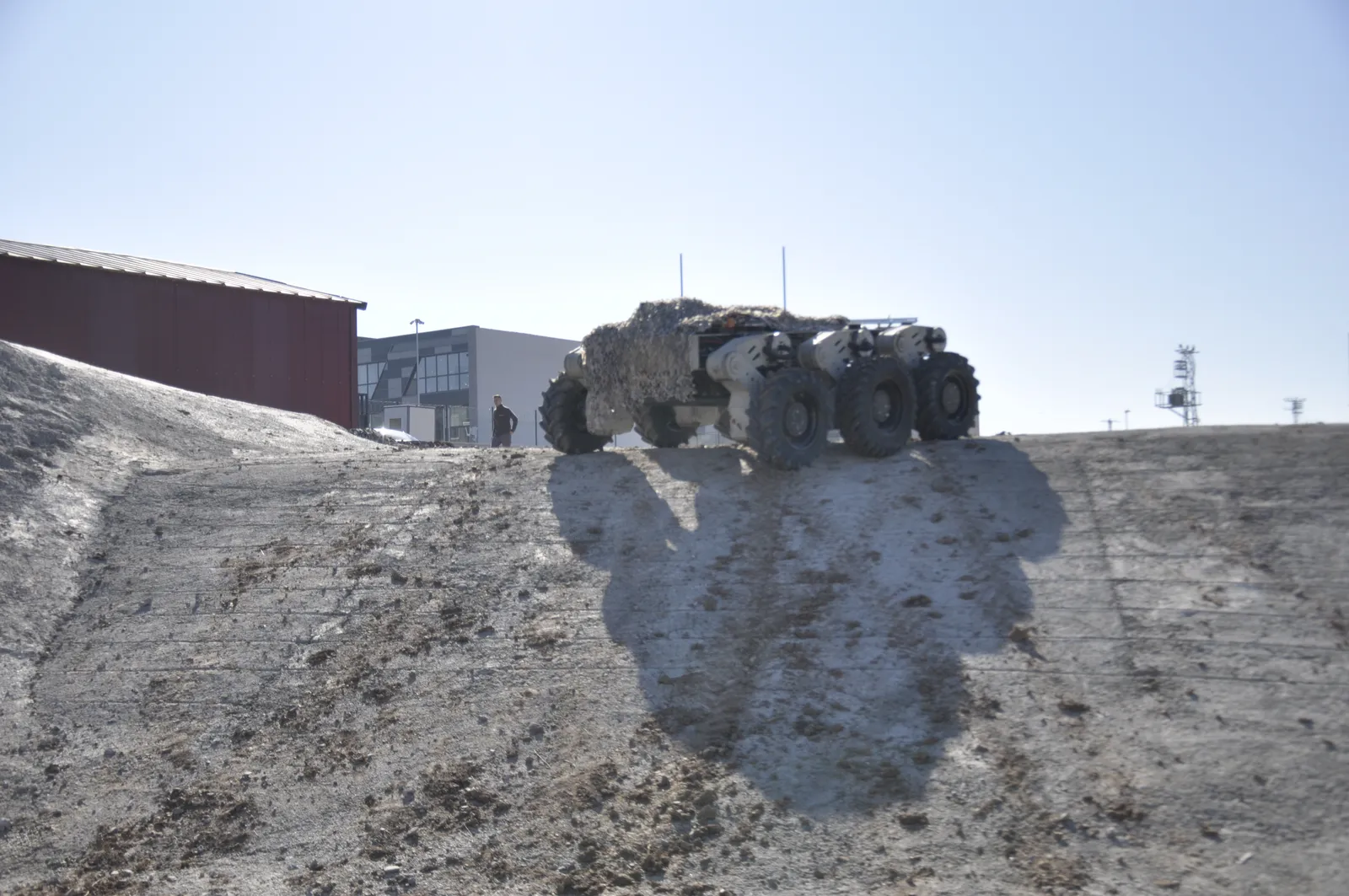
BOZKURT is Türkiye’s largest wheeled unmanned ground vehicle in the current SSB robotics portfolio: a 4.3-tonne 6×6 built by Elektroland Defence that can right itself after a rollover, keep driving upside down and, in its next phase, follow a convoy or patrol a route on its own. Developed under a programme of Türkiye’s Presidency of Defence Industries (SSB) for both the army and the national police, it targets exactly the logistics and surveillance gaps that cost African forces the most lives on their supply routes.
Photo: Presidency of Defence Industries (SSB), Türkiye.
What is BOZKURT?
BOZKURT, Turkish for “grey wolf”, is the product of SSB’s 6×6 Wheeled UGV Development Project, with Elektroland Defence as prime contractor and two Turkish users: the Land Forces Command (KKK) and the General Directorate of Security (EGM), the national police. SSB’s requirement is unusually specific about mobility. It asked for a vehicle with superior movement in difficult terrain, an adjustable ground clearance, the ability to right itself if it rolls over and to keep moving even if it ends up upside down, together with remote control and the capacity to carry out autonomous missions under minimum conditions. The vehicle is built around reconnaissance, surveillance and logistics rather than direct combat.
Elektroland describes BOZKURT as a semi-autonomous, hybrid platform with a modular design, six-wheel mobility across all terrain types and wide-angle cameras with night vision for reconnaissance and patrol work, able to carry substantial loads tailored to the mission. At 4,300 kg it is several times heavier than tracked robots such as HANÇER or BARKAN, which gives it the size to act as an unmanned supply carrier or a long-endurance surveillance vehicle.
Key specifications
| Manufacturer | Elektroland Defence (Türkiye) |
| Procurement authority | Presidency of Defence Industries (SSB) |
| Turkish users | Land Forces Command; General Directorate of Security (National Police) |
| Configuration | 6×6 wheeled UGV; 4,300 kg |
| Mobility (SSB requirement) | Adjustable ground clearance; self-righting after rollover; continues moving if inverted |
| Communications | RF and wired; GSM/LTE; 4,500 m range |
| Endurance | 6 hours operation; 8 hours surveillance |
| Equipment | Cargo basket; perimeter surveillance mast system |
| Autonomy (Phase II) | Return-to-home, patrol, UGV/convoy following |
| Status (SSB, Sept 2026) | Phase I: field trials continuing; Phase II: in production; Phase III: work started on 3 more vehicles |
| Export operators | None announced |
SSB’s data give BOZKURT a 4,500 m control range over RF, wired and GSM/LTE links, six hours of operating time and eight hours of surveillance time. The difference reflects how the vehicle is used: on the move it draws more power, while parked as an observation post with its mast raised it can watch an area for a full night shift. A cargo basket and a perimeter surveillance mast are standard equipment.
The mobility features matter most. A wheeled robot of this size is fast and economical on tracks and roads, but rough ground, ditches and steep slopes can tip it over. SSB’s requirement for self-righting and inverted driving removes that weakness: a BOZKURT that rolls into a wadi does not have to wait for a recovery team. Adjustable ground clearance lets the operator lift the body over rocks and obstacles or lower it for stability and a smaller silhouette.
The SSB programme and Turkish service
SSB is developing BOZKURT in three phases, a structure that lets the users shape each step. According to the September 2026 status, field trials and fault tracking of the Phase I UGV are continuing, the Phase II platform is in production and project work has begun to procure three additional vehicles in Phase III. SSB states that the Phase II vehicle will add return-to-home, patrol and UGV or convoy-following autonomy, turning BOZKURT from a remotely driven vehicle into one that can carry out routine movements on its own while an operator supervises.
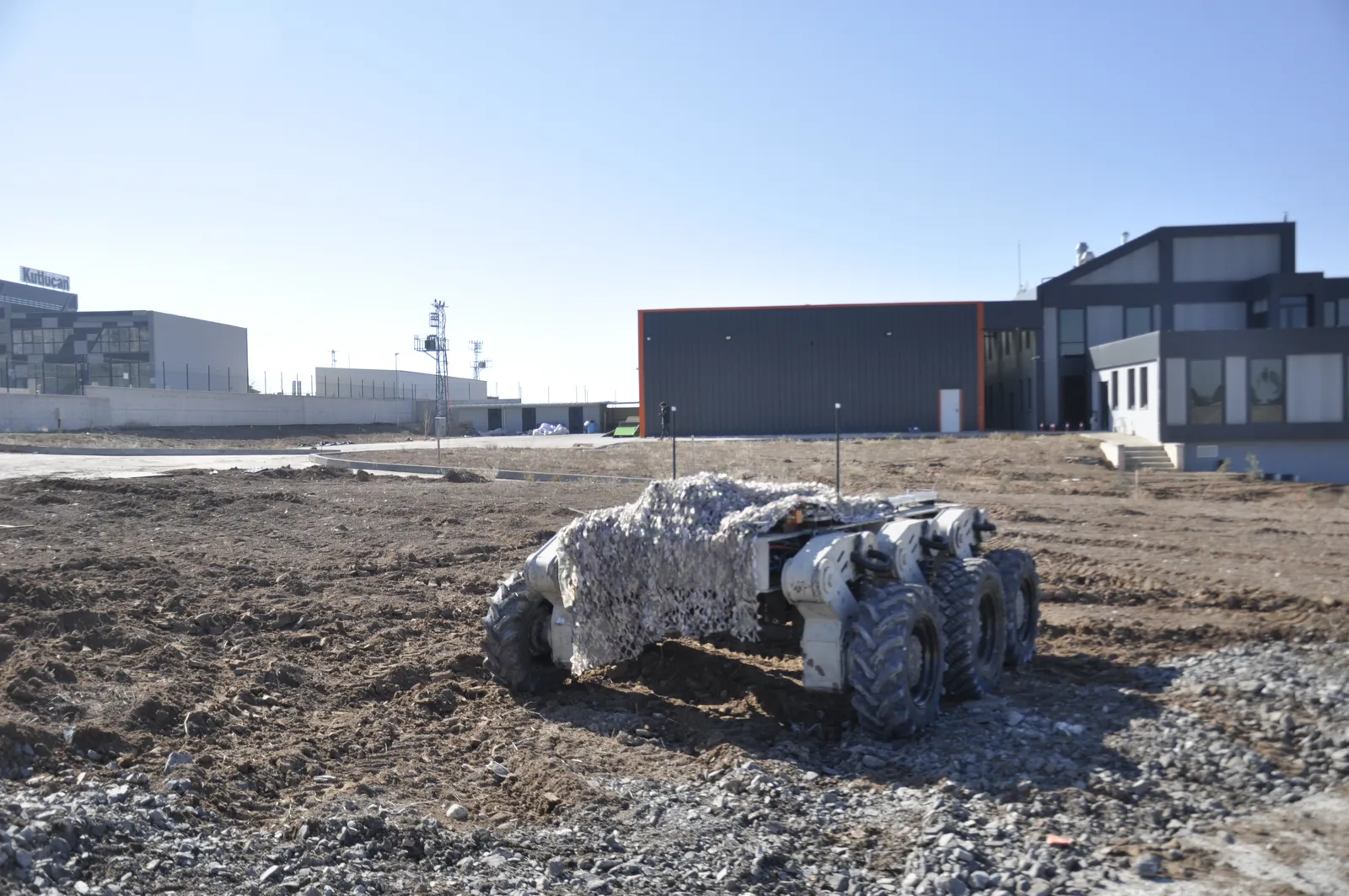
The dual army-police requirement is notable. For the Land Forces, BOZKURT is a logistics and reconnaissance asset that can move supplies or watch a sector without a driver. For the police, it offers a way to approach suspect vehicles, patrol facilities or carry equipment into dangerous areas without exposing officers. Building one platform for both, with common training and parts, is the kind of efficiency SSB has pursued across its land-vehicle programmes.
Who operates BOZKURT?
The Turkish Land Forces Command and the General Directorate of Security are the intended users, and the vehicle is still in its development and trials phases. No export customer has been announced and DefenceMENA has found none. Elektroland, however, is an established exporter: the company says it has delivered more than 1,000 systems, including hundreds of bomb-disposal robots in service in more than 15 countries, and it has subsidiaries in the United Arab Emirates, Canada and Oman. That network and training base would support BOZKURT once it is offered abroad.
Can BOZKURT go to Africa?
BOZKURT addresses the problem that has shaped African counter-insurgency for a decade: supply convoys. In the Sahel, the Lake Chad Basin, Somalia and northern Mozambique, logistics columns are hit by roadside bombs and ambushes, and drivers of soft-skinned trucks are among the most exposed soldiers in any force. A 4.3-tonne unmanned vehicle that can follow a convoy, return home automatically or patrol a route on its own takes a driver out of at least one vehicle in the column and can be sent first down a suspect stretch of road. DefenceMENA’s survey of unmanned ground vehicles in African armies found that no African force yet operates a serial logistics UGV, so a convoy-capable 6×6 would open a new capability.
The design also fits African terrain and infrastructure. Wheels give range and speed on long laterite roads and desert tracks, while self-righting and inverted driving protect the vehicle when it leaves the road. Eight hours of surveillance time and a mast camera suit border posts and the perimeters of forward bases, mines and energy sites, and the GSM/LTE link lets units exploit commercial networks where they exist, with RF and wired control as back-ups. The police role adds a second market among African interior ministries, which guard pipelines, power stations and borders.
The most natural candidates are armies and police forces that run long, contested supply lines and already work with Turkish suppliers: Nigeria in the north-east, Somalia, where Turkish-trained units protect routes against al-Shabaab, and Kenya along its north-eastern border. Libya and Egypt, with long desert borders and large security forces, and Ethiopia, which has bought Turkish equipment, are further prospects. Turkish land systems are already well established across these markets, as documented in DefenceMENA’s overview of Turkish systems in African service, and Elektroland’s long record of training African and Middle Eastern EOD teams would ease introduction.
How it compares
Wheeled 6×6 UGVs in BOZKURT’s class are offered by several international firms, but few combine a 4.3-tonne payload-capable chassis with SSB-specified self-righting, inverted driving and convoy-following autonomy. Against tracked robots, BOZKURT trades some cross-country agility for road speed, range and lower running costs, which suits African forces that operate across very long distances. Elektroland’s newer, lighter 6×6 designs shown at SAHA Expo 2026 widen the family for buyers that need a smaller vehicle.
Frequently asked questions
What is BOZKURT?
BOZKURT is a 6×6 wheeled unmanned ground vehicle developed by Elektroland Defence under a programme of Türkiye’s Presidency of Defence Industries (SSB) for the Turkish Land Forces Command and the Turkish National Police. It weighs 4,300 kg and is designed for reconnaissance, surveillance and logistics in difficult terrain, under remote control or with limited autonomy.
Can BOZKURT recover if it overturns?
Yes. SSB’s requirement calls for a vehicle that can right itself after rolling over, keep moving even when upside down, and adjust its ground clearance, which are key features for operations on steep or broken ground.
What autonomy will BOZKURT have?
According to SSB, the Phase II vehicle now in production will add return-to-home, patrol and UGV or convoy-following autonomy. The vehicle has RF, wired and GSM/LTE links with a range of 4,500 m.
Does any African country use BOZKURT?
No export customer has been announced. BOZKURT is in development and field trials for Turkish users, with a third phase covering three more vehicles under way, and its convoy-following and surveillance features make it a strong candidate for African logistics and border-security needs.
Related: Unmanned ground vehicles in African armies · Turkish systems in African service · What is BOZKURT? Explainer