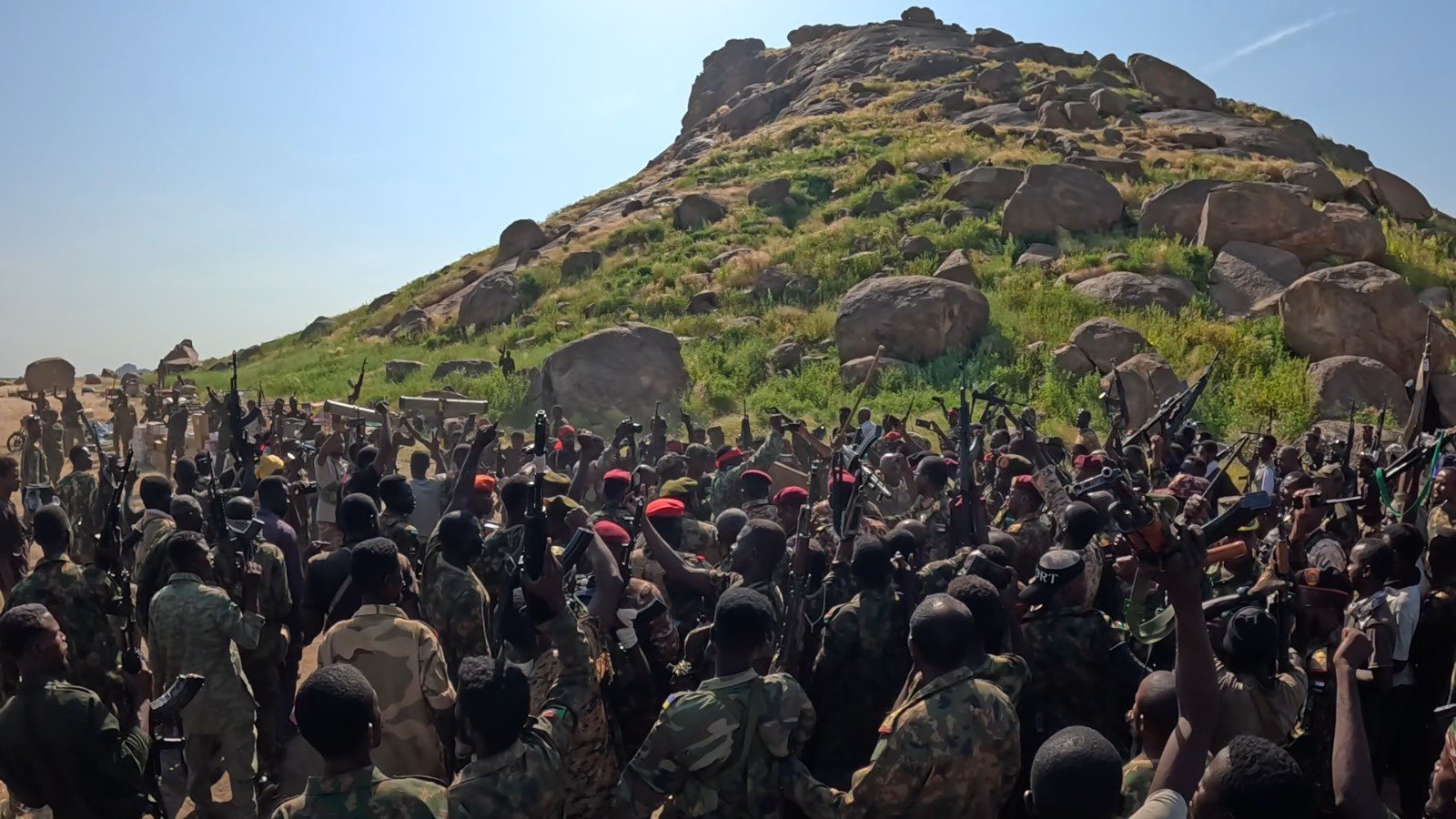
Sudan’s army and allied fighters have continued west after retaking Al-Khuwai and are now reported within about 60 kilometres of En Nahud, a major Rapid Support Forces (RSF) stronghold in West Kordofan. A 17 November territorial map by Sudans Post still shows the city itself in RSF hands. At the same time, the RSF and its allies have taken ground on a second front in Blue Nile state, a development the Critical Threats Project says could pull Sudanese Armed Forces (SAF) resources away from the main offensive in central Sudan.
DefenceMENA reported the capture of Al-Khuwai and the first push towards En Nahud on 16 November. This article covers what has been reported since then, and the wider two-front picture set out by Critical Threats on 16 November.
The advance since Al-Khuwai
Sudans Post, in a territorial control map dated 17 November, says government-aligned forces have reached Al-Morkib (also reported as Al-Murkab), about 60 kilometres east of En Nahud, after entering Al-Khuwai on 13 November and taking several villages to its west on 14 November. ACLED’s Sudan analyst, Ali Mahmoud Ali, said on 17 November that army-aligned forces had been reported that day to within around 60 kilometres of the city, and that ACLED data showed they had regained more than 30 villages and towns in North and West Kordofan since the beginning of November.
On 16 November, Mohamed Didan, a spokesman for the army’s special operations forces, announced the capture of Al-Sa’atat, an area of five settlements northeast of Abu Zabad, Sudans Post and Anadolu Agency reported. Didan told Anadolu that Abu Zabad links the northern and southern parts of West Kordofan. Sudans Post’s 17 November map still places Abu Zabad, like En Nahud, under RSF control.
On Tuesday 17 November, military sources told Anadolu that the army and allied forces advanced in three districts of West Kordofan as the RSF pulled back, and that troops carried out sweeps in villages across Al-Khuwai and areas north and east of En Nahud and Abu Zabad. The Dar Hamar Emergency Committee, a local relief group, told the same agency that the army had retaken eight administrative areas in Al-Khuwai and appealed for food, medicine and emergency supplies, and for supply convoys to be sent to the district.
In a thread posted on 16 November, the American Enterprise Institute’s Critical Threats Project said the SAF and allied militias had advanced about 70 miles (about 113 kilometres) west along the main highway from positions near El Obeid, the North Kordofan capital, since 13 November, had taken Al-Khuwai, and were then within 40 miles (about 64 kilometres) of En Nahud. It called the move the SAF’s biggest breakthrough in central Sudan since mid-2025. That assessment is Critical Threats’ own; other outlets have described the westward push as the army’s most significant in the area since it began recovering ground in North Kordofan earlier this year.
Critical Threats also said the SAF had supported the highway advance by flanking from the north, taking Iyal Bakhit, about 45 miles northwest of Al-Khuwai, on 7 November and reaching the main highway by 13 November. It said the army briefly seized Kazgil, about 30 miles south of El Obeid, on 5 November, but that the RSF reportedly retook the town. DefenceMENA has not independently verified the Kazgil sequence.
En Nahud is still in RSF hands
En Nahud has not been captured. Sudans Post’s 17 November map shows the RSF still holding the city, as well as Al-Fula, the West Kordofan capital, and Abu Zabad, Babanusa, Al-Muglad and Heglig. The same map’s authors estimate, from mapped territory rather than population, that the RSF still holds roughly 85 to 90 percent of the state.
The RSF took En Nahud in May 2025, overrunning the headquarters of the army’s 18th Infantry Brigade. The city later served as a temporary administrative centre after the RSF captured Al-Fula in June 2024. It sits on the Al-Sadarat (Al-Inqaz al-Gharbi) highway, which runs through Wad Banda towards North Darfur. If the army took it and held the road, it would have a clearer overland route for any later operation further west, although the RSF would still control a large area between the present front and Darfur.
RSF-aligned sources have disputed earlier army claims of a clean breakthrough at Al-Khuwai, as DefenceMENA noted on 16 November. Anadolu’s later report of an RSF pullback in surrounding districts came from unnamed military sources and does not, by itself, show that En Nahud has changed hands.
Civilian harm and displacement
The Associated Press reported on 16 November that the Emergency Lawyers, a Sudanese group that tracks violence in the war, said an army airstrike on the Abu Qalb area of Abu Zabad locality had killed at least 13 people, including women and children, and destroyed several homes. The AP said it could not independently verify the toll. The group blamed the army and called the strikes on residential areas a violation of international humanitarian law. The same day, Didan wrote on Facebook that his troops had gone through Abu Zabad locality and “eliminated” RSF positions, the AP reported.
Sudan Tribune, writing from Al-Khuwai on 15 November, said army drones and aircraft had struck RSF positions in En Nahud and other northern West Kordofan localities, and that thousands of civilians were fleeing En Nahud, Abu Zabad and Wad Banda towards Darfur. The Dar Hamar Emergency Room, cited in that report, said the strikes had hit several sites including En Nahud, Ghabeish and nearby areas.
The Blue Nile second front
While the army has been pushing west in Kordofan, the RSF and the Sudan People’s Liberation Movement-North (SPLM-N) faction led by Abdelaziz al-Hilu have made gains in southern and eastern Blue Nile. Sudans Post has geolocated footage of RSF fighters inside Sali, a former army base on the road between Kurmuk and Ed Damazin, after the coalition said it captured the position on 3 November. DefenceMENA reported the loss of Sali, and a later army claim that it had shot down a drone over Dindiro, on 13 November.
Critical Threats said the RSF then took al Keili, another army base about 10 miles east of Sali, on 4 November. Sudans Post reported that the RSF-led Sudan Founding Alliance (Ta’sis) announced on 5 November that it had retaken Bakori in Geisan locality, where the army’s 13th Infantry Brigade had been based. The army still holds Ed Damazin, Roseires and most of the north of the state, including the main population centres.
Sudan Tribune reported on 16 November that the 4th Infantry Division had announced the deployment of five fully equipped mobile combat units to its headquarters, and that Major General Abdel Moniem Abdel Basit had formally taken command of the division, succeeding Ismail El-Tayeb, while Major General Mohamed Osman Hamad had taken command of the Blue Nile military area, replacing Major General Al-Waleed Abdel Qadir Ajabna. Critical Threats had earlier noted that the army replaced its Blue Nile commander on 8 November, and said that past RSF advances on this secondary front have diverted SAF resources from central Sudan. Sudan Tribune also noted that Britain imposed sanctions on Abdel Basit in October, among 15 military figures from both sides, over alleged abuses in Al Jazirah state.
What remains unconfirmed
En Nahud has not been independently confirmed as having fallen, and Sudans Post’s latest map still shows it under RSF control. The capture of Al-Sa’atat rests on statements by an army special operations spokesman; the RSF had not issued a detailed public comment on that claim in the reporting reviewed here. The casualty figures given by the Emergency Lawyers for the Abu Qalb strike, and earlier Joint Force claims of vehicles destroyed or captured around Al-Khuwai, have not been independently verified. Unconfirmed reports that the RSF had already withdrawn from En Nahud, or that its commander was travelling with reinforcements, have not been corroborated by the sources cited above and are not treated here as established fact.
For earlier reporting on this campaign, see Sudan’s Army Says It Retook Al-Khuwai in West Kordofan and Is Pushing on En Nahud and Sudan Army Pushes Toward El-Khwei in West Kordofan.