South Africa Military Strength: Budget, Personnel and Equipment

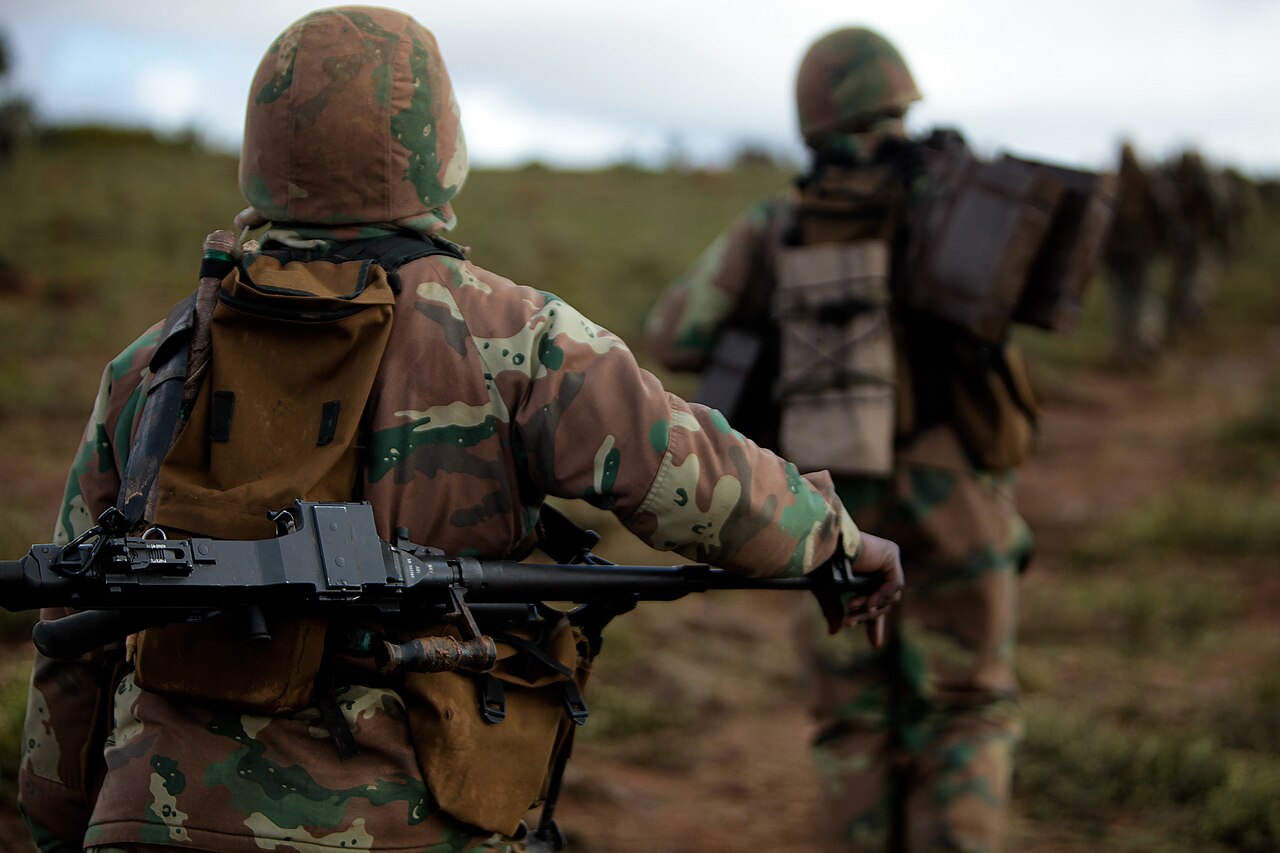


South Africa military strength looks larger on paper than in the field: Global Firepower ranks the country 40th in the world and fourth in Africa, yet the government itself describes a force held back by funding, ageing equipment and a salary bill that takes most of the budget. This profile sets out the defence budget, personnel, main equipment and procurement, with each figure tied to its source. Official statements, Auditor-General findings and SIPRI data are separated from third-party estimates, which are labelled as such.
South Africa Military Strength at a Glance
The South African National Defence Force (SANDF) combines the Army, Air Force, Navy and Military Health Service. Global Firepower (GFP), as reported by BusinessTech, puts South Africa 40th of the countries it tracks, unchanged from the previous edition and seven places lower than in 2024. In Africa it sits behind Egypt, Algeria and Nigeria.
GFP is an estimate built from public data, and experts caution against reading it as an order of battle. Defence analyst Helmoed Heitman told Africa Check that some GFP equipment figures were simply wrong, because the index counts what was acquired at some point rather than what works.
That caveat matters for South Africa military strength. The country owns a wide range of equipment, but a large share is unserviceable, and the gap between owned and usable is the central fact of the force today. Our earlier analysis, South Africa’s military has advanced hardware it can barely keep running, tracks the same gap over a longer period. For the narrower question of fighters, see our report on how many Gripens South Africa has.
South Africa Defence Budget and Spending Trend
SIPRI puts South Africa’s military spending at $3.2 billion in 2025, a real-terms fall of 1.2% on the previous year. GFP lists a similar figure of $2.87 billion. Both are small beside Algeria’s $25.4 billion, the largest budget on the continent.
In rand terms, the Department of Defence received R57.6 billion for 2026/27 under Budget Vote 23, tabled on 20 May by Defence Minister Angie Motshekga, according to the South African government news agency.
| Budget item | Amount |
|---|---|
| Total Department of Defence allocation | R57.6 billion |
| Compensation of employees | R37.7 billion |
| Army / Air Force / Navy programmes | R2.5 billion / R2.7 billion / R1.9 billion |
| Border safeguarding technology and vehicles | R557 million |
| Fighter capability maintenance | R427 million |
| Navy repairs and maintenance | R607 million |
| Support to police operations | R823 million |
Staff costs take roughly two-thirds of the vote. The Daily Friend, in an opinion piece by Chris Hattingh, reports that actual salary spending in 2025/26 reached R40.4 billion against a budget of about R38 billion, and projects a further overspend. The same piece says the October medium-term budget statement lifted the vote to R61.5 billion, but that R2 billion of the rise is departmental income and R823 million is new money for police support. Our budget statement report covers the detail.
The department says a minimum of 1.5% of GDP is needed for long-term viability, according to the budget vote summary. A 30-year Defence Capability Plan, titled “Journey to Greatness”, has been approved by Cabinet.
Personnel: Active, Reserve and Deployments
GFP lists 68,731 active and 29,350 reserve personnel. Department of Defence annual reports, cited by Africa Check, show membership falling from almost 80,000 in 2013/14 to just below 70,000 about ten years later. GFP does not state a paramilitary figure in the source reviewed.
The minister told Parliament that the department carries a personnel structure the budget does not sufficiently fund. Plans include an early retirement programme and continued intake through the Military Skills Development System, and 581 young people completed training at the SANDF’s Dunnotar institute.
Deployments have shifted inwards. South African soldiers joined a Southern African Development Community force in eastern DR Congo in 2023, 14 were killed in January 2025, and SADC began withdrawing the force in March 2025. The budget vote now stresses domestic tasks: border safeguarding, support to police against illegal mining and gang violence, and R150 million for the SANDF’s role in local government elections.
Army, Air Force and Navy: Main Equipment
The table separates what South Africa owns from what is reported to work. Air Force figures come from a News24 investigation published in March 2025 and from the Air Force’s April written answer to Parliament; GFP supplies the land and sea totals.
| Branch | Equipment | Owned | Reported condition |
|---|---|---|---|
| Air Force | Gripen C and D fighters | 26 | Two combat-ready, per the Air Force |
| Air Force | Hawk trainers | 24 acquired | Three operable in March 2025 |
| Air Force | Rooivalk attack helicopters | Not disclosed | Last three deployed ones grounded since 2022 |
| Air Force | C-130 Hercules | 5 | All reported grounded since late 2023 |
| Army | Main battle tanks | 248 (GFP estimate) | Condition not published |
| Army | Badger infantry fighting vehicle | 0 delivered | R7.7 billion paid; still in development |
| Navy | Frigates | 4 | Refits delayed; SAS Amatola sailed to India for an exercise |
| Navy | Submarines | 3 | One partially operational, per Parliament briefing |
News24 reported that only six military aircraft were operable in early 2025: two Gripens, one Oryx helicopter and three Hawks. The Daily Friend, citing the department’s annual report, adds that the Air Force flew 6,340 of 12,000 planned flight hours in 2025/26, blamed on late contracts and a shortage of spares funding.
The Navy has four frigates, SAS Amatola, Isandlwana, Spioenkop and Mendi, and three submarines. A parliamentary briefing reporting status as of February 2023 quoted the Chief of Staff as saying none of the frigates and submarines were operational because of defects. SAS Amatola has since sailed to India for Exercise MILAN, according to the budget vote summary. See our South African Navy ships guide.
Recent Procurement and Modernisation
Most flagship projects are late. The Auditor-General told Parliament on 27 May that Project Hoefyster, the Badger vehicle programme, is 14 years behind schedule, with about R7 billion of a R15.29 billion budget spent. Denel plans to finish development at the end of 2026/27, and DefenceWeb reported that production is to be re-planned.
The hydrographic ship SAS Nelson Mandela, Project Hotel, has cost more than R2 billion, with the hull about 60% complete at an April oversight visit. The refit of SAS Isandlwana, a R597 million contract that began on 6 May 2024, was due for handover on 31 March and remained incomplete in mid-May.
An earlier parliamentary briefing recorded R1.4 billion ring-fenced for refits of the submarines Charlotte Maxeke and Queen Modjaji 1, and put the cost of upgrading all frigates and submarines at about R8.5 billion. The Air Force estimates R4.96 billion to restore the grounded Gripens, and that money has not been allocated.
New purchases are rare. Russia offered Mi-17 helicopters on 27 October, but no quantity, price or timeline was given and there is no sign Pretoria has accepted, as we reported in Russia offers Mi-17 helicopters to South Africa.
Defence Industry and Main Suppliers
South Africa has a domestic defence industry that few African states can match. Armscor, the state procurement agency, receives a R1.5 billion transfer in the current budget, and the state-owned Denel is the lead contractor on Hoefyster. The October budget statement lists a new R889 million guarantee for Denel, according to the Daily Friend.
Industry body AMD announced exports worth more than R10 billion over the past year, a record, as reported by DefenceWeb. Saab built the Gripen, the Air Force’s Gripens and Hawks came from the 1999 arms package, and the Navy’s frigates and submarines were commissioned between 2006 and 2008.
Global Firepower Ranking and Regional Comparison
GFP lists South Africa at 40th globally and fourth in Africa. Spending data from SIPRI gives a second view of regional weight.
| Country | Latest SIPRI military spending | Real change on previous year |
|---|---|---|
| Algeria | $25.4 billion | Up 11% |
| Morocco | $6.3 billion | Up 6.6% |
| South Africa | $3.2 billion | Down 1.2% |
| Nigeria | $2.1 billion | Up 55% |
South Africa is the only one of these four whose spending fell. South Africa military strength in the GFP ranking therefore rests on the size of its inventory and industrial base, not on current funding, and readiness gaps could weigh on it in future editions.
Frequently Asked Questions
How strong is the South African military?
Global Firepower ranks South Africa 40th in the world and fourth in Africa, behind Egypt, Algeria and Nigeria. That ranking reflects inventory on paper. Official sources describe low serviceability, with only two of 26 Gripen fighters combat-ready and the Navy’s frigates and submarines delayed in refit.
What is South Africa’s defence budget?
The Department of Defence received R57.6 billion for 2026/27, of which R37.7 billion goes to staff. SIPRI estimates military spending at $3.2 billion in 2025. An October budget statement raised the vote to R61.5 billion, though R2 billion of that rise is departmental income.
How many soldiers does South Africa have?
GFP lists 68,731 active and 29,350 reserve personnel. Department of Defence annual reports show membership falling from almost 80,000 in 2013/14 to just below 70,000 about a decade later. The Defence Department has not published a single current headcount in the sources reviewed.
Does South Africa have fighter jets and submarines?
Yes. It owns 26 Saab Gripen C and D fighters and three submarines, but only two Gripens are reported combat-ready and one submarine is partially operational. Four frigates also await refits.
Sources
- SAnews: Defence budget prioritises border security, military readiness and crime-fighting
- African News Agency: Motshekga warns SANDF is under pressure
- SIPRI: Trends in World Military Expenditure
- BusinessTech: South Africa’s military strength vs the world
- Africa Check: Strong only on paper
- Daily Friend: Treasury tells the SANDF to make do
- News24 via Martin Plaut: South Africa’s airforce has just six working aircraft
- Parliamentary Monitoring Group: SA Navy repair and maintenance of frigates and submarines
- DefenceWeb: AGSA highlights delays on major SANDF equipment projects
- DefenceWeb: Badger project has delivered zero vehicles