Israel Opens First National Pavilion at Morocco’s Marrakech Airshow



Israel’s defence ministry opened its first-ever national pavilion at a Moroccan arms show this month, a six-year-old diplomatic relationship with Rabat now visible on the exhibition floor. The move came weeks after France limited Israeli exhibitors at the Eurosatory show in Paris.
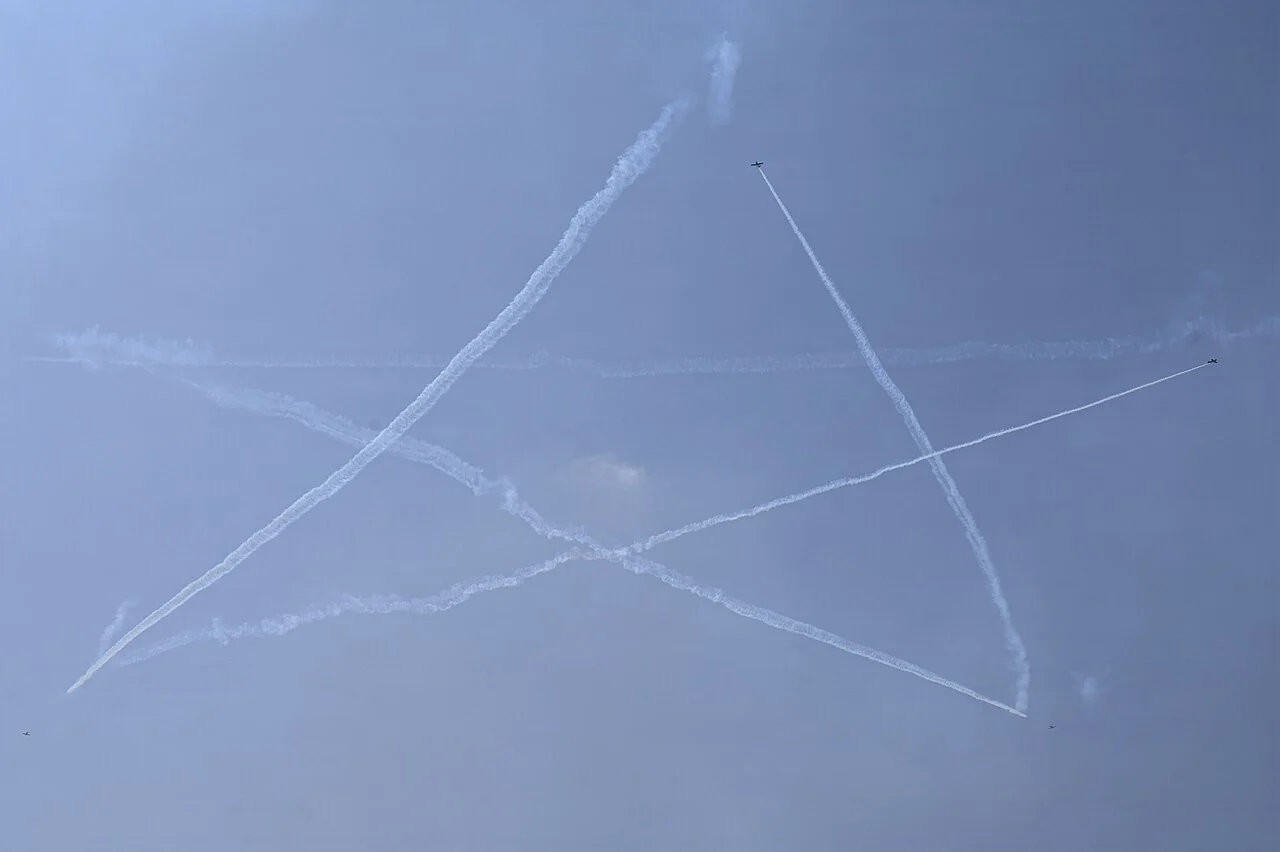
Photo: Aircraft on static display at the Marrakech Air Show 2026. Credit: U.S. Air Force photo by Staff Sgt. Brooke Rogers, Public domain, via Wikimedia Commons
Israel’s Ministry of Defense (IMOD) said its International Defense Cooperation Directorate, known as SIBAT, led a delegation of eight companies to the Marrakech Airshow, which ran from 7 to 10 October at a Royal Moroccan Air Force base outside the city. Five firms – ASIO Technologies, Orbit Communication Systems, SHILAT Optronics, UVision Air and XTEND Systems – shared the national pavilion, while Elbit Systems, Israel Aerospace Industries (IAI) and Rafael Advanced Defense Systems exhibited separately. It was the first time the IMOD has fielded an official pavilion at a Moroccan defence show since the two countries normalised relations in December 2020.
Brigadier General (Res.) Yair Kulas, head of SIBAT, called the debut a milestone for the ministry and for Israel’s defence-export drive. The exhibits leaned heavily on unmanned systems: loitering munitions, AI-enabled robotics, autonomous UAV navigation, laser guidance kits for first-person-view drones, and satellite-communication equipment – the same product mix Israeli firms have been selling into Morocco for several years.
A workaround for the Eurosatory snub
The timing was not incidental. In June, France barred Israel from holding a national pavilion at the Eurosatory show in Paris and restricted Israeli firms to air-defence displays only, a decision Israeli officials criticised as politically motivated. Marrakech gave SIBAT an alternative stage in a market it was already courting, and one considerably closer to home than the Gulf shows where Israeli firms have also been expanding since the Abraham Accords.
Morocco’s growing Israeli arsenal
The pavilion opening is less a new deal than a public marker of how far the relationship has already gone. As DefenceMENA has previously reported, Morocco has bought Elbit’s PULS rocket-artillery launcher, Atmos 155mm self-propelled howitzers, the Hermes 900 drone and SkyStriker loitering munition, IAI’s Barak 8 air-defence system and Rafael’s SPYDER system, and is reportedly in talks for Israel’s David’s Sling missile shield. BlueBird Aero Systems, an IAI subsidiary, has already trained a Moroccan technical team and opened a site at Benslimane to assemble the SpyX loitering munition locally.
That local-assembly model is instructive. It lets Rabat claim a measure of technology transfer and industrial participation while remaining dependent on Israeli designs, software and spare parts – a pattern Morocco has also followed with Turkish and Indian suppliers, as detailed in DefenceMENA’s look at why Morocco bought the SPYDER air-defence system. Morocco’s defence budget for 2026 is reported at roughly $15.7 billion, the largest in its history, and officials have made clear they intend to keep playing suppliers off against each other rather than consolidate around one partner.
Diplomatically, the pavilion followed a 16 September meeting in New York between Israeli Foreign Minister Gideon Sa’ar and his Moroccan counterpart Nasser Bourita, where the two sides agreed to upgrade their liaison offices to full embassies, exchange ambassadors and expand direct flights. No ambassadors had been named as of the airshow.
Why it matters for Africa
Morocco is now one of the clearest examples on the continent of a middle power using arms purchases as a tool of diversification and leverage rather than loyalty to a single patron. By running Israeli, Turkish, American and Indian suppliers against each other simultaneously – Baykar drones, Tata turret partnerships, Abrams tanks and now an Israeli national pavilion on home soil – Rabat has built negotiating room that few African militaries can match on budget alone. For a continent where many governments still rely on a single legacy supplier, the Moroccan model is being watched closely by procurement officials elsewhere in North and West Africa looking to escape single-source dependency. It also signals that Israeli firms, squeezed out of some European markets over the Gaza war’s political fallout, see Africa’s defence-industrial fairs as a growth lane rather than a consolation prize.
Sources
- Military Africa: “Israel Opens National Pavilion at Morocco’s Marrakech Airshow”
- Military Africa: Morocco begins local production of Israeli SpyX loitering munitions
- Military Africa: Morocco enhances integrated air defence with Israeli Barak MX