South Africa’s Defence Exports Pass R10 Billion as AMD Eyes AAD 2028



South Africa’s defence industry exported more than R10 billion worth of equipment over the past year, a record figure industry body AMD says proves the sector can compete internationally — but its leadership is already warning that the milestone means little unless the growth holds.
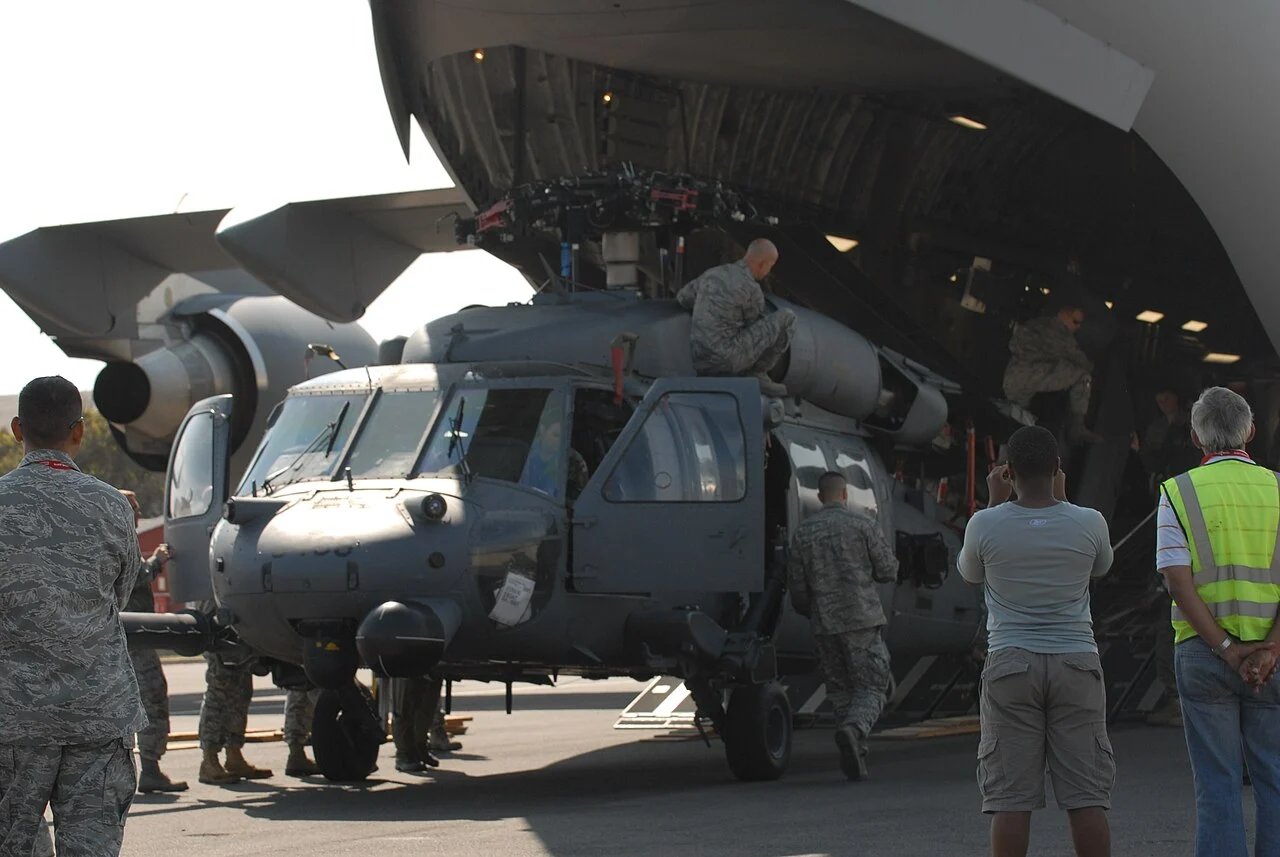
Photo: Delegates at the Africa Aerospace and Defence exhibition at Waterkloof Air Force Base, South Africa. Credit: Master Sgt. Michael Battles/U.S. Air Force, public domain, via Wikimedia Commons
The figure was announced at the joint annual general meeting of AMD, the Aerospace, Maritime and Defence Industries Association of South Africa, and SAAMDEC, its associated South African Aerospace Maritime and Defence Export Council, held at Denel’s Irene Campus near Pretoria and first reported by defenceWeb. SAAMDEC chairperson Michelle Nxumalo called the R10 billion milestone evidence that the industry can “deliver internationally competitive defence solutions,” while cautioning members that “a milestone is not a destination” — a pointed reminder that South Africa’s defence exporters have seen strong years before without sustaining the momentum.
Where the growth is coming from
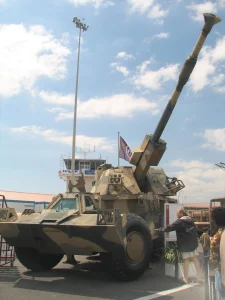
The meeting’s most concrete new development was SAAMDEC’s first-ever formal engagement with the Export Credit Insurance Corporation of South Africa (ECIC). Defence exports, particularly the large armoured-vehicle and naval contracts that have defined South African industry for decades, typically depend on long-term financing, sovereign guarantees and risk cover that individual manufacturers cannot provide on their own; a functioning relationship with the state’s export credit insurer removes one of the structural obstacles that has historically slowed South African firms from closing deals that foreign competitors, backed by their own export credit agencies, could finance more easily.
AMD CEO Sandile Ndlovu pointed to broader institutional momentum beyond financing. The association’s membership has grown in both number and quality, with Ndlovu saying applications now arrive daily, and AMD has expanded its government relationships beyond the Department of Defence — including, he said, a recent approach from the head of South Africa’s foreign intelligence service, who identified opportunities for the industry following a visit to Qatar and wants to follow up. Industry representatives have also been included in presidential state visits and international business forums, building on momentum from July’s Defence Industry Lekgotla.
Provincial politics have shifted too. Gauteng, home to much of the industry’s manufacturing base including Denel and Armscor facilities, was previously the only province to treat defence as a priority sector; the Western Cape, KwaZulu-Natal and Eastern Cape have now done the same. Regionally, the Southern African Development Community has permanently added aerospace and defence to its annual Industrialisation Week agenda, giving South African exporters a standing platform to court buyers across the 16-member bloc.
The AAD 2024 effect and the road to AAD 2028
AMD’s own finances reflect the industry’s cyclical, exhibition-driven character. Honorary treasurer Thivash Moodley reported that AMD’s revenue rose roughly 34% in the 2025/26 financial year, an increase he attributed mainly to the strength of the AAD 2024 show — the biennial Africa Aerospace and Defence exhibition that has run at Waterkloof Air Force Base since 1992 and remains the continent’s largest defence trade event. That windfall was reinvested into events supporting the industry, other economic sectors and the SANDF, and Moodley described the association as remaining financially secure heading into the next cycle.
AAD 2026 was completed during the period under review, and AMD has now been confirmed as lead partner for AAD 2028, with Moodley urging members to participate actively to capture the exhibition’s full commercial value. Neither AMD nor defenceWeb’s report disclosed attendance or exhibitor figures for the 2026 show, and the association gave no year-on-year comparison for the export total, so it is not yet possible to say how much of the R10 billion reflects new growth versus the normal volatility of a sector where a handful of large naval or armoured-vehicle contracts can swing annual totals significantly.
Why it matters for Africa
South Africa’s defence-industrial base — anchored by state-owned Denel, Armscor as procurement agency, and private exporters such as Paramount Group — is one of only a handful on the continent capable of designing and exporting complete armoured vehicles, naval vessels and aerospace systems rather than simply importing them. A sustained export recovery matters for Pretoria’s own ambitions to rebuild a SANDF budget that defenceWeb and this site have both reported is under severe strain, since a healthier export market gives domestic manufacturers a revenue base that does not depend solely on underfunded local procurement. It also matters competitively: South African firms increasingly compete for African air-defence, armoured-vehicle and naval contracts against Turkish, Chinese and European suppliers who in many cases offer more aggressive state-backed financing, which is precisely the gap SAAMDEC’s new ECIC relationship is intended to close.
Sources