What Is HIMARS, and Which Countries Operate It?

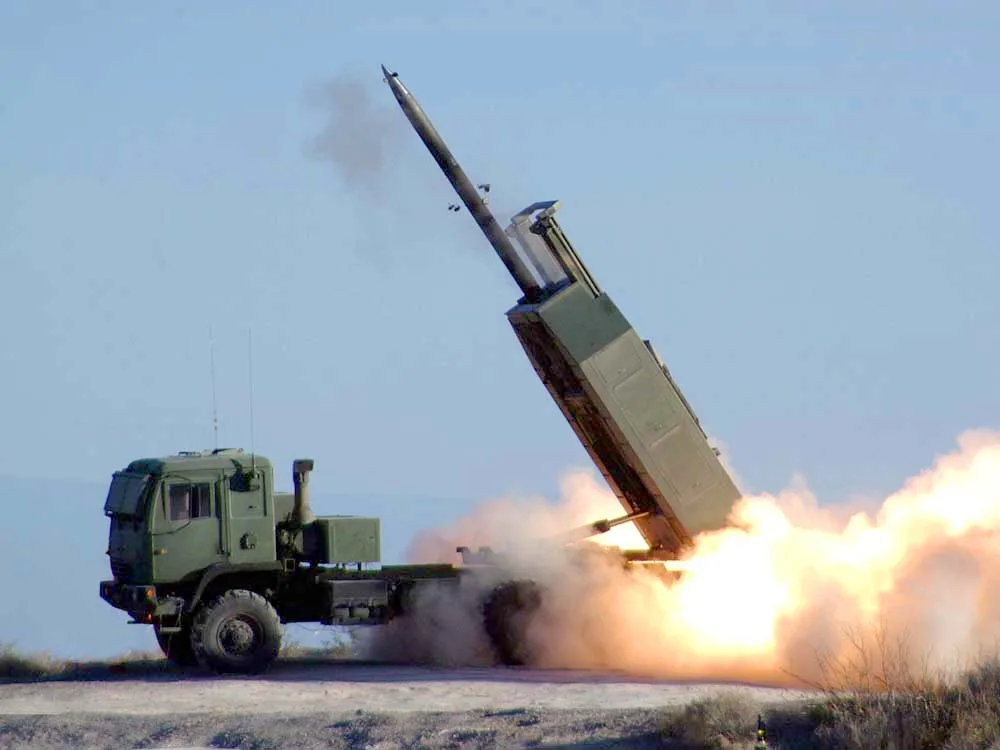


HIMARS (High Mobility Artillery Rocket System) is a wheeled, truck-mounted rocket artillery launcher built by Lockheed Martin, carrying one pod of guided rockets or a single long-range missile and transportable by a C-130 aircraft. Developed in the 1990s as a lighter, wheeled counterpart to the tracked M270 MLRS, it has become one of the most in-demand Western artillery systems since 2022, with more than a dozen countries now operating it or under contract to receive it. In Africa and the Middle East, confirmed or contracted customers include Jordan, the United Arab Emirates and Morocco.
Photo: A U.S. Army M142 HIMARS fires a guided Multiple Launch Rocket System round during testing at White Sands Missile Range. Credit: U.S. Army photo, public domain, via Wikimedia Commons.
HIMARS (M142): quick specifications
- Manufacturer: Lockheed Martin Missiles and Fire Control, produced at Camden, Arkansas
- Type: Wheeled, self-propelled multiple rocket launcher
- Chassis: Based on the US Army’s Family of Medium Tactical Vehicles (FMTV), 6×6 configuration
- Crew: 3 (commonly reported as driver, gunner and section chief/commander)
- Combat weight: commonly reported at around 16.25 tonnes (35,800 lb); DefenceMENA has not found a single official US Army figure and flags this as an open-source estimate
- Road speed / range: open-source figures vary (roughly 85–94 km/h top speed; around 480 km / 300 miles operational range); treat precise figures with caution as sources disagree
- Load: one six-round pod of Guided MLRS (GMLRS) rockets, or one Army Tactical Missile System (ATACMS) / Precision Strike Missile (PrSM) round – half the load of the tracked M270 MLRS, which carries two pods
- Transportability: fits inside a C-130 Hercules, unlike the heavier tracked M270
- Munition ranges (publicly disclosed, approximate): base GMLRS unitary rocket in the tens of kilometres; Extended-Range GMLRS out to roughly 150 km; ATACMS (M57) out to roughly 300 km; the US Army has said its newer Precision Strike Missile reaches beyond 400 km, with longer-range increments still in testing
- Unit price: Not publicly disclosed as a single figure – see Price and contract data below
- In service or on contract: more than a dozen countries as of October 2026, led by the United States, with Romania, Ukraine, the UAE and Poland among the largest non-US users reported by open-source trackers
What is HIMARS, and who makes it?
HIMARS began life as a private venture by Loral Vought Systems (later folded into Lockheed Martin Missiles and Fire Control) looking to put MLRS-family rockets on a lighter, wheeled, air-transportable chassis. The US Army awarded an initial development contract in the 1990s, and the system entered Army and Marine Corps service in the early-to-mid 2000s. It fires the same family of GMLRS rockets and ATACMS/PrSM missiles as the older, tracked M270 MLRS, but on a single-pod wheeled launcher that can be flown inside a C-130 – the M270 cannot. That mobility and airlift compatibility, more than any single performance figure, is HIMARS’s main selling point over the older system.
Development and combat use
HIMARS saw combat with US forces in Iraq and Afghanistan, but its global profile changed sharply after Ukraine received its first systems in mid-2022; Ukrainian forces have used HIMARS publicly and extensively against Russian forces since then, which Lockheed Martin and US officials have both pointed to in marketing the system to other governments. That combat record is widely credited – including by several of the newer customer governments quoted in their own announcements – with driving the wave of new orders from NATO and Gulf states described below. DefenceMENA notes this as the documented reason cited by buyers, not as an independent performance claim, since the war’s operating conditions differ substantially from Africa or the Gulf.
Mission, mobility, protection, weapons and sensors
Mission: HIMARS provides long-range, precision-guided rocket and missile fire in support of ground forces, replacing or supplementing tube artillery for deeper targets.
Mobility: the wheeled FMTV-based chassis gives HIMARS better road mobility and strategic airlift compatibility (C-130 transportable) than the tracked M270, at the cost of carrying half the ready ammunition (one pod instead of two).
Protection: HIMARS is not an armoured vehicle in the way a tank or IFV is; its survivability model relies on “shoot and scoot” – firing and relocating quickly – rather than armour.
Weapons: a single interchangeable pod carries either six GMLRS-family guided rockets or one larger missile (ATACMS or the newer PrSM). GMLRS rockets use GPS/inertial guidance for precision strikes; ATACMS and PrSM are used against longer-range, higher-value targets.
Sensors and fire control: HIMARS uses a digital fire-control system integrated with GPS and battlefield command-and-control networks to receive targeting data and compute firing solutions; DefenceMENA has not found a detailed unclassified breakdown of the specific sensor suite beyond this.
Variants
| Designation | Description | Status |
|---|---|---|
| M142 HIMARS | Baseline wheeled launcher, the subject of this page | In production |
| M270 MLRS (related system, not a HIMARS variant) | Tracked launcher, two rocket pods, same ammunition family | In service with a separate, longer-established set of operators; not covered in detail on this page |
| GMLRS / Extended-Range GMLRS | Guided rocket munition fired from the HIMARS pod | In production and service |
| ATACMS (M57 and earlier variants) | Longer-range guided missile, one per pod | In service; being phased out in favour of PrSM in US Army use |
| Precision Strike Missile (PrSM) | Newer, longer-range missile intended to eventually replace ATACMS | Early fielding with the US Army; not yet confirmed on any African or Middle Eastern HIMARS this run |
Who operates HIMARS? Africa and MENA
Status terms below follow DefenceMENA’s standard scale (RUMOURED, EVALUATED, SELECTED, ORDERED, CONTRACTED, DELIVERED, OPERATIONAL, UNDER MODERNIZATION, RETIRED). A US government approval for a possible sale (a DSCA notification) is not the same as a signed contract, and a signed contract is not the same as a delivery; DefenceMENA labels each case accordingly rather than treating every government announcement as “the country now has HIMARS.”
| Country | Status | Detail |
|---|---|---|
| Jordan | OPERATIONAL | A confirmed HIMARS operator per US and regional defence press; DefenceMENA has not found an official, current fleet-size figure and has not reproduced third-party unit counts here. |
| United Arab Emirates | OPERATIONAL | A confirmed operator; open-source trackers report a fleet in the range of 20–32 launchers, a figure not officially disclosed by the UAE government. The UAE separately received US approval in 2024 for roughly $1.2 billion in further GMLRS and ATACMS munitions for its HIMARS launchers. |
| Morocco | CONTRACTED | The US approved a possible sale of 18 HIMARS launchers to Morocco in April 2023 at an estimated $524.2 million, alongside ATACMS and GMLRS rounds. As of September 2026, reporting on a US Army fiscal year 2027 logistics planning document indicates 10 of the 18 approved launchers are now under contract and listed for temporary storage at a US Army facility in Texas before onward shipment. DefenceMENA has found no confirmed delivery date and treats Morocco as CONTRACTED, not DELIVERED or OPERATIONAL, until a delivery is confirmed. |
| Bahrain | SELECTED | The US approved a possible sale of four HIMARS launchers to Bahrain in August 2025. DefenceMENA has found no confirmed signed contract or delivery since that approval. |
| Qatar | EVALUATED | The US approved a possible sale of seven HIMARS launchers to Qatar as far back as 2012. DefenceMENA has found no evidence Qatar has signed a contract or received launchers in the years since, and treats this as a long-dormant approval rather than an active programme. |
| Saudi Arabia | Not a confirmed operator | Saudi forces have trained on US-owned HIMARS based in the kingdom, according to regional press; DefenceMENA has found no evidence of a Saudi government purchase and does not list Saudi Arabia as a HIMARS customer. |
Exports and global operators
Outside the region, the United States (Army and Marine Corps) remains the largest HIMARS operator. Ukraine has used the system in combat since 2022 and is a confirmed operator, though DefenceMENA has not reproduced disputed battlefield loss or inventory figures here. NATO’s eastern flank accounts for most of the recent order growth: Poland received an initial batch via Foreign Military Sale and is separately running the locally assembled Homar-A programme (486 vehicles planned, with Polish industry integrating HIMARS launcher components onto a Jelcz 6×6 truck; first deliveries expected from 2026). Romania (the largest non-US fleet reported by open-source trackers, around 54 launchers), Lithuania (two batteries contracted, worth a combined roughly $778 million, with first deliveries expected later in 2026), Estonia, Latvia, Croatia ($390 million sale approved in 2024, deliveries unlikely before 2027), Hungary (a package reportedly covering up to 24 launchers following US approval in 2025, after an earlier 2023 sale was blocked over Sweden’s NATO accession dispute) and Sweden (the newest confirmed customer, with a contract signed in September 2026 for about ten launchers and first deliveries planned for 2027) have all joined the customer list since 2022. Singapore, Taiwan, Australia and Canada are also confirmed or contracted operators in the Asia-Pacific and North America.
Price and contract data
Lockheed Martin and the US government do not publish a single unit price for a HIMARS launcher, because public Foreign Military Sales notifications bundle launchers with munitions, vehicles, training and support, and because final contract prices are negotiated separately from the headline DSCA notification value. DefenceMENA does not divide a package total by a launcher count to produce a per-unit price. Illustrative public package values: Morocco’s 2023 approval covered 18 launchers, 40 ATACMS rounds, 36 GMLRS unitary rounds, 36 GMLRS alternative-warhead rounds, nine support vehicles and 18 fire-control systems for an estimated $524.2 million; Croatia’s 2024 approval covered eight launchers and associated GMLRS pods and support equipment for an estimated $390 million; Lithuania’s two-battery programme is valued at a combined roughly $778 million. Each of these figures describes a package, not a per-launcher price.
Competing systems
HIMARS’s closest relative is Lockheed Martin’s own M270 MLRS, the older tracked launcher that carries two rocket pods instead of one; several existing M270 operators have chosen to add HIMARS alongside their tracked systems rather than replace them, mainly for the airlift and road-mobility advantage. Among competing systems from other manufacturers, South Korea’s Hanwha K239 Chunmoo is the most direct export competitor and has beaten HIMARS in at least one European competition: Norway selected Chunmoo over HIMARS for its own rocket artillery requirement. Poland’s domestically-integrated Homar-K programme likewise uses Chunmoo components alongside its separate, HIMARS-based Homar-A programme. Other systems sometimes compared in the same class include Israel’s PULS (selected by the Netherlands in preference to HIMARS) and India’s Pinaka. DefenceMENA treats these as a same-class comparison: each has different munitions compatibility, degrees of US technology-transfer control, and domestic-industry offset terms, and recent competitive outcomes show HIMARS does not always win on technical merit alone.
FAQ
What does HIMARS stand for?
High Mobility Artillery Rocket System. The US military designation for the launcher vehicle itself is M142.
Who makes HIMARS?
Lockheed Martin Missiles and Fire Control, produced at the company’s facility in Camden, Arkansas.
What is the range of HIMARS?
Range depends on the munition loaded, not the launcher itself. Publicly disclosed, approximate figures run from the tens of kilometres for base GMLRS rockets, to roughly 150 km for Extended-Range GMLRS, to roughly 300 km for the ATACMS missile, with the US Army describing its newer Precision Strike Missile as reaching beyond 400 km.
Does Morocco have HIMARS?
Morocco has a contract for 10 of the 18 HIMARS launchers the United States approved for sale in 2023, according to September 2026 reporting on a US Army logistics planning document, but DefenceMENA has found no confirmed delivery date. Morocco’s status is CONTRACTED, not yet DELIVERED or OPERATIONAL.
How much does a HIMARS launcher cost?
Neither Lockheed Martin nor the US government has published a single official unit price. Public package values bundle launchers with munitions, vehicles and support and range from roughly $45–50 million per launcher implied by some packages to higher figures in others, depending entirely on what else the package includes – see Price and contract data above.
What is the difference between HIMARS and the M270 MLRS?
Both fire the same family of rockets and missiles. HIMARS is a lighter, wheeled, single-pod launcher that fits inside a C-130 aircraft; the M270 is a heavier, tracked, two-pod launcher with greater ready ammunition but less strategic mobility.
Related pages
- Lockheed Martin: What It Makes, Who Owns It and Who Operates Its Systems
- F-16 Fighting Falcon product page
- What Does Morocco’s Military Arsenal Look Like in 2026?
- How Strong Is Jordan’s Military in 2026?
- What the UAE’s Armed Forces Operate, and What Is Still on Order
Sources
- Morocco World News – Morocco acquires $524 million HIMARS artillery systems from US
- Morocco World News – Morocco’s 10 HIMARS enter US Army’s fiscal 2027 logistics plan
- Lockheed Martin – October 2026 Morocco release (HIMARS reference)
- US Defense Security Cooperation Agency – Qatar HIMARS, ATACMS and GMLRS notification
- N1 – US State Department approves sale of HIMARS to Croatia for $390 million
- LRT – Lithuania signs $280m deal for second HIMARS battery
- Lockheed Martin – Poland Homar-A framework agreement
- GlobalMilitary.net – Sweden orders HIMARS, becoming the 13th operator
- Overt Defense – UAE purchasing more GMLRS/ATACMS missiles for HIMARS
- DefenceMENA – Lockheed Martin company hub