Iraq Declared Its F-16s Self-Sufficient. The Rest of the Military Isn’t



Baghdad says its F-16 fleet no longer needs American hands to keep flying. Its tanks, air defenses and drones tell a far less tidy story about who Iraq’s military actually depends on.
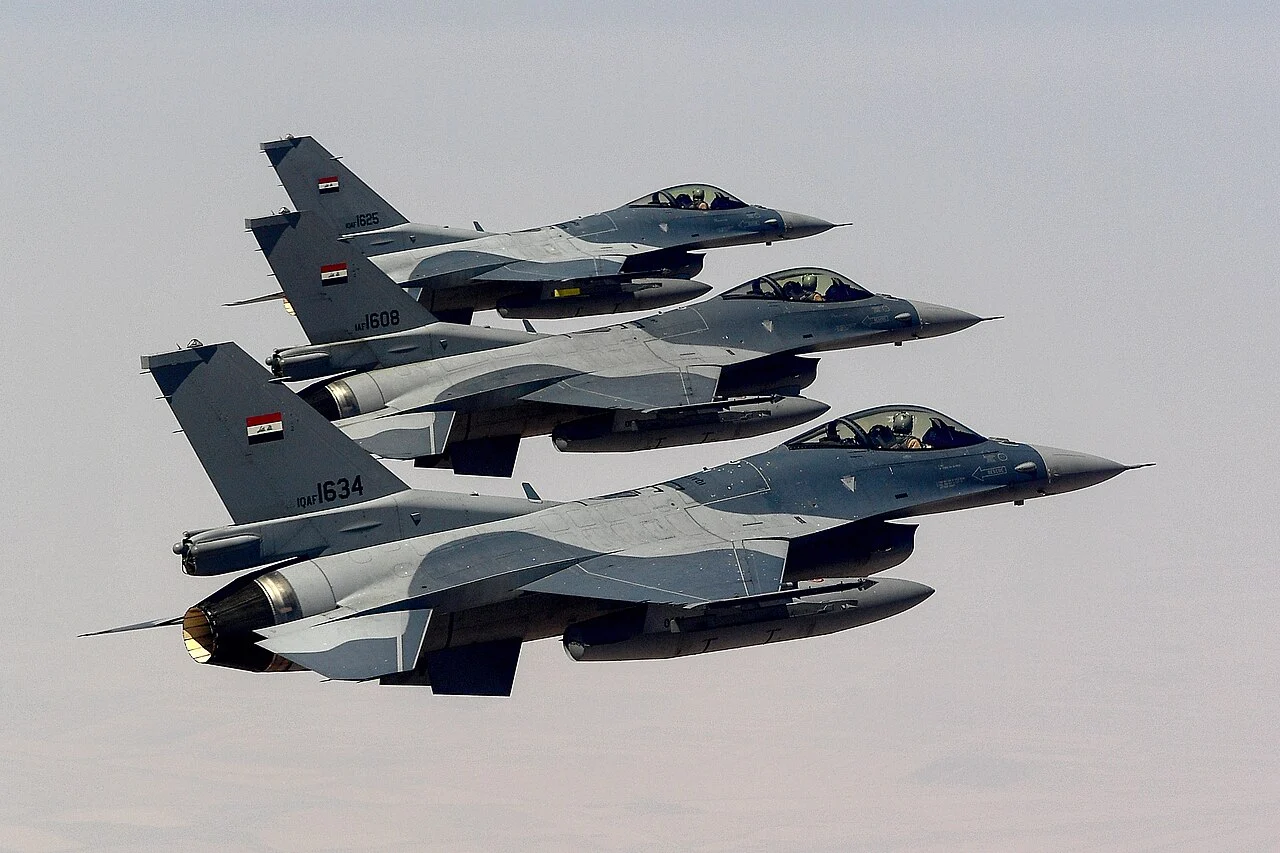
Photo: Three Iraqi Air Force F-16 Fighting Falcons fly in formation during a training sortie, 18 July 2019. Credit: Staff Sgt. Christopher Drzazgowski, US Air Force, public domain, via Wikimedia Commons
On 4 October 2026, days after the US-led anti-ISIS coalition formally ended its military mission in Iraq, a Defence Ministry spokesman told Shafaq News that Iraqi engineers now handle all maintenance on the country’s F-16s, with no need for foreign personnel. It was a statement of confidence timed to a political moment. It also sat awkwardly next to a $252 million US Air Force contract, awarded to Vectrus Systems only five months earlier, to run base operations, life support and security services for the same fleet through September 2026. Both things are true at once, and reconciling them is the real story: Iraq has spent a decade rebuilding a military from six or seven separate supply chains, and the F-16 fleet is simply the most visible example of a dependency structure that runs through almost everything Iraq flies, drives and shoots.
Key points
- Iraq’s Defence Ministry says F-16 maintenance is now fully Iraqi-run, but a US contractor still holds a $252 million base-support contract through September 2026 and Lockheed Martin remains the sole source of spare parts.
- Iraq operates US M1A1 Abrams tanks and Russian T-90S tanks side by side, after Washington suspended Abrams maintenance support in 2017-18 when several tanks reached Iran-aligned Popular Mobilization Forces units.
- A $2.8 billion, Sep. 2024 contract with South Korea’s LIG Nex1 for eight Cheongung-II (M-SAM II) batteries is Iraq’s main medium-range air defense answer, alongside a reported, unconfirmed plan to add Turkish ASELSAN short-range counter-drone systems.
- Iraq and France are reportedly in late-stage talks for 14 Rafale F4 fighters, a deal that would be Iraq’s first serious diversification of its fast-jet fleet away from the F-16 since 2014.
- Iraq’s own industrial base barely extends past small-arms ammunition; almost every platform, engine, radar and precision munition in Iraqi service is imported, maintained abroad, or dependent on a foreign contractor on Iraqi soil.
A military rebuilt from six supply chains at once
Iraq’s armed forces were effectively dissolved and rebuilt twice in two decades: once after 2003, and again after the Islamic State’s 2014 offensive stripped the army of entire divisions’ worth of American-supplied equipment. What exists today is not one coherent procurement programme but an accumulation of urgent, often parallel purchases from whoever was willing to sell and deliver fast. The inventory itself reflects that: roughly 34 Lockheed Martin F-16IQs, up to 140 US M1A1/M1A1M Abrams tanks under a long-running State Department case (DSCA), 73 Russian T-90S/SK tanks delivered from 2018, Chinese CH-4 and CH-5 armed drones acquired from 2015, and now a South Korean air-defense system worth more than the annual defence budgets of several smaller Gulf states.
No comprehensive, machine-readable SIPRI supplier-share breakdown for Iraq specifically covering 2021-25 was available at the time of writing; the clearest historical baseline, cited in Congressional Research Service figures via Statista, put the United States at roughly 52% and Russia at roughly 26% of Iraqi arms imports across 2000-2019. The more recent period looks structurally different: Iraq has not featured among the world’s 40 largest arms recipients in SIPRI’s 2021-25 Trends in International Arms Transfers, a sign that Baghdad has shifted from the large bloc purchases of the 2010s toward smaller, more scattered contracts — South Korean air defense, French fighters under negotiation, Turkish counter-drone systems, continuing US sustainment. The result is diversification by accumulation rather than by strategy, and it carries a different kind of dependency: not reliance on one supplier, but reliance on keeping several incompatible supply chains running simultaneously.
| Capability | Main supplier | Dependency level | Main risk | Alternative |
|---|---|---|---|---|
| Fighter aircraft (F-16IQ) | United States (Lockheed Martin, FMS) | High | Sole-source spares and software; contractor-run sustainment; no US permission for third-party resale or major modification | France (Rafale F4, reportedly in late-stage negotiation, unsigned) |
| Advanced trainers (T-50IQ) | South Korea (KAI) | Medium-High | History of maintenance-contract lapses that grounded most of the fleet for years | Limited; no confirmed second trainer source |
| Air defense (medium-range) | South Korea (LIG Nex1/Hanwha, Cheongung-II) | High | Contract signed 2024, deliveries not yet confirmed; no domestic integration capacity | None fielded; Patriot not in Iraqi service |
| Air defense (short-range/legacy) | Russia (Pantsir-S1, Igla-S) and reportedly Türkiye (ASELSAN, unconfirmed) | Medium | Russian-origin systems carry CAATSA-adjacent scrutiny risk if expanded; Turkish purchase unconfirmed | Additional Korean or Western short-range systems |
| Tanks/armour | United States (M1A1/M1A1M) and Russia (T-90S/SK) | High | US support was suspended in 2017-18 after Abrams reached PMF units; two separate parts and ammunition pipelines run in parallel | South Korea’s K2 (discussed, unsigned) |
| Helicopters | United States, France (H225M Caracal), Russia (Mi-28/Mi-35, legacy) | Medium | Three separate parts and training pipelines for a relatively small fleet | Diversification is itself the current strategy |
| UAVs | China (CH-4, CH-5) | Medium | Historically low mission-capable rates; limited OEM field support; fleet mothballed 2017-2021 before a 2021 contract returned it to service | Turkish Bayraktar systems (not acquired by Iraq) |
| Missiles/munitions | United States (precision-guided munitions via FMS) and mixed legacy stocks | High | War stocks drawn down heavily in the anti-ISIS campaign; replenishment tied to the political relationship with each individual supplier; a prospective Rafale deal would add MICA NG and Meteor as a fourth munitions family | No meaningful domestic production beyond small-arms ammunition |
Dependency levels are DefenceMENA’s editorial assessment based on the sources listed below, not an official rating.
Dependency by category
Platform. Every major combat platform in Iraqi service was bought, not built: F-16s and Abrams from the United States, T-90s from Russia, CH-4/CH-5 drones from China, H225M helicopters from France, Cheongung-II air defense from South Korea. There is no Iraqi platform-design or final-assembly capability at all.
Engine. Every engine in the fleet — the F-16’s Pratt & Whitney/General Electric turbofans, the Abrams’ Honeywell AGT-1500 gas turbine, the T-90’s Russian powerpack — is foreign and requires foreign overhaul capacity Iraq does not possess domestically for any of them.
Weapons. Precision-guided munitions for the F-16 fleet come through US FMS channels; a Rafale deal would add French MICA NG and Meteor missiles and AASM guided bombs as a new, separate munitions family requiring its own logistics chain. Russian-legacy tank and artillery ammunition stocks are a third, declining pipeline.
Sensor. Radar and targeting systems follow the platform supplier in every case: Lockheed Martin avionics on the F-16, Hanwha-built radar on the Cheongung-II batteries, Russian fire-control on the T-90 and Pantsir-S1. Iraq integrates none of this domestically.
Software. Mission software, data links and avionics source code on every fielded platform remain with the original manufacturer; Iraq has no indigenous mission-systems or software-integration capacity reported anywhere in open sources.
Maintenance. This is the most contested category. The Defence Ministry’s October 2026 claim that F-16 maintenance is “fully domestic” coexists with the $118 million (The Defense Post, June 2025) and $252 million (The Defense Post, November 2025) Vectrus base-support contracts, and with the Ministry’s own acknowledgment that spare parts still come from Lockheed Martin. Abrams maintenance, separately, was handled by General Dynamics Land Systems contractors from 2012 until most of them left Iraq around late 2017 after tanks reached Hashd al-Shaabi units — a halt that Foreign Policy reported was conditioned on the return of the diverted vehicles. The T-50IQ trainer fleet sat largely grounded for roughly five years after delivery in the 2010s because, as Scramble Magazine and StrategyPage reported, no maintenance contract existed at delivery and funds earmarked for one were allegedly diverted by officials, until a $360 million Korea Aerospace Industries contract in November 2021 began restoring aircraft to service.
Political. Every US-origin system carries end-use monitoring, AECA congressional notification on major cases, and — as the Abrams and T-50IQ episodes show — a real, demonstrated willingness by suppliers to suspend support when equipment moves to the wrong hands. Russian-origin systems carry a separate, standing CAATSA-adjacent risk the Washington Institute has flagged since 2019, even though no CAATSA sanctions action against the Iraqi state itself has been identified in the sources reviewed for this piece.
Industrial. Essentially absent. Iraq’s state-owned Military Industries Commission and the Ministry of Industry’s defense-adjacent plants produce small-arms ammunition and limited ordnance refurbishment; there is no reported Iraqi capacity to build, co-produce or substantially overhaul any platform category covered above.
Sanctions and export-control exposure
Iraq’s export-control exposure is unusual in MENA because the highest-profile risk episodes have come not from a state-level arms deal but from equipment reaching non-state or quasi-state actors. When US-supplied Abrams tanks and ammunition were documented in the hands of Popular Mobilization Forces units in 2016-17, Washington suspended General Dynamics’ maintenance presence and required the vehicles’ return before support resumed, according to Foreign Policy’s 2018 reporting. The CSIS Missile Defense Project has separately documented Iran-aligned factions within the PMF acquiring short-range ballistic missiles directly from Tehran — equipment entirely outside any Iraqi government procurement channel, but one that shapes how Washington calibrates end-use monitoring and congressional conditions on aid to Iraq as a whole. The US Treasury has continued designating individual PMF-linked commanders under counterterrorism and IRGC-support authorities into 2025-26, a parallel track to arms-transfer policy that nonetheless affects how comfortable Washington is approving new Iraqi FMS cases.
On the Russian side, Iraq’s 73 T-90S/SK tanks and its Pantsir-S1/Igla-S air-defense systems predate CAATSA’s 2017 entry into force and have not triggered sanctions against Iraq, but the Washington Institute’s standing warning is that any significant new Russian acquisition would land differently today than the 2012-2018 purchases did. That risk has arguably shaped Iraq’s recent choices: the big post-2022 air-defense buy went to South Korea, not Russia, and the fighter-diversification option on the table is French, not Russian or Chinese.
Local industry and what it can take over
Realistically, almost nothing in the near term. Iraq’s domestic defense-industrial base, run through the Military Industries Commission, is sized for small-arms ammunition production and basic refurbishment, not for absorbing platform maintenance, let alone manufacturing. The closest thing to a localisation success story is the Defence Ministry’s own claim that F-16 airframe and engine maintenance tasks are now performed by Iraqi technicians rather than foreign contractors — a genuine capability-building achievement if accurate, but one that still sits inside a supply chain where spare parts, technical data and the base-support contractor are all foreign. There is no reported Iraqi industrial participation in the Cheongung-II programme, the Abrams fleet, or any prospective Rafale deal.
Alternatives
Iraq’s alternative-supplier options are shaped more by political acceptability than by capability. A Rafale F4 buy, if it closes, gives Baghdad a Western fast-jet option independent of US congressional approval cycles, at the cost of adding a fourth or fifth munitions and parts pipeline. South Korea has emerged as Iraq’s preferred hedge for big-ticket air-defense and trainer programmes — Seoul offers serious capability with fewer of the political strings attached to US FMS cases, though delivery timelines on the Cheongung-II contract remain unconfirmed two years after signing. Turkish systems, chiefly ASELSAN’s counter-drone family reportedly under discussion for Iraq’s short-range layer, offer flexible transfer terms consistent with the pattern DefenceMENA has documented elsewhere in the region, but nothing in Iraq’s case has moved past the planning stage. China remains an option mainly for lower-tier systems like the CH-4/CH-5 drones, whose maintenance track record in Iraqi service has been weak. None of these is a wholesale substitute for the US relationship that still anchors the fighter fleet and the bulk of the army’s heavy armour.
Switching cost
Iraq already carries the switching costs of partial diversification rather than facing them as a future choice. Pilots and crews trained on US systems cannot simply move to Russian or Korean equivalents without full retraining; the Iraqi Air Force already runs separate training pipelines for F-16 and T-50IQ crews, and would need a third for any Rafale fleet. Maintenance infrastructure is platform-specific and has already proven fragile even for single-supplier fleets — the T-50IQ grounding shows what happens when a maintenance contract lapses even briefly. Munitions stocks cannot be pooled across suppliers: a Rafale buy means qualifying and storing MICA NG, Meteor and AASM alongside existing US and Russian stocks. Data links and IFF integration across a potential five-supplier combat fleet (US, Russian, Korean, French, Chinese-origin systems) raise interoperability costs that a smaller, single-bloc air force would not face. Every additional supplier Iraq adds for political-diversification reasons adds a parallel logistics tail that has to be funded indefinitely.
Diversification: what it solved and what it complicated
Diversification has given Iraq political insurance: no single supplier can hold Iraqi readiness hostage to one bilateral relationship, and Baghdad has visibly used that leverage, shifting its big air-defense contract to Seoul and its next fighter option toward Paris rather than deepening exposure to Washington or Moscow alone. It has not, however, produced capability. The T-50IQ episode shows that adding a supplier without securing a maintenance contract at the point of sale can leave an entire fleet grounded for years. The Abrams-to-PMF episode shows that political fragmentation inside Iraq’s own security structure — not supplier choice — can be the trigger that suspends a supply chain regardless of which country it comes from. And the sheer number of active or pending suppliers (the United States, Russia, South Korea, France, China and potentially Türkiye) means Iraq is managing six parallel logistics, training and ammunition chains for a military smaller than several of its neighbours’. Diversification reduced Iraq’s exposure to any one supplier’s politics; it increased, substantially, the logistical complexity of keeping everything simultaneously serviceable.
DefenceMENA Autonomy Index: Iraq
| Criterion | Score | Rationale |
|---|---|---|
| Domestic manufacturing (/20) | 3 | No platform design or assembly capability; state industry limited to small-arms ammunition and basic refurbishment |
| Local maintenance (/15) | 5 | Credible Iraqi-technician claims on F-16 airframe/engine work, but a foreign base-support contractor remains on site and Abrams maintenance has previously been suspended entirely |
| Local ammunition (/15) | 2 | No reported domestic production of tank, artillery or precision munitions; small-arms ammunition only |
| Supplier diversification (/15) | 10 | Six active or prospective supplier relationships (US, Russia, South Korea, France, China, Türkiye) spread risk widely, if unevenly |
| Critical components (/15) | 2 | Engines, radars, fire-control and software are foreign-sourced across every fielded platform type |
| Technology transfer (/10) | 2 | No major co-production or technology-transfer programme identified; Korean and US contracts remain supply/maintenance arrangements, not transfer |
| Export-control exposure (/10) | 3 | Documented history of US support suspension (Abrams/PMF) and standing CAATSA-adjacent risk on Russian-origin systems |
| Total | 27/100 |
DefenceMENA editorial analytical index, not an official ranking.
Why it matters for the MENA region
Iraq is the clearest regional illustration of what happens when diversification is driven by necessity rather than strategy. Gulf states like the UAE and Saudi Arabia have used multiple suppliers deliberately, as leverage against any single partner’s political conditions, while building — however unevenly — a domestic industrial base alongside the imports. Iraq has added suppliers because each successive crisis, from the 2003 collapse of the old army to the 2014 ISIS offensive to the 2020 US drawdown, forced it to buy from whoever would sell and deliver on short notice, with almost no parallel investment in absorbing the technology. The result is a cautionary data point for the rest of the region: a six-supplier military is not automatically a resilient one, and political diversification without industrial investment mostly means managing more foreign dependencies at once rather than fewer.
Sources
- Shafaq News — “Baghdad: F-16 upkeep now fully domestic” (October 2026)
- The Defense Post — Iraq-Vectrus $118 million F-16 support contract (July 2025)
- The Defense Post — Vectrus $252 million Iraq F-16 contract (November 2025)
- US Defense Security Cooperation Agency — Iraq M1A1/M1A1M Abrams case
- Foreign Policy — Abrams maintenance suspension after PMF diversion (2018)
- Korea JoongAng Daily — Iraq’s $2.8bn Cheongung-II contract (September 2024)
- Army Recognition — Iraq’s layered Korean/Turkish air-defense strategy (2026)
- Militarnyi — Iraq-France Rafale F4 negotiations (2026)
- Scramble Magazine — Iraqi T-50IQ maintenance contract history
- StrategyPage — T-50IQ fleet recovery and corruption allegations (2022)
- Washington Institute — Iraq’s air defense conundrum and sanctions risk (2019)
- CSIS Missile Defense Project — Iranian missile transfers to Iraqi militias
- US Treasury designation of PMF-linked commanders (October 2025)
- SIPRI — Trends in International Arms Transfers 2025
- Congressional Research Service — Iraq In Focus (June 2026)