Why Did Uganda Buy the Su-30MK2?

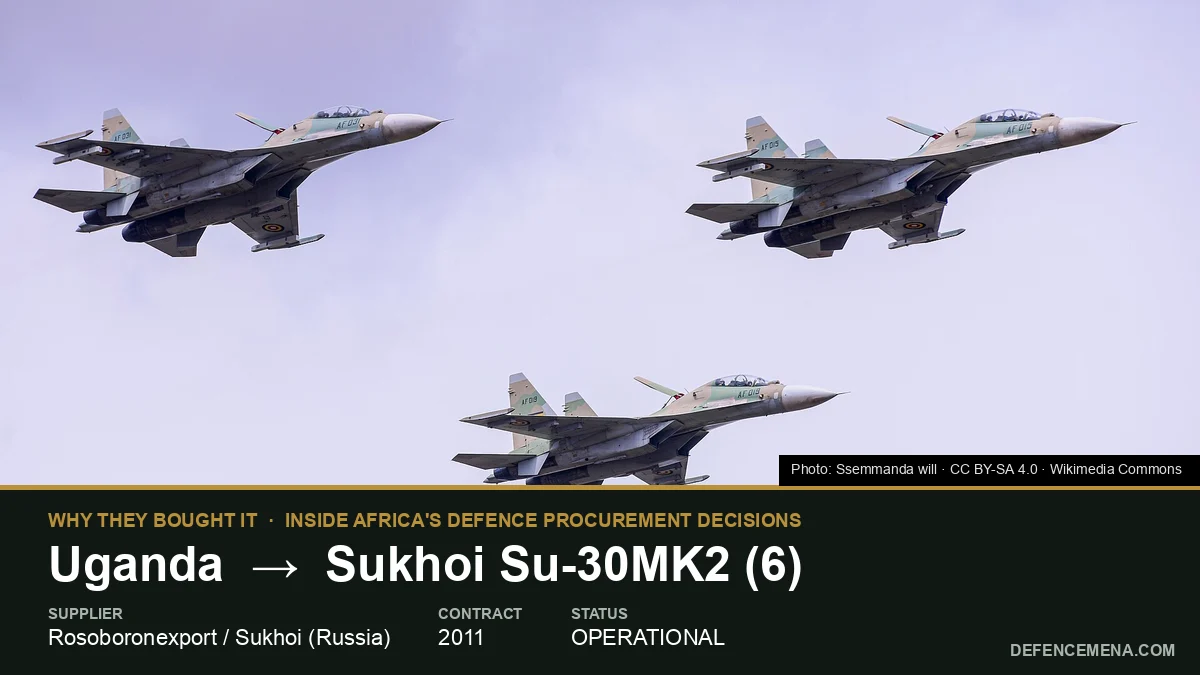


Uganda bought six Sukhoi Su-30MK2 fighters from Russia in 2011 because, in the government’s own words, “acquiring a high air force capacity” was part of a defence policy of “protecting territorial integrity and wealth”, with the Lake Albert oil fields, the Congolese border, South Sudan’s secession and the Somalia deployment all cited at the time. The deal, widely reported at about US$740 million, was paid for with money drawn from the Bank of Uganda before Parliament had approved it, which made it one of the most argued-over defence purchases in East Africa. Fifteen years on the aircraft still fly, and the question now is how Uganda keeps them in the air.
Photo: UPDF Air Force Su-30MK2s AF 031, AF 015 and AF 019 in formation during an Independence Day flypast over Kololo, Kampala. Photo: Ssemmanda will, CC BY-SA 4.0, Wikimedia Commons. Credit: Ssemmanda will, CC BY-SA 4.0, via Wikimedia Commons.
- Country
- Uganda
- System
- Sukhoi Su-30MK2 two-seat multirole fighter
- Supplier
- Rosoboronexport / Sukhoi (Russia)
- Quantity
- 6
- Contract year
- 2011
- Status
- OPERATIONAL
- Main requirement
- Defence of territory and the oil-producing Albertine region; long-range strike against regional threats (officially stated)
- Training
- Eight pilots trained by 2012; Su-30MK2 simulator commissioned 2014 (reported)
- Localisation
- None; overhaul abroad (Russia, India MoU 2022, Belarus 2023)
- Known alternatives
- No competition documented; same-class market alternatives only
What capability did Uganda need?
When the Su-30 deal surfaced in Kampala in 2011, the Uganda People’s Defence Force explained it in two sentences. “Acquiring a high air force capacity is in line with that defence policy of protecting territorial integrity and wealth,” UPDF spokesman Lieutenant Colonel Felix Kulayigye said, as reported by defenceWeb on 24 May 2011. “However, I need to add that this is not a threat to our neighbours. Our policy is defensive and not offensive or aggressive.” Information Minister Kabakumba Matsiko added: “Every country needs to be well equipped to defend its strategic interests.”
The word “wealth” was not accidental. Uganda had confirmed commercial oil in the Albertine Rift in 2006, on a border with the Democratic Republic of the Congo that had never been quiet. defenceWeb linked the purchase to that oil region and frontier, to the instability expected from South Sudan’s secession in July 2011, and to the Lord’s Resistance Army and the Allied Democratic Forces. These are reasons reported by a reliable outlet; Uganda has never published a requirements document.
A third driver was Somalia. Uganda had been the largest troop contributor to the African Union mission in Mogadishu since 2007, and by mid-2012 Ugandan press reported that the Su-30s might support UPDF forces there. That was never confirmed, but it framed the aircraft as a long-range strike asset for an army operating far beyond its borders. Our analysis of Uganda’s planned withdrawal from Somalia covers how that deployment has evolved.
What did it already operate?
Uganda’s fighter arm in 2010 consisted of six elderly MiG-21s plus a handful of L-39 jet trainers that doubled as light attack aircraft. In April 2010, when the Russian business daily Vedomosti reported that Uganda had signed for six Su-30MK2s, Kulayigye told the Daily Monitor that talks had taken place but that “we pulled out because the costs were prohibitive and we instead decided to overhaul the ones we have.” The MiG-21s, he said, had left for Russia the previous week.
That denial lasted a year. By May 2011 defenceWeb was reporting the purchase as fact, with the MiG-21s still in Russia; by February 2014 it described them as mostly inoperable. The Su-30MK2 did not supplement a fighter capability; it replaced one that had already lapsed. For how Uganda’s fleet compares, see our ranking of fighter aircraft in African air forces.
What system was selected?
The Su-30MK2 is the two-seat, strike-oriented export variant of the Su-30 family built at Komsomolsk-on-Amur, the version also sold to China, Vietnam, Venezuela and Indonesia. Uganda took six, carrying tail numbers AF 011, AF 015, AF 019, AF 023, AF 027 and AF 031 according to Army Recognition’s 2022 reporting. FlightGlobal confirmed the variant on 7 June 2012 when it reported delivery of the “last two of six” Su-30MK2 two-seat multirole fighters.
The variant tells its own story. The MK2 is a long-legged aircraft with a heavy weapons load and a second crew member for sensors and weapons, suited to a country that wanted to reach the Congolese interior or the Somali coast from central Uganda. The Independent, a Ugandan weekly, listed guided bombs, anti-ship and anti-tank missiles among the weapons delivered; types have not been disclosed. Our explainer on the Su-30 family in Africa sets the MK2 against the Su-30K and Su-30MKA flown by Angola and Algeria.
Which alternatives were considered?
No competition is documented. Uganda ran no public tender, no other manufacturer is recorded as bidding, and the only negotiation the UPDF ever acknowledged was with Rosoboronexport. What the record shows is a price negotiation within that single channel: a 2010 approach Uganda called “prohibitive”, then an agreement in April 2011 and a final contract in May. The alternatives below are same-class market options of the period, not aircraft Uganda is known to have evaluated.
| Alternative | Class | Status of consideration | Source |
|---|---|---|---|
| Sukhoi Su-30MK2 (selected) | Two-seat heavy multirole fighter | Sole negotiated option; price talks 2010–2011 | Daily Monitor, Apr 2010; defenceWeb, Jun 2012 |
| MiG-29 (RSK MiG, Russia) | Medium multirole fighter | SAME-CLASS MARKET ALTERNATIVE; no evidence Uganda evaluated it | Market context only |
| Chengdu J-10 / JF-17 (China/Pakistan) | Single-engine multirole fighter | SAME-CLASS MARKET ALTERNATIVE; no evidence Uganda evaluated it | Market context only |
| Second-hand F-16 (United States) | Single-engine multirole fighter | SAME-CLASS MARKET ALTERNATIVE; no US offer to Uganda documented | Market context only |
| Overhaul of existing MiG-21s | Legacy interceptor | Publicly stated interim choice in April 2010, superseded by the Su-30 contract | Daily Monitor, 5 Apr 2010 |
Why was the Su-30MK2 selected?
Territorial and resource defence (officially stated). The Kulayigye and Matsiko statements of May 2011 are the only official rationale on record: a defence-policy decision to protect “territorial integrity and wealth” and “strategic interests”, with an explicit disclaimer that it was not aimed at neighbours. No white paper or air force requirement has been published to expand on that.
Oil, the Congolese border and South Sudan (reported by defenceWeb). defenceWeb’s 2011 and 2012 reporting tied the aircraft to Lake Albert oil production, the DRC frontier, the uncertainty around South Sudan’s independence and the LRA and ADF. The timing supports the oil reading: the first payment was made in December 2010, when expectations of future oil revenue were at their highest.
Somalia and long-range strike (reported by Ugandan press; later borne out). The Red Pepper report cited by defenceWeb said the Su-30s might support the UPDF contingent in Mogadishu; whether they did is not officially confirmed. What is confirmed is later use at range. In November 2021 Uganda opened Operation Shujaa against ADF camps in eastern Congo with air and artillery strikes, and in September 2023 President Yoweri Museveni said that “our long-range assets paid a visit” to ADF planners in Mambasa, about 110 kilometres inside Congo. The UPDF spoke of “strategic assets”; Ugandan outlets identified them as the Su-30MK2s, the UPDF did not name the type.
Continuity with an existing Russian supply chain (analysts assess). Uganda’s fighters, transports and most helicopters were already Russian or Soviet types, and its MiG-21s were being overhauled through the same channel when the Su-30 talks resumed. Another Russian aircraft avoided a new training pipeline and spares system. This is an inference from the inventory, not something Kampala has said. For the broader pattern, see why African armies still operate Russian helicopters.
Regional standing (possible but unconfirmed). Ugandan commentary, including The Independent, has argued that the Su-30s gave Uganda more air power than any neighbour except Kenya. No official has described that as a motive. Where Uganda sits today is covered in our ranking of the strongest militaries in Africa.
What was included in the contract?
The contract has never been published. Three strands of reporting give a partial picture. defenceWeb’s October 2011 account, drawing on the Wall Street Journal, described a US$744 million deal for six to eight fighters plus associated equipment. The Independent described a package of six Su-30MKs with guided bombs, anti-ship and anti-tank missiles, 32 BTR-80A armoured vehicles and 44 T-90S tanks, valued at US$635 million. The Daily Monitor, reporting the parliamentary row in March 2011, said the Shs1.7 trillion drawn from the central bank was for “fighter jets and military hardware”.
Together, the reporting indicates the headline figure covered more than six aircraft: munitions, spares and, in the Ugandan accounts, a substantial land-forces component. A three-year warranty was in force, since defenceWeb reported a bird-strike engine repair under it in September 2011. Nothing public itemises training or support elements.
How much did it cost?
Three figures circulate and they do not agree. The most widely used is US$740 million, the amount President Museveni asked the ruling party caucus to approve retrospectively in March 2011, according to the Daily Monitor, and the figure defenceWeb, Military Africa and Army Recognition have used since. defenceWeb’s earliest reports gave US$744 million, citing the Wall Street Journal. The Independent gave US$635 million for the aircraft “with accessories” and the accompanying armour. The Monitor’s 2010 report of the Vedomosti story put the aircraft alone at about Shs654 billion.
None of these is a unit price, and this article does not divide any of them by six. defenceWeb reported a first instalment of US$446 million in December 2010, before Parliament had been told; the Financial Times, as relayed by Pambazuka, put the central bank withdrawal at about US$400 million.
The financing is what made the decision a political event. The money came from the Bank of Uganda through a supplementary budget for 2010/11, treated as classified expenditure, and was drawn during the February 2011 election campaign without prior parliamentary approval. Parliament approved it afterwards. Opposition chief whip Kassiano Wadri asked “which country is President Museveni going to attack?”; Nandala Mafabi, chairing the Public Accounts Committee, said the sum equalled the infrastructure and health budgets combined. Central bank governor Emmanuel Tumusiime-Mutebile then told the Financial Times that he had disagreed with the president, that technical advice had been ignored, and that the withdrawal had cut reserves from six months of import cover to four. Readers can set the sum against today’s spending in our table of African defence budgets ranked.
How many were ordered?
Six were ordered and six delivered. Early reports of “six to eight” reflected uncertainty in April 2011, not an option later exercised; FlightGlobal settled the number at six in June 2012, and every later count agrees. Whether all six remain airworthy is addressed below.
Training, maintenance and support
Pilot training is the least documented part of the programme and the first to cause trouble. By June 2012 defenceWeb reported that eight Ugandan pilots had been trained on the type, that two had left for better-paid work, and that the remaining six had written to the president about an unimplemented pay rise; military pilots were said to earn about US$500 a month against US$8,000 to US$10,000 for airline captains. Where training took place was not stated. Claims that Russian pilots flew the aircraft appear only in Ugandan press and reader commentary and are not treated as established. In February 2014 defenceWeb reported a Su-30MK2 simulator commissioned to cut training cost and airframe wear.
Maintenance has moved between three countries. Rosoboronexport repaired the bird-strike damage of 8 September 2011 under warranty within three weeks, and AeroTime later reported repairs at Komsomolsk-on-Amur after incidents in 2012 and 2016. On 4 March 2022 the Commander of the Air Force, Lieutenant General Charles Lutaaya, signed a memorandum of understanding at the Indian High Commission in Kampala under which Hindustan Aeronautics Limited, which builds the Su-30MKI under Russian licence, would provide maintenance and technical support; financial terms were not disclosed. On 6 July 2023 two fighters arrived at the 558th Aircraft Repair Plant at Baranavichy in Belarus for inspection, repair and software updates. Military Africa’s reading was that the Indian arrangement had “fallen through”; neither Uganda nor HAL has said so, and the Daily Monitor reported in May 2026 that HAL has serviced the fleet since 2022. The record does not resolve the two versions.
Local production or technology transfer
None. No assembly, component manufacture or technology transfer was associated with the purchase or claimed. The only in-country investments linked to the fleet are the Nakasongola air base upgrade, with a main hangar and three buildings completed after January 2011, and the 2014 simulator.
Delivery and operational status
Deliveries ran over eleven months. The first pair arrived at Entebbe aboard an Antonov An-124 in July 2011; a second pair followed in mid-October, UPDF spokesman Captain Kiconco Tabaro telling reporters, “We don’t disclose shipment of military equipment”; the final two landed on 30 May 2012. The fleet moved from Entebbe’s congested civil airport to Nakasongola in 2014.
- Apr 2010Vedomosti reports a contract; UPDF says it withdrew over “prohibitive” cost.
- Dec 2010First instalment of about US$446 million paid from the Bank of Uganda before Parliament is informed.
- Mar 2011President Museveni seeks retrospective approval for US$740 million (Shs1.7 trillion); Parliament later grants it.
- Apr–May 2011Agreement with Rosoboronexport in April; final contract in May after price negotiation.
- Jul 2011First two Su-30MK2s delivered to Entebbe by An-124; first flights 11–12 July.
- 8 Sep 2011Bird strike on take-off damages an engine; repaired under warranty.
- Oct 2011Second pair delivered.
- Nov 2011One aircraft lands wheels-up at Entebbe; both crew unhurt.
- 30 May 2012Final two aircraft delivered, completing the order of six.
- 2014Fleet relocates to Nakasongola; Su-30MK2 simulator commissioned.
- 4 Mar 2022Maintenance and technical support MoU signed with Hindustan Aeronautics Limited.
- 6 Jul 2023Two aircraft arrive at the 558th Aircraft Repair Plant, Baranavichy, Belarus.
The status is OPERATIONAL: the fleet flies at Independence Day flypasts, has been used in combat since 2021 and was in depot maintenance in 2023. The number airworthy at any time is not published.
Has it been used operationally?
Yes. The clearest case is Operation Shujaa, the joint UPDF–FARDC campaign against the ADF in eastern Congo, which opened on 30 November 2021 with air strikes and long-range artillery on ADF bases around Kambi Ya Yua; Army Recognition noted the jets had been deployed against ADF targets that month. In September 2023 the UPDF announced a “surgical operation using our strategic assets” against ADF camps in Mambasa, Ituri, and Museveni said “our long-range assets paid a visit to the authors of the plan to kill Ugandans with home-made bombs”, adding that Kinshasa had “now allowed us to follow these terrorists wherever they go”. Reported use in Somalia and South Sudan is not confirmed by any Ugandan or AU statement.
What has operational use shown?
Three things, at the public level. First, range is what Uganda values: the 2021 and 2023 targets lay deep inside Congo, the reach the MK2 was built for and that no other Ugandan aircraft offers. Second, sustainment is the binding constraint: within two years of the 2021 strikes Uganda had signed with an Indian contractor and then flown aircraft to Belarus. Third, transparency has not improved: the UPDF has never named the type in an operational statement and, as the Daily Monitor noted in July 2025, has never published an accident investigation.
Did Uganda order more?
No. On 21 September 2012, at the Africa Aerospace and Defence exhibition in Pretoria, Rosoboronexport deputy director Alexander Mikheyev said Uganda had contacted the agency about six more Su-30s. Kulayigye’s answer to the Daily Monitor was blunt: “Stop wasting your time, I am not aware about this move.” No contract or budget line for more fighters has appeared since.
What does this tell us about African procurement?
The Ugandan Su-30 is this series’ Russian case, and it shows that the legacy question in African air forces is less about politics than logistics. Uganda bought a Russian fighter largely because it already flew Russian aircraft and knew the Rosoboronexport channel. That was rational in 2011. The difficulty came later, when the aircraft needed depot overhaul in a decade in which the manufacturer was absorbed by wartime production and sanctions complicated payment, transport and parts. Uganda’s answer has been to diversify the sustainment of a Russian aircraft without diversifying the aircraft: an Indian licensee in 2022, a Belarusian plant in 2023, the same Baranavichy facility that prepared Angola’s Su-30Ks. For Russian-type operators across the continent the choice is modernise, replace or keep patching, and Uganda has so far chosen the third.
The second lesson concerns financing. Most African fighter purchases are paid through loans, export credits or oil-backed arrangements whose terms are never published. Uganda’s was unusual in being paid largely in cash from central bank reserves, and unusual again in that the governor said so. The result was a public argument about opportunity cost, measured in months of import cover and health budgets, that most procurement decisions on the continent never face. It did not stop the purchase, but it established in Ugandan politics that classified defence spending has a price in reserves and parliamentary trust.
Third, the case shows how thin the crew layer can be beneath an expensive platform. Eight pilots for six two-seat fighters is a small pool, and losing two to the airlines within a year while the rest petition the president over pay rarely reaches procurement debates but decides whether the aircraft fly. The simulator was a partial answer; a career structure that keeps fast-jet crews in uniform has not been publicly addressed.
Finally, the Su-30MK2 has done what Uganda bought it for: it lets a landlocked state strike more than 100 kilometres beyond its frontier, in a campaign both governments involved endorse. Its weaknesses are those of its class: a small fleet, a thin crew base, no local industry, and foreign depots that have changed three times. Any African air force weighing a heavy fighter today, from whichever supplier, will find in Uganda’s fifteen years an account of what the second decade of ownership costs.
Procurement record
| Field | Value |
|---|---|
| Country | Uganda |
| Service | Uganda People’s Defence Force – Air Force (UPDF-AF) |
| System | Sukhoi Su-30MK2 two-seat multirole fighter |
| Manufacturer | Sukhoi (Komsomolsk-on-Amur Aircraft Plant), via Rosoboronexport |
| Origin | Russia |
| Category | Multirole fighter |
| Requirement | Protection of “territorial integrity and wealth” (UPDF, May 2011); reported: Lake Albert oil, DRC border, South Sudan, LRA/ADF, Somalia |
| Order date | April 2011 (agreement with Rosoboronexport); earlier talks 2010 |
| Contract date | May 2011 (final contract, reported) |
| Quantity | 6 |
| Contract value | About US$740 million package (reported; US$744m and US$635m also reported); US$446m first instalment Dec 2010; contract not published |
| Delivery | 2 in July 2011, 2 in October 2011, 2 on 30 May 2012 |
| Operational status | OPERATIONAL |
| Training | Eight pilots trained by 2012 (reported); simulator commissioned 2014 (reported); training location not disclosed |
| Support | Three-year warranty (Rosoboronexport); repairs in Russia after 2012 and 2016 incidents (reported); HAL MoU 4 Mar 2022; 558 ARP Belarus overhaul from 6 Jul 2023 |
| Localisation | None |
| Tech transfer | None |
| Confirmed competitors | None documented |
| Follow-on order | None; Rosoboronexport claim of six more (Sep 2012) denied by UPDF |
| Primary source | defenceWeb, 24 May 2011 and 7 Jun 2012; Daily Monitor, 26 Mar 2011 |
| Last verified | 5 October 2026 |
FAQ
Does Uganda have Su-30 fighter jets?
Yes. Uganda bought six Su-30MK2s from Russia under a contract finalised in May 2011. They were delivered between July 2011 and 30 May 2012 and are operated by the UPDF Air Force from Nakasongola air base. The Daily Monitor described the fleet in May 2026 as “half a dozen” aircraft.
Why did Uganda buy the Su-30MK2?
The UPDF said in May 2011 that a high air force capacity was part of its policy of “protecting territorial integrity and wealth”. Reporting at the time linked the purchase to the Lake Albert oil fields, the Congolese border, South Sudan’s secession and insurgent groups such as the ADF, and Ugandan press later linked it to the Somalia deployment. No competition with another aircraft is documented.
How much did Uganda pay for the Su-30s?
The most widely reported package value is about US$740 million, including other military hardware; figures of US$744 million and US$635 million have also been published. A first instalment of US$446 million was paid from the Bank of Uganda in December 2010 before Parliament approved it. The contract has not been published and no official unit price exists.
Has a Ugandan Su-30 ever crashed?
There have been incidents but no officially confirmed loss. In November 2011 one aircraft landed wheels-up at Entebbe with both crew unhurt, an event the UPDF first described as a training-aircraft exercise before the Civil Aviation Authority confirmed it was a military jet. defenceWeb reported a bird-strike engine repair in September 2011, and AeroTime reported repairs in Russia after incidents in 2012 and 2016. AeroTime also stated in 2022 that one aircraft crashed in 2020 killing both pilots; that claim is not supported by any Ugandan official statement, does not appear in the Daily Monitor’s July 2025 list of UPDF air crashes, and conflicts with later reports of a six-aircraft fleet, so we treat it as unconfirmed.
Where are Uganda’s Su-30s maintained?
Initially by Rosoboronexport under warranty and at the Komsomolsk-on-Amur plant. In March 2022 Uganda signed a maintenance and technical support MoU with India’s Hindustan Aeronautics Limited, and in July 2023 two aircraft were flown to the 558th Aircraft Repair Plant in Baranavichy, Belarus, for overhaul.
Has the Uganda Air Force used the Su-30 in combat?
Yes. The aircraft were used in Operation Shujaa against ADF camps in eastern DR Congo from November 2021, and in September 2023 President Museveni said Uganda’s “long-range assets” had struck ADF planners in Mambasa, Ituri. Reports of use in Somalia and South Sudan have not been confirmed officially.
Did Uganda order more Su-30s?
No. A Rosoboronexport official said in September 2012 that Uganda had asked about six more aircraft; the UPDF spokesman denied any such move, and no further order has been placed.
More from Why They Bought It
- Why Did Morocco Buy the AH-64E Apache?
- Why Did Nigeria Buy the VT-4 Tank?
- Why Did Côte d'Ivoire Buy the Wing Loong II?
- Why Did Kenya Buy 118 Katmerciler HIZIR Armoured Vehicles?
- Why Did Nigeria Buy the M-346FA?
- Why Did Egypt Buy (and Build) the K9 Howitzer?
- Why Did Niger Buy the Bayraktar TB2?
- Why Did Senegal Buy the OPV 58 S?
- Why Did Kenya Buy the MD 530F Cayuse Warrior?
Sources
- defenceWeb – Uganda buys fighter jets (24 May 2011)
- defenceWeb – Uganda receives more Su-30s (October 2011)
- defenceWeb – Ugandan Su-30 crash-lands: witnesses (24 November 2011)
- defenceWeb – Uganda receives final Su-30s from Russia (7 June 2012)
- defenceWeb – Uganda moving combat aircraft out of Entebbe (28 February 2014)
- defenceWeb – Angola has received its first Su-30s (20 September 2017)
- FlightGlobal – Russia delivers last Su-30s to Uganda (7 June 2012)
- Daily Monitor – UPDF denies fighter jet deal (5 April 2010)
- Daily Monitor – Uganda government takes Shs1.7 trillion for jet fighters (26 March 2011)
- Daily Monitor – Russia says Uganda to buy six more jets (22 September 2012)
- Daily Monitor – UPDF air crashes kill 33 in five years (3 July 2025)
- Daily Monitor – Everything you need to know about jets in Kampala’s skies (9 May 2026)
- Pambazuka News – Uganda: Museveni, Mutebile clash over jets cash, citing the Financial Times (15 June 2011)
- The Independent (Uganda) – Who’s buying the biggest guns in East Africa?
- Army Recognition – Sukhoi Su-30MK2 fighters of Uganda Air Force to be maintained by HAL (March 2022)
- AeroTime – India to repair Uganda’s Su-30 fighter jets (March 2022)
- Military Africa – Ugandan Su-30MK2s flown to Belarus for MRO (July 2023)
- ChimpReports – How ADF commanders survived UPDF air strikes (30 December 2021)
- ChimpReports – Uganda’s fighter jets strike ADF bases deep in DR Congo (19 September 2023)
- SoftPower News – Operation Shujaa: Uganda Air Force strikes ADF camps as UPDF mandate extends (September 2023)
Last updated: 5 October 2026. This article is updated in place when the procurement status changes.