ASELSAN is looking for a Nigerian company to manufacture its equipment locally, the Turkish defence group’s chief executive said, as the company deepens a partnership that already spans naval inspections, air-defence demonstrations and a joint venture with Nigeria’s state arms maker.
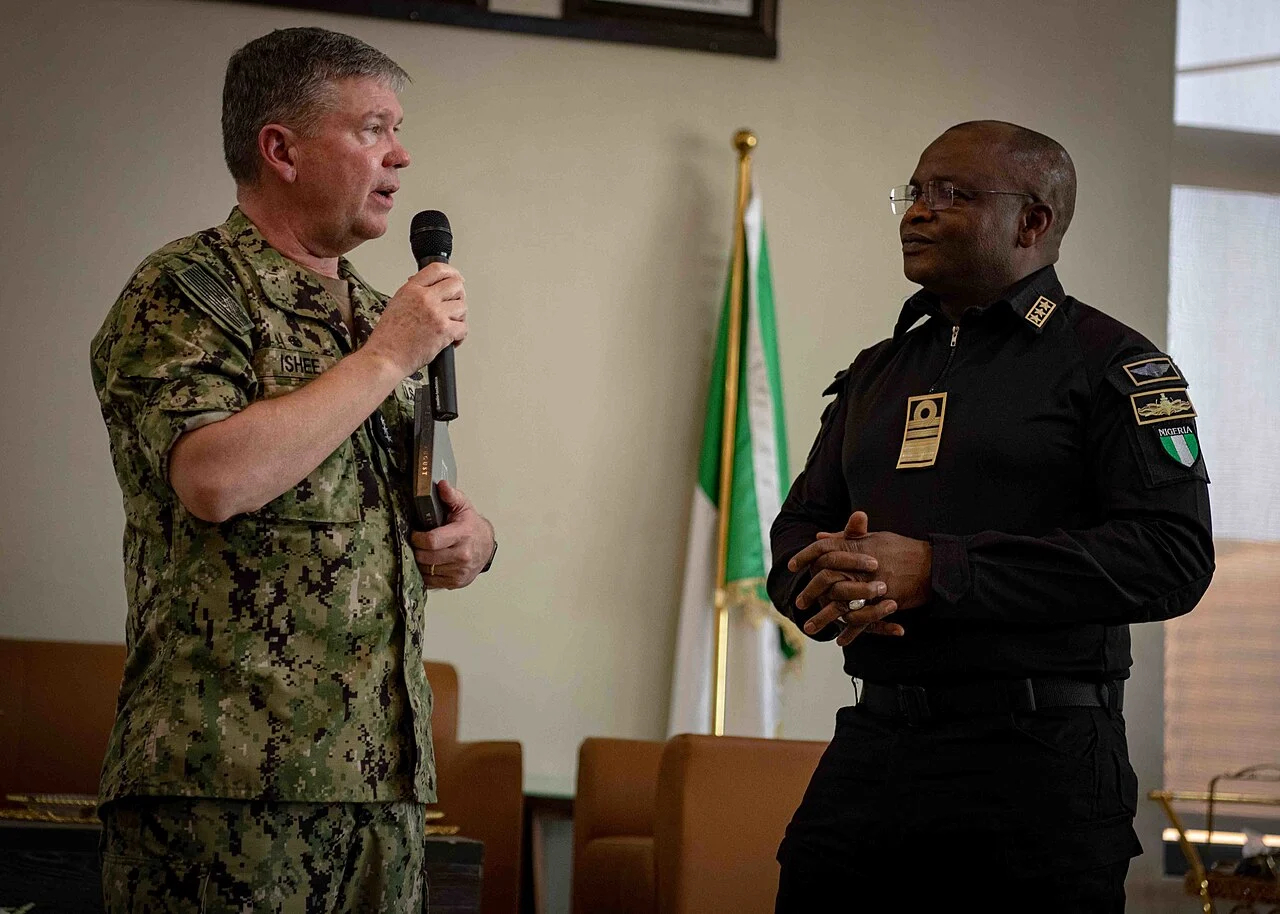
Photo: Nigerian Navy and U.S. Sixth Fleet officers at Naval Air Base Ogo, Lagos, during a 2023 maritime exercise. Credit: Petty Officer 2nd Class Cameron Edy, U.S. Navy, public domain, via Wikimedia Commons
ASELSAN CEO and President Ahmet Akyol said the company is actively scouting Nigerian partners to produce its systems inside the country, describing the relationship between Türkiye’s largest defence manufacturer and Abuja as a “close-knitted friendship,” Military Africa reported. “We are finding local companies to deploy this solutions and solve the security challenges,” Akyol said.
A relationship that has moved from sales to production
The comments build on groundwork already under way. ASELSAN opened an office in Abuja in September 2025, and the company has since sent an inspection team to a Nigerian Navy shipyard as part of talks on naval systems work, according to Military Africa. ASELSAN is also one of the Turkish firms collaborating with Nigeria’s Defence Industries Corporation (DICON) through the DICON-D7G joint venture, which already covers infantry combat equipment, assault rifles and armoured vehicles.
DefenceMENA reported in September on Nigeria and Türkiye’s broader shift from arms sales toward joint production, and Nigeria has since moved to open DICON to more foreign manufacturers ahead of Afridex 2026 in Lagos. Nigeria’s 2023 DICON Act underpins that push, giving the state arms maker a legal framework to bring in foreign technology partners rather than simply buy finished equipment.
Akyol linked the local-manufacturing push to Nigeria’s security needs, pointing to the drone threat the Nigerian military faces from Islamic State West Africa Province (ISWAP) and Boko Haram in the northeast. ASELSAN has pitched its Steel Dome layered air-defence concept, covering ranges from 100 metres to more than 150 kilometres, demonstrating it to officials from twelve countries in September. Vice Admiral Emmanuel Ikechukwu Ogalla, Nigeria’s Chief of Naval Staff, has engaged with ASELSAN on the naval side of the relationship, Military Africa reported.
ASELSAN’s wider growth
The Nigeria push comes as ASELSAN posts record growth at home. The company climbed to 40th place in the Defense News Top 100 ranking of the world’s largest defence companies this year, up from 43rd, becoming the first Turkish company to break into the global top 40 — a rise independently confirmed by trade outlets including Asia Pacific Defence Reporter. ASELSAN’s order backlog has grown from roughly $7-8 billion to $23 billion, with the company targeting $30 billion by the end of the year, while 2025 revenue reached $4.5 billion, up from $3.5 billion the year before. Export contracts now exceed $2.5 billion across 97 countries, and ASELSAN runs offices in 25 countries, including Algeria, Egypt, South Africa and Nigeria.
Akyol said the company’s growth reflects “the scale, momentum and global competitiveness ASELSAN has built,” citing investments including a roughly $1.5 billion Oğulbey Technology Base and a $56 million Guidance Systems Production Centre, alongside $1.3 billion in annual R&D spending.
Why it matters for Africa
Nigeria is Turkish industry’s most advanced local-production partner in West Africa, and a genuine ASELSAN manufacturing line — rather than a sales office — would mark a step beyond the assembly and co-production deals Ankara has struck elsewhere on the continent. For Nigeria, it offers a path to domestic radar, electronic-warfare or air-defence capacity to go with the small arms and vehicles DICON already assembles with Turkish partners, at a moment when ISWAP and Boko Haram’s growing use of weaponised drones has exposed gaps in low-altitude air defence across the Lake Chad Basin. A Steel Dome-type system, even partially localised, would also give the region’s only prospective domestic systems producer something few African militaries currently operate themselves. The deal, if it materialises, would reinforce Nigeria’s push to position itself as a defence-manufacturing hub ahead of Afridex 2026, when Lagos hosts African governments and global contractors shopping for exactly this kind of technology-transfer partnership.