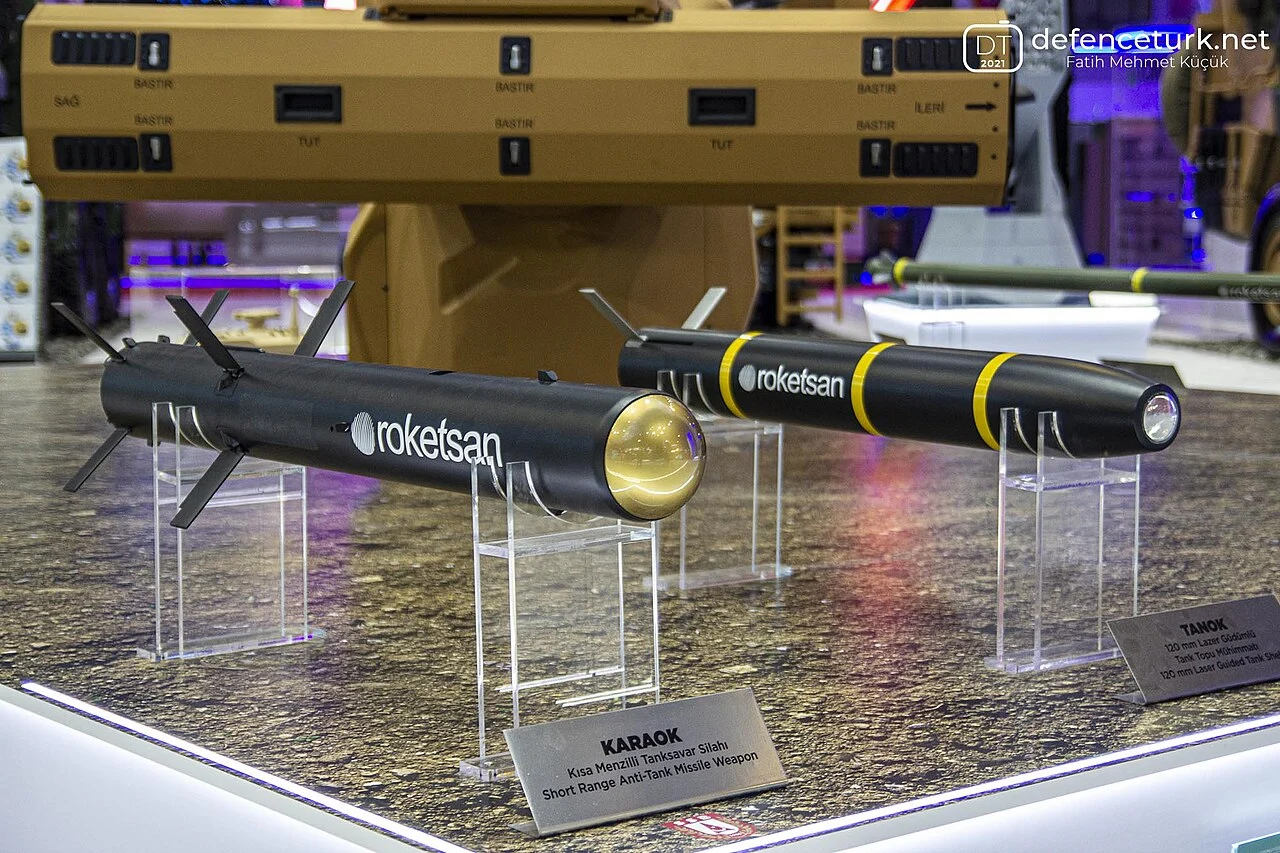
KARAOK is ROKETSAN’s man-portable, short-range anti-tank guided missile (ATGM), built with an ASELSAN-developed imaging-infrared seeker under a Turkish Presidency of Defence Industries (SSB) programme. It is a fire-and-forget weapon with an effective range beyond 2.5 km, a tandem-charge warhead designed to defeat explosive reactive armour, and direct- or top-attack modes. The Turkish Army achieved initial operational capability with KARAOK in 2020 and inducted it into service in 2022. In 2023 Malaysia became KARAOK’s first export customer, and in April 2026 the Malaysian Armed Forces received their first batch of 18 systems — making Malaysia the first confirmed foreign operator.
Photo: ROKETSAN KARAOK short-range anti-tank missile (foreground) next to ROKETSAN TANOK tank-gun munition, on display at a defence exhibition. Credit: Fatih Mehmet Küçük / defenceturk.net, via Wikimedia Commons (CC BY-SA 4.0).
| Manufacturer | ROKETSAN (prime, airframe/warhead/motor); ASELSAN (imaging-infrared seeker); procured under a Turkish Presidency of Defence Industries (SSB) programme |
| Type | Man-portable, short-range, fire-and-forget anti-tank guided missile (ATGM) |
| Range | Greater than 2.5 km (ROKETSAN official specification) |
| Warhead | Tandem-charge, armour-piercing (HEAT), designed to defeat explosive reactive armour |
| Guidance | Imaging infrared (IIR) seeker, lock-on before launch, fire-and-forget |
| Weight / dimensions | Less than 16 kg (missile and launch tube combined); 125 mm diameter; approx. 110 cm length |
| Status | Operational (Turkish Army, since 2022); exported and delivered (Malaysia, first batch April 2026) |
| Confirmed operators | Türkiye, Malaysia |
What is the KARAOK missile?
KARAOK is ROKETSAN’s short-range anti-tank weapon system, officially described by the manufacturer as a “man-portable, short-range, fire-and-forget anti-tank guided missile” (ROKETSAN, official product page, accessed 3 October 2026). It is designed to let a single infantry soldier engage a main battle tank or other armoured vehicle without exposing the operator to return fire during the missile’s flight: once the imaging-infrared seeker locks onto the target before launch, the gunner can relocate immediately. ROKETSAN markets KARAOK alongside its longer-range OMTAS and UMTAS/L-UMTAS anti-tank missiles, with KARAOK filling the short-range, man-portable niche in that family.
Who manufactures KARAOK — ROKETSAN’s role versus SSB and ASELSAN
KARAOK was procured under Türkiye’s Presidency of Defence Industries (SSB), which acted as the requirement-setting and serial-production contracting authority; Turkish industry press reports a serial-production contract between SSB and ROKETSAN signed in early 2024. ROKETSAN is the prime contractor and system integrator: it is responsible for the 125 mm-diameter, 110 cm airframe, the tandem-charge warhead and the propulsion system that gives the missile its stated 2.5 km-plus range, and it carries overall engineering accountability for the weapon. The missile’s imaging-infrared seeker — the component that enables fire-and-forget lock-on — was developed separately by ASELSAN under a contract with ROKETSAN signed in early August 2016, reported at the time at a combined value of roughly TL 44 million and EUR 7.45 million (Defence Turkey, August 2016; Envanter Medya). As with other Turkish precision-guided weapons, DefenceMENA attributes the seeker specifically to ASELSAN rather than describing KARAOK as a ROKETSAN-only product.
Development and testing timeline
| Date | Milestone |
|---|---|
| 12 August 2016 | ASELSAN signs contract to develop KARAOK’s imaging-infrared seeker |
| 2020 | Initial Operational Capability (IOC) reached with the Turkish Army |
| 2022 | KARAOK formally inducted into Turkish Army service |
| 11 September 2023 | ROKETSAN wins its first export order for KARAOK, from Malaysia, reported at roughly US$20 million |
| 3 February 2024 | SSB–ROKETSAN serial-production contract signed |
| July 2025 | ROKETSAN publicises KARAOK’s Full Operational Capability (FOC) status at LandEuro 2025 |
| 20 April 2026 | First batch of 18 KARAOK systems delivered to the Malaysian Armed Forces; displayed publicly at the DSA 2026 exhibition, Kuala Lumpur |
| 23 September 2026 | ROKETSAN conducts and announces KARAOK’s first test against an aerial target, successfully scoring a direct hit and extending the missile’s stated role beyond ground vehicles |
Sources: Defence Turkey, August 2016 (ASELSAN/ROKETSAN seeker contract); The Defense Post, 25 September 2026 (SSB/ASELSAN contract dates); Defense News, 14 September 2023; Janes, 26 October 2023; Armada International, July 2025; defenceturk.net, 20 April 2026; The Defense Post, 25 September 2026.
What is KARAOK’s current status?
KARAOK is operational with the Turkish Army, which uses it as its standard man-portable short-range ATGM alongside the longer-range OMTAS and UMTAS/L-UMTAS systems. It is also in early service with Malaysia, which received its first batch of 18 systems in April 2026 under a contract originally announced in September 2023. ROKETSAN describes the system as combat-ready and in serial production; DefenceMENA has not found public reporting of KARAOK combat use to date. On 23 September 2026, ROKETSAN announced that KARAOK had been tested for the first time against an aerial target and scored a direct hit, stating it was “strengthening versatile engagement capabilities against diverse threats” (The Defense Post, 25 September 2026). ROKETSAN did not disclose the target type or engagement distance, and DefenceMENA treats this as a demonstrated test capability rather than a confirmed operational counter-drone role.
Range, guidance and warhead — what ROKETSAN discloses publicly
ROKETSAN’s official specification states an effective range greater than 2.5 km, a missile-and-tube weight below 16 kg, a diameter of 125 mm and a length of approximately 110 cm. The warhead is a tandem-charge, armour-piercing (HEAT) design intended to defeat explosive reactive armour (ERA) fitted to modern armoured vehicles. Guidance is via an ASELSAN-developed imaging infrared (IIR) seeker: the operator locks onto the target before firing, after which the missile is fully autonomous (“fire-and-forget”), allowing the gunner to take cover or displace immediately after launch. The system supports both direct-attack and top-attack flight profiles, letting operators choose a traditional straight-line hit or an angled strike against a vehicle’s typically thinner top armour. ROKETSAN’s public materials do not disclose a flight-speed figure, penetration depth in RHA-equivalent terms, or a minimum engagement range, and this article does not estimate any of these.
Launch platform and operation
KARAOK is a man-portable system, fired from the shoulder or from a tripod by a single infantry operator, with no vehicle or crew-served mount required. This distinguishes it from ROKETSAN’s longer-range OMTAS (vehicle- or tripod-mounted, medium range) and UMTAS/L-UMTAS (helicopter- and vehicle-launched, long range) anti-tank missiles, which address different tactical roles. ROKETSAN has not publicly disclosed a vehicle-integrated or remote-weapon-station variant of KARAOK as of this writing.
Who operates the KARAOK missile?
| Country | Status | Quantity | Contract value | Year | Source |
|---|---|---|---|---|---|
| Türkiye | OPERATIONAL | Not publicly disclosed | Not publicly disclosed | Inducted 2022 | ROKETSAN; defence industry press |
| Malaysia | DELIVERED (first batch) | 18 launchers delivered of a contracted 18 launchers / up to 108 missiles | Approx. US$20 million (package; scope not fully itemised in public reporting) | Contracted September 2023; delivered 20 April 2026 | Defense News, 14 Sep 2023; Janes, 26 Oct 2023; defenceturk.net, 20 Apr 2026 |
Public reporting on the Malaysian contract gives slightly different missile counts (some sources cite 18 missiles plus a bonus round, others cite a package of approximately 106–108 missiles against the same roughly US$20 million value); DefenceMENA presents both figures rather than selecting one. No other country has publicly confirmed KARAOK operator or contract status as of this writing. ROKETSAN has also signed a September 2026 sales and joint-production agreement with Saudi Arabia’s SAMI Land Systems covering an unnamed “anti-tank guided missile weapon system” (Türkiye Today, SAMI statements, World Defense Show 2026); public reporting on that deal does not name KARAOK specifically, so it is not listed as a KARAOK contract here. DefenceMENA will update this table if ROKETSAN or SAMI confirm which missile the agreement covers.
Are there confirmed African or Middle Eastern KARAOK users?
As of 3 October 2026, no African or Middle Eastern country has a publicly confirmed KARAOK order, contract or delivery. The only confirmed foreign customer is Malaysia. The September 2026 ROKETSAN–SAMI Land Systems anti-tank guided missile agreement, signed in Saudi Arabia at the World Defense Show, has not been confirmed as a KARAOK-specific deal in public reporting, so it is not treated as KARAOK operator evidence on this page. DefenceMENA will add any African or Middle Eastern country to the table above, and cross-link this page from the ROKETSAN Middle East and Africa hubs, once product-level evidence is public.
What has KARAOK cost, and what do contracts include?
The only public contract figure is Malaysia’s package, reported at approximately US$20 million, covering 18 launchers, a contracted batch of missiles (reported variously as 18 plus a bonus round, or up to around 106–108 in total), and instructor training. Public sources do not break this total down into separate launcher, missile and training line items, so no reliable per-missile price can be derived, and this article does not estimate one. Turkish Army procurement values for KARAOK have not been publicly disclosed.
How does KARAOK compare with other man-portable anti-tank missiles?
The systems below are compared on the same basis: man-portable, short-range, fire-and-forget ATGMs using imaging-infrared guidance with tandem-charge warheads against explosive reactive armour. Figures are each manufacturer’s or government’s own published or reported data, not independently tested like-for-like results. The South Korean AT-1K Raybolt and a Chinese system are included because Malaysia’s own procurement process evaluated KARAOK against competing South Korean and Chinese offers before selecting ROKETSAN.
| Missile | Origin / maker | Public range | Weight (missile + launcher) | Guidance | Status |
|---|---|---|---|---|---|
| KARAOK | Türkiye / ROKETSAN, ASELSAN (seeker) | >2.5 km (official) | <16 kg | Imaging infrared, fire-and-forget, direct/top attack | Operational (Türkiye); exported and delivered (Malaysia, 2026) |
| FGM-148 Javelin | United States / Raytheon & Lockheed Martin | ~2.5 km (reported up to ~4 km for newer rounds) | ~22 kg (missile + Command Launch Unit) | Imaging infrared, fire-and-forget, direct/top attack | Operational; widely exported |
| AT-1K Raybolt | South Korea / LIG Nex1 (LIG D&A) | 2.5–3 km (reported) | ~33 kg (13 kg missile + 20 kg launcher) | Imaging infrared, fire-and-forget, direct/top attack | Operational (Republic of Korea Army); exported (Philippines) |
| HJ-12 | China / NORINCO | Reported 2–4 km depending on variant | ~17 kg (reported) | Imaging infrared / other seeker options, fire-and-forget | Operational (PLA); exported |
On the figures each government or manufacturer has published, KARAOK’s weight compares favourably with the Javelin and Raybolt systems while covering a broadly similar range band; a full side-by-side comparison including cost, combat record and integration support is planned as a separate DefenceMENA article. For further Turkish-language technical background on Javelin pricing as a benchmark, see Envanter Media’s analysis of Javelin missile costs.
Related ROKETSAN systems
KARAOK covers ROKETSAN’s man-portable short-range anti-tank role — alongside ROKETSAN’s man-portable SUNGUR short-range air defence missile, both infantry-carried, fire-and-forget systems. For the company’s drone-launched precision munitions, see MAM-L, MAM-C and MAM-T Explained; for its naval anti-ship missile, see ATMACA Anti-Ship Missile Explained; and for ROKETSAN’s full product range, see the ROKETSAN company hub. ROKETSAN’s longer-range anti-tank missiles, OMTAS and UMTAS/L-UMTAS, are covered in Turkish Anti-Tank Missiles Explained, which also includes Nigeria’s confirmed use of L-UMTAS — the first confirmed African operator of a ROKETSAN anti-tank missile.
Frequently asked questions
What is the range of the KARAOK anti-tank missile?
ROKETSAN’s official specification states an effective range greater than 2.5 km. This is the manufacturer’s own published figure.
Which countries use the KARAOK missile?
Türkiye operates KARAOK with its army, in service since 2022. Malaysia is the only confirmed foreign operator, having received its first batch of 18 systems in April 2026 under a contract signed in September 2023.
Is KARAOK the same as Javelin?
No. KARAOK is a separate Turkish-developed system, though it is often compared to the US FGM-148 Javelin because both are man-portable, fire-and-forget ATGMs with imaging-infrared seekers and similar published range bands. Malaysia’s KARAOK procurement itself cited the Javelin as a performance benchmark during evaluation.
What does KARAOK cost?
Malaysia’s 2023 order, covering 18 launchers, a contracted missile batch and training, was reported at approximately US$20 million. Public sources do not itemise the package, so no reliable unit price can be derived. Turkish Army procurement values have not been publicly disclosed.
Who makes the KARAOK missile’s seeker?
ASELSAN developed KARAOK’s imaging-infrared seeker under a contract signed in August 2016, while ROKETSAN is the prime contractor responsible for the airframe, warhead, propulsion and overall system integration.
Has Saudi Arabia ordered KARAOK?
Not confirmed. ROKETSAN signed a September 2026 sales and joint-production agreement with Saudi Arabia’s SAMI Land Systems covering an anti-tank guided missile system, but public reporting has not named KARAOK specifically as the missile involved.
Can KARAOK engage drones or aerial targets?
ROKETSAN announced on 23 September 2026 that KARAOK had been tested for the first time against an aerial target and scored a direct hit. The company did not disclose the target type or range, and this is a demonstrated test capability rather than a confirmed operational counter-drone role.
Sources
- ROKETSAN: KARAOK Short-Range Anti-Tank Weapon System, official product page (accessed 3 October 2026)
- Defense News: “Turkey’s Roketsan wins Malaysian deal for Karaok anti-tank missiles” (14 September 2023)
- Janes: “Malaysian Army to receive Turkey’s Karaok anti-tank guided weapons” (26 October 2023)
- Armada International: “Roketsan Touts Export Order for Karaok ATGM” (July 2025)
- defenceturk.net: “Malezya’ya KARAOK teslimatı” (20 April 2026)
- Defence Security Asia: Malaysia KARAOK anti-tank missile system delivery report (2026)
- Türkiye Today: “Roketsan signs joint missile production deals with Saudi Arabia’s SAMI at WDS2026” (2026)
- Envanter Medya: “KARAOK nasıl geliştirildi? SSB, ROKETSAN ve ASELSAN’ın projedeki rolleri” (Turkish-language technical background on SSB/ASELSAN roles)
- Defence Turkey: “Aselsan and Roketsan’s ‘Karaok’ Infrared Seeker Development Program” (August 2016)
- The Defense Post: “Turkey’s Karaok Missile Hits Air Target For First Time” (25 September 2026)
- ROKETSAN: official website (accessed 3 October 2026)