Denel Aerospace and South African engineering firm Sparcx have signed a memorandum of understanding to integrate Denel’s fixed-wing VTOL drone into public-safety operations, the latest in a string of partnership announcements at Africa Aerospace and Defence 2026.
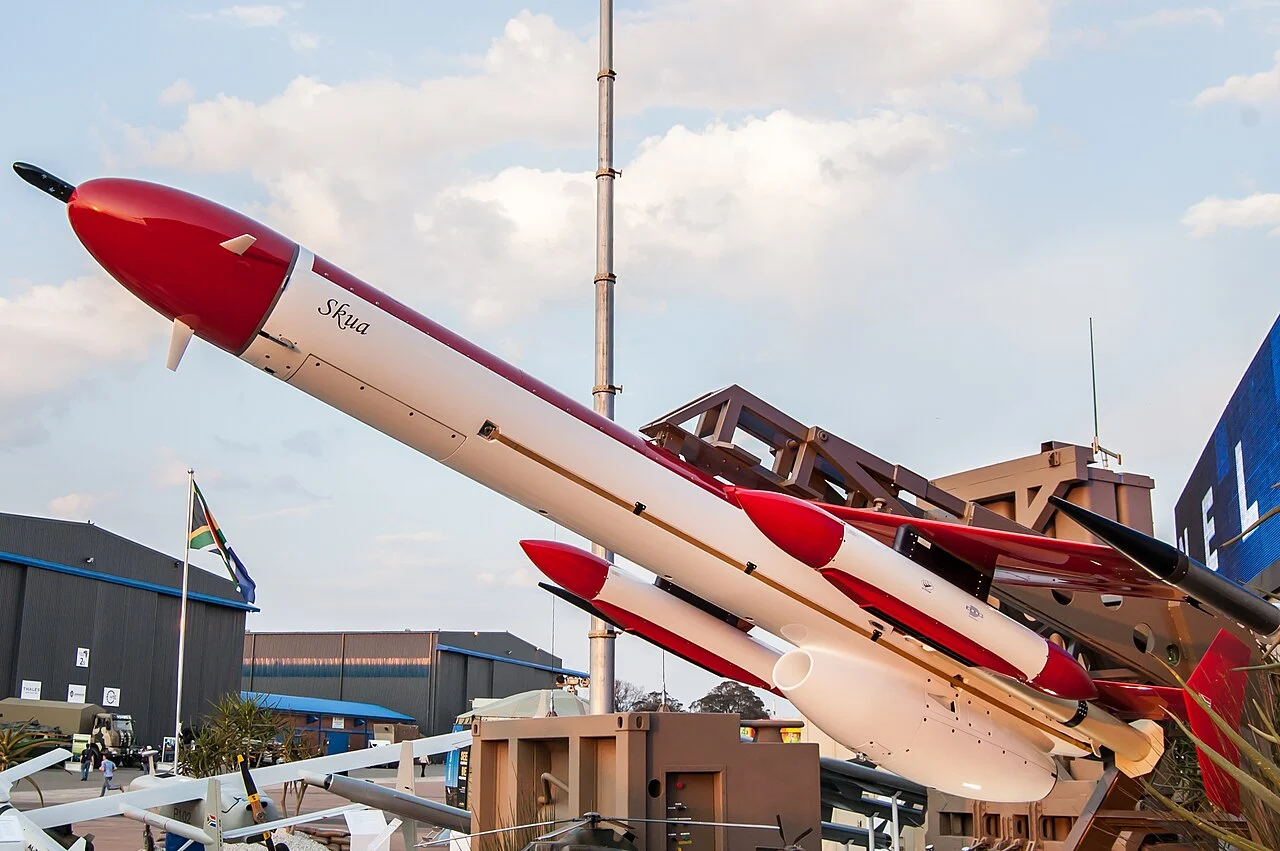
Photo: Denel Dynamics Skua target drone on display at AAD, illustrating the company’s unmanned systems line. Credit: Darren Olivier, CC BY-SA 3.0, via Wikimedia Commons
What was agreed
Denel Aerospace and Sparcx signed the MoU during AAD 2026, the companies said, covering joint work on aerospace engineering, research and development, industrialisation and technology commercialisation. The centrepiece is integrating Denel’s Fixed-Wing Vertical Take-off and Landing (FW-VTOL) unmanned aerial vehicle into Sparcx’s public-safety product line, alongside joint customer engagement and development of subsystems for future aerial platforms.
“This collaboration reflects the importance of bringing together South African aerospace and engineering capabilities to explore new opportunities in a rapidly changing technology environment,” Denel Group chief executive Tsepo Monaheng said, according to defenceWeb. Sparcx managing director Sujo Mulamattathil said unmanned systems “provide valuable situational awareness,” with their value growing once the data they collect is tied into an operational and evidence ecosystem — a reference to Sparcx’s focus on public-safety and law-enforcement data platforms rather than military sensors alone.
Background: Denel’s drone portfolio
Denel’s unmanned aircraft lineage runs from the long-serving Seeker family of fixed-wing reconnaissance drones to more recent VTOL designs aimed at the surveillance and public-safety market, where fixed-wing endurance is combined with helicopter-style vertical launch and recovery so the aircraft does not need a runway. The FW-VTOL is part of that newer generation, positioned for customers — including police services, border agencies and ports — that need extended loiter time without the infrastructure a conventional runway-based UAV requires.
Denel itself has spent recent years rebuilding its commercial footing after years of financial distress and state-owned-enterprise restructuring, with its aerospace and dynamics units increasingly seeking partnerships and export orders to supplement South African defence force contracts. Sparcx is a smaller, privately held South African technology firm focused on integrated surveillance and evidence-management systems for public-safety clients. More on the company’s broader programme history is tracked on DefenceMENA’s Denel desk.
What it means in practice
An MoU is a framework for cooperation, not a signed order, and the companies have not disclosed a timeline for when an integrated FW-VTOL/Sparcx offering would be available to customers or whether any launch client has been identified. The announcement sits alongside a wave of other partnership news at AAD 2026, including Paramount’s unveiling of its V-Raven VTOL drone and South African firm Dinkwanyana’s UVH-170 VTOL system, underscoring how crowded the domestic VTOL-drone segment has become as manufacturers compete for both African and export public-safety and defence contracts.
Why it matters for Africa
South Africa’s aerospace sector has struggled to translate decades of engineering expertise — Denel’s own UAV programmes date back to the 1980s — into sustained commercial success, hampered by state funding constraints and the collapse of several export deals. A string of smaller partnerships like the Denel-Sparcx MoU, rather than a single large contract, reflects how the industry is now trying to rebuild: pairing established platform designers with niche South African technology firms to reach markets, such as public safety and law enforcement, that sit outside traditional defence-ministry procurement. If it leads to a deployed product, it would also give African police and border agencies a locally built alternative to imported VTOL drones from Chinese, European and Gulf suppliers.