South African defence companies exported more than R10 billion worth of equipment and munitions in 2025, nearly tripling the previous year’s total, according to new National Conventional Arms Control Committee (NCACC) figures. The destinations tell an awkward story for Pretoria: Europe, not the BRICS partners the ANC government has courted for defence cooperation, bought almost half of everything South Africa sold abroad.
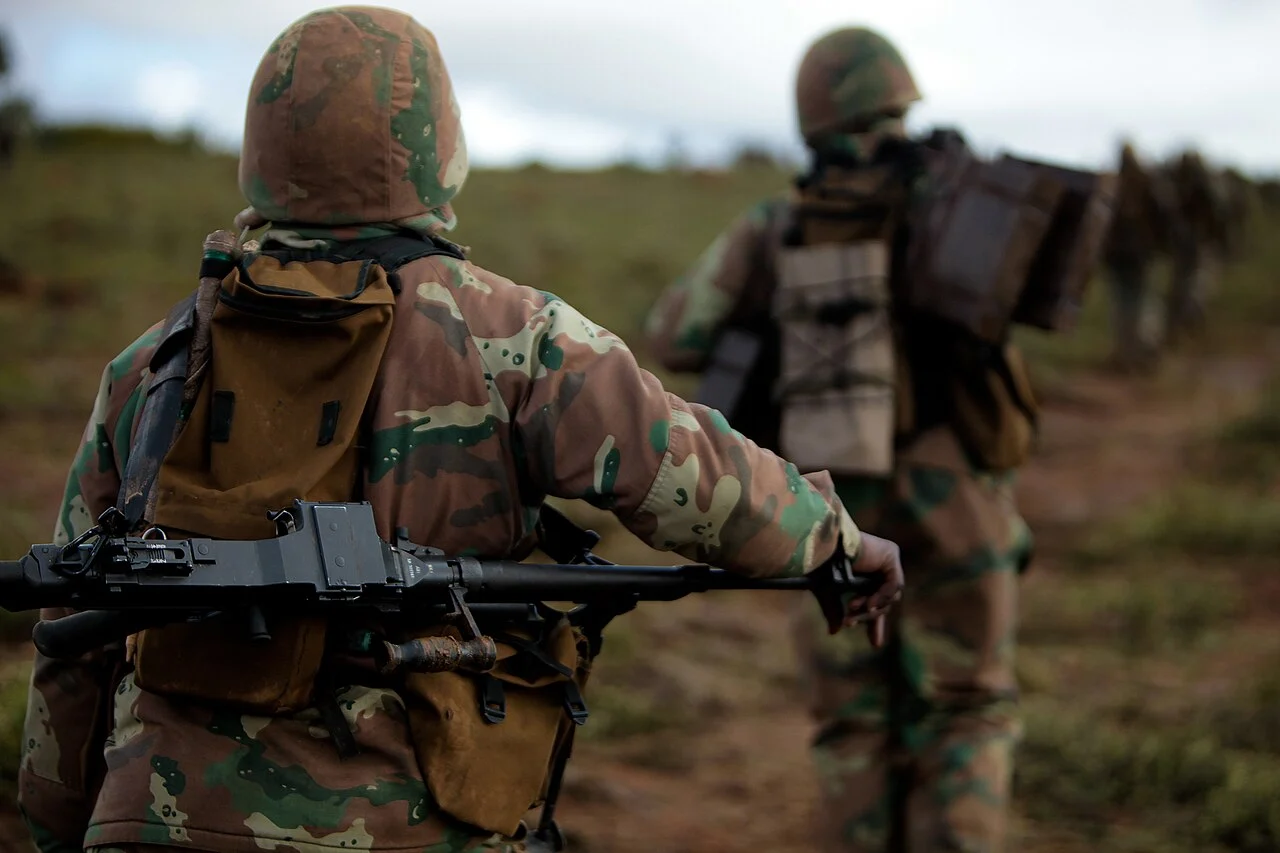
Photo: South African National Defence Force soldiers during a joint exercise. Credit: Cpl. Jad Sleiman, U.S. Marine Corps, Public domain, via Wikimedia Commons
The NCACC’s 2025 annual report to parliament’s joint standing committee on defence, cited by TimesLive and corroborated by the Daily Dispatch, recorded 582 export permits issued to 42 countries, worth a combined R10.1 billion, up from R3.6 billion in 2024. A further R600 million in dual-use goods went to 14 countries under 132 separate permits.
Those totals landed in the same week as an opinion piece in defenceWeb arguing that the export breakdown exposes a mismatch between government messaging and where South African industry actually earns its money: Europe accounted for 42 per cent of 2025 exports, the Middle East 23 per cent, Africa 20 per cent, Asia-Pacific 12 per cent and the Americas just 3 per cent. Russia, China and India — South Africa’s BRICS partners alongside Brazil — do not register as significant buyers in the public breakdown.
Munitions Did the Heavy Lifting
Much of the surge traces back to one business line: artillery ammunition. Rheinmetall Denel Munition (RDM), the joint venture between Germany’s Rheinmetall and the state-owned Denel, has spent the past three years filling European orders for 155mm shells as NATO members restock inventories depleted by arms transfers to Ukraine. In September 2026, Rheinmetall confirmed a fresh order for a low five-figure quantity of 155mm projectiles worth a low three-digit million-euro sum, with deliveries running into 2027. RDM is also one of two suppliers, alongside Norway’s Nammo, on a Swedish Defence Materiel Administration contract worth more than SKr5 billion (about $525 million) for shells and propellant charges to feed Sweden’s Archer artillery system.
Rheinmetall has said it wants to lift group-wide 155mm output to around 1.5 million shells a year by 2030, a target that keeps the Denel-linked production line in South Africa’s Western Cape running at capacity for the foreseeable future — and keeps Europe as the company’s dominant customer regardless of what Pretoria’s foreign policy signals.
Beyond munitions, armoured vehicles brought in just over R1 billion from more than 130 units sold to over a dozen countries, spanning manufacturers such as Paramount Group and DCD Protected Mobility. Aircraft sales — unspecified types — went to Iraq (six aircraft worth R802 million), the Democratic Republic of Congo (four worth R618 million), Mozambique (two worth R327 million) and the UAE (one worth R27 million), while Saab’s local radar-warning joint venture, Saab Grintek, continues to supply India.
A Trade Show Built on a Different Premise
The defenceWeb commentary ties the export data to this year’s Africa Aerospace and Defence (AAD) show, marking 25 years since it was first launched, and to South Africa’s accession to BRICS back in 2006. Its argument: the government has spent two decades promoting defence cooperation with Russia, China and other BRICS partners — including joint naval exercises with Russian and Chinese vessels off Durban in January 2023 — while the industry’s actual order book has been built overwhelmingly on NATO-aligned European buyers.
Part of the disconnect is structural. South Africa’s last major state procurement programme — the corvettes, submarines, Hawk trainers and Gripen fighters bought under the late-1990s Strategic Defence Package — is three decades old, and the South African National Defence Force (SANDF) itself has placed few large new orders since. With a thin domestic order book, South African manufacturers have had to chase export markets wherever demand exists, and in 2025 that demand was European rearmament, not BRICS industrial partnership. The NCACC’s own data shows regulatory approval can take around six months, compared with same-day clearance cited for some NATO export regimes — a friction point industry figures argue costs South Africa deals when European demand is this time-sensitive.
Compliance Record
The NCACC stated it did not approve exports to any country under United Nations arms embargoes in 2025 and said it was not aware of any diversion of South African-origin munitions to parties in active conflicts, addressing a recurring concern raised by arms-control researchers about end-use monitoring on 155mm shells moving through European stockpiles during the Ukraine war.
Why It Matters for Africa
South Africa remains the continent’s most diversified arms producer, and its export performance is a bellwether for the wider Southern African defence-industrial base: Denel’s turnaround, RDM’s order book and Paramount’s vehicle sales all ripple through to subcontractors and the SADC supply chain profiled in DefenceMENA’s coverage of Southern African security contracts. A R10 billion export year also strengthens South Africa’s hand as a potential regional manufacturing base for foreign primes looking to localise production for the SADC market — a dynamic already visible in Czech rifle maker CZ’s interest in the country, and in the steady flow of South African-made armoured vehicles profiled in DefenceMENA’s survey of the continent’s indigenous arsenal. But the export mix also underlines a dependency: with Africa taking only a fifth of South African arms exports, the industry’s health is currently tied more closely to the pace of European rearmament than to demand from the continent it is headquartered on.