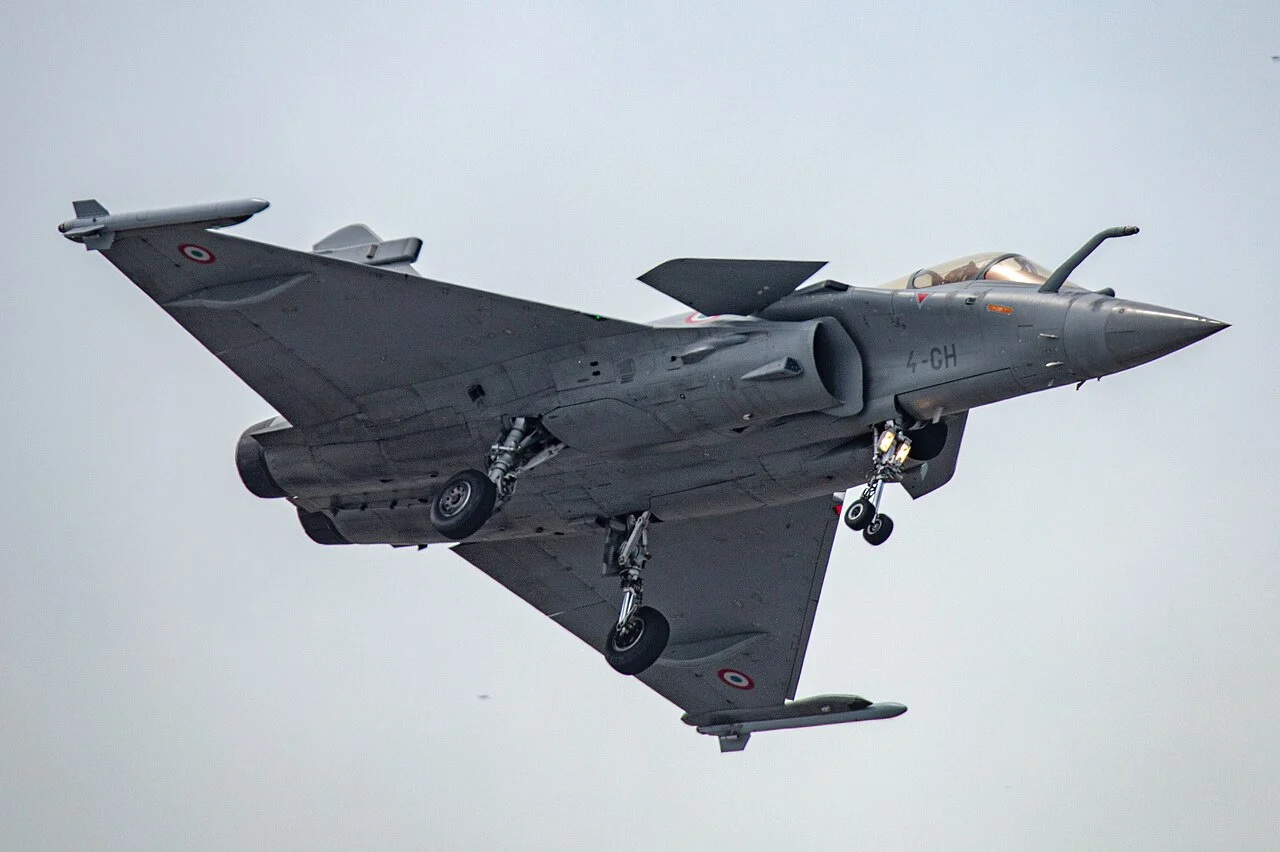
Egypt has sent Dassault Aviation a formal request for 24 more Rafale fighters, a move that would make it the largest export operator of the French jet with 78 aircraft. No contract has been signed, and Dassault has declined to comment.
Photo: A Dassault Rafale multirole fighter, the type at the center of Egypt’s new request to France. Credit: Clemens Vasters, CC BY 2.0, via Wikimedia Commons
According to the French daily La Tribune, as reported by The Defense Post, Cairo submitted a Request for Proposal to Dassault on September 1 covering 24 additional Rafale F4 fighters. Army Recognition and other outlets have since confirmed the RFP, though none report an Egyptian government or Dassault statement confirming the figures. If Cairo and Paris turn the request into a contract, it would be Egypt’s third Rafale order and would take the Egyptian Air Force’s Rafale holdings past every other export customer, including India and Qatar.
A Fleet Built in Three Stages
Egypt became the Rafale’s first export customer in 2015, ordering 24 aircraft — 16 two-seat and 8 single-seat — in a roughly $5.9 billion package that also included a FREMM frigate and munitions. A second order followed in 2021 for 30 more Rafale F3R jets, worth about €3.75 billion and financed over ten years with an 85 percent French state guarantee. Egypt’s existing Rafale fleet is expected to reach 54 aircraft by the end of 2026 as deliveries from the second order continue.
A third order for 24 more jets would lift the total to 78 — more Rafales than any other export customer operates or has on order. It would also deepen a relationship that has already made France one of Egypt’s principal arms suppliers, alongside long-standing US ties and a growing list of Russian and Chinese programs.
Why Cairo Is Still Buying
The reported motivation is straightforward fleet renewal. Egypt’s air force still operates more than 200 aging American F-16s, many of them Block 15, 32 and 40 variants delivered between 1982 and the mid-1990s. The Rafale, unlike the older F-16 variants in Egyptian service, is cleared to carry the MICA and Meteor air-to-air missiles as well as a range of French precision-guided munitions that Washington has been reluctant to release for Cairo’s F-16 fleet.
Egypt has also spent the past several years diversifying deliberately rather than replacing one supplier with another. The air force operates Russian-made MiG-29M/M2 fighters, has reportedly explored the Chinese J-10C, and continues to weigh options as Washington keeps tighter conditions on some US systems. The Rafale RFP fits that pattern: rather than betting on any single supplier, Cairo is keeping several fighter programs alive at once, a strategy examined in more detail in DefenceMENA’s look at whether Egypt has really diversified its defence suppliers.
Obstacles Before Any Deal
Several practical hurdles stand between the RFP and a signed contract. Financing would again likely depend on French state-backed loans similar to those used for the 2021 order, and Dassault’s production line is already carrying orders from India, Indonesia, Greece, Croatia, Serbia and the United Arab Emirates, among others. Egyptian officials have also kept Chinese fighters under consideration as a hedge, which could affect the pace or scale of any French deal. The Defense Post notes that Dassault “declined to comment” when asked about the request, leaving the story resting on French press reporting rather than an official confirmation from either government.
Why It Matters for Africa
Egypt already fields the largest and most diverse air force on the African continent, and a move toward 78 Rafales would extend that lead further, reinforcing Cairo’s position as the benchmark for airpower spending in North Africa and the wider Middle East. It would also sharpen the contrast with regional rivals: Algeria has leaned on Russian Su-30MKAs and reported Su-57E interest, while Morocco has built its fighter fleet around US-supplied F-16s. A larger Egyptian Rafale fleet would give Cairo a qualitative edge in precision-strike and beyond-visual-range air combat that neither of its main regional competitors currently matches, and would reinforce France’s position as a long-term supplier to African militaries at a moment when Gulf and Asian buyers are competing hard for Dassault’s production slots.