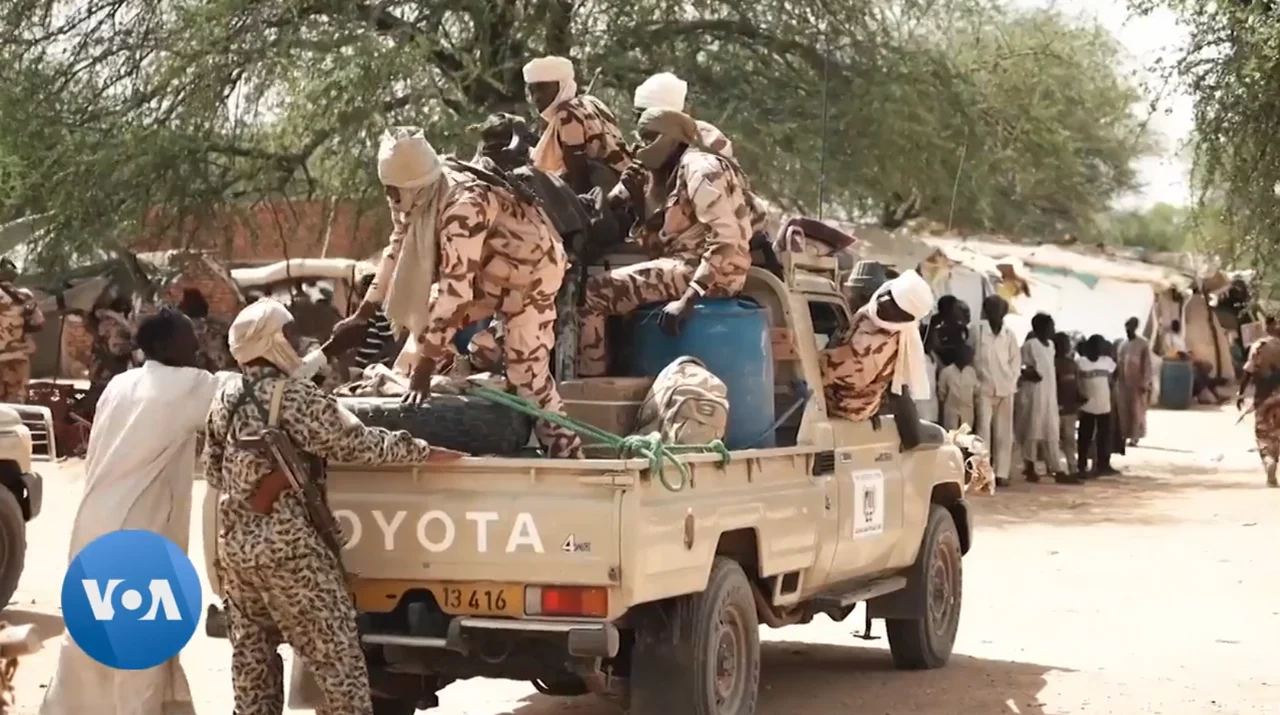
Chad has created a state-owned defence manufacturer, Sahel Défense Industrie (SDI), tasked with assembling small arms and ammunition on Chadian soil as N’Djamena works to cut its reliance on imported weapons. The move follows a decree signed by President Mahamat Idriss Déby in early August and comes weeks after France’s Arquus won a contract to renew Chad’s military logistics fleet.
Photo: Chadian soldiers oversee the Chad-Sudan border. Credit: Henry Wilkins and Arzouma Kompaoré (VOA), Public domain, via Wikimedia Commons
President Déby signed the decree creating SDI on 4 August 2026, placing the new company under the Ministry of Armed Forces, Veterans and Victims of War, Military Africa reported. Ten days later, a second decree named Dr Idriss Saleh Bachar, an engineer and longtime Déby ally who most recently served as the president’s civilian chief of staff, as SDI’s director general. Brigadier-General Mahamat Bongo, an air force officer who previously served as Chad’s defence attaché in Russia, was appointed deputy director general.
What Chad plans to build
According to Military Africa, officials meeting in N’Djamena this month set out an initial production list centred on assembling AK-pattern rifles, machine guns and rocket-propelled grenades, alongside lines for small-calibre ammunition from 9mm to 12.7mm. Chadian security officials are also said to be weighing local manufacture of kamikaze drones, reflecting the growing role loitering munitions have played in Sahel counterinsurgency operations. No contracts, technology-transfer partners or investment figures have been made public.
Chad’s arsenal and existing suppliers
Chad’s armed forces have historically relied on a patchwork of foreign suppliers, buying armoured vehicles, artillery and small arms from Russia, France, Ukraine and, more recently, the United Arab Emirates and China as they fought Boko Haram and Islamic State-linked militants along the country’s borders with Nigeria, Niger and Libya. That dependence is precisely what SDI is meant to address. N’Djamena’s most recent major foreign contract came in August 2026, when French manufacturer Arquus, part of the Belgian group John Cockerill, won a contract worth more than €50 million to renew the Chadian army’s logistics vehicle fleet — its largest single order from N’Djamena to date and the first since relations with Paris were repaired.
That repair followed a rupture: Chad ended its 65-year defence agreement with France in November 2024, and roughly 1,000 French troops withdrew by the following January. Ties began to thaw in 2026, with President Emmanuel Macron hosting Déby in Paris in January and defence ministers from both countries meeting at the Eurosatory exhibition in June. Neither Arquus nor Chad’s defence ministry has said whether the French company’s return to N’Djamena has any connection to SDI’s plans.
A crowded, uneven field
Chad is not the first Sahelian state to announce ambitions to build its own weapons. Mali unveiled a similar domestic assembly programme in January 2025 but continues to depend heavily on Chinese imports for its frontline equipment, according to Afrique Confidentielle, which has covered SDI’s creation critically. The outlet points to Nigeria’s push into joint arms production, revived under a 2023 industrial framework, as a rare African example that has reached output of vehicles and ammunition at scale — alongside South Africa’s long-established indigenous arsenal — and argues that building a functioning arms industry requires patient capital, a technical workforce and a market large enough to sustain it. Chad, whose finances lean heavily on oil revenue and external aid, does not yet clearly meet those conditions. Afrique Confidentielle’s own assessment is that SDI’s near-term output is more likely to be repair, refurbishment and consumables than finished weapons systems.
Why it matters for Africa
SDI is the latest entry in a wider pattern of African governments setting up state arms companies to reduce exposure to embargoes, currency shocks and the diplomatic conditions that can come with foreign military assistance — a logic reinforced across the Sahel by the abrupt French withdrawals from Mali, Burkina Faso and, briefly, Chad itself. If SDI moves beyond assembling small arms and ammunition into genuine component manufacturing, it would join a short list of African states with a domestic base extending past simple maintenance. But the region’s record, as Afrique Confidentielle notes, is one of announcements outrunning capacity: several African governments have unveiled arms-manufacturing plans over the past two decades without progressing past assembly and repair work. For neighbours watching N’Djamena’s campaign against Boko Haram and Islamic State West Africa Province, the more immediate question is whether a Chadian ammunition line can supplement, rather than replace, the imported systems the army still depends on for years to come.
Sources
- Military Africa: “Mahamat Déby Pushes for Local Production of Arms in Chad”
- Afrique Confidentielle: “Le Tchad veut fabriquer ses propres armes : le pari risqué de N’Djamena”
- Military Africa: “Arquus secures deal to renew Chadian army logistics fleet”