Nine variants span half a century of the Boeing (formerly McDonnell Douglas) F-15 Eagle, from the 1972 air-superiority prototype to the F-15IA now entering Israeli Air Force service. This guide traces every major production standard and details how the family equips three MENA air forces: Saudi Arabia, Qatar and Israel, as of September 2026.
DEFENCE MENA | Family explained | Data as of September 2026
The F-15 Eagle is still in production more than 50 years after its first flight. What began as a pure air-superiority interceptor for the US Air Force has branched into a strike-fighter lineage that now underwrites the high-end combat power of three MENA air arms. Saudi Arabia flies the largest F-15 fleet outside the United States, Qatar operates what was, until 2021, the most advanced Eagle ever built, and Israel is simultaneously running the oldest operational F-15s anywhere and the newest.
Each variant reflects a different generation of radar, engine and mission-systems technology on the same basic airframe. The dividing lines are not cosmetic: an F-15C air-superiority fighter and an F-15E-derived strike variant differ in radar mode, fuel system and weapons stations, and the export standards sold to Riyadh, Doha and Tel Aviv each carry avionics fits negotiated separately with Washington. This piece groups the family by production standard, states what changed and why, and identifies which variants MENA air forces fly today.
Key facts
- Saudi Arabia’s combined F-15C/D, F-15S and F-15SA fleet is commonly put at roughly 210 aircraft, the largest F-15 force outside the United States, according to open-source fleet tallies (Simple Flying, 2026).
- Qatar received all 36 F-15QA Ababil aircraft ordered under its 2017 contract, with the final jets handed over by 2024 (Key.aero; Bulgarian Military, 2023).
- Israel signed a contract worth up to $8.5 billion for 25 F-15IA aircraft on 29 December 2025, with an option for 25 more (The Aviationist; TWZ, 2025-2026).
- The US State Department cleared a possible $3 billion sustainment package for Saudi Arabia’s F-15 fleet on 3 February 2026 (FlightGlobal; Army Recognition, 2026).
- Boeing had delivered 18 of 33 contracted F-15EX Eagle II aircraft to the US Air Force as of April 2026, with the FY2027 budget request more than doubling the planned buy from 129 to 267 (defence-industry.eu; Air & Space Forces Magazine, 2026).
1. F-15A/B Eagle — the founding air-superiority variant
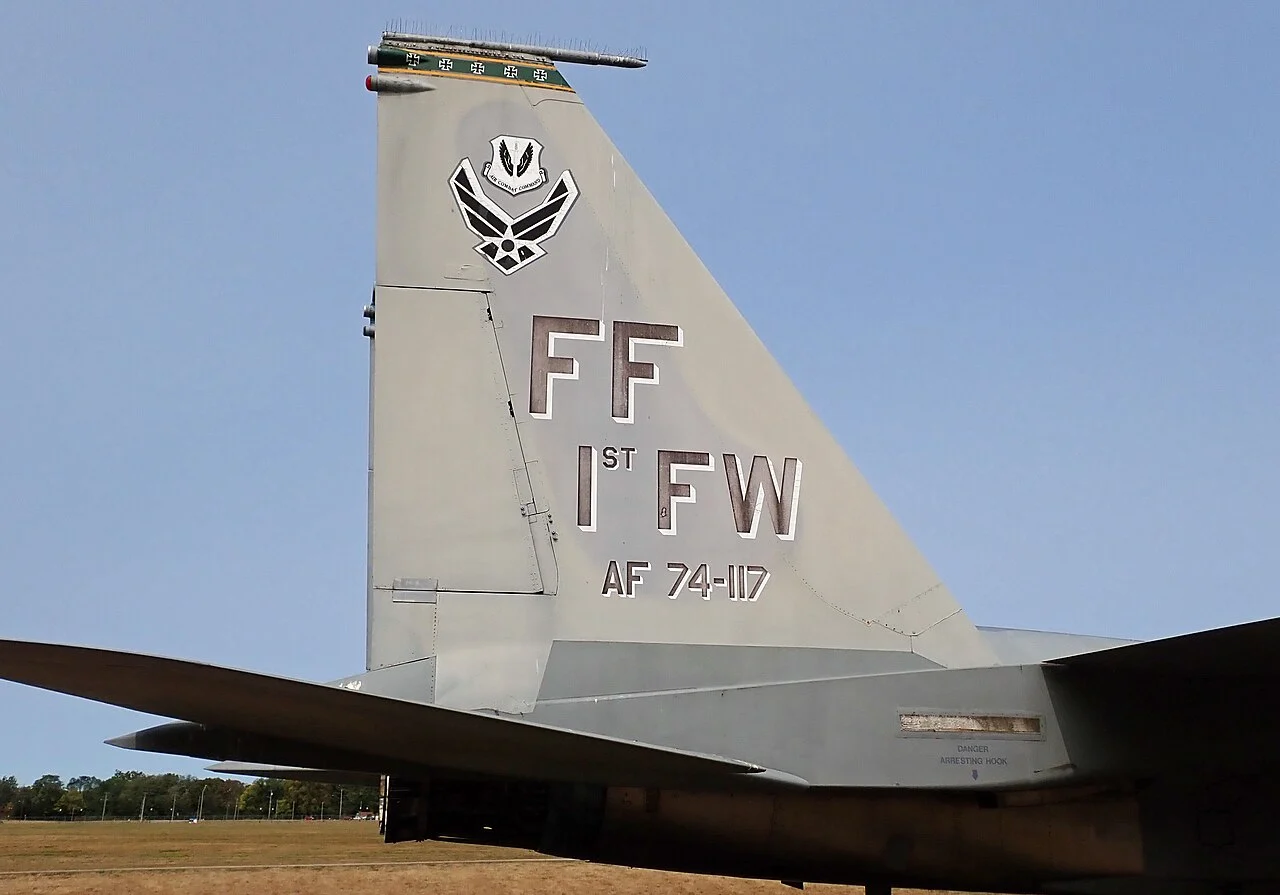
The F-15A single-seat and F-15B twin-seat variants were the original production standard, first flying in July 1972 and entering US Air Force service in 1976. Designed purely as an air-superiority interceptor after lessons from Vietnam-era air combat, the A/B carried the AN/APG-63 pulse-Doppler radar, twin Pratt & Whitney F100 engines and no dedicated air-to-ground systems. Israel became the type’s first export customer in 1976, receiving F-15A/B aircraft that formed the core of what the Israeli Air Force calls the “Baz” (Eagle) fleet, later supplemented by F-15C/D airframes under the same squadron designation.
Worldwide, the F-15A/B was operated by the United States and Israel; both have long since retired or upgraded away from the baseline standard. No MENA air force operates the F-15A/B on the front line today: Israel’s active “Baz” squadrons fly later F-15C/D-standard jets, covered next.
2. F-15C/D Eagle — the definitive air-superiority standard
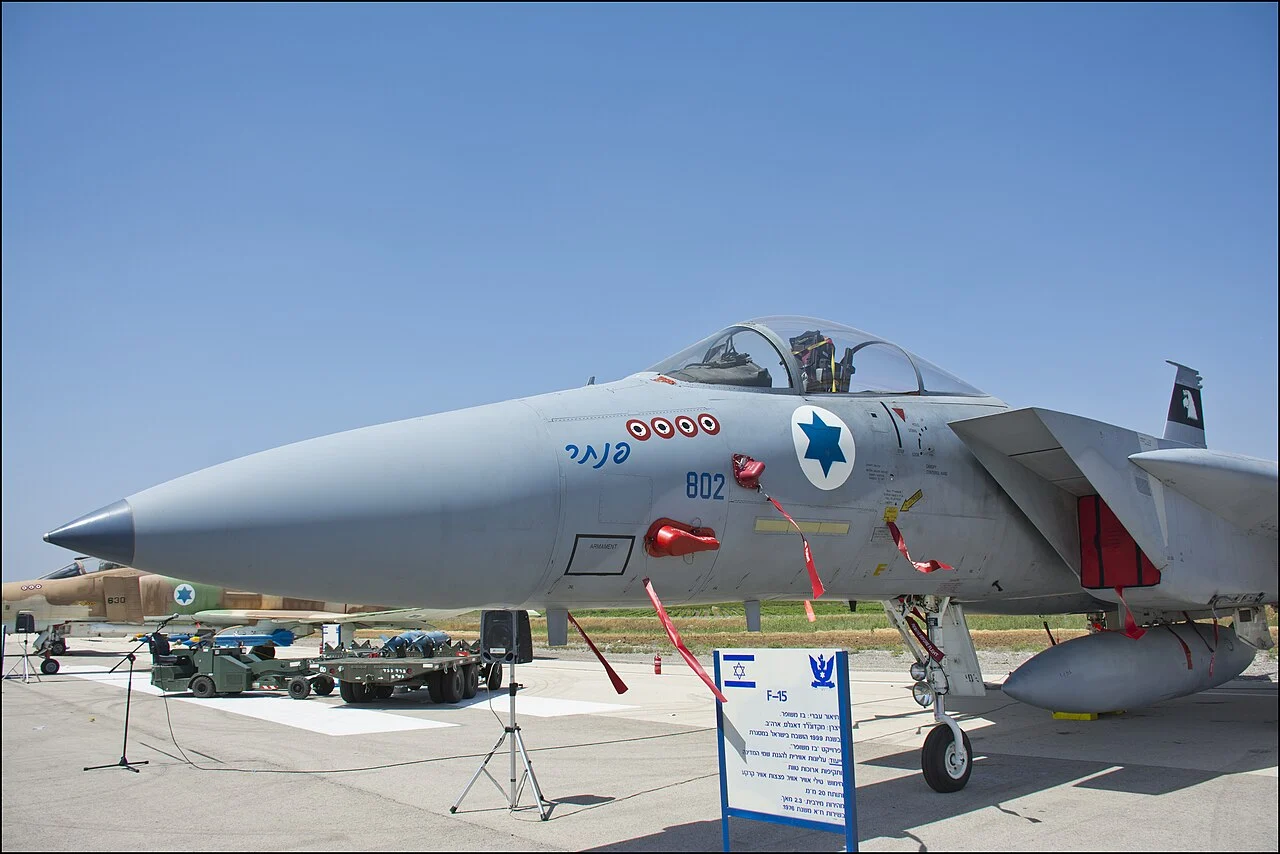
Entering service in 1979, the F-15C and two-seat F-15D added conformal fuel tanks as an option, increased internal fuel capacity and a strengthened airframe for a higher maximum take-off weight than the A/B. Radar and engines were progressively upgraded through service life, with later aircraft fitted with the improved AN/APG-63(V)1 radar and Pratt & Whitney F100-PW-220/229 engines. Saudi Arabia ordered 47 F-15C and 15 F-15D aircraft under the “Peace Sun” Foreign Military Sales programme, with deliveries beginning in 1982; the type remains in Royal Saudi Air Force service today with squadrons including No. 5, No. 13 and No. 34 at King Fahad and King Abdulaziz air bases.
Israel’s F-15C/D aircraft, delivered from the late 1970s onward, fly alongside earlier A/B airframes under the collective “Baz” designation. Two squadrons of these long-serving Eagles remain active, some tracing their airframe history back to 1979, according to TWZ reporting; they are the oldest F-15s still flying combat missions anywhere and the primary candidates for replacement as Israel’s new F-15IA enters service. Worldwide, the F-15C/D generation also equips the US Air National Guard and, as the licence-built F-15J/DJ, Japan’s Air Self-Defense Force. Status: operational in both Saudi Arabia and Israel.
3. F-15E Strike Eagle — the dual-role baseline
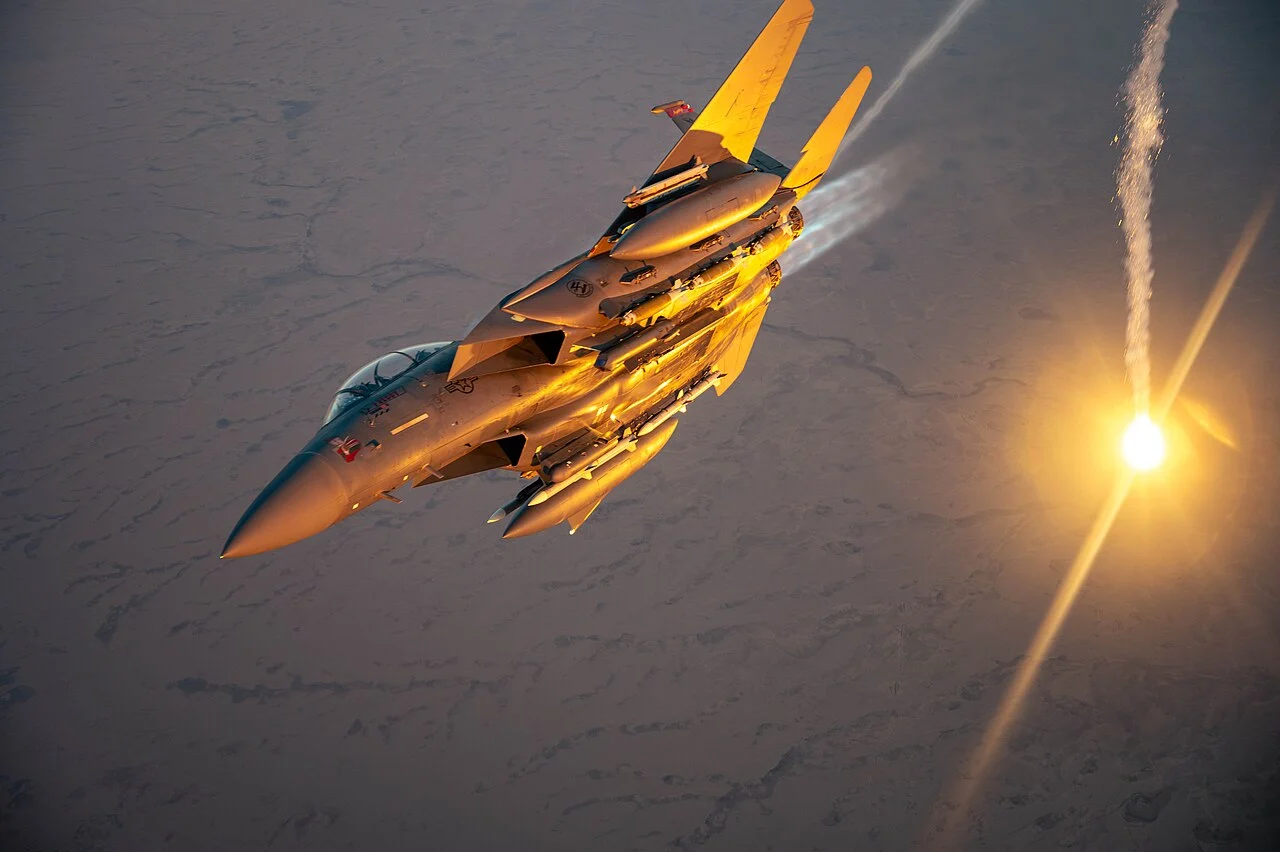
The F-15E Strike Eagle, which entered US Air Force service in 1988, is a two-seat dual-role variant re-engineered for low-level strike missions while retaining air-to-air capability. Its AN/APG-70 radar added synthetic-aperture ground-mapping modes absent from the APG-63, and conformal fuel tanks became a standard structural feature rather than an option, extending range and payload for the rear-seat weapon systems officer’s strike mission set. The F-15E is the structural and systems basis for every subsequent MENA export variant covered below.
No MENA air force operates the baseline F-15E itself; Saudi Arabia, Israel and Qatar each received distinct export derivatives built on the same airframe but with different avionics, reflecting separate negotiations over what US technology could be released to each customer. Worldwide, the F-15E remains in front-line US Air Force service, and derivatives also equip South Korea (F-15K) and Singapore (F-15SG).
4. F-15S — Saudi Arabia’s first Strike Eagle derivative
Ordered in 1993 under the “Peace Sun IX” programme and delivered between 1995 and 1999, the F-15S gave the Royal Saudi Air Force 72 aircraft built on the F-15E’s strike-capable airframe. Because Washington judged the F-15E’s full avionics suite too sensitive for export at the time, the F-15S was fitted with downgraded, F-15C/D-level radar and mission systems rather than the US Air Force’s own APG-70, according to research compiled by aviation historian Joe Baugher. The result was an airframe with Strike Eagle range and payload but reduced air-to-ground precision compared with the US Air Force standard.
The F-15S remains in Royal Saudi Air Force service and has been progressively brought closer to the later F-15SA configuration; Boeing’s 2016-2020 F-15SA programme included both new-build aircraft and modernisation of part of the existing F-15S fleet. Worldwide, the F-15S was built exclusively for Saudi Arabia. Status: operational, with a subset of the fleet upgraded to F-15SA standard.
5. F-15I Ra’am — Israel’s Strike Eagle
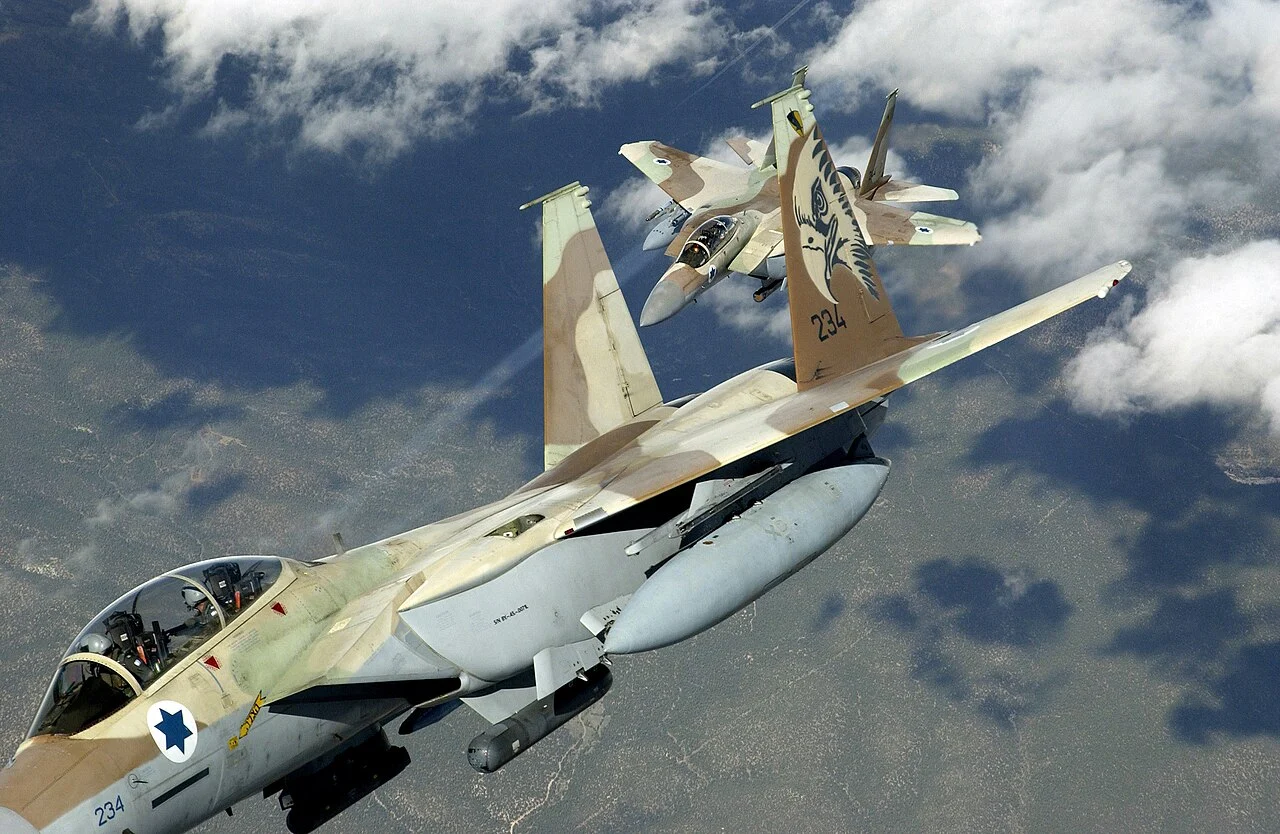
Israel’s F-15I Ra’am (“Thunder”) entered service in 1998 as a long-range strike variant built on the F-15E airframe but fitted with an indigenous Israeli avionics and electronic-warfare suite developed with Elbit Systems and Rafael rather than the standard US Air Force fit, giving the Israeli Air Force sovereign control over its mission systems and weapons integration. Twenty-five aircraft were delivered by 1999 and remain in service with 69 Squadron (“The Hammers”) at Hatzerim air base.
The F-15I has flown Israel’s longest-range strike missions, including operations attributed to it in regional media covering deep-strike campaigns in 2024-2025. Worldwide, the F-15I was built exclusively for Israel. Status: operational, and reportedly under negotiation for an avionics upgrade to bring its cockpit and sensor fit closer to the F-15EX/F-15IA standard, according to TWZ reporting citing Israeli procurement requests.
6. F-15SA — Saudi Arabia’s Advanced Eagle
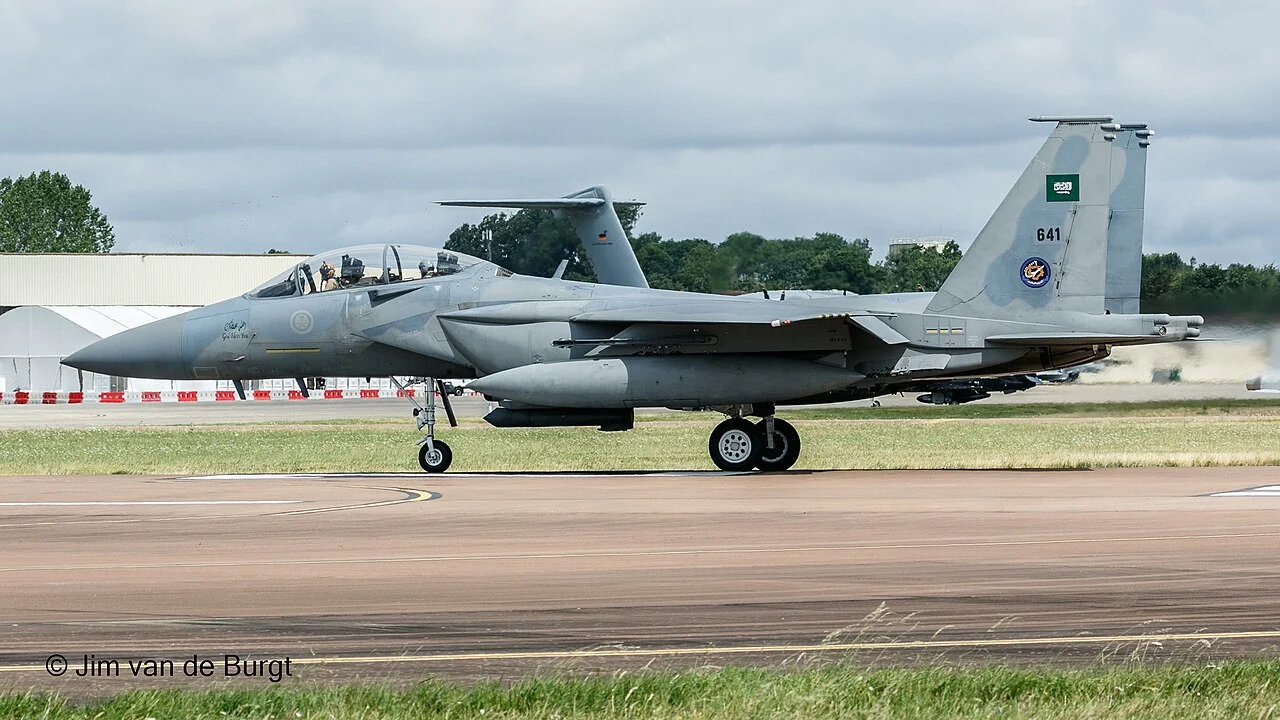
The F-15SA (“Saudi Advanced”) was a generational jump for the Royal Saudi Air Force: fly-by-wire flight controls replacing the mechanical linkages of earlier Eagles, the AN/APG-63(V)3 active electronically scanned array (AESA) radar, an infrared search-and-track (IRST) system, and BAE Systems’ digital electronic warfare system (DEWS). The aircraft switched to General Electric F110-GE-129 engines, later adopted by Qatar’s F-15QA too. Saudi Arabia contracted for 84 new-build F-15SA aircraft and the upgrade of roughly 70 existing F-15S airframes to the same standard, with new-build deliveries running from 2016 to 2020.
The F-15SA forms the backbone of Saudi Arabia’s air-superiority and strike capability today, and the US State Department’s February 2026 approval of a possible $3 billion sustainment package for the RSAF’s F-15 fleet, reported by FlightGlobal and Army Recognition, underscores its continued central role. Worldwide, the F-15SA was built exclusively for Saudi Arabia, though its fly-by-wire architecture and F110 engine fit directly informed the later F-15QA and F-15EX designs. Status: operational.
7. F-15QA Ababil — Qatar’s Advanced Eagle
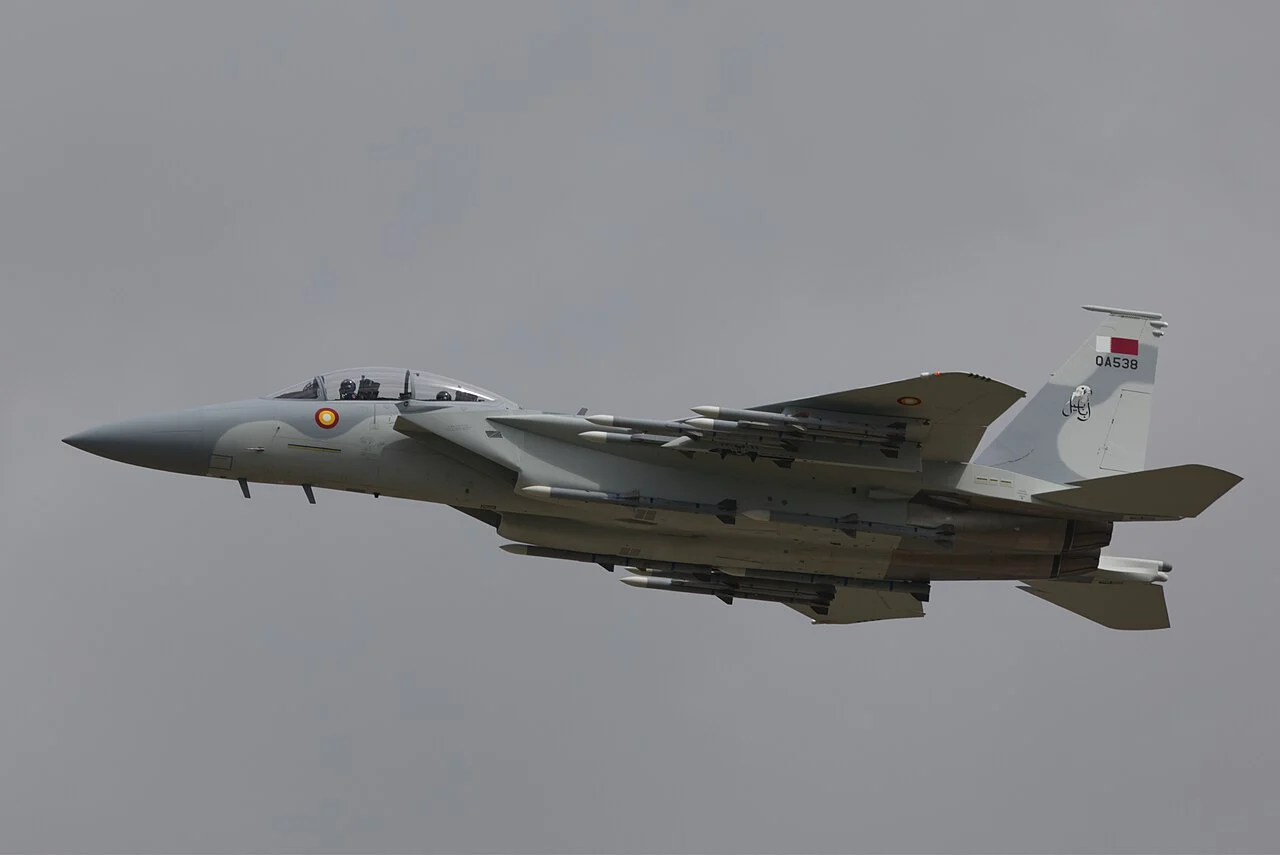
Contracted in 2017 in a package Boeing and Qatari officials valued at up to $12 billion, the F-15QA “Ababil” (Swift) was, at its 2021 introduction, the most advanced F-15 variant ever built, predating the US Air Force’s own F-15EX. It carries the AN/APG-82(V)1 AESA radar, combining the processing architecture of the F/A-18E/F’s APG-79 with an APG-63(V)3-derived antenna, alongside BAE Systems’ DEWS suite and twin 10-by-19-inch Large Area Displays replacing the multiple smaller screens of earlier Eagles. Like the F-15SA, it uses fly-by-wire controls and F110-GE-129 engines.
Qatar’s first F-15QA flew in April 2020, and Boeing completed delivery of all 36 aircraft ordered by 2024, according to defence-industry.eu reporting; the jets equip the Qatar Emiri Air Force’s 11 Squadron. The contract retains an option for additional aircraft, though no confirmed order for further QA-standard jets had been announced as of September 2026. Worldwide, the F-15QA was built exclusively for Qatar. Status: operational.
8. F-15EX Eagle II — the US Air Force’s new-build Eagle
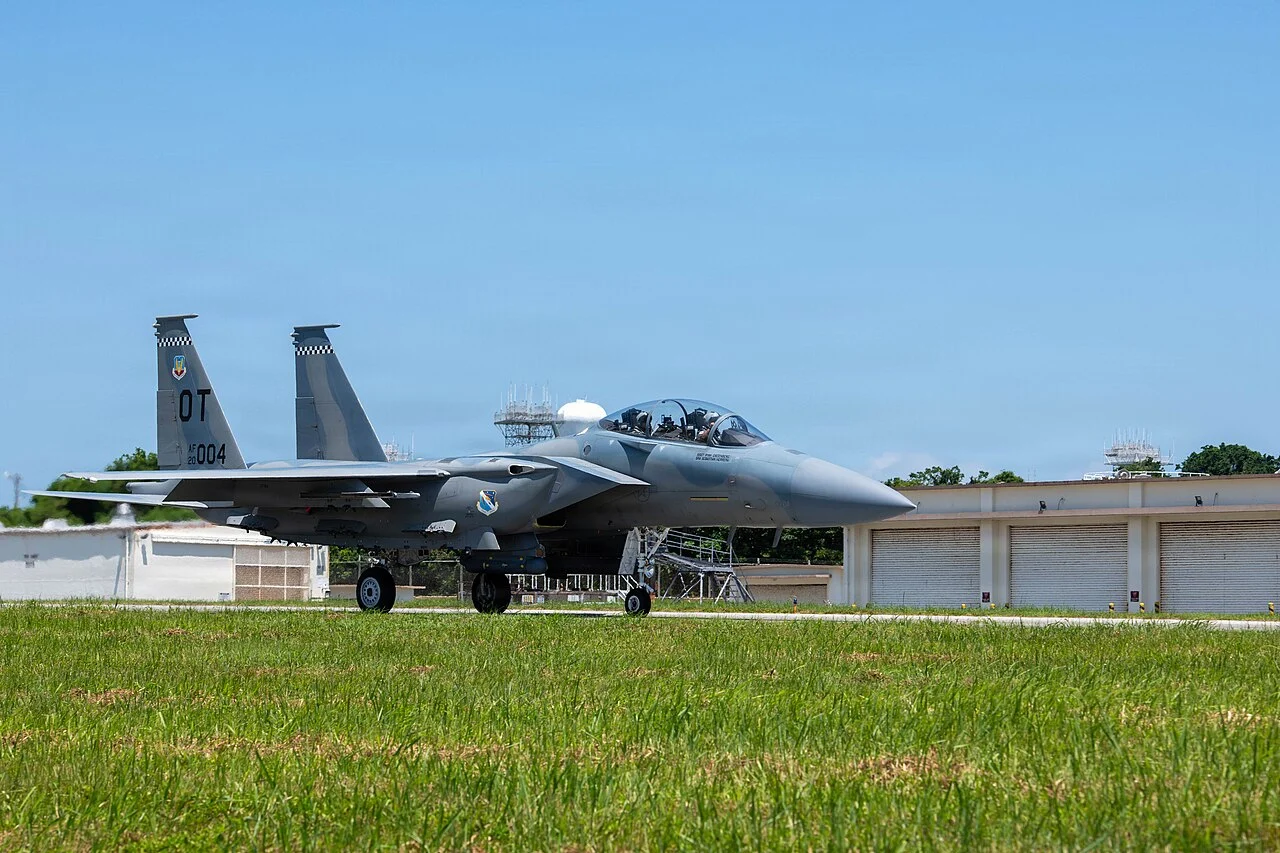
The F-15EX Eagle II is the US Air Force’s own new-build Eagle, structurally and electronically derived from the F-15QA rather than the older F-15E, sharing the AN/APG-82(V)1 AESA radar, fly-by-wire controls and F110-GE-129 engines. Its main difference from the Qatari jet is the electronic warfare suite: BAE Systems’ AN/ALQ-250 EPAWSS, a USAF-specific successor to the DEWS family fitted to the export SA and QA variants, plus compatibility with the AIM-260 missile under development.
The programme has faced production delays: Boeing had delivered 18 of 33 contractually required F-15EX aircraft as of April 2026, according to defence-industry.eu and Air & Space Forces Magazine reporting, with a 2025 labour strike at Boeing’s St Louis facilities cited as a factor; full delivery of the current contract lot is now projected to slip into 2027. Despite the delays, the US Air Force’s FY2027 budget request more than doubled the planned total buy from 129 to 267 aircraft. Worldwide, the F-15EX is flown solely by the US Air Force; no MENA air force currently operates it, though its systems and airframe directly underpin Israel’s F-15IA, below. Status: in production, entering operational service.
9. F-15IA — Israel’s newest Eagle
The F-15IA (“Israel Advanced”) is Israel’s version of the F-15EX Eagle II, contracted on 29 December 2025 in a deal worth up to $8.5 billion for 25 aircraft with an option for 25 more, according to The Aviationist and TWZ. It is the first entirely new-build Eagle airframe Israel has ordered since the F-15I contract of the 1990s. Reported specifications include the F110-GE-129 engine, AN/APG-82(V)1 AESA radar, conformal fuel tanks giving a reported ferry range approaching 12,000 nautical miles, and digital fly-by-wire controls, closely mirroring the F-15EX baseline with Israeli-specific systems integration.
Deliveries are expected to begin in 2026 and continue into the mid-2030s. Reporting in May 2026 indicated the programme may expand toward a second full squadron of roughly 50 aircraft, intended primarily to replace the Israeli Air Force’s remaining F-15A-D “Baz” airframes, some in service since 1979, while continuing to operate alongside the F-15I and the growing F-35I fleet. Worldwide, the F-15IA is being built exclusively for Israel. Status: ordered, with deliveries not yet reported as complete as of September 2026.
Which variants are operated in the MENA region?
Saudi Arabia flies the broadest cross-section of the family: F-15C/D air-superiority jets from the 1980s Peace Sun programme, F-15S Strike Eagle derivatives from the 1990s, and the advanced F-15SA that anchors the Royal Saudi Air Force’s strike and air-defence posture today. Qatar operates a single, uniform fleet of 36 F-15QA Ababil aircraft delivered 2021-2024. Israel simultaneously operates the oldest F-15s still flying combat missions, the F-15A-D “Baz,” alongside the F-15I Ra’am from the late 1990s, and has now contracted for the newest variant in the family’s history, the F-15IA. No other MENA state operates the F-15 family.
| Variant | First flight / service entry | Key change |
|---|---|---|
| F-15A/B Eagle | 1972 / 1976 | Baseline air-superiority Eagle, APG-63 radar |
| F-15C/D Eagle | 1979 | More internal fuel, higher gross weight, conformal tanks option |
| F-15E Strike Eagle | 1986 / 1988 | Two-seat dual-role strike variant, APG-70 radar, CFTs standard |
| F-15S | 1995 | Saudi export Strike Eagle airframe, downgraded C/D-level avionics |
| F-15I Ra’am | 1997 / 1998 | Israeli Strike Eagle variant, indigenous avionics and EW suite |
| F-15SA | 2013 / 2016 | Fly-by-wire, AESA APG-63(V)3, F110 engines, IRST, DEWS |
| F-15QA Ababil | 2020 / 2021 | AESA APG-82(V)1, DEWS, Large Area Displays, F110 engines |
| F-15EX Eagle II | 2021 / 2024 | USAF new-build on QA airframe, EPAWSS EW suite, AIM-260 ready |
| F-15IA | Contracted 2025, deliveries from 2026 | Israel’s F-15EX derivative, replacing the F-15A-D Baz fleet |
Why it matters for the MENA region
The F-15 family’s evolution tracks the region’s air-power balance directly. Saudi Arabia’s roughly 210-strong fleet across three generations gives the Royal Saudi Air Force numerical depth few regional air arms can match, though it also means sustaining three distinct avionics standards at once, a factor behind the February 2026 sustainment package covering the older jets alongside the SA fleet. Qatar’s single, uniform, top-specification F-15QA fleet reflects a smaller air force prioritising commonality and the highest available mission-systems standard over fleet size.
Israel’s position is distinct: it is retiring the oldest operational F-15s anywhere while contracting for the newest, a decision defence media reporting has linked to the intensity of the 2024-2025 air campaigns against Iran and Iranian-aligned targets. For the region as a whole, the F-15 remains the default heavy, long-range strike and air-superiority platform for states that can afford it, with each export customer’s avionics standard negotiated individually, producing a genuinely differentiated regional fleet rather than a single common type.
Sources
- FlightGlobal — Saudi Arabia requests $3bn support deal for Boeing F-15 fighter fleet, February 2026
- Army Recognition — US approves $3bn sustainment programme for Saudi F-15 fleet, February 2026
- Army Recognition — WDS 2026: Saudi F-15SA fighter jets demonstrate combat-ready capabilities
- Joe Baugher — McDonnell Douglas/Boeing F-15S for Saudi Arabia
- defence-industry.eu — Boeing delivers final batch of F-15QA Ababil fighters to Qatar
- The Aviationist — Israel signs contract for 25 F-15IA aircraft
- TWZ — Israel rearming its Eagle force with the new F-15IA
- defence-industry.eu — US Air Force projects F-15EX Eagle II full operational capability in early 2028
- Air & Space Forces Magazine — F-15EX Eagle II
- BAE Systems — EPAWSS product page
- Wikipedia — Boeing F-15EX Eagle II (background reference)
Related: How Strong Is Saudi Arabia’s Military? | Qatar’s Small Army and Very Large Arsenal, Explained | The Biggest Defence Deals of Saudi Arabia