Egypt buys more foreign weapons than any Arab state except Saudi Arabia, and from more different countries than almost any military in the world. That spread is often read as independence. A closer look at who builds, arms, fuels and fixes each platform shows something more layered: dependency has not disappeared, it has been distributed.
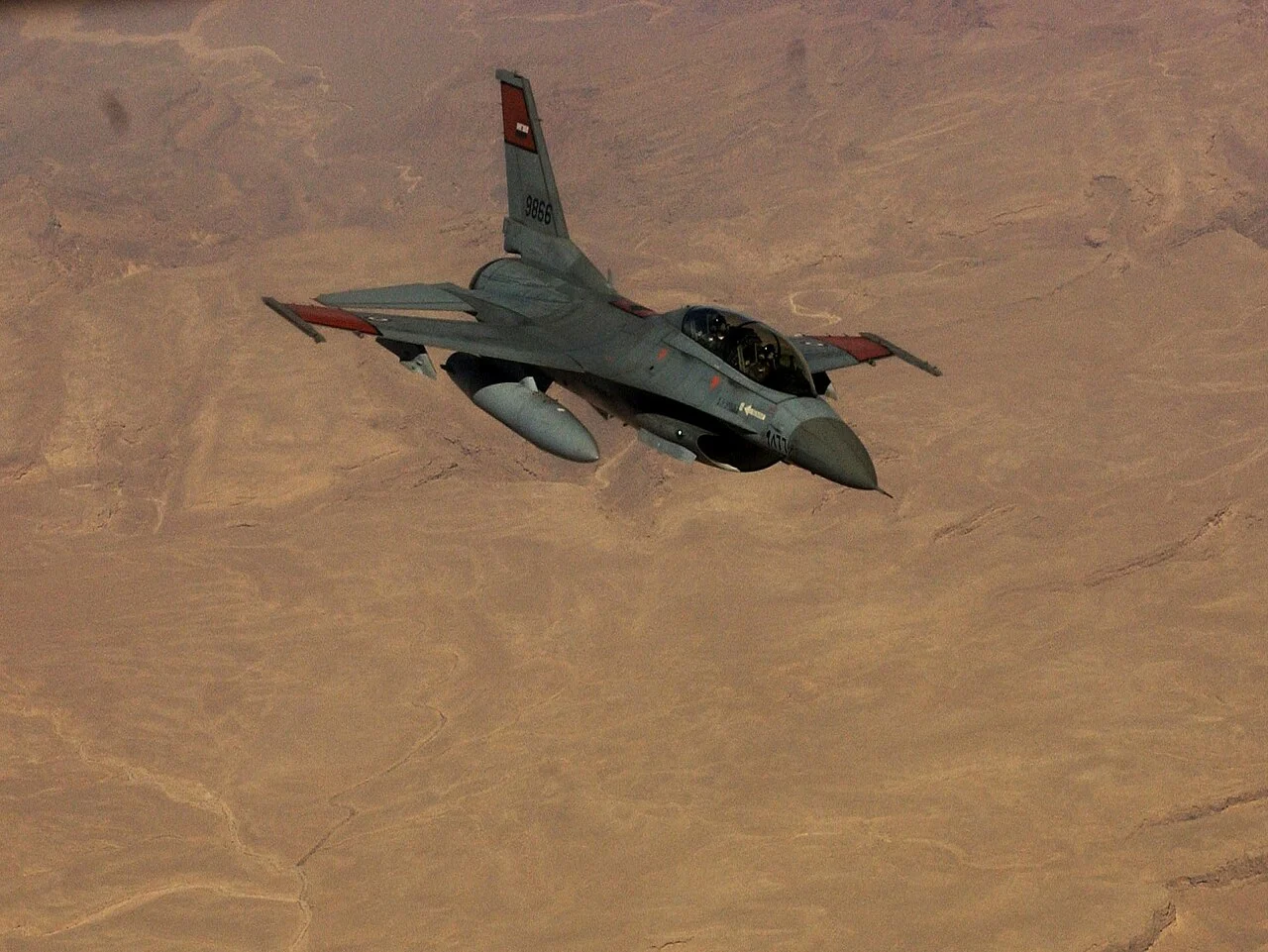
Photo: An Egyptian Air Force F-16 Fighting Falcon prepares for in-flight refueling training with a U.S. Air Force KC-135 Stratotanker, November 2007. Credit: U.S. Air Force photo/Staff Sgt. Amy Abbott, public domain, via Wikimedia Commons
Key points
- Egypt was the world’s seventh-largest arms importer in 2019-2023, drawing major platforms from Russia, France, Germany, Italy, the United States, China and South Korea in the same period, according to SIPRI.
- The Su-35 purchase was abandoned after explicit CAATSA warnings from Washington, while more than 200 US-origin F-16s remain the backbone of the air force and stay tied to American spares, munitions and software support.
- France, Germany and South Korea have each moved beyond simple sales into local assembly, component manufacturing or technology transfer through the Arab Organization for Industrialization (AOI), the most consequential shift of the past five years.
- Russian-origin combat aircraft (MiG-29M/M2) and air defence systems still depend on a Russian supply chain for engines, radars and munitions that Cairo cannot easily substitute without political cost.
- Diversification has cut Egypt’s exposure to any single supplier’s political leverage, but it has multiplied the number of munitions types, maintenance contracts and training pipelines the armed forces must sustain in parallel.
A supplier map with no single anchor
Egypt’s arms procurement since the mid-2010s reads less like a shopping list than a hedging strategy. SIPRI’s Arms Transfers Database shows Egypt receiving 20 combat aircraft from Russia, 3 frigates and long-range missiles from France, 3 frigates and 2 submarines from Germany, and 2 frigates from Italy in 2019-2023 alone, on top of a long-running US Foreign Military Sales relationship built around the F-16 fleet. Add South Korea‘s K9 self-propelled howitzers, Chinese Wing Loong and WJ-700 drones, and Italian FREMM frigates purchased earlier in the decade, and Egypt now operates a wider mix of national-origin platforms than any other Arab air force or navy, a spread detailed in DefenceMENA’s broader look at how strong Egypt’s military is in 2026 and in its comparison with Algeria’s more Russia-centred force.
That breadth is deliberate. Cairo’s turn to Russia and France after 2013 was a direct response to a temporary US suspension of some military aid following the change of government that year, a episode the Egyptian military has not forgotten. The lesson drawn in Cairo was that a single dominant supplier is a political vulnerability, not just a logistical convenience. The result, a decade later, is a force structure where no one country can credibly threaten to ground the Egyptian military by withholding support on its own — but where Egypt instead manages seven or eight separate supply relationships, each with its own political terms.
| Capability | Main supplier | Dependency level | Main risk | Alternative |
|---|---|---|---|---|
| Fighter aircraft (F-16) | United States (Lockheed Martin) | High | ITAR-controlled spares, munitions and software; end-use monitoring | Rafale fleet expansion; MiG-29M for high-end sorties |
| Fighter aircraft (Rafale) | France (Dassault Aviation) | Medium-High | Single-source airframe and Safran M88 engine; French export licence for weapons integration | AOI co-production reduces but does not remove French control of core systems |
| Fighter aircraft (MiG-29M/M2) | Russia (RAC MiG) | Medium | RD-33MK engine and munitions supply chain, CAATSA exposure on any expansion | Limited; further Russian orders carry sanctions risk |
| Air defence | United States / Germany (Diehl, mixed with legacy Soviet systems) | Medium | Fragmented inventory across US Hawk/NASAMS-family and European systems | Domestic integration by AOI on some subsystems |
| Tanks / armour | United States (M1A1 Abrams, co-produced) | Low-Medium | Co-production licence terms, US-controlled fire-control components | Substantial local assembly reduces exposure |
| Naval systems (frigates, submarines) | Germany / France / Italy | Medium | European export licences, combat-system integration by multiple OEMs | Local frigate construction at Alexandria Shipyard underway |
| Artillery (K9 Thunder) | South Korea (Hanwha) | Low-Medium | Early-stage local production, still reliant on Korean subsystems | Technology transfer under way at Factory 200 |
| UAVs | China (Wing Loong, WJ-700) | Medium | Limited transparency on munitions and data-link sourcing | Domestic UAV programmes and Turkish co-production (Hamza-1 with Havelsan) |
| Trainers | China (K-8E, license-built) | Low | Minimal, largely localised since 2000s | Already substituted through AOI production |
Dependency levels are DefenceMENA’s editorial assessment based on the sources listed below, not an official rating.
Dependence by category, not by country
Platform. Egypt’s combat fleet is split roughly three ways between roughly 200 F-16s of various blocks, a Rafale fleet built up through 2015 and 2021 contracts and now the subject of a reported request for 24 more aircraft that would take the total to 78, and about 50 MiG-29M/M2s delivered from 2017. Each platform is a separate ecosystem with its own spares pipeline, simulators and pilot-training track; none can substitute for another without years of retraining.
Engine. The F-16 fleet runs on US-built Pratt & Whitney or General Electric engines subject to American export controls. The Rafale depends on the Safran M88, sole-sourced from France; Egypt’s AOI has moved into engine maintenance for smaller French Larzac engines used on Alpha Jets, but full M88 overhaul capability has not been localised. The MiG-29M2’s RD-33MK is entirely Russian-sourced, with no announced local maintenance line.
Weapons and munitions. Munitions are frequently the least diversified layer. US-origin AIM-9 and AIM-120 missiles for the F-16 require State Department approval for each sale; French air-to-air and air-to-ground munitions for the Rafale are licensed separately by Paris; Russian R-77 and R-73 missiles for the MiG-29M come through a distinct Moscow-controlled channel. Owning three fighter types means managing three separate munitions-resupply relationships, each capable of being slowed by its own supplier’s political decision.
Sensor. Radar and electronic-warfare suites are similarly split: AN/APG-68 on the F-16, Thales RBE2 AESA on the Rafale, Zhuk-ME on the MiG-29M. Each requires its own software support contract and, for the F-16 and Rafale, US or French sign-off on any third-country technology sharing.
Software. Mission software, data links and avionics on the F-16 remain closed systems controlled from the United States; Egypt cannot modify core flight or weapons software without US cooperation. The Rafale’s software ecosystem is similarly closed to Dassault and Thales, though France has historically been more flexible on integration requests from export customers, as seen with other Rafale operators.
Maintenance. This is where the picture has shifted most since 2020. AOI now performs structural maintenance and, since 2024, some component manufacturing for the Rafale under an expanded partnership with Dassault Aviation, and in September 2024 signed an agreement with Safran covering Larzac engine maintenance in Egypt. AOI showcased Egyptian-made Rafale wing components at EDEX 2025, evidence of a real, if partial, shift from pure maintenance to component-level industrial participation. No comparable local maintenance capability exists yet for the MiG-29M’s Russian-sourced systems.
Political. Every US-origin sale to Egypt requires State Department and often Congressional notification through the DSCA Foreign Military Sales process, with end-use monitoring attached. France applies its own export licensing regime, generally less publicly contested than the US process but still a sovereign veto point. Russia’s willingness to sell further high-end aircraft to Egypt is now constrained less by Moscow’s preference than by Washington’s CAATSA threat, demonstrated in practice when Egypt shelved its planned Su-35 purchase after Secretary of State Mike Pompeo warned that the CAATSA statute would require sanctions if the deal went ahead.
Industrial. AOI, founded in the 1970s, remains the backbone of what local production exists: license-built K-8E trainers with China since 2000, growing Rafale component work with France, and now K9 Thunder artillery production with South Korea’s Hanwha at Factory 200 under a technology-transfer arrangement. None of these programmes give Egypt full design authority; all remain licensed production or component supply within foreign-controlled architectures.
Sanction and export-control exposure
Egypt’s most direct brush with CAATSA came over the Su-35. Cairo signed a roughly $2 billion contract for the Russian fighter in 2018, but after repeated US warnings — including Pompeo’s explicit statement that CAATSA sanctions would follow — the order was quietly abandoned by around 2020-2022, with reporting suggesting some of the airframes were later diverted to Iran. Egypt bought Rafales instead. The episode shows CAATSA functioning less as an automatic trigger than as a credible deterrent: no sanctions were actually imposed, because the disputed purchase never went through in the end.
For the F-16 fleet, exposure runs through ordinary ITAR and FMS mechanics rather than CAATSA: every major sale, from the 2025 approval of National Advanced Surface-to-Air Missile System support to the 2025 Fast Missile Craft Modernization case, moves through DSCA notification, with end-use monitoring and re-export restrictions attached as standard FMS conditions. These are not sanctions; they are the routine cost of operating US-origin systems, and they apply regardless of the state of US-Egypt relations.
Russian systems already in service — the MiG-29M/M2 fleet, older air-defence equipment — sit in a different category. They were delivered before CAATSA-era scrutiny intensified and are not now subject to new sanctions for continued operation, but any significant expansion of the Russian relationship, additional aircraft, new air-defence systems, would revive the same political calculation that killed the Su-35 deal.
Local industry and what it can take over
AOI’s trajectory over the past decade is the clearest evidence that Egypt’s diversification strategy has an industrial component, not just a procurement one. The K-8E trainer programme with China, running since the early 2000s, shows what a mature localisation track looks like: over a hundred aircraft assembled domestically with limited residual foreign dependency beyond a few subsystems. The Rafale relationship is following a similar but earlier-stage path, from maintenance to component manufacturing since 2021, and the K9 howitzer deal with South Korea explicitly includes technology transfer and Egyptian production at Factory 200.
What AOI cannot yet do is design and certify a fast jet, a modern naval combat system or a high-end air-defence radar from scratch. Its role remains that of a trusted, increasingly capable licensed producer and maintenance partner across multiple foreign architectures, rather than an independent developer. That distinction matters for how much genuine autonomy the diversification strategy has actually purchased.
Alternatives
For the F-16 fleet’s long-term sustainment, Egypt’s practical alternatives are limited: expanding the Rafale fleet toward the reported 78-aircraft target reduces reliance on any single Western supplier without escaping Western export-control frameworks altogether. A further, politically improbable option would be additional Russian aircraft, which would reopen the CAATSA question. For air defence, European systems from Germany and France offer partial alternatives to a fragmented mixed inventory, though integration costs are non-trivial. For artillery and land systems, the South Korean model — Hanwha’s technology-transfer approach with K9 — offers a template Egypt could extend to other categories, since Seoul has historically imposed fewer end-use restrictions than Washington or Moscow. None of these options removes foreign dependency; each simply changes which government holds leverage over which system.
Switching cost
Every fighter type Egypt operates trains its own pilots, requires its own simulators, and depends on airbase infrastructure built around specific munitions, fuel and maintenance equipment. Retiring the F-16 fleet in favour of an all-Rafale or all-MiG-29 force is not a paper exercise: it would mean retraining several thousand personnel, rebuilding logistics chains for a single munitions family, and absorbing years of reduced readiness during the transition. The same logic applies at the naval level, where German, French and Italian-built ships each carry different combat management systems, sensors and weapons that Egyptian crews and shore facilities must support in parallel. Diversification bought political flexibility; it also means Egypt now pays the fixed cost of maintaining, training for, and stocking munitions across systems, instead of once.
Diversification: what it solved and what it complicated
Egypt is the clearest illustration in the region of the diversification trade-off. Spreading acquisitions across the United States, France, Russia, Germany, Italy, China and South Korea has meant that no single supplier can hold Cairo’s entire air force or navy hostage to a bilateral dispute, a real gain in strategic flexibility compared to the near-total dependence on Soviet and then American equipment in earlier decades. Egypt’s 2013-2014 experience with a partial US aid suspension is the direct cause of that strategy, and by that measure it has worked: Cairo now has options that did not exist a decade ago.
The cost is complexity. The air force alone must sustain distinct munitions stocks, training pipelines, simulators and maintenance contracts for F-16, Rafale and MiG-29M fleets simultaneously, a logistical burden that did not exist under a single-supplier model. The navy faces a comparable challenge across German, French and Italian-built ships. Each new supplier relationship reduces political risk at the margin while adding a fixed administrative and logistical cost that persists for the operational life of the platform, typically decades.
DefenceMENA Autonomy Index: Egypt
| Criterion | Weight | Score | Justification |
|---|---|---|---|
| Domestic manufacturing | 20 | 9 | AOI produces trainers, growing Rafale components and howitzers under licence, but no indigenous fast jet or major warship design |
| Local maintenance | 15 | 8 | Real Rafale and Alpha Jet engine maintenance capability since 2024; limited for Russian and German-origin systems |
| Local ammunition | 15 | 4 | Munitions for F-16, Rafale and MiG-29M all imported from their respective suppliers, with minimal domestic production |
| Supplier diversification | 15 | 13 | Among the most diversified inventories in the region, spanning seven-plus supplier countries |
| Critical components | 15 | 5 | Engines, radars and mission software for all major platforms remain foreign-controlled |
| Technology transfer | 10 | 7 | Active transfer arrangements with France (Rafale components) and South Korea (K9), less with the US or Russia |
| Export-control exposure | 10 | 4 | Heavy ITAR/FMS exposure for the F-16 fleet plus demonstrated CAATSA sensitivity over the Su-35 |
Total: 50/100. DefenceMENA editorial analytical index, not an official ranking.
Why it matters for the MENA region
Egypt is often cited elsewhere in this series as the model case for supplier diversification, and the comparison is deserved: no other Arab military manages as many distinct, technologically serious supplier relationships at once. But the Egyptian case also shows the limits of diversification as a strategy. Spreading risk across seven or eight suppliers has not produced an autonomous defence industrial base; it has produced a more resilient but more complex dependency structure, one where AOI’s growing role in maintenance and component production is real progress without yet adding up to independence. For neighbours weighing whether to imitate the Egyptian model, the lesson is that diversification buys political room to maneuver, not self-sufficiency, and that room comes at a permanent logistical price.
Sources
- SIPRI Yearbook 2024, International Arms Transfers (2024)
- SIPRI, Trends in International Arms Transfers 2023 (2024)
- US Defense Security Cooperation Agency notification via GlobalSecurity.org, Egypt – National Advanced Surface-to-Air Missile System (2025)
- The Defense Post, US Approves Sale of Modernization Kits for Egypt’s Fast Missile Craft (2025)
- Anadolu Agency, Pompeo: Egypt would face sanctions over Russian Su-35s (2019)
- Military Africa, Egypt’s Sukhoi Su-35Es sold to Iran due to US pressure (2022)
- Safran Group, AOI and Safran sign agreement for Larzac engine maintenance in Egypt (2024)
- Army Recognition, EDEX 2025: Egypt begins certified Rafale component production (2025)
- Defense News, Egypt inks $1.7 billion deal for K9 howitzers from South Korea (2022)
- Army Recognition, Egypt launches local production of K9A1 Thunder howitzer (2026)
- defenceWeb, TKMS launches Egypt’s fourth Type 209 submarine and confirms local frigate production (2021)
- Army Recognition, Egypt sends proposal request to France for 24 additional Rafale fighters (2026)