Iraq does not have one army. It has a federal military under the Ministry of Defence, an elite Counter Terrorism Service that answers to the prime minister, a state-funded paramilitary umbrella called the Popular Mobilization Forces, and a Kurdish Peshmerga that completed a formal merger of its two wings only this week. Each has different equipment, funding and loyalties, and any single “Iraq military strength” number hides that. This profile separates them, then sets out what Iraq really operates from the United States, Russia, China, France, South Korea and Turkey, and where the air-defence gap still sits.
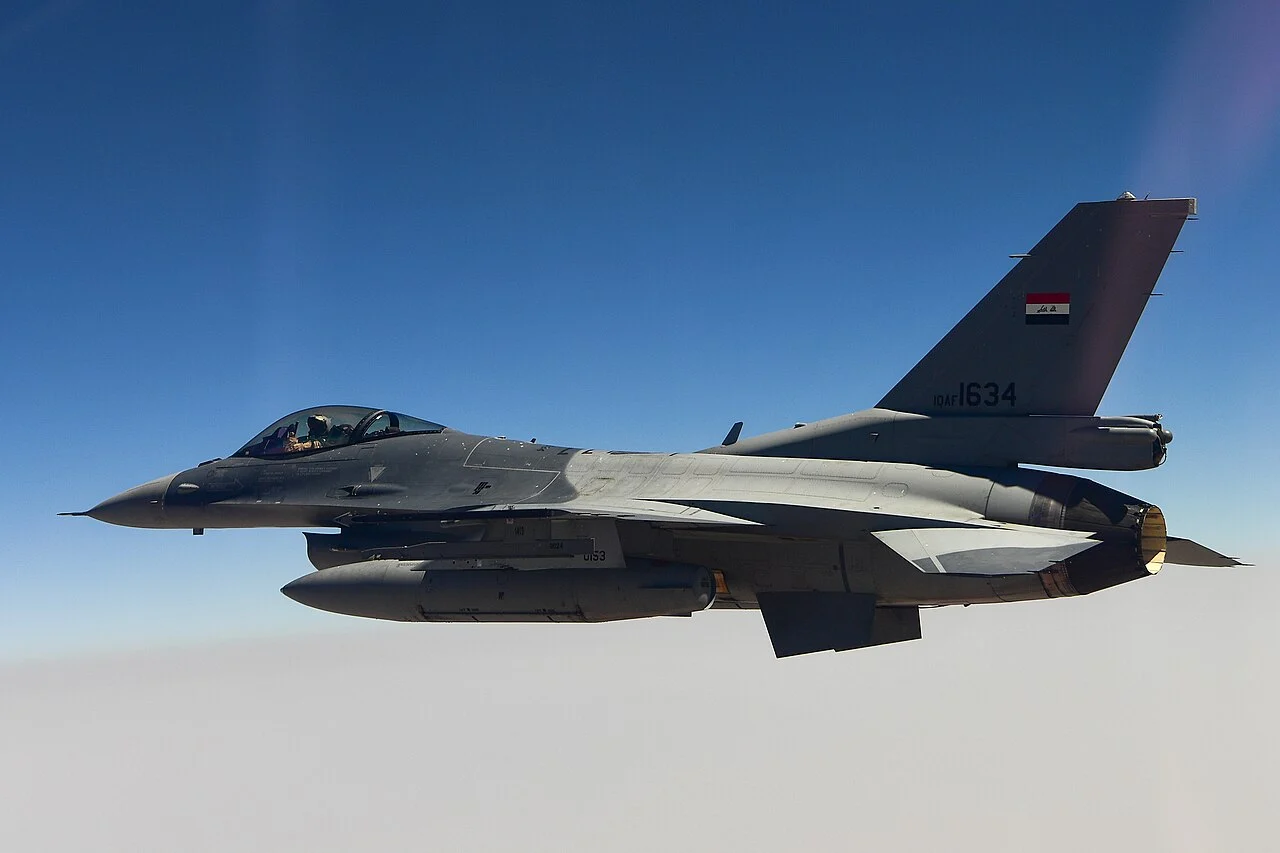
Photo: An Iraqi Air Force F-16 Fighting Falcon flies over an undisclosed location, 18 July 2019. Credit: Staff Sgt. Christopher Drzazgowski, US Air Force, public domain, via Wikimedia Commons
The short answer to how strong Iraq’s military is depends on what is being counted. By money, Iraq is a middle spender: SIPRI puts its 2025 military expenditure at about US$6.4 billion, 40th in the world. By headcount it is large, because the state pays several security bodies at once. By modern equipment it is thin: a small F-16 fleet that depends on American contractors, Russian armour and helicopters bought in the 2010s, and an air-defence layer that is only now being rebuilt. Every line below carries a status label. An order is not a delivery, and a delivery is not an operational unit.
| Indicator | Figure | Year / source |
|---|---|---|
| Military expenditure | About US$6.4 billion, 40th largest spender | SIPRI, 2025 |
| Arms imports rank | Not among the 40 largest recipients of major arms in 2021–25 (the 40th, Thailand, had a 0.5% share) | SIPRI Arms Transfers Database, March 2026 |
| Popular Mobilization Forces | About 238,000 personnel; 2024 budget about US$3.4 billion | Congressional Research Service, June 2026 |
| Counter Terrorism Service | Roughly 14,000 (Estimated, open-source) | Reported 2024 |
| Fighter fleet | 34 F-16IQ reported | Army Recognition and The Defense Post, 2025 (Estimated) |
| Air defence, flagship programme | 8 Cheongung-II (KM-SAM Block II) batteries, US$2.8 billion contract | Iraqi Ministry of Defence announcement, September 2024 |
| US and coalition presence | Fewer than 2,000 US troops after the 2025 drawdown, mostly in Erbil; coalition mission to end during 2026 | Pentagon statement, 1 October 2025; CRS, June 2026 |
| US train-and-equip funding | More than US$8.4 billion appropriated since 2014 | CRS, June 2026 |
| Main foreign suppliers | United States, Russia, France, South Korea, China; Turkey planned | Reported; see sections below |
Security environment and who commands what
The Congressional Research Service, updating its Iraq brief on 8 June 2026, describes a government under a new prime minister, Ali Al Zaydi, sworn in during May 2026, and a security picture shaped by the wider conflict involving Iran. It records that since February 2026 Iran-backed Iraqi armed groups have carried out hundreds of attacks on US forces in Iraq and on civilian targets in the Kurdistan Region and neighbouring countries, and that Iraq’s airspace has seen unilateral military operations by Israel, Iran, Turkey and the United States. Those are documented statements, not forecasts, and this profile does not extend them.
The structural point matters more for anyone counting equipment. Iraq’s armed power is split across four authorities.
| Force | Answers to | Size (open source) | Note |
|---|---|---|---|
| Federal forces (Army, Air Force, Army Aviation, Navy, Air Defence Command) | Ministry of Defence | About 450,000 personnel on the Ministry’s books; Interior Ministry about 380,000 (2024, Estimated) | Payroll figures include an unknown number of inactive names; a 2014 audit found 50,000 “ghost soldiers” (Shafaq News) |
| Counter Terrorism Service (CTS) | Prime Minister | Roughly 14,000 (Estimated) | US-trained special operations force; the US FY2027 request seeks funds for it |
| Popular Mobilization Forces (PMF) | Prime Minister (state force) | About 238,000; disputed between 204,000 and 238,000 | Mixed: state-run brigades and factions with Iran-linked ties; not a single equipment pool |
| Kurdistan Region Peshmerga | Kurdistan Regional Government, Ministry of Peshmerga Affairs | No verified recent figure | Units 70 (PUK) and 80 (KDP) merged under the Ministry in September 2026 |
Federal forces
The Army, Air Force, Army Aviation, Navy and Air Defence Command sit under the Ministry of Defence, currently headed by Thabit al-Abbasi. They received the bulk of US equipment after 2003 and remain the main customer for foreign arms. Personnel numbers on the Ministry’s books are large, but Shafaq News, citing Ministry of Finance data and Iraqi officials, notes that the payroll has long included non-serving names. Treat any “450,000” as an administrative figure, not a count of combat troops.
Counter Terrorism Service
The CTS, often called the Golden Division, is the force Washington has invested in most and the one it still funds: the FY2027 request seeks nearly US$119 million for Iraq’s military and the CTS together, according to CRS. It reports to the prime minister rather than the Defence Ministry, which is why it should not be added to the Army’s numbers without comment.
Popular Mobilization Forces
The PMF was formed in 2014 from volunteers and existing militias to fight the Islamic State group and was later legally consolidated into the security sector. CRS gives about 238,000 personnel and a 2024 budget of roughly US$3.4 billion. It also notes that some armed groups have remained outside the PMF, and that Prime Minister Al Zaydi has welcomed decisions by some groups to disengage from the PMF or accept state control of weapons. A draft law that would make the PMF an autonomous body was on parliament’s agenda in March 2025 and was later withdrawn from the agenda, according to the Fair Observer and other reporting. No source reviewed publishes a reliable equipment inventory for the PMF, so this profile does not invent one.
Kurdish Peshmerga
Asharq Al-Awsat reports that the Kurdistan Region formally unified the Peshmerga in September 2026, ending a three-decade split between the KDP-aligned Unit 80 and the PUK-aligned Unit 70 under a single structure overseen by the Ministry of Peshmerga Affairs. The report notes doubts about political unity persist; CRS says the two parties had kept separate aligned units despite US efforts to unify them. The US delivered 24 M119 105 mm howitzers to the Peshmerga in August 2024 with Baghdad’s approval, according to Amwaj. The FY2027 US request does not seek funds for the Ministry of Peshmerga Affairs, per CRS.
Defence budget: what the numbers do and do not show
Three different figures circulate for “Iraq’s defence budget” and they measure different things. SIPRI’s 2025 estimate of about US$6.4 billion is a comparable international series. Iraqi budget tables published by the press are larger and less comparable: Shafaq News reported a Ministry of Defence allocation of US$21.1 billion in 2024 within a 210.9 trillion dinar federal budget, a number that plainly includes items outside the SIPRI definition and should not be set against it. For the first nine months of 2025, The National Context reported actual spending of 6.34 trillion dinars by the Defence Ministry and 10.19 trillion by the Interior Ministry, inside a wider fiscal deficit of about 8.8 trillion dinars.
Four caveats apply. First, Iraq passed a multi-year budget for 2023–2025 in June 2023, so the 2025 line largely repeats 2024, according to the CNAS analysis. Second, oil supplies most of federal revenue, so security spending moves with oil prices and export volumes; CRS flags a possible “conflict-amplified fiscal and energy crisis” under the new government. Third, the PMF is funded through a separate line that press estimates put at US$2.6–3.5 billion depending on year and method. Fourth, US assistance sits outside all of these: Congress has appropriated more than US$8.4 billion for Iraqi counter-IS train-and-equip programmes since 2014, though the FY2027 request seeks no specific Foreign Military Financing for Iraq and US$900,000 for military education.
Army and armour
Iraq’s tank fleet is a case study in mixed supply. The US delivered M1A1 Abrams from 2010 to the 9th Armoured Division. In 2016 Baghdad contracted 73 Russian T-90S and T-90SK tanks from UralVagonZavod, with deliveries starting in February 2018 and 39 going to the 35th Brigade of the 9th Division, according to The War Zone. Behind the switch was a dispute over American conditions: the Pentagon acknowledged that at least nine Abrams reached PMF units, the Defense Department later confirmed they were returned to the Ministry of Defence, and Washington and General Dynamics put restrictions on support. No recent official figure for how many Abrams are serviceable exists.
| System | Origin | Quantity | Status | Source |
|---|---|---|---|---|
| M1A1 Abrams | United States | No recent official figure | Delivered from 2010; serviceability unclear | US Army/DVIDS; Military Times, 2018 |
| T-90S / T-90SK | Russia | 73 contracted 2016; 39 to 35th Brigade | Delivered from February 2018 | The War Zone, June 2018 |
| K2 Black Panther | South Korea | About 250 discussed | Planned; no deal finalised (Hyundai Rotem, January 2026) | MarketScreener/Korea JoongAng Daily |
| K9 Thunder howitzer | South Korea | None reported | Reported (unconfirmed): Iraqi officials toured the factory in 2025 | Korea JoongAng Daily |
| Caesar 155 mm howitzer | France | Not confirmed | Reported (unconfirmed): Iraq “finalising” a deal, October 2024; no contract or delivery found | Forbes, 22 October 2024 |
| M119 105 mm howitzer (Peshmerga) | United States | 24 | Delivered, August 2024 | Amwaj, October 2024 |
The Caesar item deserves a flat statement: reports say Iraq was close to a deal for French self-propelled howitzers, but the only confirmed 2024–26 Caesar contracts found are French, Estonian and other European orders, and no Iraqi contract or delivery has been verified. Nor does any source reviewed show US AH-64 Apache helicopters in Iraqi service. The attack helicopter fleet is Russian.
Air Force and Army Aviation
The fixed-wing core is the F-16IQ, reported at 34 aircraft in 2025. Iraq began receiving them in 2014. They operate from the Martyr Brigadier General Ali Flaih air base in Salah al-Din province, where a US Air Force contract for base support, life support and security services awarded to Vectrus on 24 November 2025 was worth US$252 million and runs to 24 September 2026, following an earlier US$118 million contract in June 2025, according to The Defense Post. That reliance on American contractors is the real measure of readiness: Army Recognition also reports the fleet lacks access to modern AIM-120 and AIM-9X missiles and uses older AIM-7 and AIM-9 variants, a claim that rests on a single secondary source and is marked Estimated below.
| System | Origin | Quantity | Status | Source |
|---|---|---|---|---|
| F-16IQ Block 52 | United States | 34 (Estimated) | In service; readiness depends on US contractor support | Army Recognition; The Defense Post, 2025 |
| Rafale F4 | France | 14 discussed (10 Rafale C, 4 Rafale B) | Planned; contract not signed in sources reviewed; talks since 2022 | Army Recognition, citing Avions Légendaires, 16 December 2025 |
| Su-25 attack jet | Russia (Iran transferred some in 2014) | No recent official figure | Delivered 2014; fleet status unclear | Open-source compilation, 2014 deliveries |
| KAI T-50IQ / FA-50 offer | South Korea | T-50 bought from 2013; FA-50 and KF-21 offered in 2025 | T-50 delivered; FA-50 and KF-21 only offered; no order | Korea JoongAng Daily |
| Mi-28NE, Mi-35M | Russia | No recent official figure | In service (Army Aviation) | Open-source compilation |
| H225M Caracal | France | 12 ordered September 2024; 2 handed over 30 April 2025 | Under delivery | Overt Defense; Flight Global, 2025 |
| CH-4 / CH-5 armed drones | China | Undisclosed | In service; Army Aviation Command shown as operator in April 2024 | Janes, April 2024 |
The French route is the most recent shift. Airbus handed over the first two of 12 H225M helicopters at Marseille on 30 April 2025, and Army Recognition reports that 14 Rafale F4s, ten single-seaters and four two-seaters, have been under negotiation since 2022, with signature expected in 2026, possibly in the first half. As of this writing, no signed contract turned up in the sources available. The Rafale would not replace the F-16s; it would sit beside them. That would give Iraq the same two-supplier fighter mix seen in Egypt, covered in the Egypt profile.
Air defence: the gap and the programme meant to fill it
Iraq’s air-defence problem is old. The Washington Institute described it in 2019 as an integrated system “comprehensively diminished” in 1991 and never rebuilt, with Baghdad unable to monitor or defend its own airspace, and noted that only part of an order for US Avenger short-range systems had been delivered. What Iraq fields now is a short-range layer: AN/TWQ-1 Avenger with Stinger, Russian Pantsir-S1 gun-missile systems and Igla-S man-portable missiles. There is no verified medium or long-range layer in service.
The programme meant to change that is the Cheongung-II, known in Korea as M-SAM II or KM-SAM Block II. LIG Nex1 disclosed a 3.71 trillion won contract, about US$2.8 billion, in September 2024, and Iraq’s Ministry of Defence announced it on 19 September 2024. Army Recognition puts the buy at eight batteries. Breaking Defense noted Iraq was the third Arab customer after the UAE and Saudi Arabia. Iraqi and Korean officials have said deliveries would begin in early 2026; no source reviewed confirms a battery has arrived or become operational, so the status here is Contracted, delivery reported as expected 2026. Alongside it, Army Recognition reports Iraq planning 20 Turkish short-range systems, probably ASELSAN Korkut, though it says the specific Turkish system has not been publicly confirmed.
| Tier | System | Origin | Quantity | Status | Source |
|---|---|---|---|---|---|
| Medium range | Cheongung-II (M-SAM II / KM-SAM Block II) | South Korea | 8 batteries | Contracted September 2024; delivery reported as expected 2026, arrival not confirmed | Breaking Defense; Army Recognition |
| Long range | S-300 / S-400 | Russia | None | Talks only; an Iraqi MP said no contracts were signed | Reported via Army Recognition |
| Short range | Pantsir-S1 | Russia | No recent official figure | In service | Army Recognition, 2026 |
| Short range | AN/TWQ-1 Avenger with Stinger | United States | No recent official figure | In service | Army Recognition, 2026 |
| Point defence, counter-drone | Turkish system, probably Korkut | Türkiye | 20 planned | Planned; system not confirmed | Army Recognition, 2026 |
Compared with the layered systems described in the UAE’s integrated air and missile defence or the options in 5 Alternatives to Patriot for MENA, Iraq is many years behind and is starting with one mid-range purchase.
Drones, missiles and long-range strike
Iraq’s armed drones are Chinese. The Army Aviation Command has shown the CH-4 (100 Squadron) and the longer-range CH-5, which Janes reports it identified as an operator in April 2024; quantities are not disclosed. Iraq has no confirmed ballistic or cruise missile force in official sources. On Turkish drones, the picture is thin: in 2021 Iraq’s defence minister said Baghdad had reached a consensus with Ankara on Bayraktar TB2 drones, but the reporting reviewed shows no later contract, and no Iraqi TB2 or Akinci order is verified.
Who supplies Iraq’s forces
SIPRI’s March 2026 fact sheet lists the 40 largest arms recipients of 2021–25, and Iraq is not among them. That is a change from 2014–18, when SIPRI reported Iraq among the largest importers with imports up 139 per cent on the previous period, mainly from the US and Russia. The current pattern is diversification with smaller orders.
| Supplier | What is verified | Constraint or condition documented |
|---|---|---|
| United States | F-16IQ and support contracts (US$118 million June 2025; US$252 million November 2025); M1A1 Abrams; training and train-and-equip funding; a January 2026 State Department approval of about US$110 million of satellite terminals (per DSCA release) | End-use monitoring after Abrams reached militia units; US aid tied by Congress to curbing Iran-aligned groups (House Armed Services Committee version of the FY2027 defence bill, CRS) |
| Russia | T-90S/SK, Mi-28NE, Mi-35M, Su-25, Pantsir-S1, Igla-S | US sanctions risk on new Russian purchases (Washington Institute, 2019); S-300/S-400 talks unsigned |
| France | H225M Caracal contract and first deliveries; Rafale F4 negotiation; Caesar reported | Rafale contract unsigned in sources reviewed |
| South Korea | Cheongung-II contract; T-50 trainers since 2013; K2 and KF-21 discussed | Korea JoongAng Daily reports Iraqi officials cite price and delivery time against the Russian option |
| China | CH-4 and CH-5 armed drones | Quantities undisclosed |
| Türkiye | Planned short-range air defence, probably Korkut; TB2 discussion in 2021 with no verified deal | Turkish forces operate in the Kurdistan Region, which Baghdad opposes (CRS); DefenceArabia’s headline reports an agreement in September 2026 on a gradual handover of the Bashiqa and Zilkan camps to Iraq |
No Iranian equipment has been verified in federal Iraqi inventories. Iran-linked groups inside and outside the PMF are covered in the security discussion above; their arsenals are not documented in official sources, and this profile does not attempt to list them.
US-led coalition: what is documented
The coalition timeline is documented in official and wire-service form only. Iraq and Washington reached a two-phase plan in September 2024: the first phase, ending September 2025, had coalition forces leave Ain al-Asad and reduce their presence in Baghdad; the second, running through 2026, kept forces in Erbil to support operations against IS in Syria, according to L’Orient Today and Kurdistan24. On 1 October 2025 the Pentagon said fewer than 2,000 US troops would remain, most in Erbil, according to Stars and Stripes. CRS in June 2026 says the coalition presence was to end during 2026, that US forces have mostly left central Iraq and consolidated in Kurdistan, and that the outbreak of the Iran conflict in February 2026 “accelerated” the transition. Its account of the US plan is “counterterrorism-focused training, intelligence sharing, and episodic presence without permanent basing.” The bilateral relationship therefore continues in a different form.
Recent procurement and events, September 2025 to September 2026
| Date | Event | Value | Status |
|---|---|---|---|
| September 2025 | First phase of coalition drawdown; Ain al-Asad handed over | — | Completed (Stars and Stripes) |
| 1 October 2025 | Pentagon says fewer than 2,000 US troops will remain, mostly in Erbil | — | Official statement |
| 24 November 2025 | Vectrus awarded F-16 base support contract | US$252 million | Contracted, to 24 September 2026 |
| 16 December 2025 | Rafale F4 negotiation reported at 14 aircraft | Not disclosed | Reported (unconfirmed) |
| 14 January 2026 | US State Department approval of satellite terminals for Iraq | About US$110 million | Approved (per DSCA release) |
| January 2026 | Hyundai Rotem confirms Iraq’s interest in the K2, no deal finalised | About US$6.5 billion, analyst estimate | Planned |
| February 2026 | Iran-conflict escalation; attacks on US forces and accelerated US transition (CRS) | — | Documented |
| May 2026 | Ali Al Zaydi sworn in as prime minister | — | Documented (CRS) |
| September 2026 | Peshmerga Units 70 and 80 merged under the Ministry of Peshmerga Affairs | — | Announced (Asharq Al-Awsat) |
Modernisation priorities and what is changing
Three priorities are visible in the purchases. The first is air defence, where the Cheongung-II is the only large-scale programme and its delivery is the number to watch. The second is diversification away from a single supplier: helicopters from France, drones from China, air defence from South Korea, tank talks with Seoul. The third is sustaining what exists, which is why US support contracts for the F-16s matter as much as new aircraft. Against that, a bigger political question sits behind every purchase: who controls the equipment. The Abrams episode, the PMF law debate and the FY2027 US aid conditions all turn on that point.
For context on regional comparisons, see the profile of Saudi Arabia’s military, the analysis of main battle tanks in Arab armies, the Iraq desk, the Middle East category, and the Lebanon military strength profile, another case where a state army and a separate armed actor have to be counted apart. Arabic readers can find an Arabic-language profile on DefenceArabia.
A note on the numbers
SIPRI expenditure is an estimate built on the same definition across countries, while Iraqi budget tables mix salaries, pensions and security items. Personnel totals are administrative and include non-serving names. Inventory counts come mainly from press reports and open-source compilations; where these disagree the range is stated, and a blank means no recent official figure was found. The Iraqi Navy is not covered because no current inventory could be verified. Global Firepower’s ranking, if cited elsewhere, is an indicative composite and not an inventory. This profile will be updated as the Rafale, Cheongung-II and K2 statuses change.
Sources
- Congressional Research Service, Iraq (IF10404, updated 8 June 2026)
- SIPRI, Trends in International Arms Transfers, 2025 (March 2026)
- SIPRI, World Military Expenditure 2025
- SIPRI, Trends in International Arms Transfers, 2018 (March 2019)
- Stars and Stripes, US military begins reducing its mission in Iraq (1 October 2025)
- L’Orient Today, US-Iraq deal on troop withdrawal
- Kurdistan24, US forces to stay in Kurdistan Region until 2026
- Army Recognition, Iraq’s new air defence strategy (2026)
- Army Recognition, Iraq to acquire 14 French Rafale F4s (2026)
- Breaking Defense, Iraq boosts air defences with Cheongung-II (September 2024)
- Korea JoongAng Daily, Iraq leans on Korea in arms shift
- MarketScreener, Hyundai Rotem confirms Iraq’s interest in K2, no deal finalised
- The Defense Post, Vectrus lands US$252 million contract for Iraqi F-16s (November 2025)
- The Defense Post, Iraq inks US$118 million deal with Vectrus (July 2025)
- Flight Global, Iraq receives first H225M Caracals
- Overt Defense, Iraq receives first two H225M Caracals
- Janes, Iraqi Army Aviation Command identifies itself as CH-5 UAV operator
- The War Zone, Iraqi armoured brigade ditches M1 Abrams for T-90 tanks (June 2018)
- Washington Institute, Iraq’s air defence conundrum (2019)
- Washington Institute, Extraordinary PMF expansion by the numbers
- Shafaq News, Ghost soldiers, bloated budgets: can Iraq afford its security?
- The National Context, Iraq posts 8.8 trillion dinar deficit, January to September 2025
- CNAS, Analysis: Iraq’s new budget may hamper more than it helps
- Asharq Al-Awsat, Iraq’s Kurdistan Region officially unifies Peshmerga forces
- Amwaj, US howitzer transfer to Peshmerga stokes Iraqi fears
- Forbes, A well-armed Kurdish Peshmerga could actually benefit Iraq (October 2024)
- Fair Observer, The high cost of legalising the PMF in Iraq
- DefenceArabia, Turkey agrees gradual handover of Bashiqa and Zilkan camps to Iraq