Four African air forces still operate the Northrop F-5: Kenya, Morocco, Tunisia and Botswana. FlightGlobal’s 2025 directory lists Morocco with 22 F-5E fighters and 4 F-5F two-seaters, Kenya with 17 F-5Es and 6 F-5Fs, Tunisia with 10 F-5Es and 3 F-5Fs, and Botswana with about 15 ex-Canadian CF-5A/Ds. Morocco has upgraded its fleet most extensively; Kenya and Botswana are looking for replacements but have not funded one. Ethiopia, Libya and Sudan flew F-5s in the past and have retired them.
Quick answer
Active operators (FlightGlobal 2025 listing): Morocco 22 F-5E + 4 F-5F; Kenya 17 F-5E + 6 F-5F; Tunisia 10 F-5E + 3 F-5F; Botswana 11 CF-5A/D + 4 F-5D. Former operators: Ethiopia, Libya, Sudan. Origin: US new-build and aid deliveries (1965–1990), ex-Jordanian jets for Kenya (2010–2012), ex-Canadian jets for Botswana (1996–2000).
Last updated: 8 November 2026. Fleet figures are FlightGlobal/Cirium directory listings (published November 2024) and count aircraft in inventory, not confirmed airworthy aircraft. Delivery figures are from SIPRI and include estimates.
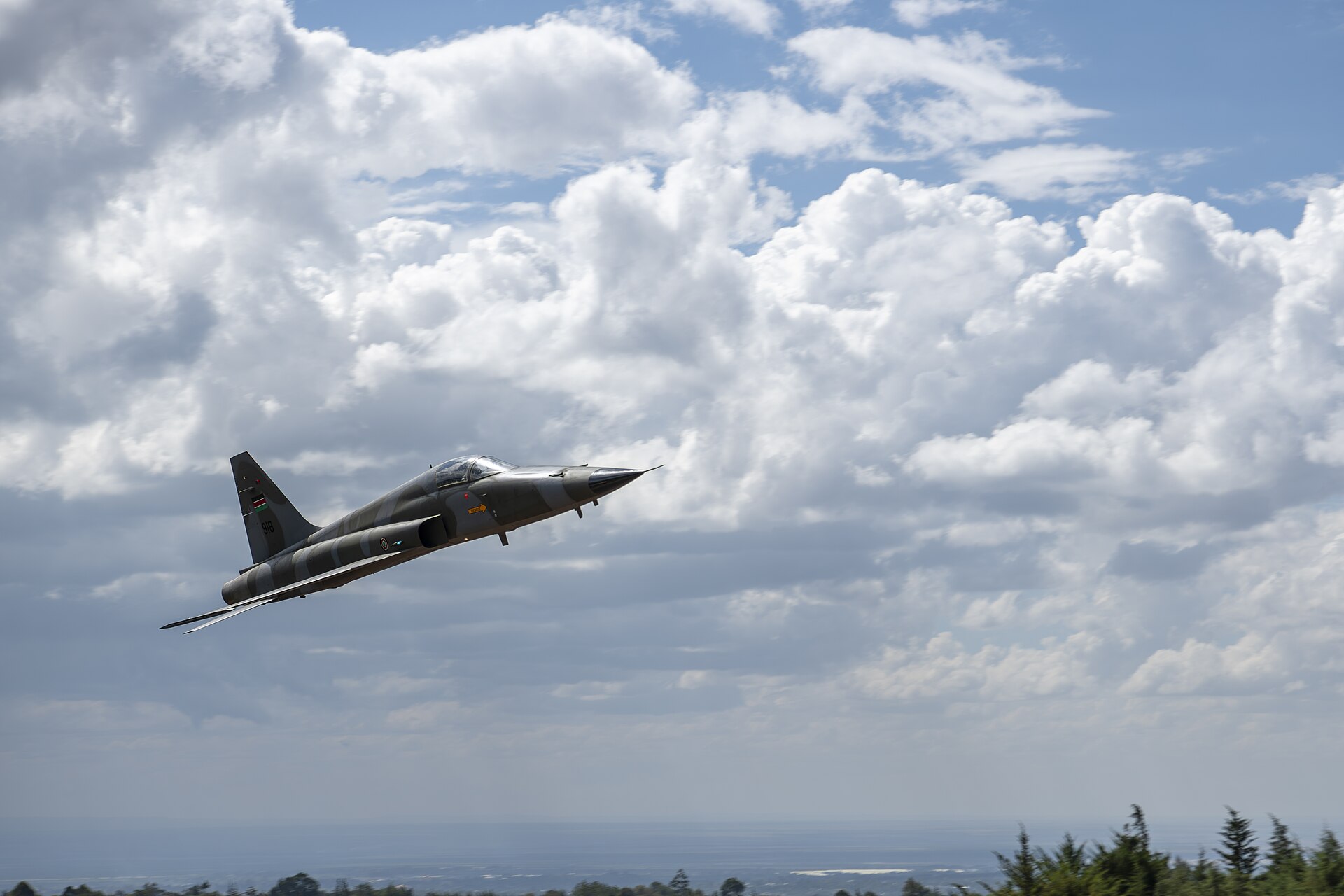
The F-5: a light fighter built for export
Northrop designed the F-5 in the late 1950s as a simple, affordable supersonic fighter for US allies. The first-generation F-5A Freedom Fighter (and two-seat F-5B) was supplied widely under US military aid. The improved F-5E Tiger II, with more powerful engines and a radar, followed in the 1970s, with the two-seat F-5F. Canada built its own CF-5 variant, and those airframes later reached Botswana.
In Africa the F-5 was the Western counterpart to the MiG-21: cheap to buy, easy to maintain and suited to small air forces. Unlike most MiG-21 fleets, the surviving African F-5 fleets are still flown regularly, largely because Morocco, Kenya and Tunisia have kept access to US and Western support. For the Soviet-designed equivalent, see our guide to MiG-21 and F-7 operators in Africa.
F-5 operators in Africa
| Country | Listed (FlightGlobal 2025) | Deliveries (SIPRI) | Origin | Status |
|---|---|---|---|---|
| Morocco | 22 F-5E, 4 F-5F | ~64 F-5A/B/E/F (1965–1990) | US new-build and aid, ex-Iran, ex-US | Active; upgraded |
| Kenya | 17 F-5E, 6 F-5F | ~29 F-5E/F (1978–2012) | US new-build; ex-Jordan (modernised) | Active; replacement sought |
| Tunisia | 10 F-5E, 3 F-5F | 16 F-5E/F (1984–1989) | US new-build and second-hand | Active |
| Botswana | 11 CF-5A/D, 4 F-5D | 18 CF-5A/B/D (1996–2000) | Ex-Canada (modernised) | Active; replacement unfunded |
| Ethiopia | – | ~26 F-5A/B/E (1966–1976) | US aid | Retired |
| Libya | – | ~10 F-5A/B (1968–1969) | US | Retired |
| Sudan | – | 4 F-5E/F (1982–1984) | US | Retired |
Sources: FlightGlobal 2025 World Air Forces directory; SIPRI Arms Transfers Database (data to 2025). In FlightGlobal’s listing some two-seaters appear under training aircraft.
Morocco: the largest and most modernised fleet
Morocco received F-5As under US aid from 1965, F-5Es and F-5Fs in the early 1980s and ten ex-US F-5Es modernised in the UK in 1989–1990. In the early 2000s its F-5E/Fs were upgraded to a standard often called “Tiger III”, with a new radar, cockpit displays and compatibility with modern air-to-air and precision weapons. Army Recognition reported in May 2022 that Morocco’s F-5s would receive Elbit Systems equipment, including Delilah cruise missiles. The F-5s now sit below Morocco’s F-16s and Mirage F1s in the fleet; see our Moroccan F-16 fleet profile and Morocco military strength guide.
Kenya: the backbone of a small fighter force
Kenya’s F-5 fleet, based at Laikipia Air Base near Nanyuki, is the country’s only fighter type. Kenya bought ten F-5Es and four F-5Fs new from the United States in 1978–1982, then 15 ex-Jordanian aircraft modernised by a US company and delivered in 2010–2012 under a deal SIPRI values at $38 million. The jets regularly take part in exercises with US forces, as in Justified Accord 2024. Our Kenya Air Force aircraft guide covers the wider fleet, and Kenya vs Uganda compares Kenya’s F-5s with Uganda’s Su-30s.
Tunisia and Botswana
Tunisia bought 12 F-5E/Fs in a $200 million deal delivered in 1984–1985 and four second-hand aircraft in 1989. They remain its only fighters; FlightGlobal’s 2025 listing shows SF-260 and T-6C trainers alongside them and AT-6C light attack aircraft on order.
Botswana took 13 modernised ex-Canadian CF-5s in 1996–1997 and five more in 2000. In a December 2024 interview with defenceWeb, the head of the Botswana Defence Force Air Arm described the F-5s as costly to maintain and said a replacement was under consideration, with funding the deciding factor. Military Africa reported in May 2023 that Botswana was negotiating with India over the Tejas light fighter, but no contract followed.
Former F-5 operators
Ethiopia received F-5As under US aid from 1966 and eight F-5Es in 1976, before the 1977 change of alignment ended US deliveries; the remaining six F-5Es on order were embargoed. Libya’s ten F-5A/Bs were delivered under the monarchy, before Libya turned to Soviet and French combat aircraft in the 1970s. Sudan’s order for 12 F-5E/Fs was cut to four for financial reasons. None of these countries lists the type today. For Ethiopia’s current fleet, see our Ethiopian Air Force aircraft guide.
Frequently asked questions
Which African countries fly the F-5?
Morocco, Kenya, Tunisia and Botswana. FlightGlobal’s 2025 directory lists 26 Moroccan, 23 Kenyan, 13 Tunisian and about 15 Botswanan F-5s, including two-seaters.
Where did Kenya’s F-5s come from?
Kenya bought 14 new F-5E/Fs from the United States in 1978–1982 and 15 modernised ex-Jordanian F-5s delivered in 2010–2012, according to SIPRI.
Is Botswana replacing its F-5s?
The Botswana Defence Force Air Arm said in December 2024 that a replacement was under consideration but depended on funding. Earlier talks with India over the Tejas did not lead to a contract.
What is the Moroccan F-5 ‘Tiger III’?
It is the name widely used for Morocco’s early-2000s F-5E/F upgrade, which added a new radar, modern cockpit displays and compatibility with newer weapons.
Did Ethiopia operate F-5s?
Yes. SIPRI records about 26 F-5A/B/E aircraft delivered in 1966–1976. US deliveries stopped after 1977, and the type is no longer listed.
Sources
- FlightGlobal, “2025 World Air Forces directory”, November 2024. https://www.flightglobal.com/defence/2024/11/2025-world-air-forces-directory/ (accessed 8 November 2026).
- Stockholm International Peace Research Institute (SIPRI), “SIPRI Arms Transfers Database, trade registers for African recipients (data to 2025)”, March 2026 release. https://armstransfers.sipri.org/ (accessed 6 November 2026 (local extract re-checked 8 November 2026)).
- defenceWeb, “Botswana Air Arm chief discusses the importance of strategic airlift, maintenance and technology”, 18 December 2024. https://defenceweb.co.za/aerospace/aerospace-aerospace/botswana-air-arm-chief-discusses-the-importance-of-strategic-airlift-maintenance-and-technology/ (accessed 8 November 2026).
- Military Africa, “Botswana in negotiation with India for Tejas aircraft”, May 2023. https://www.military.africa/2023/05/botswana-in-negotiation-with-india-for-tejas-aircraft/ (accessed 8 November 2026).
- Army Recognition, “Moroccan Air Force F-5 fighters to get Elbit Systems Delilah cruise missiles”, 13 May 2022. https://armyrecognition.com/archives/archives-aerospace-defense/aerospace-defense-2022/moroccan-air-force-f-5-fighters-to-get-elbit-systems-delilah-cruise-missiles (accessed 8 November 2026).
Method: counts from SIPRI are deliveries recorded by SIPRI, not current inventories. Status labels distinguish delivered, reported in service, ordered and retired; where open sources disagree, the range is shown rather than a single figure.