Last updated: 25 November 2026.
Sudan’s main state arms maker still exists on paper and at trade fairs, but its best-known factory complex in Khartoum was fought over in June 2023 and has not published a verified production figure since. The organisation is known as the Military Industry Corporation (MIC). The US Treasury lists it as Defense Industries System (DIS), with “Military Industry Corporation” as an alias, and designated it on 1 June 2023 under Executive Order 14098. Treasury described DIS as Sudan’s largest defence enterprise, “generating an estimated $2 billion in revenue via hundreds of subsidiaries,” and said it manufactures small arms, conventional weapons, ammunition and military vehicles for the Sudanese Armed Forces (SAF). That revenue figure is a US government estimate, not a company report.
What happened to the plants themselves should be answered with what can be sourced. The Yarmouk Industrial Complex in southern Khartoum was attacked by the Rapid Support Forces (RSF) in early June 2023; a large fire burned at a nearby fuel facility; the RSF claimed to have seized weapons warehouses; the army did not publicly confirm the loss of the complex. Later research and satellite work describe heavy damage. Other named MIC sites have far less public evidence. Current output is not officially confirmed.
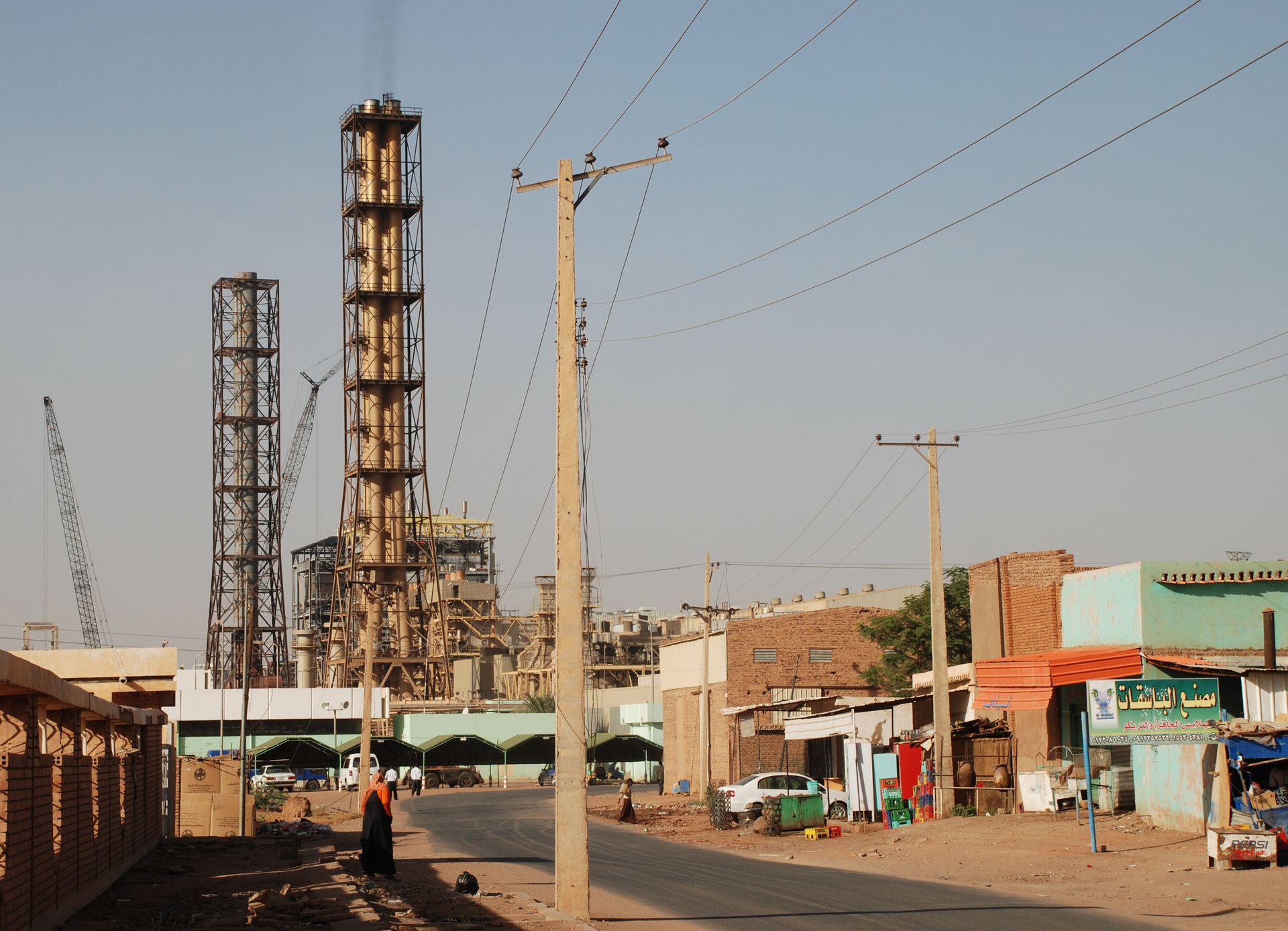
What MIC / DIS is
OFAC’s designation, dated 1 June 2023, gives the organisation an establishment date of 1993 and an address in Khartoum North. Small Arms Survey’s Human Security Baseline Assessment (HSBA) briefing on the MIC, based on open sources and limited field work, traces Sudanese ammunition-making further back, to the Al Shaggara plant opened in 1959 under President Ibrahim Abboud, and dates the formal opening of MIC to 1993 under Omar al-Bashir.
The same HSBA briefing, which is careful to say that the true extent of manufacturing “remains unknown,” listed MIC’s advertised product lines as ammunition, conventional weapons, armoured vehicles and main battle tanks, equipment, electronics, aviation, marine products and vehicles. The plants then publicly associated with the group were Yarmouk Industrial Complex, the main conventional-weapons site built in the 1990s at Soba in Khartoum; Al Shaggara Ammunition Plant; Elshaheed Ibrahim Shams el Deen Complex for Heavy Industries; Al Zarghaa Engineering Complex; Saria Industrial Complex; and Safat Aviation Complex.
A later Belgian Royal Higher Institute for Defence focus paper (October 2025) repeats that plant list and adds that, before the war, MIC produced armoured vehicles, tanks, trucks, artillery, light aircraft, boats and ships, “most of which under licences from China, Russia, Türkiye” and other partners. That is a secondary compilation, not a factory-by-factory official catalogue, and it does not give current rates of output. Older language sometimes called Sudan the third-largest arms producer in Africa, after Egypt and South Africa; Small Arms Survey recorded that as a Sudanese claim, not as an independently audited ranking.
On the same day as the DIS designation, Treasury also listed Sudan Master Technology (also known as Giad Industrial City / Giad Industrial Group) as an arms company and a shareholder in multiple DIS firms, and designated two RSF-linked companies, Al Junaid Multi Activities Co Ltd and the UAE-based Tradive General Trading L.L.C. Those RSF designations are separate from MIC, but they are part of the same 1 June 2023 action “fueling both sides of the conflict.”
Yarmouk: what reporting shows about June 2023
Yarmouk was the plant most often described, before the war, as Sudan’s largest military manufacturing complex, producing rockets, artillery, light weapons and ammunition. Small Arms Survey and later academic summaries also reported Iranian involvement in the site in earlier years, including claims of partial ownership. Those older allegations were never turned into a public, official Iranian or Sudanese breakdown of shareholding, and they should not be restated as a current fact.
On 7–8 June 2023, Reuters reported that the RSF had attacked the Yarmouk complex the previous day, that the group had posted videos claiming a weapons warehouse and several entry points, that the army used air strikes to try to push the RSF back, and that a massive fire had broken out near the military complex and a fuel facility in southern Khartoum. Al Jazeera, reporting the same days, said the RSF claimed control of the weapons company, and that the army said fighting was still going on and the depot was not completely under RSF control. A resident living near the site told both outlets that columns of smoke were visible and that nearby fuel and gas depots made any explosion a danger to the neighbourhood.
On 24 June 2023, the BBC reported that the assault on al-Yarmouk was “a serious blow to the army,” that a fire had raged for days, that the RSF declared it had seized the complex, and that local residents confirmed RSF control, while “the military, however, has not confirmed the loss of the complex.” VOA, on 8 June 2023, quoted RSF political adviser Yousef Izzat as saying forces loyal to Hemedti had captured the Yarmouk military factory. Those are claims and witness reports, not an official SAF inventory of what was lost.
Later research is bleaker on the physical plant. A GIGA Focus paper (2024) wrote that Yarmouk “was destroyed in July 2023” after it had been Sudan’s biggest military manufacturer. The Belgian defence-institute paper says the RSF took control in June 2023 “and the factory was destroyed as a result of the fighting.” Small Arms Survey and Conflict Armament Group’s 2025 co-publication on damage in Khartoum includes satellite imagery from 25 May 2024 showing damage at the industrial complex. Those sources agree on severe damage. They do not publish a residual production figure or an official list of relocated lines.
Sanctions, and what they do and do not prove
The US designation of 1 June 2023 blocks DIS property in US jurisdiction and generally bars US persons from dealing with it, subject to general licences that Treasury issued the same day for certain humanitarian, agricultural and medical activity and for a wind-down involving DIS or Al Junaid. A $2 billion revenue estimate and “hundreds of subsidiaries” are Treasury’s words. They are not a 2026 accounts filing, and they are not proof that every plant is still running.
GIGA notes that the European Union adopted a framework for targeted measures on 9 October 2023 and, in January 2024, sanctioned companies manufacturing weapons and other military equipment for the SAF and the RSF, and that the United Kingdom sanctioned a set of RSF- and SAF-linked companies on 12 July 2023. Those measures raise compliance risk for buyers and partners. They are not, by themselves, a factory status report.
What is known about production after the Khartoum fighting
No official MIC or DIS production volume, workforce figure or 2026 output total was found in the sources reviewed for this article. Displaying a weapon at a fair is not the same as serial production, and it is not the same as a delivery to the SAF or an export contract.
In 2026, DIS exhibited at BAMEX in Bamako, Mali, and showed items it described as locally manufactured FAB-250 and FAB-500 unguided aerial bombs. DefenceMENA’s report on that exhibition noted that Sudan had previously imported those Soviet-designed types from Russia, that no contract was announced in Bamako, and that DIS did not publish production volumes, a start date, or details on the origin of explosive filling and fuzes. Exhibition is not proof that Yarmouk itself has restarted.
MIC had also shown systems in earlier years that should not be padded into a current inventory. At IDEX 2023 it unveiled the Kamin-25 loitering munition; Janes was told acceptance tests were planned for May 2023, and DefenceMENA’s loitering-munitions guide records that no reviewed source confirms what happened after those tests or gives a fielded quantity. The Safaroog one-way attack drone was displayed at IDEF 2025; its combat record is not public, as set out in the Sudan drones file. The wider African manufacturing overview, Which African Countries Manufacture Their Own Weapons?, already flags that war damage since 2023 leaves current output unconfirmed.
If those lines are damaged, captured or idle, the SAF has to lean more on imports and on whatever capacity may have been moved. That is a logical inference, not a substitute for a production table. Licensed assembly of foreign designs, including Chinese, Russian and, according to the Belgian paper, Turkish types, also means that “Sudanese-made” on a brochure can still depend on foreign drawings, kits or key components. No source reviewed here gives a current, official breakdown of which licences are still active. There is no official public list of which MIC plants are operating in late 2026.
Frequently asked questions
Is MIC the same organisation as Defense Industries System?
Yes, in US sanctions language. The Treasury and OFAC list Defense Industries System with the alias Military Industry Corporation, established in 1993. Older Sudanese and research usage is usually “MIC”; more recent exhibition branding has used DIS.
Was the Yarmouk factory destroyed?
Independent reporting from June 2023 established a battle, a large fire at a nearby fuel facility, an RSF claim of seizure, and witness accounts of RSF control. The army did not publicly confirm the loss. Later research and 2024 satellite imagery describe severe damage or destruction. A full official damage survey has not been published.
Is Sudan still making weapons?
DIS has continued to exhibit, including FAB-250 and FAB-500 bombs at BAMEX 2026 in Mali, which it called locally manufactured. Exhibition is not proof of serial production, current volumes, or exports. No official 2026 output figure was found.
Does the US $2 billion figure mean MIC is still earning that much?
No. That is the US Treasury’s June 2023 estimate of revenue “via hundreds of subsidiaries across various sectors,” given at the moment of designation. It is not a later audited account, and it is not limited to arms-factory output alone.
Sources
- US Department of the Treasury, “Treasury Sanctions Military-Affiliated Companies Fueling Both Sides of the Conflict in Sudan,” press release JY1514, 1 June 2023: home.treasury.gov/news/press-releases/jy1514
- US Treasury OFAC, “Counter Terrorism Designations; Sudan Designations…,” 1 June 2023, SDN listing for Defense Industries System (a.k.a. Military Industry Corporation) and Sudan Master Technology: ofac.treasury.gov/recent-actions/20230601
- Reuters, “Massive fire as Sudanese factions battle for control of arms factory,” 7–8 June 2023: reuters.com
- Al Jazeera, “Arms depot battle rages in Sudan as fuel facility burns,” 7 June 2023, and “Southern Khartoum residents fear ongoing fighting after fuel fire,” 8 June 2023.
- BBC News, “Sudan conflict: Army outnumbered on Khartoum’s streets,” 24 June 2023: bbc.com/news/world-africa-65962771
- VOA Africa, “Sudan’s Powerful Paramilitary Claims Control Over Weapons Factory,” 8 June 2023 (RSF adviser Yousef Izzat).
- Small Arms Survey, HSBA, “The Military Industry Corporation (MIC)” briefing (open-source review of plants and product lines).
- Small Arms Survey / Conflict Armament Group, “Urbicide in Khartoum,” 2025 (satellite imagery dated 25 May 2024 showing industrial-complex damage).
- Hager Ali, “The War in Sudan: How Weapons and Networks Shattered a Power Struggle,” GIGA Focus, 2024.
- Stan Brabant, “Who is Fuelling the Sudan 2023 Civil War?,” Royal Higher Institute for Defence (Belgium), Focus Paper 56, October 2025.
- DefenceMENA, “Sudan’s Sanctioned Defence Industries System Shows Locally Made FAB-500 Bombs at BAMEX 2026 in Mali”: defencemena.com
- DefenceMENA, “Which African Countries Manufacture Their Own Weapons?”: defencemena.com