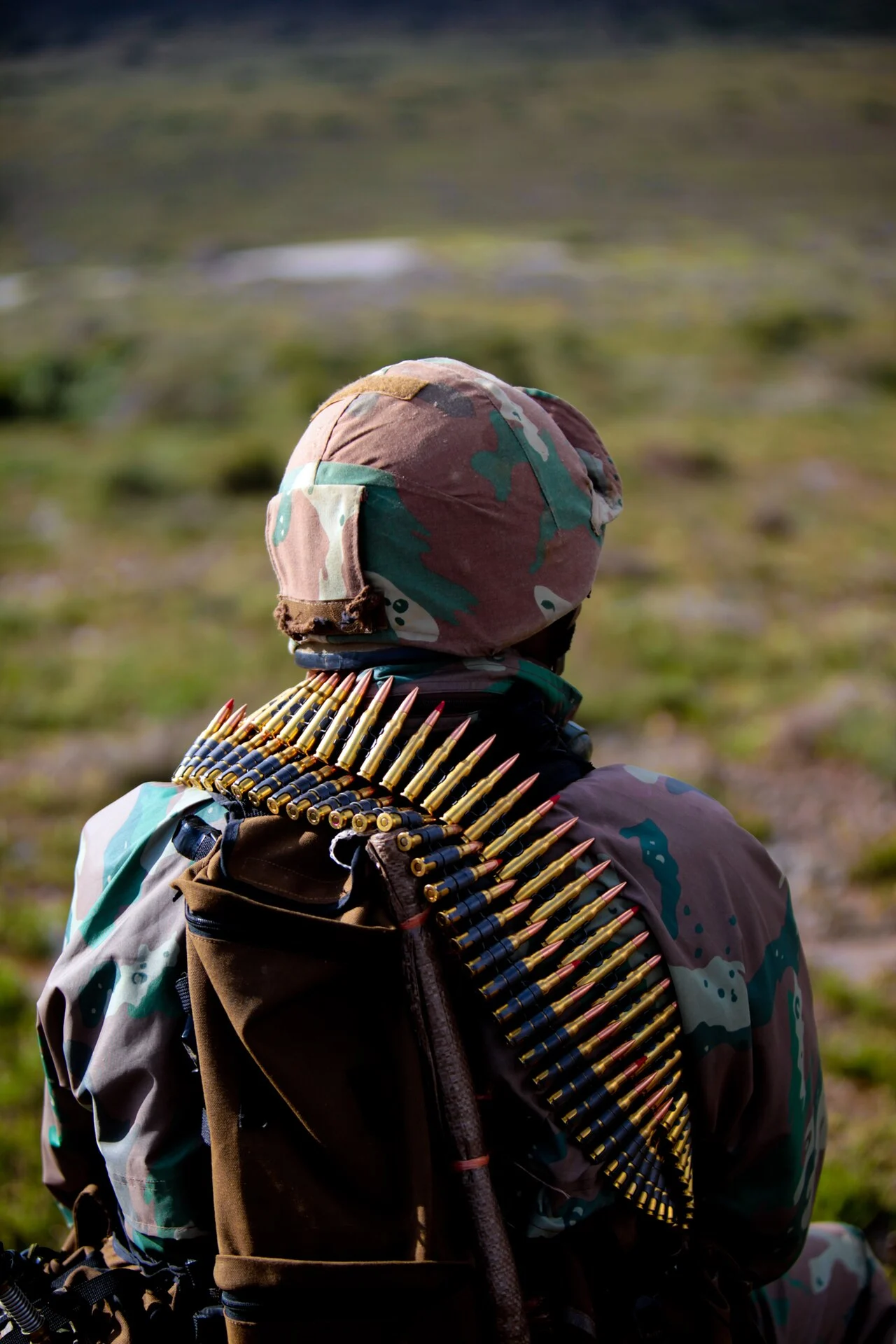
South Africa has put five brigades through a three-month combat-readiness exercise at its largest training ground, the fifth run of an annual drill the army says tests everything from divisional planning to crowd control. All 16 SADC member states have been invited to observe.
Photo: A South African National Defence Force soldier advances during a simulated assault in a past field-training exercise (file photo). Credit: Cpl. Jad Sleiman, U.S. Marine Corps, Public domain, via Wikimedia Commons
Exercise Vukuhlome V — isiZulu for “arise and arm yourself” — is under way at the Lohatla Combat Training Centre in the Northern Cape, defenceWeb reported. The exercise runs from 19 September to 5 December 2026 across the 158,000-hectare range, the largest the South African National Defence Force (SANDF) operates.
Five brigades, multiple services
The exercise is built around five “modern brigades” — airborne, light, mechanised, motorised and reserve units — under the command of Lieutenant General Lawrence Mbatha, plus a specialist medical brigade from the SA Military Health Service. The South African Air Force is providing air support, Defence Intelligence and Military Police are embedded in the exercise structure, and the SA Police Service is expected to take part in crowd and riot-control serials, reflecting the SANDF’s growing emphasis on domestic stability operations alongside conventional combat training. Previous iterations of Vukuhlome have involved 7,000 to 9,000 personnel, according to defenceWeb.
What it tests
defenceWeb reports the drill is structured around division-level planning and tactical execution, continuation training for units returning from other deployments, and command-and-control evaluation across the brigade and divisional planning cycle. That scope is notable for a force that has spent much of the past three years focused on peace-support deployments — including the SANDF’s now-concluded Operation Mistral in the Democratic Republic of Congo (DRC), which ended 27 years of South African peacekeeping in the DRC earlier this year — rather than large-scale conventional manoeuvre at home.
SADC observers
All 16 Southern African Development Community member states have been invited to send observers to Vukuhlome V, according to defenceWeb, giving the exercise a regional dimension beyond South Africa’s own order of battle. SADC militaries have cooperated closely in recent years on peace-support missions, most visibly in the DRC and earlier in Mozambique’s Cabo Delgado province, and a shared-observation framework for a divisional-level exercise gives regional partners a direct look at South African command-and-control procedures they could draw on in future joint deployments.
Why it matters for Africa
Vukuhlome V is a readiness test at a moment when the SANDF’s force posture is under scrutiny: South African defence budgets have been squeezed for years even as the force has sustained deployments in the DRC and the Mozambique Channel, and questions persist in Parliament about serviceability rates for army vehicles and air force aircraft. A divisional-scale exercise that can actually assemble five brigades simultaneously is itself a data point on how much conventional capacity South Africa retains after a decade of budget pressure and peace-support commitments. For the wider region, South Africa remains SADC’s most capable conventional land force on paper, and how it performs at Lohatla feeds directly into what Pretoria can credibly offer the next time the bloc needs troops for a Mozambique- or DRC-style intervention.