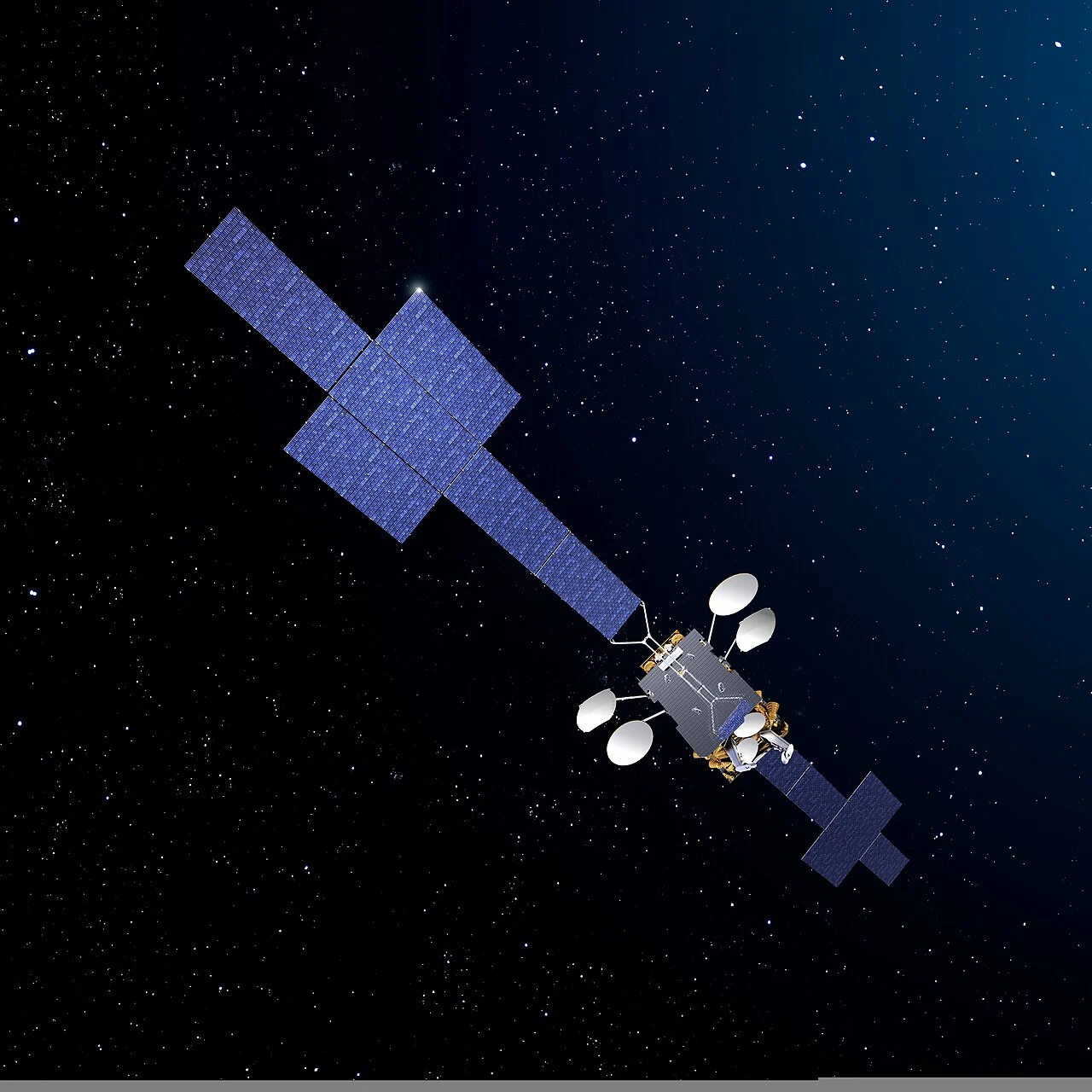
Nigeria has contracted Thales Alenia Space to build NigComSat-2A, a new geostationary communications satellite meant to extend broadband, broadcast and emergency-communications coverage across West, Central and Southern Africa. The deal, confirmed by both parties in mid-September, will eventually replace Nigeria’s only orbital communications asset, whose 15-year design life is running out.
Photo: Illustrative artist rendering of a Thales Alenia Space Spacebus-series satellite; NigComSat-2A imagery has not yet been released. Credit: Emmanuel Briot, CC BY-SA 4.0, via Wikimedia Commons
NIGCOMSAT, Nigeria’s government-owned satellite operator, announced on 14 September that it had selected Thales Alenia Space to build NigComSat-2A. The French-Italian manufacturer confirmed the award in its own statement, describing a satellite built on its Spacebus B2 platform with a launch mass close to four tonnes and a service life of more than 15 years.
“NigComSat-2A will strengthen our nation’s satellite communications capacity and expand access to broadband services across Africa,” said Nkechi Jane Egerton-Idehen, NIGCOMSAT’s chief executive, in the announcement. Hervé Derrey, president and chief executive of Thales Alenia Space, said the new satellite “will enable NIGCOMSAT to strengthen its competitive position by delivering reliable, high-quality services.”
Neither company disclosed a contract value or a target launch date. NigComSat-2A will carry C-band, Ku-band, Ka-band and L-band payloads, according to NIGCOMSAT, giving it the mix of frequencies needed to serve broadcasters, government agencies, internet service providers and mobile-network backhaul customers across a footprint stretching from the West African coast through Central Africa into Southern Africa.
Replacing Africa’s first sovereign geostationary satellite
The new spacecraft succeeds NigComSat-1R, which Nigeria ordered from the China Great Wall Industry Corporation after its first satellite, NigComSat-1, failed in orbit in 2008 due to a solar-array fault less than two years after launch. NigComSat-1R reached geostationary orbit in December 2011 and became the first sovereign communications satellite operated by a Sub-Saharan African state, a status Nigeria has used since as a point of prestige in its space programme alongside the National Space Research and Development Agency’s earth-observation satellites.
NigComSat-1R’s own 15-year design life puts it close to end-of-service, which is the immediate driver behind NigComSat-2A. Losing geostationary communications capacity without a replacement already in orbit or under construction would leave Nigeria dependent on leased transponder capacity from foreign operators for government, broadcast and rural-connectivity services — a gap NIGCOMSAT has flagged as a strategic risk in prior public statements about fleet renewal.
The choice of Thales Alenia Space marks a shift in supplier for Nigeria’s satellite programme, moving from the Chinese-built NigComSat-1R to a European manufacturer already well established on the continent through Africa’s other geostationary operators. It also lands the same month Thales’s parent group, Thales, has been expanding its footprint in African defence and security markets more broadly, including electronics and radar cooperation elsewhere on the continent.
A dual-use asset with security relevance
NigComSat-2A is being procured as civilian and government communications infrastructure rather than a military satellite, but its resilience and broadband-backhaul role has direct relevance for Nigeria’s security establishment. Nigerian government communications, including links supporting the armed forces’ counter-insurgency campaign against Boko Haram and the Islamic State West Africa Province in the northeast, have historically drawn on NigComSat capacity where terrestrial fibre and microwave networks do not reach. A modern, higher-throughput replacement would give security agencies more resilient backhaul in exactly the remote and contested areas where fixed infrastructure is weakest.
The satellite’s declared coverage footprint — extending from West Africa through Central Africa to Southern Africa — also positions NIGCOMSAT to sell capacity to neighbouring states and regional bodies whose own satellite communications options are limited, reinforcing Nigeria’s position as a communications infrastructure provider for the wider region rather than only a domestic operator.
Why it matters for Africa
Africa’s geostationary satellite fleet remains thin relative to the continent’s size and connectivity needs, and most in-orbit capacity serving African users is still leased from non-African operators. A second Nigerian-flagged geostationary satellite, if it reaches orbit on schedule, would add sovereign broadband and broadcast capacity at a moment when African governments are increasingly framing satellite communications as critical infrastructure for disaster response, rural connectivity and, indirectly, security communications in regions where insurgencies and cross-border crime outpace terrestrial network build-out. It also signals that African state operators can secure major Western manufacturers for strategic space assets on commercial terms, rather than relying solely on financing-linked deals with Chinese or Russian suppliers, broadening the field of partners available to other African governments weighing their own satellite programmes.
Sources
Related reading: Nigeria’s Military Strength in 2026: Tanks, Jets and Turkish Drones and the DefenceMENA Nigeria desk.