Last updated: 25 November 2026
Egypt has the larger military by active manpower, combat-aircraft numbers and surface warships, including Africa’s only Mistral-class helicopter carriers. Israel spends far more. SIPRI’s April 2026 fact sheet puts Israel’s 2025 military expenditure at $48.3 billion, or 7.8 per cent of GDP. Egypt’s published total is much lower: a secondary compilation of SIPRI’s database, already used in DefenceMENA’s budget ranking, gives about $2.5 billion, a figure that does not capture off-budget military income or annual U.S. Foreign Military Financing. Israel also fields the Middle East’s only operational F-35 fleet. This is a comparison of air, land and naval forces, not a forecast of a war. The 1979 Egypt–Israel peace treaty remains in force.
Neither government publishes a complete, current inventory. Personnel and many equipment totals below are IISS-derived or taken from open aircraft and naval directories, and are labelled as such. Ordered, delivered and in-service figures are kept separate. Public indexes that add stored or obsolete equipment into a single “operational” total are not used as authority here.
Egypt vs Israel at a glance
| Metric | Egypt | Israel | Source |
|---|---|---|---|
| Military expenditure, 2025 | About $2.5 billion reported (understated; see note) | $48.3 billion (7.8% of GDP) | SIPRI, April 2026 (Israel: fact sheet Table 1; Egypt: secondary SIPRI-database compilation) |
| Active personnel | About 438,500 | About 169,500 | IISS-derived figures used in open trackers |
| Reserves | About 479,000 | About 465,000 | IISS-derived figures used in open trackers |
| Main battle tanks | More than 1,100 M1A1 Abrams estimated, plus a large M60 fleet; older T-62 and T-55 family vehicles mostly stored | Merkava family, including Merkava IV; no official in-service total is published | Open-source estimates and manufacturer/official type identification; see land section |
| Combat aircraft | About 330 (F-16, Rafale, MiG-29M/M2, Mirage 2000) | Smaller fighter force built around F-35I, F-15 and F-16 aircraft | Open-source air-force directories, 2026; official type lists |
| Fifth-generation fighters | None in service | F-35I Adir in service; a fourth squadron approved in 2026, not yet a delivered total | Israel Ministry of Defence, 2026; open directories for in-service estimates |
| Submarines | 4 Type 209/1400mod delivered; 4 ageing Romeo-class boats still listed | Dolphin / Dolphin-AIP class; INS Drakon announced as the sixth boat and the third AIP submarine, en route from Germany in 2026; 3 Dakar-class boats are future deliveries, not in service | Delivery records; Israel Ministry of Defence, 2026 |
| Major surface ships | 2 Mistral-class LHDs; FREMM and MEKO A-200 frigates; Gowind corvettes; older Perry- and Knox-class ships still listed | Sa’ar 6 corvettes and older Sa’ar-class missile boats; no amphibious assault ship comparable to a Mistral LHD | Open naval inventories and official naming/delivery announcements |
| U.S. security assistance (recent, documented) | About $1.3 billion a year in Foreign Military Financing has long been allocated; the State Department said in September 2024 that the full $1.3 billion for that year would be provided | Longstanding U.S. financing and arms-transfer relationship; SIPRI notes assistance continued in 2025 (a partial sentence in the fact sheet is not treated here as a complete official total) | Reuters and The Washington Post, citing the U.S. State Department, 11–13 September 2024; SIPRI, April 2026 |
Land power
Egypt fields the larger pool of modern Western tanks. Open-source estimates of the in-service M1A1 Abrams fleet generally put it above 1,100 vehicles. A 2015 agreement for 125 additional tanks would, according to contemporaneous Defense News reporting cited in DefenceMENA’s Abrams profile, take the assembled fleet to about 1,130. Kits have been assembled at Military Factory 200 near Cairo under a long-running co-production arrangement with the United States. A substantial M60 fleet remains, part of it stored. Older T-62 and T-55 family vehicles, including Ramses II conversions, should not be added to a single operational total. Public indexes that put Egypt above 3,600 tanks mix stored and legacy hulls with tanks that can deploy.
Israel’s main battle tank is the Merkava, designed and built in Israel, with Merkava IV the current production family. The Israeli government does not publish an official in-service count, and this article does not invent one. The two fleets are built for different problems: Egypt maintains a large armoured mass for a wide territory; Israel fields a smaller, domestically supported tank force designed around its own doctrine and logistics.
Air power
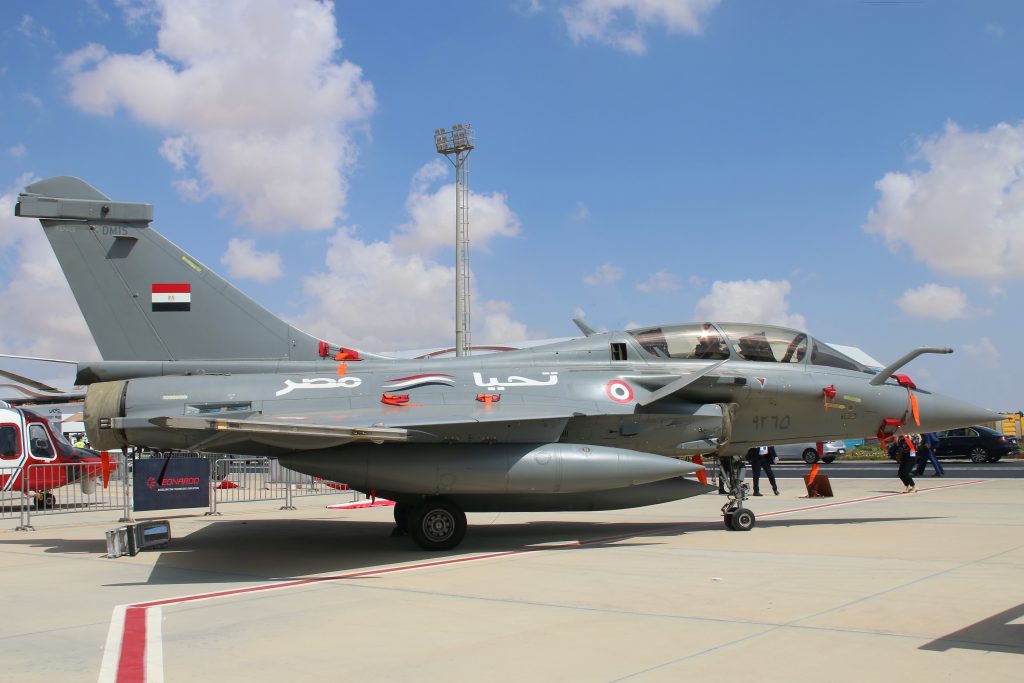
Egypt has the larger combat-aircraft inventory, about 330 fighters and attack jets in open 2026 directories, built around a mixed fleet of U.S., French and Russian types. About 218 F-16A/B/C/D aircraft are still listed, including training airframes and some that may be stored; the oldest Block 15 aircraft date from the early 1980s. Egypt received 24 Rafale DM/EM aircraft under a 2015 contract, then signed a second contract for about 30 more in 2021, with deliveries from that batch under way. A further request for 24 Rafales has been reported as a request for proposal, not as a completed order. MiG-29M/M2 and Mirage 2000 aircraft remain in the combat force. Details and source notes are in DefenceMENA’s fighter-fleet guide.
Egyptian F-16s have not been publicly cleared to carry the AIM-120 AMRAAM air-to-air missile. In July 2025 the U.S. Defense Security Cooperation Agency announced a possible NASAMS sale that included AIM-120C-8 and AMRAAM-ER missiles for the ground-based system. That notice is a potential package, not a completed fighter integration, and it is not evidence that Egyptian F-16s have been cleared for AMRAAM. The Rafale, armed with MICA and, where supplied, Meteor missiles, is therefore Cairo’s most capable air-to-air fighter among types now in service.
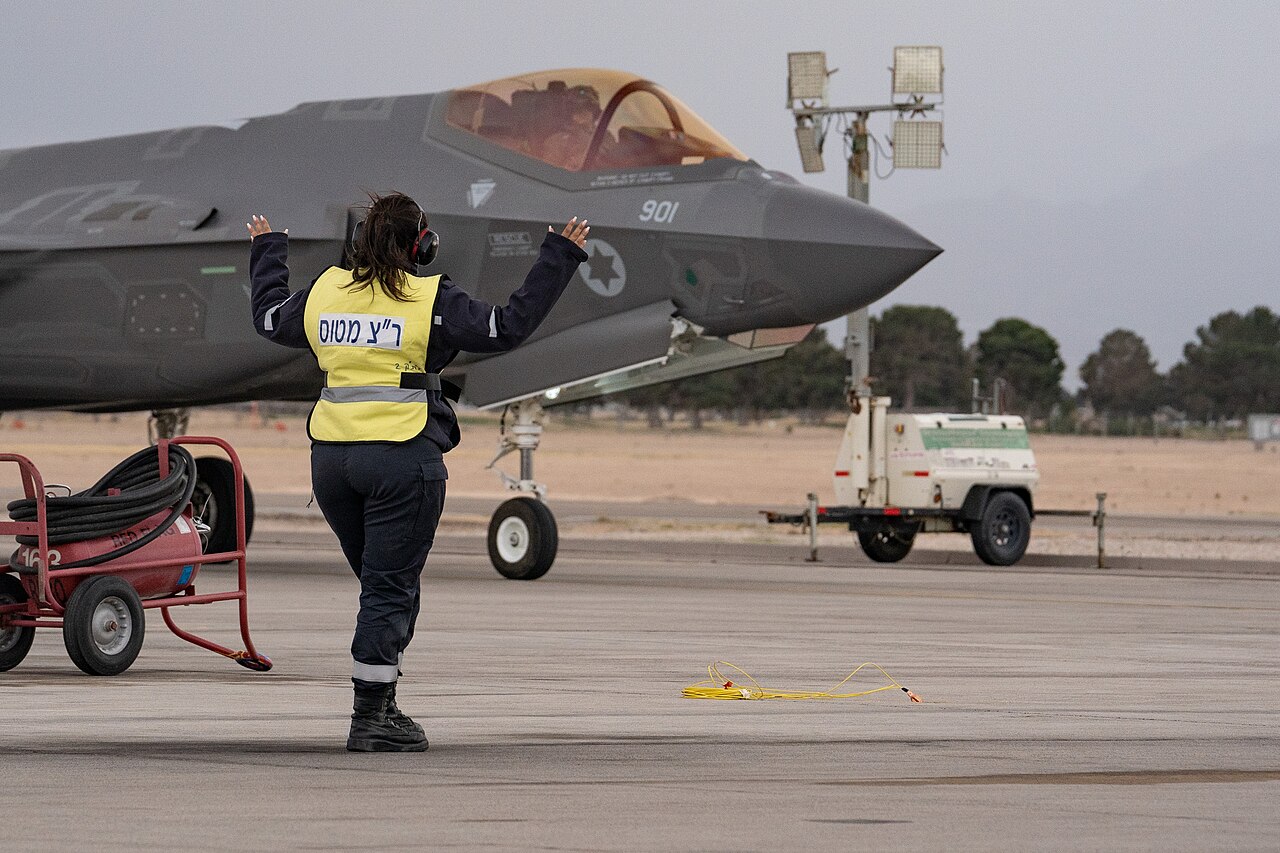
Israel’s fighter force is smaller in airframe count but includes the region’s only operational F-35 aircraft, the F-35I Adir, alongside F-15 and F-16 families. Israel has not published a single official in-service F-35 total. Open air-force directories in 2026 typically list around 45 F-35I aircraft delivered. In 2026 the Israel Ministry of Defence said the ministerial procurement committee had approved plans for a fourth F-35 squadron and a second F-15IA squadron. Those approvals are not deliveries. The gap that matters in the air is less raw numbers than sensors, munitions and the ability to operate a fifth-generation type that Egypt does not yet field.
Naval power
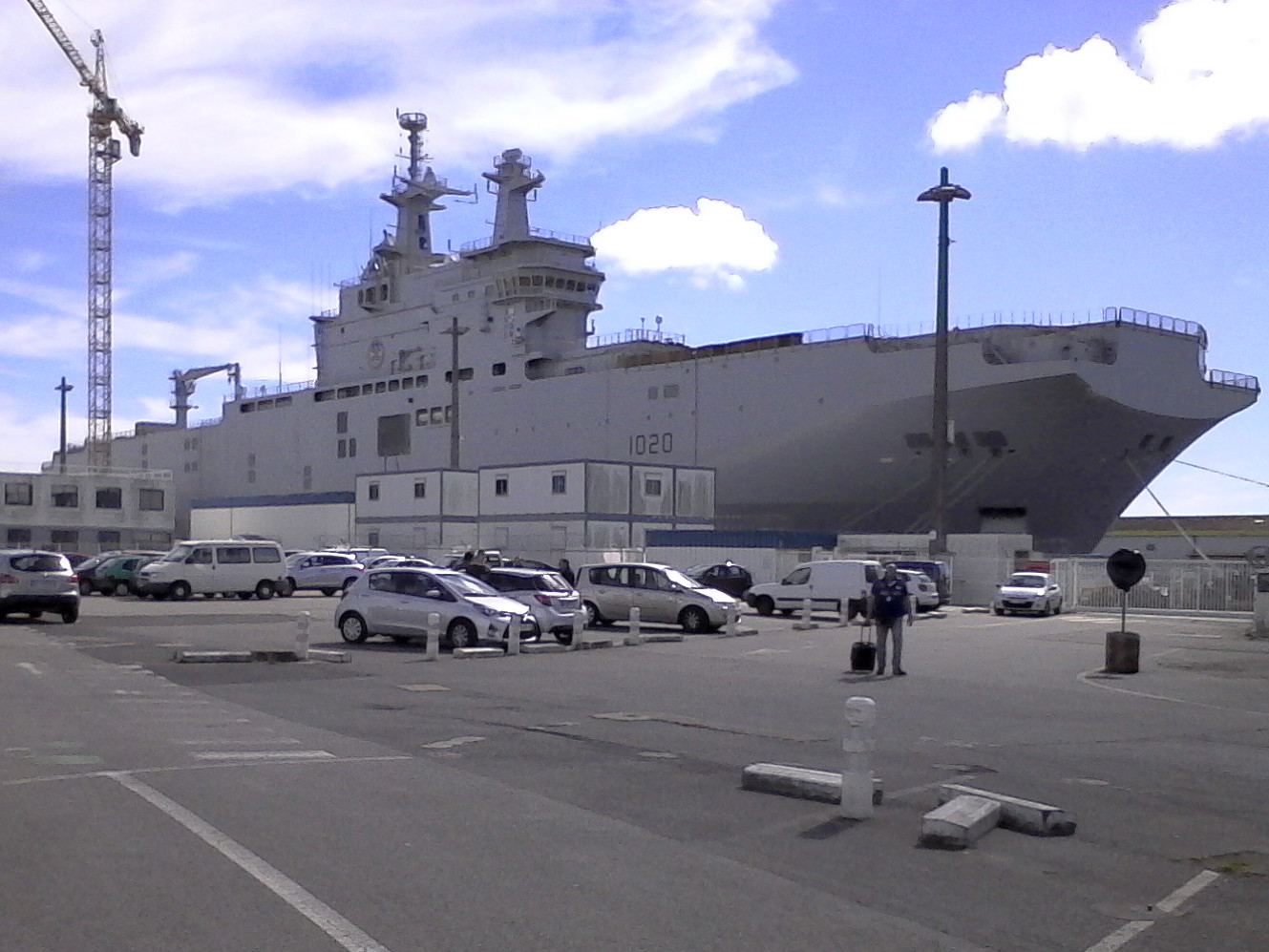
Egypt has the only Mistral-class landing helicopter docks in Africa, Gamal Abdel Nasser and Anwar El Sadat, and the larger modern surface fleet. The frigate force combines the French-built FREMM Tahya Misr, the Italian-built FREMMs Al-Galala and Bernees, and MEKO A-200EN frigates from ThyssenKrupp Marine Systems, of which the first three were delivered from Germany between 2022 and 2023. The fourth, Al-Jabbar, was launched at Alexandria Shipyard in December 2023; its delivery has been reported, but this article treats final commissioning as confirmed only when a primary delivery or commissioning notice is on the record. Four Gowind 2500 corvettes, some built in Alexandria, complete the modern surface core. Four German Type 209/1400mod submarines were delivered between 2016 and 2021. Four ageing Romeo-class boats are still listed in some inventories and should not be counted as equivalent to the Type 209s. DefenceMENA’s Germany–Egypt deals file sets out the submarine and MEKO contracts.
Israel’s submarine force is smaller in hull count on current listings but is being renewed. In 2026 the Israel Ministry of Defence announced that INS Drakon, described as Israel’s sixth submarine and the third and final boat of the Dolphin-class air-independent-propulsion series, had left the TKMS yard in Kiel for Haifa. The same official statement said three Dakar-class submarines “will join” the navy; those boats are future deliveries, not vessels in service today. On the surface, open naval reporting and official naming ceremonies identify a four-ship Sa’ar 6 corvette class, built in Germany for the Israeli Navy, plus older Sa’ar-class missile boats. Egypt has the amphibious and blue-water surface advantage. Israel’s navy is built around submarines, missile corvettes and the defence of a short coastline.
Air defence and budgets
SIPRI’s April 2026 fact sheet puts Israel’s 2025 military spending at $48.3 billion, 4.9 per cent lower than in 2024 but still 120 per cent higher than in 2016 and 97 per cent higher than in 2022. The military burden was 7.8 per cent of GDP, the third-highest among countries SIPRI lists, after Ukraine and Algeria. Egypt’s published $2.5 billion figure is a secondary reading of SIPRI’s database, not a line in the published top-40 table, and is not directly comparable. Much Egyptian military income sits off the published budget, and U.S. aid is additional. In September 2024 the U.S. State Department said, as reported by Reuters and The Washington Post, that Egypt would receive its full $1.3 billion Foreign Military Financing allocation for that year.
Egypt’s Air Defence Forces, a separate service since 1968, operate a layered network bought from several suppliers. Confirmed or well-documented systems include the Russian S-300VM (Antey-2500), whose contract quantity was never officially disclosed; German IRIS-T SLM batteries, of which SIPRI records seven systems and 400 missiles as delivered; and Buk-M2 and Tor-family missiles, among older U.S. and Soviet-era types. A July 2025 DSCA notice covered a possible NASAMS package; possible sales are not deliveries. Israel’s architecture is built around Iron Dome, David’s Sling and Arrow, developed by Israeli industry with U.S. cooperation. Official battery counts are not used here where the governments have not published them.
How to read the comparison
Egypt is the larger force on manpower, combat-aircraft numbers and amphibious surface ships. Israel spends many times more on the figures that can be compared, maintains a large trained reserve relative to its regular force, and is the only operator of the F-35 in the Middle East. The United States remains a major supplier to both countries, and U.S. policy on maintaining what Washington calls Israel’s qualitative military edge has long shaped which weapons are cleared for Egypt, including air-to-air missiles on the F-16. The 1979 peace treaty is the political frame for this comparison. It does not produce a single winner for every mission. For the wider Egyptian inventory, see Egypt’s army, air force and navy inventory, the budget and personnel profile, and Egypt compared with Algeria.
Frequently Asked Questions
Which country has a bigger defence budget, Egypt or Israel?
Israel does, by a wide margin on published figures. SIPRI puts Israel at $48.3 billion in 2025. Egypt’s reported figure of about $2.5 billion, from a secondary compilation of SIPRI’s database, is not directly comparable, because off-budget military income and about $1.3 billion a year in U.S. Foreign Military Financing sit outside that total. Those additions still do not close the official gap.
Who has more fighter jets, Egypt or Israel?
Egypt has the larger combat-aircraft inventory, about 330 aircraft in open 2026 directories, including a large F-16 force, Rafales, MiG-29M/M2s and Mirage 2000s. Israel’s fighter force is smaller in airframe count but includes the F-35I, which Egypt does not operate, plus F-15 and F-16 aircraft.
How many submarines does each navy operate?
Egypt has four German Type 209/1400mod boats in service, delivered between 2016 and 2021, with four ageing Romeo-class boats still listed. Israel’s Ministry of Defence described INS Drakon in 2026 as the sixth submarine and the third Dolphin AIP boat, then en route from Germany. Three Dakar-class boats have been announced as future additions, not as boats already in service.
Does this comparison mean Egypt and Israel are heading for a war?
No. The article compares force structure. The 1979 peace treaty between Egypt and Israel remains in force, and nothing in the open inventories above is presented as a prediction of conflict.
Sources
- SIPRI, “Trends in World Military Expenditure, 2025” (April 2026 fact sheet): Israel $48.3 billion, –4.9% on 2024, +120% on 2016, +97% on 2022, 7.8% of GDP.
- DefenceMENA, “African Defence Budgets Ranked”: Egypt about $2.5 billion labelled as a secondary compilation of the SIPRI Military Expenditure Database, with off-budget caveats.
- International Institute for Strategic Studies, The Military Balance (IISS-derived personnel totals used in open trackers): Egypt about 438,500 active and 479,000 reserves; Israel about 169,500 active and 465,000 reserves.
- U.S. Defense Security Cooperation Agency notice on a possible NASAMS sale to Egypt, 24 July 2025.
- Reuters, 11 September 2024, and The Washington Post, 11 September 2024, citing the U.S. State Department on the release of Egypt’s $1.3 billion FMF allocation for that year.
- Israel Ministry of Defence, “IDF to Receive Two New Fighter Squadrons…”, 2026 (fourth F-35 squadron and second F-15IA squadron approved, not delivered).
- Israel Ministry of Defence, “INS Drakon En Route from Germany to Israel”, 2026 (sixth submarine; third Dolphin AIP boat; three Dakar-class boats described as future additions).
- Naval delivery records and DefenceMENA profiles: Egypt fighter fleet; M1A1 Abrams fleet; Germany–Egypt arms deals (Type 209 and MEKO A-200); Egypt military inventory and budget profile.