Nigeria’s armed forces field a mixed fleet built for counter-insurgency: Chinese drones and armour, Russian and Turkish attack helicopters, Pakistani and Brazilian light combat aircraft, and Turkish Cobra vehicles, with US AH-1Z helicopters and Italian M-346FA jets on order, according to the SIPRI Arms Transfers Database.
Quick answer
- Global Firepower 2026 estimates 159 military aircraft, 330 tanks and about 12,200 armoured vehicles.
- SIPRI records six Turkish T129 ATAK attack helicopters delivered in 2023-2024, with CIRIT and TAM-LR munitions.
- Chinese Wing Loong II and CH-4B armed drones are in service; six Bayraktar TB2 are recorded as ordered.
- The fleet mixes suppliers from China, Russia, Türkiye, the US, Pakistan, Brazil and Italy, which complicates logistics.
Last updated: 24 November 2026. Holdings are estimates; deliveries come from the SIPRI Arms Transfers Database (data to 2025). This guide is part of Defence Mena’s country inventory series.
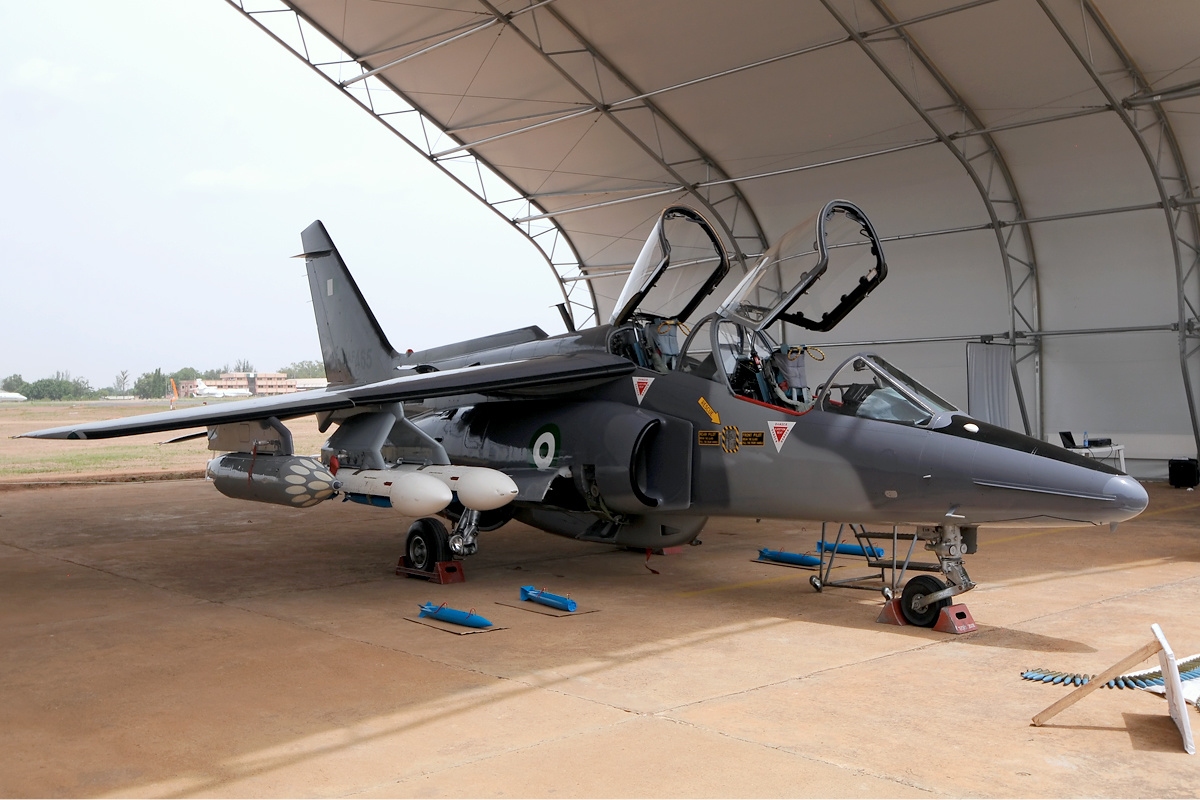
Nigeria military inventory at a glance
The table below uses Global Firepower’s 2026 estimates. Global Firepower is an aggregator, not an official source, and its counts include aircraft and vehicles that may not be operational.
| Category | Estimate (2026) |
|---|---|
| Total military aircraft | 159 |
| Fighters | 14 |
| Dedicated attack aircraft | 24 |
| Transport aircraft | 12 |
| Trainers | 28 |
| Helicopters | 69 |
| Attack helicopters | 15 |
| Tanks | 330 |
| Armoured vehicles (incl. utility) | 12,219 |
| Self-propelled artillery | 40 |
| Towed artillery | 339 |
| Rocket launchers | 37 |
Key systems and who else in Africa operates them
SIPRI records deliveries and orders, not current holdings, so retired or lost equipment may still appear. The last column lists other African countries that SIPRI records as having received the same system.
| System | Type | Supplier | SIPRI record | Other African recipients |
|---|---|---|---|---|
| JF-17 Thunder Block III | Light combat jet | Pakistan | 3 delivered, ordered 2016 | None recorded by SIPRI |
| M-346FA | Light combat jet | Italy | 24 ordered 2021, no deliveries recorded to 2025 | None recorded by SIPRI |
| A-29 Super Tucano | Light attack / counter-insurgency | Brazil | 12 delivered, ordered 2018 | Burkina Faso, Mauritania, Angola, Mali |
| T129 ATAK | Attack helicopter | Türkiye | 6 delivered, ordered 2022 | None recorded by SIPRI |
| Mi-35M | Attack helicopter | Russia | 14 delivered, ordered 2012-2015 | Togo, Rwanda, Mali |
| AH-1Z Viper | Attack helicopter | United States | 12 ordered 2024, no deliveries recorded to 2025 | None recorded by SIPRI |
| Wing Loong II | Armed MALE drone | China | 5 delivered, ordered 2020 | Algeria, Morocco |
| Bayraktar TB2 | Armed MALE drone | Türkiye | 6 ordered 2022, no deliveries recorded to 2025 | Ethiopia, Burkina Faso, Niger, Kenya, Morocco, Djibouti and 4 more |
| VT-4 | Main battle tank | China | 12 delivered, ordered 2019 | None recorded by SIPRI |
| Otokar Cobra | MRAP / protected vehicle | Türkiye | 204 delivered, ordered 2007 | Ghana, Burkina Faso, Gambia, Mauritania, Rwanda, Congo |
| CS/VP3 | MRAP / protected vehicle | China | 220 delivered, ordered 2013-2020 | Sierra Leone, DR Congo, Zambia, Kenya |
| Mi-17 | Transport/utility helicopter | Russia | 12 delivered, ordered 2002-2019 | Ethiopia, Algeria, Burkina Faso, Niger, Eritrea, Kenya and 20 more |
| Dearsan OPV-76 | Offshore patrol vessel | Türkiye | 2 ordered 2021, no deliveries recorded to 2025 | None recorded by SIPRI |
Chinese, Russian, US and Turkish alternatives
The table matches each class in Nigeria’s inventory with the main current export option from each of the four suppliers. It is an editorial comparison by role and class, not a statement that any purchase is planned.
| Class | China | Russia | United States | Türkiye |
|---|---|---|---|---|
| Light combat jet | JF-17 Block III (with Pakistan) / L-15 | Yak-130 | F-16 Block 70 | Hürjet (in development) |
| Light attack / counter-insurgency | K-8 | Yak-130 | AT-6 Wolverine / A-29 (US-built) | Hürkuş-C |
| Attack helicopter | Z-10ME | Mi-28NE / Mi-35M | AH-64E Apache / AH-1Z Viper | TUSAŞ T129 ATAK |
| Armed MALE drone | Wing Loong II / CH-4 | Orion | MQ-9B | Bayraktar TB2 / Akıncı / Anka / Aksungur |
| Main battle tank | VT-4 (MBT-3000) | T-90MS | M1A2 Abrams | ALTAY |
| MRAP / protected vehicle | CS/VP3 / VP11 | Typhoon-K | MaxxPro / M-ATV | BMC Kirpi / Otokar Cobra II / Nurol Ejder Yalçın |
| Transport/utility helicopter | Z-9 / Z-8 | Mi-171Sh | UH-60M Black Hawk | T-70 (licence-built S-70) / T625 Gökbey |
| Offshore patrol vessel | P18N (as built for Nigeria) | Project 22160 | ex-US Coast Guard cutters | Dearsan OPV-76 (ordered by Nigeria) / Hisar-class OPV |
Which option makes sense for Nigeria?
This section is Defence Mena analysis based on the records above, not a forecast of purchases.
Air power: light attack before air superiority
Nigeria’s air war is mostly fought against insurgents in the north-east and against armed groups in the north-west. That favours aircraft that can loiter, carry precision munitions and fly from short strips. The A-29 Super Tucano and the incoming M-346FA cover that need better than a heavy fighter would. For a future light-combat purchase, the realistic comparison is the Chinese L-15, the Russian Yak-130 and Türkiye’s Hürjet, which remains in development. A heavy fighter such as the J-10CE, Su-35 or F-16 Block 70 would add air-defence capability but at a much higher operating cost.
Attack helicopters: build on the T129 base
Nigeria now operates three attack helicopter families: Russian Mi-35M, Turkish T129 ATAK and, on order, US AH-1Z Viper. In our analysis, adding a fourth type would make little sense. The T129 fleet already has Turkish munitions, CIRIT rockets and TAM-LR anti-tank missiles, delivered in 2024 according to SIPRI. Follow-on T129 orders would reuse that training and supply chain, while the AH-1Z covers heavier missions.
Drones: Chinese and Turkish systems side by side
SIPRI records five Wing Loong II and four CH-4B armed drones delivered from China, and six Bayraktar TB2 ordered from Türkiye. The TB2 is the most widely exported armed drone in Africa, with ten African recipients in SIPRI’s register. Its large regional user base gives Nigeria more partners for training and spare parts. For long-range missions, the Turkish Akıncı and Chinese Wing Loong II compete in the same class as the US MQ-9B, which is far more expensive.
Armour and protected mobility
Mine-protected vehicles matter more than tanks in Nigeria’s current fight. The 204 Otokar Cobra vehicles delivered in 2007-2008 and 220 Chinese CS/VP3 MRAPs are the core of that fleet. Natural successors include Otokar’s Cobra II and BMC’s Kirpi, which already serve with several African armies, as well as the US MaxxPro and Chinese VP11. For tanks, Nigeria received 12 Chinese VT-4s; any expansion would weigh the VT-4 against Türkiye’s ALTAY and Russia’s T-90MS.
Where Turkish systems fit
Türkiye is now one of Nigeria’s main suppliers. SIPRI lists Turkish T129 ATAK helicopters, CIRIT and TAM-LR munitions, ASELPOD targeting pods, 204 Cobra armoured vehicles, two Dearsan OPV-76 patrol ships and a tug on order, and six Bayraktar TB2 drones on order. That spread across air, land and sea gives Nigeria a base on which further Turkish purchases could build with lower training and support costs.
Related Defence Mena guides
- Nigerian Air Force Aircraft Inventory 2026
- Nigerian Army Weapons & Equipment List 2026
- Nigeria’s Drone Fleet: TB2 to Wing Loong II
- Nigerian Navy Ships List 2026: Full Fleet & Builders
- How Many Tanks Does Nigeria Have? (2026 Count)
- Nigeria’s Armoured Vehicle Fleet Explained (2026)
- Nigeria’s T129 ATAK Fleet Explained: Deliveries, Cost, Use
- Nigeria’s Biggest Defence Deals, Ranked by Value
- Nigeria Military Strength: Ranking, Budget and Peers
Frequently asked questions
What weapons does Nigeria’s military use?
Nigeria uses Chinese, Russian, Turkish, US, Pakistani, Brazilian and Italian equipment. Key systems include A-29 Super Tucano and JF-17 aircraft, Mi-35M and T129 ATAK helicopters, Wing Loong II drones, VT-4 tanks and Cobra and CS/VP3 protected vehicles.
Does Nigeria use Turkish weapons?
Yes. SIPRI records six T129 ATAK helicopters delivered in 2023-2024, 204 Otokar Cobra vehicles, ASELPOD pods and Turkish missiles, with OPV-76 patrol ships and Bayraktar TB2 drones on order.
Which attack helicopter suits Nigeria best?
Nigeria already operates the Mi-35M and T129 and has ordered the AH-1Z. Adding more of an existing type, rather than a new family, would keep training and spare-parts costs down.
Sources
- Stockholm International Peace Research Institute (SIPRI), Arms Transfers Database, trade register for Nigeria, data to 2025, generated 3 November 2026.
- Global Firepower, 2026 Military Strength Ranking, country page for Nigeria, retrieved November 2026.
- Manufacturers’ published product information for the alternative systems listed (NORINCO, AVIC, Rosoboronexport, Lockheed Martin, Boeing, General Atomics, Baykar, TUSAŞ, ASELSAN, Roketsan, Otokar, FNSS, BMC, Nurol Makina, MKE, Dearsan, STM).
Method: SIPRI figures are deliveries and orders since 1995 unless noted; they are not active inventory. Other African recipients cover SIPRI records from 1960 to 2025. Equivalents are matched by role and class. Defence Mena did not use IISS Military Balance data for this guide.