At least 23 African countries have received BTR-60, BTR-70 or BTR-80 eight-wheeled armoured personnel carriers, according to SIPRI. The largest deliveries went to Egypt (about 650 BTR-60PBs), Algeria (about 560 including 150 BTR-80s), Ethiopia, Angola and Libya, mostly in the 1970s and 1980s. Since 2000, the busiest buyers of second-hand or new BTRs have been Sudan, Mali, Angola, Zambia, Chad, Uganda and Ghana. Delivery totals are not current fleets: many early BTR-60s have been lost, scrapped or stored, and few African armies publish APC counts.
Quick answer
Largest deliveries (SIPRI, BTR-60/70/80): Egypt ~650; Algeria ~560; Ethiopia ~550; Angola ~539; Libya ~500; Sudan ~171 plus 10 Ukrainian BTR-3s. Recent deliveries (2015–2023): Sudan (BTR-70 and BTR-70MB from Belarus), Angola (29 BTR-70, 2019), Zambia (10 BTR-80, 2019), Mali (BTR-70, 2021–2023), Ghana (20 BTR-70, 2023). Ukrainian derivatives: Nigeria, Chad and Sudan bought BTR-3s; Nigeria also bought BTR-4s.
Last updated: 8 November 2026. SIPRI delivery data run to 2025 and include many estimates (marked “?” in SIPRI). Figures are cumulative deliveries and do not deduct losses or retirements.
What does “BTR” mean?
BTR stands for bronetransporter, Russian for “armoured transporter”. The designation covers several Soviet and post-Soviet vehicles. The family most associated with the name is the eight-wheeled BTR-60, BTR-70 and BTR-80, which carry an infantry squad and mount a turret with a heavy machine gun. The BTR-80A adds a 30 mm cannon and is sometimes classed as an infantry fighting vehicle. Older BTR-40, BTR-152 and tracked BTR-50 vehicles also reached Africa in large numbers, and Ukraine’s BTR-3 and BTR-4 are newer derivatives sold under the same prefix.
The appeal in Africa has been simplicity and supply. Wheeled vehicles move quickly on roads, are easier to maintain than tracked infantry carriers, and Soviet stocks were plentiful. Our explainer on how one large African army organises its armoured vehicle fleet shows how these older types now sit beside newer mine-protected vehicles.
BTR-60, BTR-70 and BTR-80 deliveries to Africa
| Country | Types delivered (approx. number) | Approx. total | Latest delivery recorded |
|---|---|---|---|
| Egypt | BTR-60PB (650) | 650 | 1973 |
| Algeria | BTR-60PB/P (410), BTR-80 (150) | 560 | 1995 |
| Ethiopia | BTR-60PB (550) | 550 | 1986 |
| Angola | BTR-60PB (499), BTR-80 (11), BTR-70 (29) | 539 | 2019 |
| Libya | BTR-60PB (500) | 500 | 1976 |
| Sudan | BTR-80A (80), BTR-80 (10), BTR-70 incl. BTR-70MB (81) | 171 | 2023 |
| Mozambique | BTR-60PB (90) | 90 | 1986 |
| Mali | BTR-60PB (54), BTR-70 (17) | 71 | 2023 |
| Zambia | BTR-60PB (13), BTR-70 (20), BTR-80 (10) | 43 | 2019 |
| DR Congo | BTR-60PB (40) | 40 | 2000 |
| Uganda | BTR-80A (32) | 32 | 2011 |
| Botswana | BTR-60PB (30) | 30 | 1981 |
| Congo | BTR-60PB (28) | 28 | 1984 |
| Chad | BTR-80 (24) | 24 | 2001 |
| Ghana | BTR-70 (20) | 20 | 2023 |
| Djibouti | BTR-60PB (12), BTR-80 (8) | 20 | 2002 |
| Somalia, Guinea-Bissau, Burundi, Côte d’Ivoire, Guinea, Liberia, Nigeria | Small batches of BTR-60/70/80 | 2–15 each | 1979–2018 |
Source: DefenceMENA aggregation of SIPRI Arms Transfers Database rows (data to 2025). Ukrainian BTR-3/BTR-4 deliveries are listed separately below. Many SIPRI figures are estimates.
The Cold War wave: Egypt, Algeria, Ethiopia, Libya and Angola
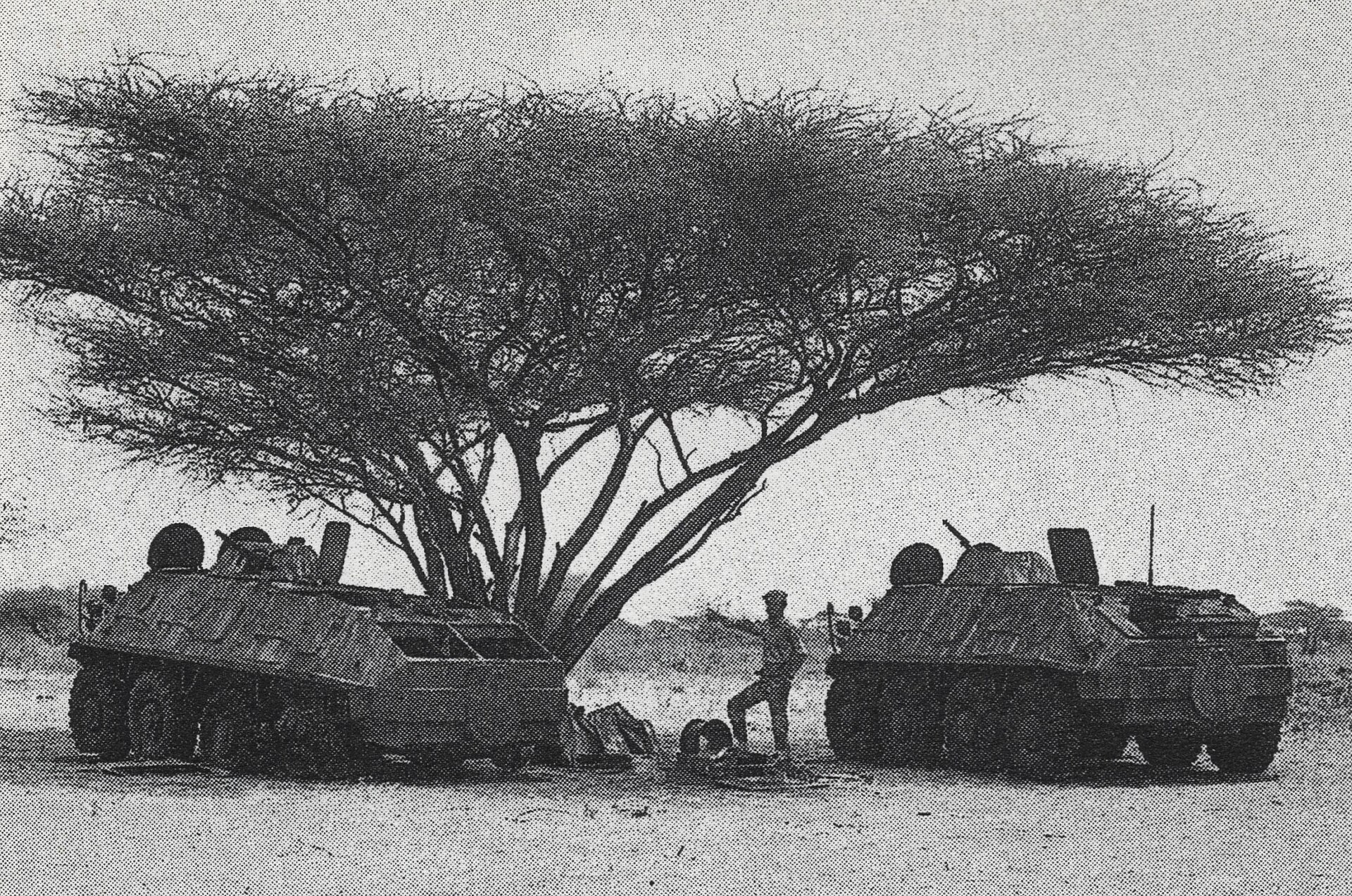
Most African BTRs arrived between 1970 and 1988, when the Soviet Union equipped allied armies on a large scale. SIPRI records about 650 BTR-60PBs for Egypt in 1970–1973, about 500 for Libya in 1975–1976, and Ethiopian deliveries of roughly 550 in three batches between 1977 and 1986, many of them second-hand. Angola received about 500 BTR-60PBs between 1975 and 1988, during its civil war. These are the countries where very large “armoured vehicle” totals in rankings often originate. Fleets of that age should not be assumed to be serviceable today.
Recent BTR buyers since 2000
- Sudan is the most active recent customer. SIPRI records BTR-80As from Russia (locally designated Shareef-1) in 2001–2002 and 2009–2010, about 70 second-hand BTR-70s from Belarus in 2015–2017, six BTR-70MB upgrades in 2018 and two more BTR-70s in 2023. Since April 2023, these vehicles have been used in the war between the Sudanese Armed Forces and the Rapid Support Forces, making any current count unreliable; see our Sudan military strength profile.
- Angola took 29 second-hand BTR-70s in 2019, possibly via Bulgaria, according to SIPRI.
- Zambia received about 10 new BTR-80s, including the BREM-K recovery variant, which SIPRI dates to 2019; Zambian BTR-80s were shown publicly at a June 2021 parade.
- Mali received refurbished BTR-60PBs from Bulgaria in 2008–2009, more BTR-60/70s via Bulgaria in 2012 and further second-hand BTR-70s in 2021–2023.
- Ghana commissioned 20 BTR-70s in February 2023, partly for its UN peacekeeping contingent in Abyei. SIPRI records them as second-hand vehicles from Azerbaijan. Ghanaian media later questioned their age and condition.
- Côte d’Ivoire bought six BTR-80s from Belarus in 2003 and four modernised BTR-70MBs in 2018.
Ukrainian BTR-3 and BTR-4 in Africa
Ukraine’s eight-wheeled BTR-3 and BTR-4 share the BTR name but are post-Soviet designs. SIPRI records about 51 BTR-3s and 10 BTR-4s for Nigeria (2006–2014), 12 BTR-3Es for Chad (2008–2009) and 10 BTR-3s for Sudan (2010–2011). They are typically better protected and better armed than BTR-60s, but deliveries largely stopped after 2014.
How BTRs compare with newer African APCs
The BTR-60/70/80 family was designed for conventional mechanised warfare, not for roadside bombs. Its flat-bottomed hull offers little blast protection, which is why many African armies fighting insurgencies have added mine-protected vehicles. Our guides to MRAPs in African service and Africa’s most widely exported armoured vehicles cover the Casspir, Otokar Cobra, Paramount Mbombe and others that now compete for the same role.
Frequently asked questions
Which African country has the most BTRs?
By deliveries recorded by SIPRI, Egypt (about 650 BTR-60PBs) and Algeria (about 560 BTR-60s and BTR-80s) top the list. Neither publishes a current BTR count, and many early vehicles are likely retired or stored.
Is the BTR-80 used in Africa?
Yes. SIPRI records BTR-80 or BTR-80A deliveries to Algeria, Sudan, Uganda, Zambia, Chad, Angola, Burundi, Djibouti, Côte d’Ivoire and Somalia.
What is the difference between the BTR-80 and BTR-80A?
The BTR-80 carries a heavy machine gun turret, while the BTR-80A mounts a 30 mm cannon. SIPRI classifies Sudan’s and Uganda’s BTR-80As as infantry fighting vehicles.
Did Ghana buy BTR-70s?
Yes. Ghana commissioned 20 BTR-70s in February 2023, partly for UN peacekeeping. SIPRI lists them as second-hand vehicles from Azerbaijan.
Is the Ukrainian BTR-3 the same as the Soviet BTR-70?
No. The BTR-3 is a post-Soviet Ukrainian design based on the BTR-80 layout, with a different engine and weapon station. Nigeria, Chad and Sudan bought it.
Sources
- Stockholm International Peace Research Institute (SIPRI), “SIPRI Arms Transfers Database, trade registers for African recipients (data to 2025)”, March 2026 release. https://armstransfers.sipri.org/ (accessed 6 November 2026 (local extract re-checked 8 November 2026)).
- Ghana News Agency, “President presents vehicles and communication equipment to GAF”, February 2023. https://gna.org.gh/2023/02/president-presents-vehicles-and-communication-equipment-to-gaf/ (accessed 8 November 2026).
- The Herald Ghana, “Nitiwul’s US$8.8 million Soviet-scrap armoured vehicles put Ghanaian soldiers in danger”, undated report (2024 or later). https://theheraldghana.com/nitiwuls-us8-8-million-soviet-scrap-armoured-vehicles-put-ghanaian-soldiers-in-danger/ (accessed 8 November 2026).
- Military Africa, “Zambian military parades new weapons”, June 2021. https://www.military.africa/2021/06/zambian-military-parades-new-weapons/ (accessed 8 November 2026).
- Somali Democratic Republic, Ministry of Foreign Affairs (via Wikimedia Commons), “Ethiopian armored vehicles captured by the Somali army”, July 1982. https://commons.wikimedia.org/wiki/File:Ethiopian_armored_vehicles_captured_by_the_Somali_army.jpg (accessed 8 November 2026).
Method: counts from SIPRI are deliveries recorded by SIPRI, not current inventories. Status labels distinguish delivered, reported in service, ordered and retired; where open sources disagree, the range is shown rather than a single figure.