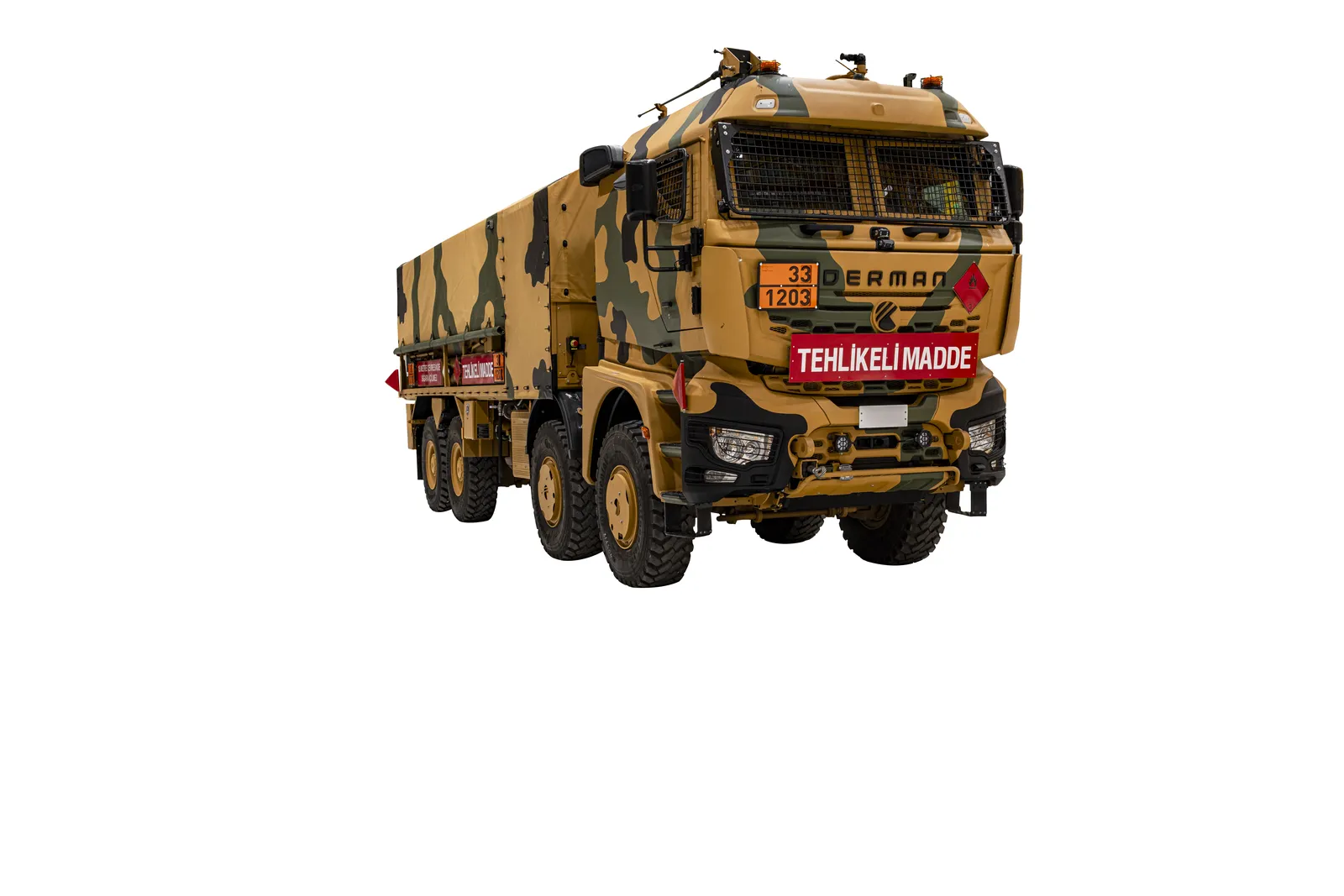
Türkiye’s battlefield fuel tanker programme gives its forces 12,000-litre refuellers that can follow combat units forward instead of waiting at rear depots. Türkiye’s Presidency of Defence Industries (SSB) has already delivered 86 tankers built by BMC and Koluman, and a further 41 armoured 8×8 tankers with ballistic leak-proof tanks and protected cabs are being procured for the Land Forces and Gendarmerie.
Photo: Presidency of Defence Industries (SSB), Türkiye.
What is the battlefield fuel tanker?
Armies run on fuel, and the vehicle that brings it to the front is one of the most exposed in any convoy. SSB’s Battlefield Fuel Tanker project was set up to deliver fuel to units in the field in the quantity, place and time they need it, faster and more efficiently than with the commercial-pattern tankers used before. In practice, that means a tactical vehicle with off-road mobility, a large tank, its own pumping system and, in the newest version, armour that lets it operate close to the fighting.
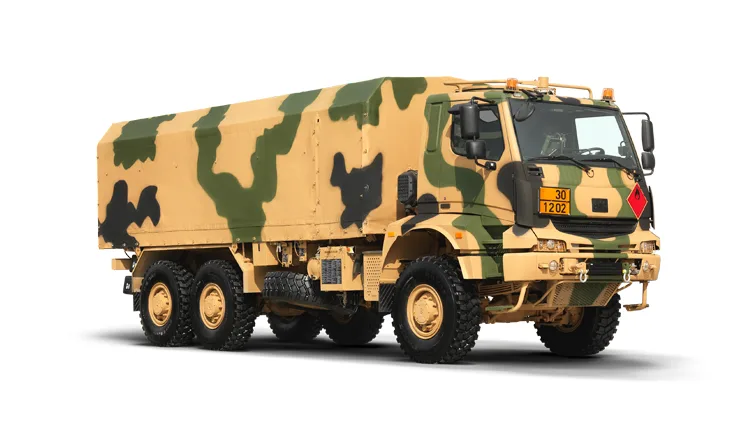
The programme covers two families. BMC markets the AKTAN battlefield fuel tanker, a tactical field refueller offered in 6×6 and 8×8 drive configurations, that can serve tanks, armoured vehicles, helicopters and aircraft, and refuel up to four vehicles at the same time according to the company. The armoured branch, referred to in SSB imagery as the armoured AKTAN, moves the same mission onto an 8×8 ballistic-protected vehicle. Koluman is prime contractor for that armoured tanker under a contract SSB signed in October 2023.
Key specifications
| Manufacturers | BMC and Koluman (Türkiye) |
| Procurement authority | Presidency of Defence Industries (SSB) |
| Turkish users | Land Forces Command, Naval Forces Command, Gendarmerie General Command, Turkish National Police |
| Fuel capacity | 12,000 litres |
| Tank protection | Ballistic leak-proofing |
| Crew | 3 |
| Drive options | 6×6 and 8×8 |
| Powertrain | 400+ hp engine, automatic transmission |
| Deliveries (SSB, Sept 2026) | 86 tankers delivered; 41 armoured tankers being procured |
| Armoured tanker contract | Koluman, October 2023: 39 for Land Forces, 2 for Gendarmerie |
The ballistic leak-proofing is the specification that matters most in a combat zone. A conventional fuel tank hit by a rifle round or a fragment leaks, often catches fire and takes the vehicle out of the fight. A leak-proof tank is designed to seal itself or contain the damage, so the vehicle can keep moving and the fuel stays usable. Combined with a protected cab for the three-person crew, this turns the tanker from a liability into a vehicle that can accompany a manoeuvre force. The 400+ horsepower engine and automatic gearbox keep a heavy, fully loaded vehicle mobile on rough tracks, and the choice between 6×6 and 8×8 lets users balance protection, payload and cost.
The SSB programme and Turkish service
According to SSB, 86 tankers have been delivered so far, and 41 armoured tankers are being procured. The user list is broader than for most land systems: the Land Forces Command (KKK), the Naval Forces Command (DzKK), the Gendarmerie General Command (JGK) and the General Directorate of Security (EGM, the Turkish National Police). That spread reflects the vehicle’s flexibility. The same tanker can refuel a mechanised battalion in the field, aircraft and helicopters at an austere airstrip, or security forces’ vehicles on a long internal-security deployment.
The armoured phase is a clear example of SSB’s local-content policy. The contract with Koluman, signed in October 2023, covers 41 ballistic-protected 8×8 tankers, 39 for the Land Forces and two for the Gendarmerie, each with 12,000 litres of capacity, according to Defence Turkey. The project committed to 50% domestic value added, with armour steel, armoured glass, hydraulic pump systems and superstructure components sourced in Türkiye. In an interview at IDEF 2025, Koluman’s chief executive Kaan Saltık said part of the contract had already been delivered and that the armoured tanker allows refuelling with crew protection behind the front line.
The programme draws on two companies with deep roots in Turkish military trucks. BMC, based in İzmir, has built tactical trucks and armoured vehicles for the Turkish Armed Forces for decades, and its Kirpi MRAP is among the best-known Turkish vehicles abroad. Koluman, from Mersin, is a long-established builder of truck superstructures that has moved firmly into military logistics, with its DERMAN 8×8 family now in Turkish service. SSB’s decision to work with both has given the Turkish forces a deeper supplier base for a type of vehicle every army needs in numbers.
Who operates the battlefield fuel tanker?
The SSB battlefield fuel tankers are in service with the Turkish Land Forces Command, Naval Forces Command, Gendarmerie General Command and Turkish National Police. The armoured tanker is entering service with the Land Forces and Gendarmerie.
We found no public report of an export customer for either the AKTAN or the armoured tanker. Both companies are active exporters in other segments: BMC has supplied Kirpi vehicles to Tunisia, among other customers, as covered in our report on the BMC Kirpi’s African combat record, and Koluman has reported a growing number of delegations from Asia, Africa and South America visiting its facilities. The tanker is offered for export, and its design was intended from the start to have export potential, according to the October 2023 contract announcement.
Can the fuel tanker go to Africa?
Fuel logistics is one of the weak points that armed groups in Africa have learned to target. Since September 2025, JNIM has attacked tanker convoys bringing fuel into Mali from Senegal and Côte d’Ivoire, causing serious shortages in Bamako and other cities. In north-east Nigeria, the Lake Chad basin and Somalia, resupply convoys travel long distances on roads where IEDs and ambushes are routine. In northern Mozambique, supply runs to forward positions in Cabo Delgado face similar risks. A tanker that can take a hit to its tank and keep driving, with a protected crew, directly addresses this problem.
Distance is the other African constant. Operations in the Sahel or the Horn of Africa can be hundreds of kilometres from the nearest depot, and a 12,000-litre tanker that can refuel four vehicles at once cuts the time a column spends stationary and exposed. The ability to refuel helicopters and aircraft in the field also matters to air forces running Turkish-made drones and light aircraft from improvised strips.
Turkish vehicles already have a strong presence on the continent, as our overview of Turkish systems in African service shows. For the fuel tanker, the most logical candidates are countries already running Turkish armour or drones and facing long, contested supply lines: Mali, Burkina Faso and Niger in the central Sahel, Nigeria, Somalia, Kenya and Chad. Larger armies modernising their logistics fleets, such as Egypt, Morocco and Angola, are further opportunities, and a 6×6 unarmoured version offers a cost-effective option for forces whose main need is reliable rear-area refuelling.
How it compares
Most African armies still rely on commercial-pattern fuel bowsers or ageing Soviet-era tankers, which have little off-road capability and no protection. Western armoured refuellers exist but tend to come at a high price and with complex export procedures. The Turkish tanker family sits between the two: a modern tactical vehicle built to the requirements of a NATO army, with armour available where needed, delivered through SSB’s government-to-government framework with training and support included.
FAQ
What is the AKTAN?
AKTAN is the name of BMC’s battlefield fuel tanker, a tactical refueller that can supply fuel to tanks, armoured vehicles, helicopters and aircraft in the field. An armoured version is part of the SSB battlefield fuel tanker programme.
How much fuel does the battlefield tanker carry?
SSB gives a capacity of 12,000 litres, with ballistic leak-proofing, a three-person crew, a 400+ hp engine with automatic transmission, and 6×6 or 8×8 configurations.
How many tankers has Türkiye received?
According to SSB, 86 tankers have been delivered, and 41 armoured tankers are being procured from Koluman under a contract signed in October 2023.
Who uses the Turkish battlefield fuel tanker?
The Turkish Land Forces Command, Naval Forces Command, Gendarmerie General Command and Turkish National Police. No export customer has been announced.
Why is an armoured fuel tanker relevant for Africa?
Fuel convoys are frequent targets in the Sahel, the Lake Chad basin and Somalia. A tanker with a leak-proof tank and a protected cab keeps fuel moving to forward units over long and dangerous routes.