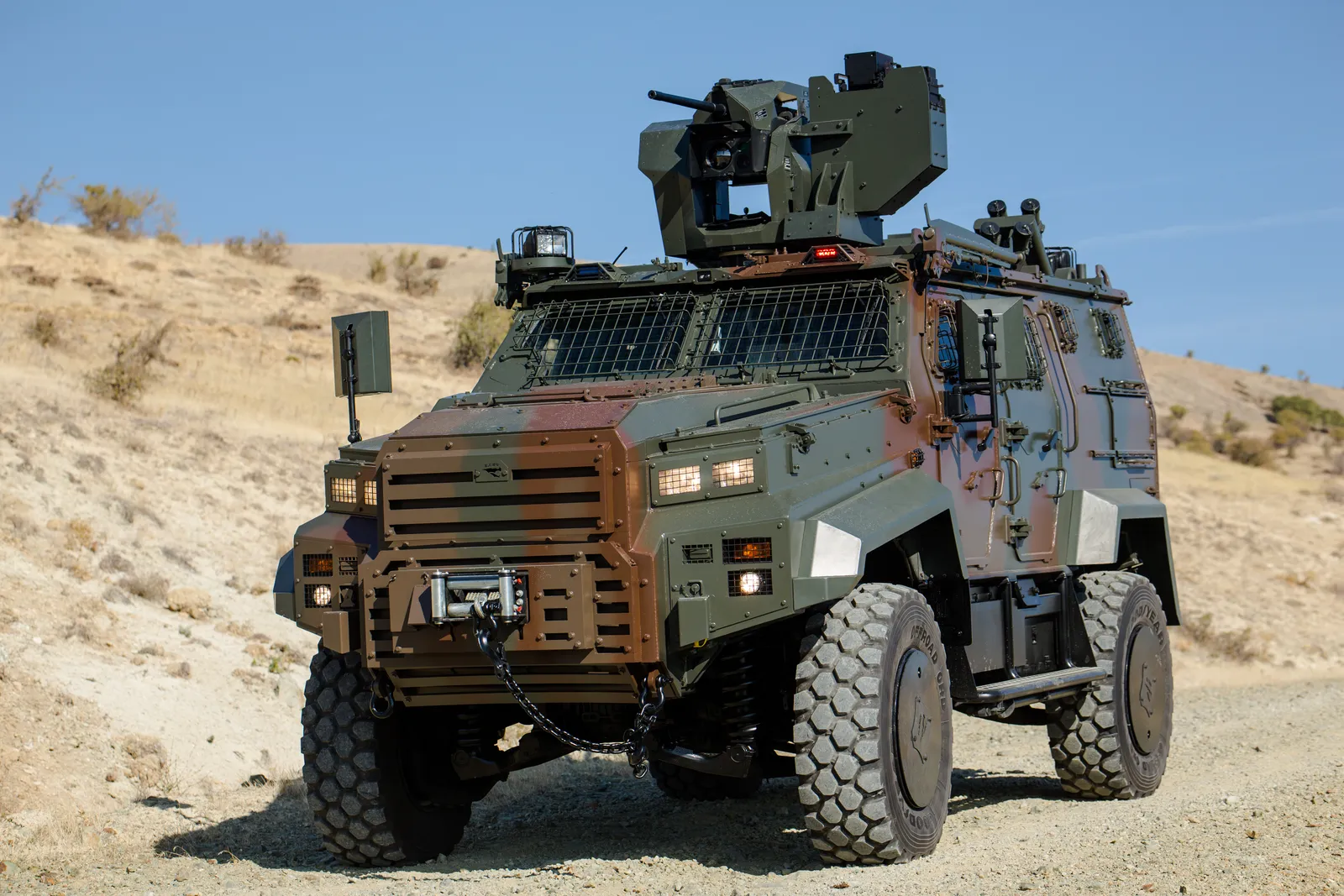
Before the Ejder Yalçın became one of Türkiye’s most exported armoured vehicles, it was a police vehicle. Nurol Makina built it around a requirement from Turkish police special operations units, and today Türkiye’s Presidency of Defence Industries (SSB) lists the National Police (EGM) and the Gendarmerie General Command (JGK) as its Turkish users. This file looks at the vehicle through that domestic lens: how the SSB-managed programme shaped it, what a decade of Turkish internal-security service has added, and what that record means for the African armies and gendarmeries that already operate it or are weighing it up.
Photo: Presidency of Defence Industries (SSB), Türkiye.
What is the Ejder Yalçın?
The Ejder Yalçın is a 4×4 tactical wheeled armoured vehicle made by Nurol Makina in Ankara, part of Nurol Holding. It was shown as the Ejder 4×4 at IDEF in 2013 and went into serial production in 2014. It sits at the heavy end of the protected 4×4 class, with a V-shaped monocoque hull, blast-attenuating seats, five doors, run-flat tyres and a roof that accepts anything from a manual machine-gun mount to a remote weapon station or a 120 mm mortar. Nurol describes both its ballistic protection and its protection against mines, IEDs and lateral blasts as MRAP-level.
For a full technical profile, including the debate over published weights and engine data, see our Ejder Yalçın explainer. This page focuses on the Turkish programme behind it and the African market ahead of it.
Key specifications
| Manufacturer | Nurol Makina ve Sanayi A.Ş., Ankara, Türkiye |
| Type | 4×4 tactical wheeled armoured vehicle, V-shaped monocoque hull |
| Turkish users (SSB data) | General Directorate of Security (EGM, National Police) and Gendarmerie General Command (JGK) |
| In production | Since 2014 |
| Capacity | Up to 12 personnel (Nurol) |
| Protection | MRAP-level ballistic, mine, IED and lateral blast protection; optional CBRN system (Nurol) |
| Mobility (Nurol) | 60% gradient, 30% side slope, 1.1 m fording, 1.1 m trench, 0.5 m vertical obstacle |
| Weight | Not published by Nurol; press figures range from 12-14 t for early vehicles to about 18 t for the current standard |
| Armament options | Manual mounts or remote weapon stations such as ASELSAN SARP; 120 mm mortar version |
| Variants | 14 named by Nurol, including border surveillance, command and control, reconnaissance, air defence, anti-tank, CBRN, mine and IED clearance, forward observer, mortar and armoured ambulance |
| Licence production | Hungary, as the Gidrán |
A police requirement that became a national programme
Most armoured vehicles start with an army requirement and are later adapted for police use. The Ejder Yalçın went the other way. Turkish police special operations units needed a vehicle that could carry a full team through mined rural roads and into urban areas under fire, with good visibility and enough doors to get people out quickly. Nurol’s answer was a vehicle with a large, high-roofed protected cabin, wide side and rear doors and glazed panels that can take wire-mesh window guards, as seen in the SSB photograph above.
The police became the launch customer in 2014, and the Gendarmerie followed. From there the programme was taken up within the SSB framework that governs Türkiye’s security-force procurement. Anadolu Agency reported in 2019 that more than 280 Ejder Yalçın had been delivered to Turkish security units under SSB coordination, and that the police’s own direct purchases had brought the total in service to about 360. Later reporting put the figure at around 400.
SSB’s contribution went beyond placing orders. Under its local-content policy, successive batches moved to Turkish subsystems, with ASELSAN’s SARP remote weapon station becoming a standard fit on the Block III configuration and domestic armour suppliers, including Nurol’s sister company Nurol Teknoloji, supplying ballistic protection. Steady domestic orders let Nurol run a continuous production line in Ankara and revise the design every few years based on user feedback, a practice the company has described publicly. The vehicle that Turkish units receive in 2026 is heavier, better protected and more digitally integrated than the one delivered in 2014.
What Turkish service has taught
A decade of daily use by the police and gendarmerie has given the Ejder Yalçın something that brochures cannot supply: a large, documented operating base in demanding terrain. Turkish units use the vehicle in the mountainous south-east, on long border patrols and in urban security roles, often in the same week. That mix has driven the variant list. Border surveillance vehicles with mast-mounted sensors, command posts, armoured ambulances and mine and IED clearance versions all came from Turkish operational needs before they were offered abroad.
The domestic experience also matters for support. Turkish units have built up years of maintenance practice, spare-parts planning and crew training on the type, and Nurol has organised its after-sales service around a large home fleet. For a foreign buyer, that means the vehicle comes with a working logistics model rather than a promise of one.
Who operates it abroad?
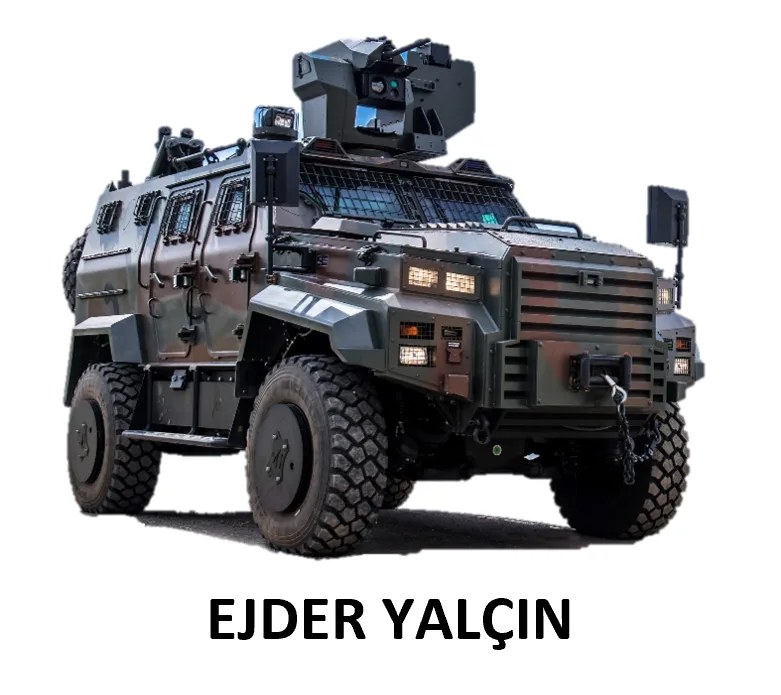
Nurol Makina told European Security & Defence in September 2026 that the Ejder Yalçın is used in more than ten countries. Our Ejder Yalçın operator tracker documents service with Türkiye, Qatar, Tunisia, Senegal, Chad, Burkina Faso, Morocco, Hungary and Malaysia, deliveries of 24 vehicles to Uzbekistan, and an order from Niger. Qatar’s Emiri Land Force is the largest export user, with 342 vehicles announced in 2018. Hungary builds the vehicle under licence as the Gidrán and signed an agreement for up to 800 in March 2026, which makes it a European production line for a Turkish design.
Africa accounts for more Ejder Yalçın operators than any other region. Tunisia became the first export customer, taking about 70 vehicles in 2017. Senegal’s Gendarmerie paraded 25 in 2018. Chad’s army has used them at home and with its contingent in the UN mission in Mali. Burkina Faso and Morocco’s special forces followed. Country detail, quantities and sources are kept on the tracker linked above.
Can the Ejder Yalçın expand further in Africa?
The vehicle’s African record is already strong, and its Turkish origins help explain why. Many African states give a central internal-security role to gendarmeries and police intervention units rather than to the army alone. A vehicle designed first for Turkish police special operations and then proved with the Gendarmerie fits that model better than a pure army carrier. Senegal’s choice of the Ejder Yalçın for its Gendarmerie intervention legion is a clear example.
The design also fits African operating conditions. MRAP-level protection answers the IED threat in the Sahel and the Lake Chad basin. A large cabin for up to 12 people suits section-sized patrols and quick-reaction forces. The armoured ambulance and command variants are useful to armies that deploy on UN and African Union missions, where Chad has already used the type. And the Hungarian model of licence production shows that Nurol is willing to transfer manufacturing, which matters to countries such as Nigeria, Kenya or Egypt that want local industrial participation.
The clearest opportunities are in the coastal West African states that are strengthening their northern border forces, among them Benin, Togo, Ghana and Côte d’Ivoire; in the Sahel, where Niger’s order points to continued demand; and in East Africa, where Kenya and Tanzania run large police and paramilitary forces. Lusophone markets such as Mozambique and Angola, where security forces need long-range protected patrol vehicles, are a natural next step. In each case the argument rests on the same base: a vehicle shaped by more than a decade of Turkish police and gendarmerie service, supported by an SSB-backed industrial programme.
How it fits the Turkish range
Within Nurol’s line-up, the Ejder Yalçın is the heavier sibling of the NMS 4×4, known in Türkiye as the Yörük, which is lighter and faster. Among Turkish manufacturers it is usually compared with Otokar’s COBRA II and BMC’s Kirpi. For the company behind it, see our Nurol Makina company profile, and for the lighter vehicle, our NMS 4×4 (Yörük) page.
Frequently asked questions
Which Turkish forces use the Ejder Yalçın?
According to Türkiye’s Presidency of Defence Industries (SSB), the Turkish users are the General Directorate of Security (EGM, the National Police) and the Gendarmerie General Command (JGK). The police special operations units were the launch customer in 2014.
How many Ejder Yalçın are in Turkish service?
Anadolu Agency reported in 2019 that more than 280 had been delivered to security units under SSB coordination, and that police direct purchases brought the total to about 360. Later reporting gives a figure of around 400.
Which African countries operate the Ejder Yalçın?
Documented African operators are Tunisia, Senegal’s Gendarmerie, Chad, Burkina Faso and Morocco’s special forces. Niger ordered the vehicle in 2022.
How many people does the Ejder Yalçın carry?
Nurol Makina gives a capacity of up to 12 personnel, with MRAP-level ballistic, mine and IED protection and an optional CBRN protection system.
Is the Ejder Yalçın built outside Türkiye?
Yes. Hungary produces it under licence as the Gidrán and signed an agreement for up to 800 vehicles in March 2026.
Sources: Nurol Makina Ejder Yalçın 4×4 product page; Anadolu Agency (2019); European Security & Defence (May 2025, September 2026); Daily Sabah (2017); SSB land vehicles portfolio (2026); DefenceMENA Ejder Yalçın operator tracker.