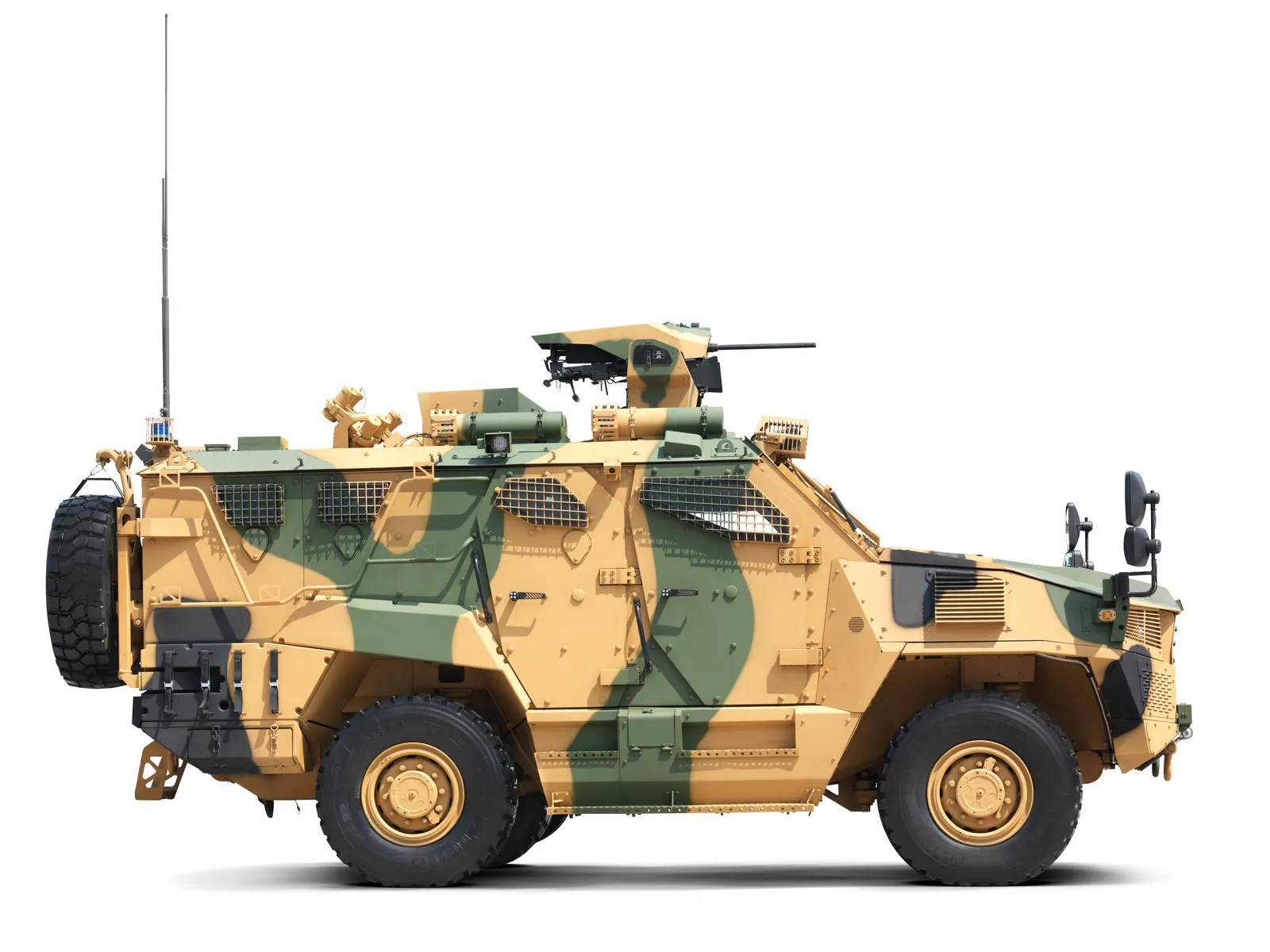
The BMC Vuran is a 4×4 multi-purpose armoured vehicle that has become one of the most widely shared platforms in Türkiye’s security forces, serving with the army, the gendarmerie, the national police, the navy and the coast guard. Procured through the Presidency of Defence Industries (SSB) with a domestic engine and domestic armour listed as its critical subsystems, it has also found export customers in Georgia, Kosovo and Tunisia. This product file sets out the vehicle’s features, its SSB programme, its operators and its prospects in Africa.
Photo: Presidency of Defence Industries (SSB), Türkiye.
What is the BMC Vuran?
BMC Otomotiv unveiled the Vuran at the IDEF exhibition in Istanbul in 2015 as a medium-class tactical wheeled armoured vehicle, and the type has been in Turkish service since 2019. It sits between the company’s compact Amazon and the heavier Kirpi MRAP. The Vuran is smaller and more agile than a full-size MRAP, but it keeps a V-shaped, blast-deflecting hull and a protected crew cell, which makes it suitable for patrols, convoy escort, reconnaissance and rapid reaction in areas where mines and roadside bombs are a real risk.
The vehicle’s strength is its versatility. The same armoured body has been fitted with remote weapon stations such as ASELSAN’s SARP Dual, with an ASELSAN ALKAR 120 mm mortar system, and with Roketsan’s SUNGUR short-range air defence launcher. It also serves as a command, patrol and personnel vehicle. That spread of roles explains why the Vuran ended up in so many Turkish organisations: a single chassis can cover the needs of a border gendarmerie post, a police special operations team, a naval base security unit and an army mortar battery.
Key specifications
SSB lists the Vuran’s critical subsystems as a domestic engine and domestic armour. The remaining figures below come from BMC and published reporting; detailed protection levels are not released.
| Manufacturer | BMC Otomotiv, Türkiye |
| Type | 4×4 multi-purpose tactical wheeled armoured vehicle |
| Procurement authority | Presidency of Defence Industries (SSB) |
| First shown / in service | IDEF 2015 / 2019 |
| Turkish users (SSB) | Land Forces Command, Gendarmerie General Command, General Directorate of Security (police), Naval Forces Command, Coast Guard Command |
| Critical subsystems (SSB) | Domestic engine, domestic armour |
| Engine | BMC Power TUNA domestic diesel on recent deliveries |
| Protection | Ballistic and mine protection, V-shaped hull (levels not disclosed) |
| Capacity | Crew plus up to seven personnel in the rear compartment |
| Range | About 1,000 km at 60 km/h (manufacturer data, reported) |
| Weapon options | 7.62 mm / 12.7 mm machine guns, ASELSAN SARP Dual remote weapon station |
| Mission variants | Personnel carrier, patrol, command, 120 mm and 81 mm mortar carrier (ALKAR), SUNGUR air defence |
The range figure is worth noting for large countries. A protected 4×4 that can cover around 1,000 km at road-march speed reduces the need for forward refuelling on long border patrols, which is a recurring issue for security forces operating far from their bases.
The SSB programme and Turkish service
The Vuran shows how SSB has used repeated, multi-user orders to build a domestic production line with real scale. Instead of each service buying its own foreign vehicle, the army, gendarmerie, police, navy and coast guard draw on the same Turkish design, which concentrates spares, training and upgrades on one platform. SSB data lists five Turkish users, a breadth few armoured vehicles anywhere can match.
The programme is also part of SSB’s push to localise the components that matter most. Both the engine and the armour of the Vuran are domestic, according to SSB. In January 2025 SSB President Haluk Görgün attended the handover at BMC’s Pınarbaşı facility in İzmir of 100 tactical wheeled armoured vehicles powered by domestic engines, most of them Vurans, for the Land Forces Command and the Gendarmerie General Command, Janes reported. Serial deliveries to Turkish users continue.
In Turkish service the Vuran’s tasks range from internal security and border patrols to fire support. The gendarmerie operates it for rural security and counter-terrorism. The police special operations department uses it as a protected response vehicle. The army fields both troop-carrying and mortar-carrying versions, and naval and coast guard units use the type to secure bases and coastal areas.
Who operates the Vuran?
| Türkiye | Confirmed (SSB): Land Forces, Gendarmerie, Police (EGM), Naval Forces, Coast Guard |
| Georgia | Confirmed: 46 vehicles delivered to the Georgian Defence Forces, ceremony in June 2024 |
| Kosovo | Confirmed: Vuran mortar-carrier variants for the Kosovo Security Force, first delivered in 2022 |
| Tunisia | Confirmed: contract for nine 4×4 multi-purpose armoured vehicles in 2020, deliveries reported the same year |
| Turkmenistan | Reported: Vuran with SARP Dual seen with state forces in 2018 |
| El Salvador | Reported: Vurans with the army and the National Civil Police |
Georgia is the largest confirmed export so far. Anadolu Agency reported that 46 Vurans, built by BMC under a 2022 agreement with the Turkish defence ministry company ASFAT, were handed over at the Vaziani base near Tbilisi in June 2024. The Georgian vehicles carry a remote weapon station with a 40 mm automatic grenade launcher. Kosovo, for its part, chose mortar-carrier versions developed with ASELSAN for its Security Force, with the first vehicles handed over in 2022, Hürriyet Daily News reported.
In Africa, Tunisia’s purchase is the key reference. Military Africa reported in 2020 that Tunisia had ordered nine BMC 4×4 multi-purpose armoured vehicles following an international tender and that a batch of Vurans was being delivered. Tunisia already operated BMC’s Kirpi, so the Vuran gave its forces a lighter, more agile complement on a familiar supply chain.
Can the Vuran go to Africa?
It already has, through Tunisia, and the Vuran’s profile fits a gap that many African forces describe in their procurement plans: a protected vehicle that is lighter and cheaper to run than an MRAP but much safer than an unarmoured pickup or an open patrol vehicle.
The fact that five different Turkish organisations use the Vuran is a selling point in Africa, where gendarmeries, police tactical units, border guards and armies often buy separately but face similar threats. A ministry that standardises on one 4×4 across its army and paramilitary forces gains the same advantages Türkiye has: a single training pipeline, shared spares and one support contract. The mortar-carrier version adds an option that few light armoured vehicles offer, giving infantry units their own protected indirect fire on rough terrain.
Several markets stand out as opportunities. North African states that already know BMC products, starting with Tunisia, could expand their fleets or add variants. West African and Sahel countries, where gendarmeries carry much of the counter-insurgency burden, match the Vuran’s internal-security role closely. Coastal states in the Gulf of Guinea and East Africa that are building up naval infantry and coast guard units could follow the Turkish model of using the Vuran for base and coastline security. Turkish land vehicles already have a solid base on the continent, as our survey of Turkish systems in African armed forces shows.
How it compares
The Vuran competes in the same broad class as other Turkish and European 4x4s, such as Otokar’s Cobra II, Nurol Makina’s NMS and Arquus’s Bastion. Each has its own strengths, which we discuss in Cobra II vs Bastion vs VN4. The Vuran’s particular advantages are its wide spread of mission variants, including mortar and air defence versions, the domestic engine and armour backed by SSB, and its place in BMC’s family alongside the Kirpi II MRAP, which allows a customer to buy a matched light-and-heavy fleet from one supplier.
Frequently asked questions
Who makes the Vuran?
The Vuran is designed and built by BMC Otomotiv in Türkiye and procured through the Presidency of Defence Industries (SSB).
Which Turkish forces use the Vuran?
According to SSB, the Land Forces Command, Gendarmerie General Command, General Directorate of Security (police), Naval Forces Command and Coast Guard Command.
Which countries have bought the Vuran?
Confirmed export customers are Georgia (46 vehicles delivered in 2024), Kosovo (mortar-carrier versions) and Tunisia (contract in 2020). Turkmenistan and El Salvador have been reported as users.
Does the Vuran have a Turkish engine?
Yes. SSB lists a domestic engine and domestic armour as the Vuran’s critical subsystems, and recent deliveries use BMC Power’s TUNA diesel.
What versions of the Vuran exist?
Personnel carrier, patrol and command vehicles, 120 mm and 81 mm mortar carriers with ASELSAN’s ALKAR system, and a SUNGUR air defence version, plus remote weapon station options.
Related: BMC Kirpi II product file · BMC Kirpi in Africa · ASELSAN company profile