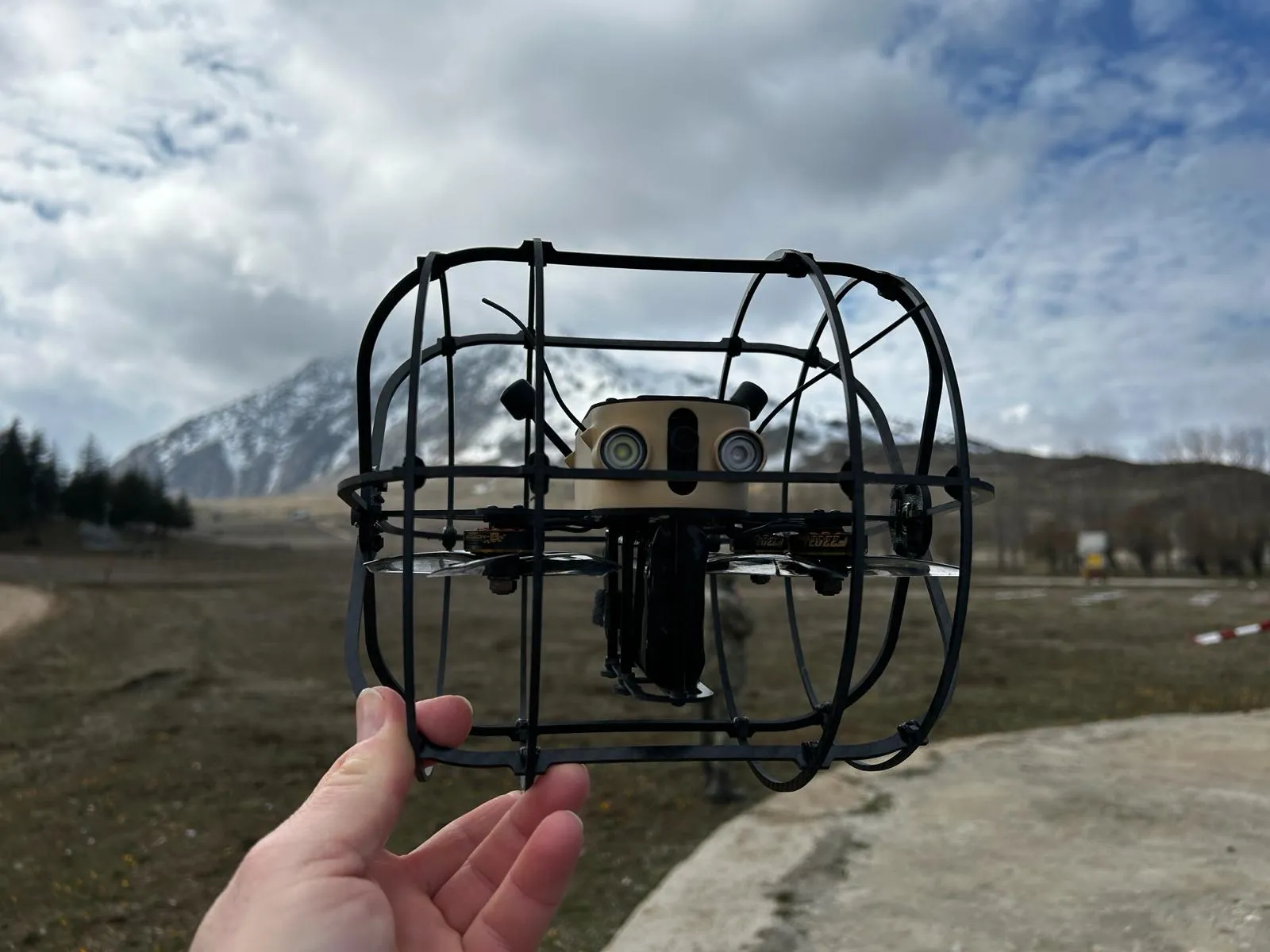
HİKA-6 is a caged micro-drone that can fly through a cave or tunnel, bump off its walls without crashing and roll along the floor when it lands, giving a small team eyes deep underground before anyone steps inside. Built by the Turkish company Arox under the sixth Light-Class Unmanned Ground Vehicle project of Türkiye’s Presidency of Defence Industries (SSB), it has been delivered to the Turkish Land Forces, Gendarmerie and Special Forces, and the project is now in its warranty phase.
Photo: Presidency of Defence Industries (SSB), Türkiye.
What is the HİKA-6?
The name gives away the programme behind it. HİKA stands for Hafif Sınıf İKA, or Light-Class Unmanned Ground Vehicle, and HİKA-6 is the sixth project in a series that SSB launched to meet urgent requirements for cave and tunnel operations. Most entries in that series are small wheeled or tracked robots. The sixth took a different route: a lightweight multirotor wrapped in a protective cage, which can fly over rubble and vertical drops that would stop a ground robot, yet still move on the ground when needed. SSB therefore lists it as a system with both air and ground mobility, and files it with its other small UGVs because the mission is the same.
The cage is the core of the design. In a narrow, dark passage, an ordinary quadcopter is one wall strike away from a crash. A caged airframe can touch rock, ceilings and timber supports, absorb the impact and carry on. Commercial inspection drones built on the same principle are used in mines, sewers and industrial tanks, and the military logic is identical: reach the spaces nobody can see into, without sending a soldier first.
Key specifications
| Manufacturer | Arox (Türkiye) |
| Programme | Light-Class UGV Project-6 (caged drone), Presidency of Defence Industries (SSB) |
| Turkish users | Land Forces Command, Gendarmerie General Command, Special Forces Command |
| Mission | Reconnaissance in caves, tunnels and other confined spaces |
| Weight | 1,001 g to 1,910 g |
| Payload | 400 g to 700 g |
| Data link | RF supported by mesh networking |
| Protection | Protective cage with high impact resistance |
| Mobility | Flies and moves on the ground |
| Autonomy | Hover hold, return-to-home, emergency landing |
| Status (SSB, Sept 2026) | Deliveries complete; project in warranty phase |
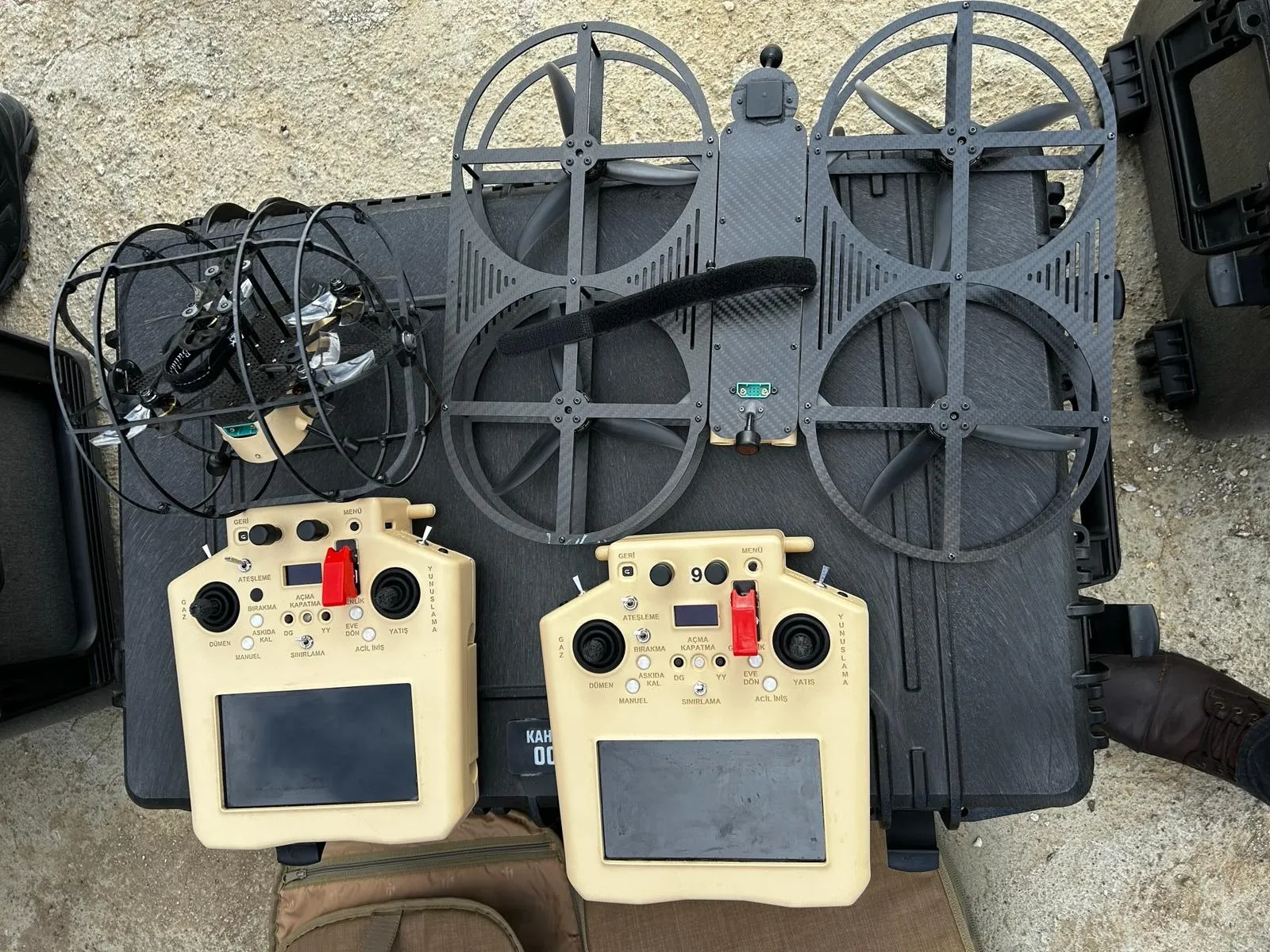
The weight band of about 1 to 1.9 kg, which depends on the configuration, keeps HİKA-6 in the hand-launched class that a soldier can carry in a backpack. A payload of 400 to 700 g is generous for a drone of this size and leaves room for a stabilised day camera, a thermal imager, lighting and, in principle, sensors such as gas detectors. The mesh-supported RF link matters underground: radio waves do not travel far around bends in rock, so a mesh architecture lets the signal hop through relay nodes and keep video flowing back to the operator as the drone goes deeper. The autonomy features (holding position, flying home and landing safely if the link is lost) reduce the pilot’s workload in an environment where GPS is unavailable and orientation is easily lost.
The SSB programme and Turkish service
SSB framed the Light-Class UGV projects as an answer to an urgent operational need: making cave and tunnel operations more effective for the Land Forces Command (KKK), the Gendarmerie General Command (JGK) and the Special Forces Command (ÖzKK). Turkish units conducting counter-terrorism operations in south-eastern Türkiye and across the border in northern Iraq regularly come across cave systems used as shelters, ammunition stores and fighting positions. Clearing them safely means knowing what is inside before entering.
Rather than running one large programme for a single universal robot, SSB split the requirement into several light-class projects and gave them to different domestic firms. That approach shortened the path from requirement to delivery, spread the work across Türkiye’s growing base of small unmanned-systems companies, and gave users a range of tools for different cave geometries. HİKA-6 has moved quickly through that path. According to SSB, the project is now in its warranty phase, meaning deliveries have been completed and the system is in the hands of the troops, with the manufacturer supporting it in service.
The project also shows how SSB uses small, focused contracts to bring new companies into the defence supply chain. Arox does not have the public profile of Türkiye’s large defence primes, and HİKA-6 is the kind of niche, fast-turnaround capability that a small specialist can deliver well.
Who operates the HİKA-6?
HİKA-6 is in service with the Turkish Land Forces Command, the Gendarmerie General Command and the Special Forces Command, according to SSB. These units operate in the mountainous terrain of south-eastern Türkiye and northern Iraq, where caves remain one of the main hiding places for armed groups.
We found no public report of an export customer for HİKA-6. The system is presented as a Turkish-service capability; like other products that have completed SSB delivery and entered warranty support, it can be offered abroad through Türkiye’s government-backed export channels.
Can the HİKA-6 go to Africa?
Many of Africa’s hardest security problems take place in terrain where a caged drone would be useful. In the Sahel, armed groups use the caves and rock shelters of northern Mali’s Adrar des Ifoghas and the hills of the Burkina Faso-Niger-Mali tri-border area. Around Lake Chad, Boko Haram and ISWAP fighters have used caves in the Mandara Mountains along the Nigeria-Cameroon border. In Somalia, Puntland forces have spent long campaigns clearing Islamic State fighters from cave complexes in the Cal Miskaad mountains. In each of these theatres, soldiers clearing a cave mouth or a building in a captured town face the same question: what is waiting inside?
HİKA-6 answers that question cheaply and quickly, and it is equally relevant to urban clearance, where the drone can fly into a building, a basement or a drainage tunnel ahead of an assault team. The same capability has civil-security value. Collapses in artisanal mines are a recurring tragedy in West and Central Africa, and a caged drone that can fly into an unstable shaft can help rescuers assess conditions without putting more lives at risk.
The logistics footprint is small: batteries, a ground control station and spare cages. That suits armies that are short of maintenance capacity. Türkiye is also already a familiar defence partner on the continent, from Bayraktar TB2 drones in many African air forces to BMC Kirpi vehicles in Tunisia, as our overview of Turkish systems in African service shows. Likely candidates include Somalia, where Türkiye already trains the national army, Nigeria, Cameroon and Chad around Lake Chad, Kenya, the central Sahel states of Mali, Burkina Faso and Niger, and Mozambique in Cabo Delgado. Our analysis of unmanned ground vehicles in African armies shows how thin the continent’s small-robot inventory still is, which is exactly where a system like HİKA-6 fits.
How it compares
Caged drones are a small but growing niche. Industrial inspection models are widely sold, and several Western and Israeli companies offer militarised versions for subterranean reconnaissance. HİKA-6 sets itself apart through its military requirement baseline: it was specified by SSB for Turkish units who clear caves for real, it pairs the cage with a mesh-supported radio link and fail-safe autonomy, and its 400 to 700 g payload band is substantial for its size. For African buyers, the availability of a government-to-government route through SSB, with training and support from the Turkish side, is often as important as the technical sheet.
FAQ
What is the HİKA-6?
HİKA-6 is a caged micro-drone developed by Arox under SSB’s Light-Class Unmanned Ground Vehicle Project-6. It can fly and move on the ground, and is used for reconnaissance in caves, tunnels and confined spaces.
What does HİKA stand for?
HİKA is the Turkish abbreviation for Hafif Sınıf İnsansız Kara Aracı, meaning Light-Class Unmanned Ground Vehicle. HİKA-6 is the sixth project in SSB’s light-class series.
What are the main specifications of the HİKA-6?
According to SSB, it weighs between 1,001 g and 1,910 g, carries a payload of 400 g to 700 g, uses an RF link supported by mesh networking, has a high-impact protective cage, and offers hover hold, return-to-home and emergency landing.
Who uses the HİKA-6?
The Turkish Land Forces Command, Gendarmerie General Command and Special Forces Command. Deliveries are complete and the project is in its warranty phase. No export customer has been announced.
Why would African armies be interested?
Caves, tunnels and urban buildings are recurring threats in the Sahel, the Lake Chad basin, Somalia and northern Mozambique. A small caged drone lets troops see inside before they enter, at low cost and with a light logistics footprint.