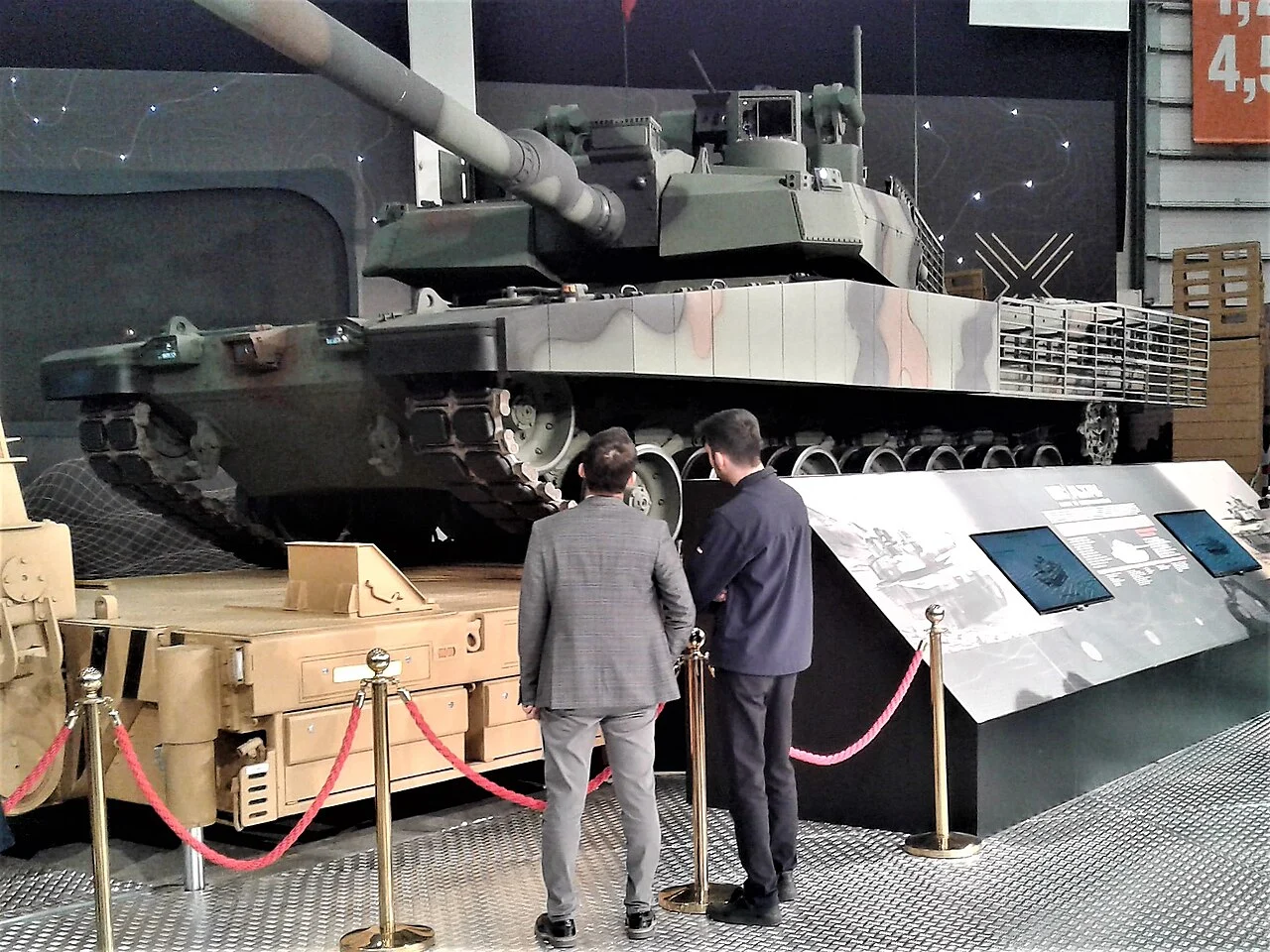
The ALTAY is Türkiye’s national main battle tank: a 63-tonne, 120 mm-armed vehicle built by BMC under a 250-tank serial production contract managed by Türkiye’s Presidency of Defence Industries (SSB). It does not arrive alone. Around it SSB has assembled an ecosystem of domestic subsystems, from ASELSAN’s AKKOR hard-kill active protection system to HAVELSAN’s AYGİS gunnery management and imaging range, which together turn a tank purchase into a complete armoured capability.
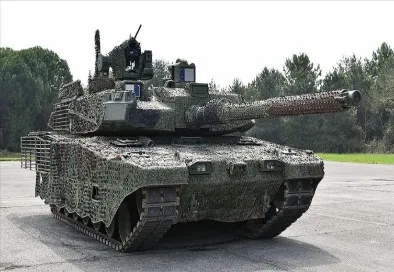
Lead photo: CeeGee, Wikimedia Commons, CC BY-SA 4.0. Additional photo: Presidency of Defence Industries (SSB), Türkiye.
What is the ALTAY?
The ALTAY is a third-generation-plus main battle tank developed in Türkiye with national resources to meet the main battle tank requirement of the Turkish Land Forces Command. It is a conventional four-crew design with a turret-mounted 120 mm smoothbore main gun, a rear engine compartment and a modular armour package, and it was conceived from the outset to carry Turkish electronics, fire control and protection systems rather than imported ones.
The programme has a long industrial lineage. Development work by Otokar produced the prototypes that defined the design, and in 2018 the serial production contract went to BMC, which built a dedicated tank and armoured vehicle plant at Kahramankazan near Ankara. The first production tanks were handed over to the Turkish Armed Forces at that plant on 28 October 2025, a milestone widely covered by the Turkish and international defence press.
What sets the ALTAY apart from a simple tank buy is the way SSB has structured the programme. The tank itself is one project; its active protection system, its training range and a string of mission subsystems are run as related projects with their own prime contractors. The result is that Türkiye is not only fielding a new tank, but also building the domestic knowledge needed to protect it, train its crews and keep it upgraded for decades.
Key specifications
| Prime contractor | BMC |
| Programme authority | Presidency of Defence Industries (SSB) |
| User | Turkish Land Forces Command |
| Contracted quantity | 250 tanks (serial production project) |
| Main armament | 120 mm main gun |
| Combat weight | About 63 tonnes |
| Maximum speed | 65 km/h |
| Deep fording | 4 m |
| Gradient | 60% |
| Operating temperature | -32°C to +55°C |
| Critical subsystems | Fire control system; active protection system; remote-controlled weapon station; tank command, control and battle management system; laser warning system; combat identification (friend-or-foe) system; crew training system |
| Status (SSB, Sept 2026) | Serial production project in qualification phase; first production tanks delivered October 2025 |
Two of those figures matter more than they first appear. The 4 m deep-fording capability means the tank can cross rivers with snorkel preparation rather than waiting for bridging, and the -32°C to +55°C operating band covers everything from eastern Anatolian winters to desert summer heat, which is directly relevant to any buyer in North Africa or the Gulf.
The SSB programme: tank, protection and training as one package
SSB’s September 2026 programme sheet lists the ALTAY serial production project, with BMC as prime contractor and the Land Forces as user, at the qualification stage. In practice this is the phase in which production-standard tanks and their subsystems are tested against the Land Forces’ requirements while deliveries build up. Open reporting describes the 250 tanks as two batches: 85 ALTAY T1 tanks and 165 ALTAY T2 tanks, with the T2 standard planned from 2028.
The split reflects one of SSB’s clearest policy choices: local content in the powerpack. The first T1 batch uses a proven 1,500 hp South Korean diesel and transmission so that tanks could reach units without waiting, while the T2 is planned to receive the domestic BATU powerpack developed by BMC Power, whose factory acceptance testing was reported as completed in late 2025. That sequencing lets the Land Forces receive tanks now and a fully national powerpack later, without stopping the production line.
AKKOR: ASELSAN’s hard-kill active protection
The second project is AKKOR, the active protection system developed by ASELSAN. Its purpose, in SSB’s words, is to give main battle tanks effective hard-kill protection against the asymmetric anti-tank threats they now face in large numbers on the battlefield. The system pairs a high-resolution active phased-array radar, which detects incoming rockets and missiles, with smart countermeasure munitions that intercept them before impact. SSB highlights a high rate of protection against the rocket and missile threats most often seen in the field, and lists the project at the qualification stage.
AKKOR is one of the most significant pieces of the ecosystem. Recent conflicts have shown that guided missiles, rocket-propelled grenades and top-attack munitions are the main danger to armour, and few countries can field a home-grown hard-kill system. ASELSAN’s 2024 annual report, as cited by the defence press, already recorded AKKOR entering the Turkish inventory, and the qualification work under SSB anchors it to the ALTAY fleet.
AYGİS: HAVELSAN’s gunnery management and imaging system
The third project concerns how crews learn to fight the tank. AYGİS, developed by HAVELSAN, transfers each tank’s periscope and screen images, together with the ballistic data that affects a shot, to a central management system. Instructors can then watch gunners and tank commanders in real time, correct them, score them and run after-action reviews from recorded footage. The project also renovates an existing tank firing range and builds an additional new one.
According to SSB, AYGİS comprises a control centre with a system control station, a target control station and an after-action review centre; an on-vehicle data transfer system covering audio and video recording, fire control data collection and RF communications; target systems including fixed, moving, sniper-silhouette and bunker targets; and the construction of the firing course infrastructure. The project is at the critical design stage.
Who operates the ALTAY?
The Turkish Land Forces Command is the confirmed and, so far, only operator. Production tanks have been delivering from BMC’s Kahramankazan plant since October 2025, and the 250-tank programme runs through the end of the decade.
The export picture needs care. In March 2019 Turkish and Gulf media reported that Qatar had signed for up to 100 ALTAY tanks, with a first batch of 40, and the figure has been repeated many times since. DefenceMENA has not found an activated export contract or a delivery confirmed by either government, so that order should be treated as reported rather than confirmed. What is confirmed is Qatar’s industrial stake: a Qatari state-linked shareholder owns 49.9% of BMC, and Qatar’s deputy prime minister for defence affairs attended the opening of the Kahramankazan plant. Our full breakdown of Türkiye–Qatar defence deals separates the confirmed items from the reported ones.
BMC has said it intends to market the ALTAY to the Gulf, the wider Middle East and Asia once the tank is established in Turkish service. In other words, the ALTAY is in Turkish service and offered for export, with Qatar as the most visible prospective customer.
Can the ALTAY go to Africa?
Technically, yes, and the specifications point to where it fits best. A 63-tonne tank needs heavy tank transporters, bridges and rail cars rated for that weight, plus a maintenance organisation already used to large Western-style tanks. That profile matches North Africa more than most of sub-Saharan Africa. Egypt and Morocco both operate Abrams-family tanks of similar weight and therefore already have the transporters, recovery vehicles and workshops that a 60-tonne-class fleet requires.
The ALTAY’s case in those markets rests on three arguments. The first is climate: SSB’s +55°C operating requirement covers the summer conditions found across the Sahara and the Nile valley, so the tank does not need to be re-engineered for the region. The second is protection: AKKOR gives the tank an answer to the anti-tank guided missiles and RPGs that armed groups across the Sahel and Libya have used against armour, and an active protection system is now one of the first questions any army asks of a new tank. The third is the package: AYGİS-style instrumented ranges and ASELSAN’s fire control and battle management systems mean a buyer gets training infrastructure and digital command tools rather than a bare vehicle.
For armies that are not ready for a new tank, the ecosystem itself is exportable. AKKOR and HAVELSAN’s range systems could in principle be offered to protect or train existing fleets, a route that fits African budgets well. Türkiye already has a strong footprint on the continent in wheeled armour, from BMC’s Kirpi to Otokar’s Cobra and Nurol’s Ejder Yalçın, and our overview of Turkish systems in African service shows how quickly that footprint has grown. Heavy armour would be the next step for Turkish industry in Africa, and the North African markets are the logical place to start.
How it compares
The ALTAY sits in the same class as the Leopard 2A7, the M1A2 Abrams and South Korea’s K2 Black Panther, a design with which it shares part of its early technical lineage through the programme’s cooperation with Hyundai Rotem. Its combat weight is lighter than the latest Abrams and Leopard versions, and its protection philosophy pairs passive modular armour with AKKOR from the start rather than adding an active system later. For a buyer, the most practical difference is political and industrial: Türkiye offers technology transfer, local workshops and a supply chain that is largely national, which reduces the risk of third-country export restrictions on spare parts.
Frequently asked questions
Who builds the ALTAY tank?
BMC is the prime contractor for serial production, at its Kahramankazan plant near Ankara. The programme is managed by Türkiye’s Presidency of Defence Industries (SSB) for the Turkish Land Forces Command.
How many ALTAY tanks has Türkiye ordered?
The serial production project covers 250 tanks. Open reporting describes 85 ALTAY T1 and 165 ALTAY T2 tanks, with the first production tanks delivered in October 2025.
Does Qatar operate the ALTAY?
Not as of November 2026. A Qatari order for up to 100 tanks was reported in 2019, but no activated export contract or delivery has been confirmed. Qatar does hold a 49.9% stake in BMC.
What is AKKOR?
AKKOR is ASELSAN’s hard-kill active protection system. It uses a high-resolution active phased-array radar to detect incoming rockets and missiles and smart munitions to destroy them before they hit the tank. SSB lists the project at the qualification stage.
Could an African army buy the ALTAY?
Yes, the tank is offered for export. Its 63-tonne weight makes it best suited to armies that already operate heavy tanks and the transporters and bridges they need, such as those in North Africa.
Related: ASELSAN company profile · Türkiye and Qatar: the defence relationship · Turkish systems in African service