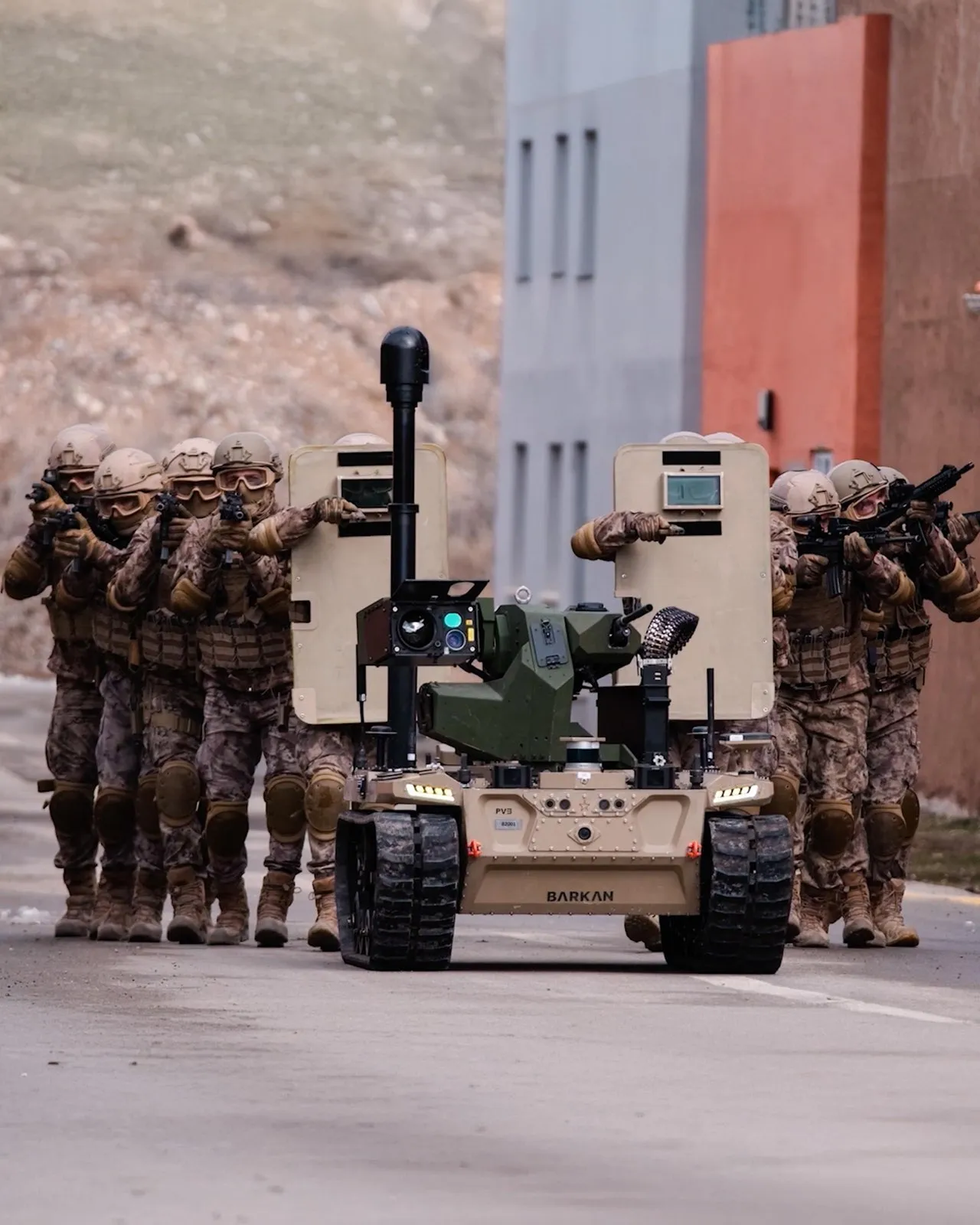
BARKAN is the unmanned ground vehicle that took Türkiye’s army robotics from demonstration to serial production. Built by HAVELSAN under a programme run by Türkiye’s Presidency of Defence Industries (SSB), the tracked, one-tonne robot carries a remote weapon station and a radar, and is designed to do the reconnaissance, surveillance and fire-support jobs that would otherwise put a soldier in the line of fire. With a third version in production and HAVELSAN co-producing a related vehicle in Egypt, it is also the Turkish UGV with the clearest path toward African armies.
Photo: Presidency of Defence Industries (SSB), Türkiye.
What is BARKAN?
BARKAN is a medium-class, Level-1 unmanned ground vehicle (UGV) on tracks, remotely operated from a hand-held or vehicle-mounted control unit. SSB procures it for the Turkish Land Forces Command (KKK) under the BARKAN Medium Class Level-1 UGV Serial Production Project, known by its Turkish abbreviation B-OİKA1, with HAVELSAN as prime contractor. The stated aim is straightforward: use unmanned land systems to reduce how often personnel are exposed to dangerous situations, while giving small units their own reconnaissance, surveillance and fire support.
HAVELSAN is best known as Türkiye’s software, simulation and command-and-control house, and BARKAN reflects that background. The company treats the vehicle as a node in a wider family of autonomous systems rather than as a stand-alone remote-control car, and it has steadily added autonomy, sensors and networking from one version to the next. The vehicle entered the Turkish inventory in 2023 and moved into serial production on SSB’s decision, which made it the first UGV of its class to be mass-produced in Türkiye.
Key specifications
| Manufacturer | HAVELSAN (Türkiye) |
| Procurement authority | Presidency of Defence Industries (SSB) |
| Turkish user | Turkish Land Forces Command |
| Class | Medium class, Level 1 UGV; about 1,000 kg |
| Mobility | Tracked, remotely operated, with growing autonomy |
| Mission modules (SSB) | Remote weapon station, radar system, cargo basket, perimeter surveillance system, stretcher module |
| Control | Common Remote Control Unit (O-UKB) produced by Esetron |
| Distinctive features | Weapon turret and radar on the same small platform |
| Status (SSB, Sept 2026) | 3 BARKAN V2 accepted; 2 BARKAN V3 in production; contract amendment signed for 5 more |
| Export operators | None announced; related Aqrab UGV co-produced in Egypt with AOI’s Kader Factory |
SSB places BARKAN at around 1,000 kg in the Medium Class-1 category. The mission equipment it lists shows how broad the concept is: a remote weapon station for fire support, a radar system, a cargo basket for resupply, a perimeter surveillance system and a stretcher module for moving a casualty out of a fire zone. SSB singles out the weapon turret and the radar as the features that set BARKAN apart, and the combination is unusual on a vehicle this size, because it lets a single robot both detect movement at range and engage it.
Control is being standardised as well. SSB states that Common Remote Control Units (O-UKB) produced by the Turkish firm Esetron will be procured for the vehicle, part of a wider effort to let soldiers operate different Turkish UGVs with the same controller, which simplifies training and logistics for units that field more than one type.
The SSB programme and Turkish service
SSB’s handling of BARKAN is a good example of how the agency has built a domestic robotics base step by step. Instead of waiting for a perfect design, it put early vehicles into the hands of troops, collected feedback and ordered improved versions. As of September 2026, SSB reports that acceptance of three BARKAN V2 vehicles has been completed, two BARKAN V3 vehicles are in production, and a contract amendment has been signed for five additional vehicles.
BARKAN 3, shown at SAHA Expo 2026 in Istanbul where the contract amendment with SSB was signed, illustrates the direction of travel. Turkish trade press reported a new chassis reaching the 1,000 kg mark, fording depth increased to 50 cm, a higher top speed and a choice of all-electric or hybrid-electric drive. The heavier build can take a full-size 12.7 mm remote weapon station or KARAOK anti-tank guided missiles, while lighter BARKAN variants use stations such as TRAKON LITE or SARP 100/L. The sensor load was reported as four times that of the earlier vehicle, with more lidars and cameras and a radar for autonomous driving, plus an anti-jam antenna from TUALCOM for contested radio environments.
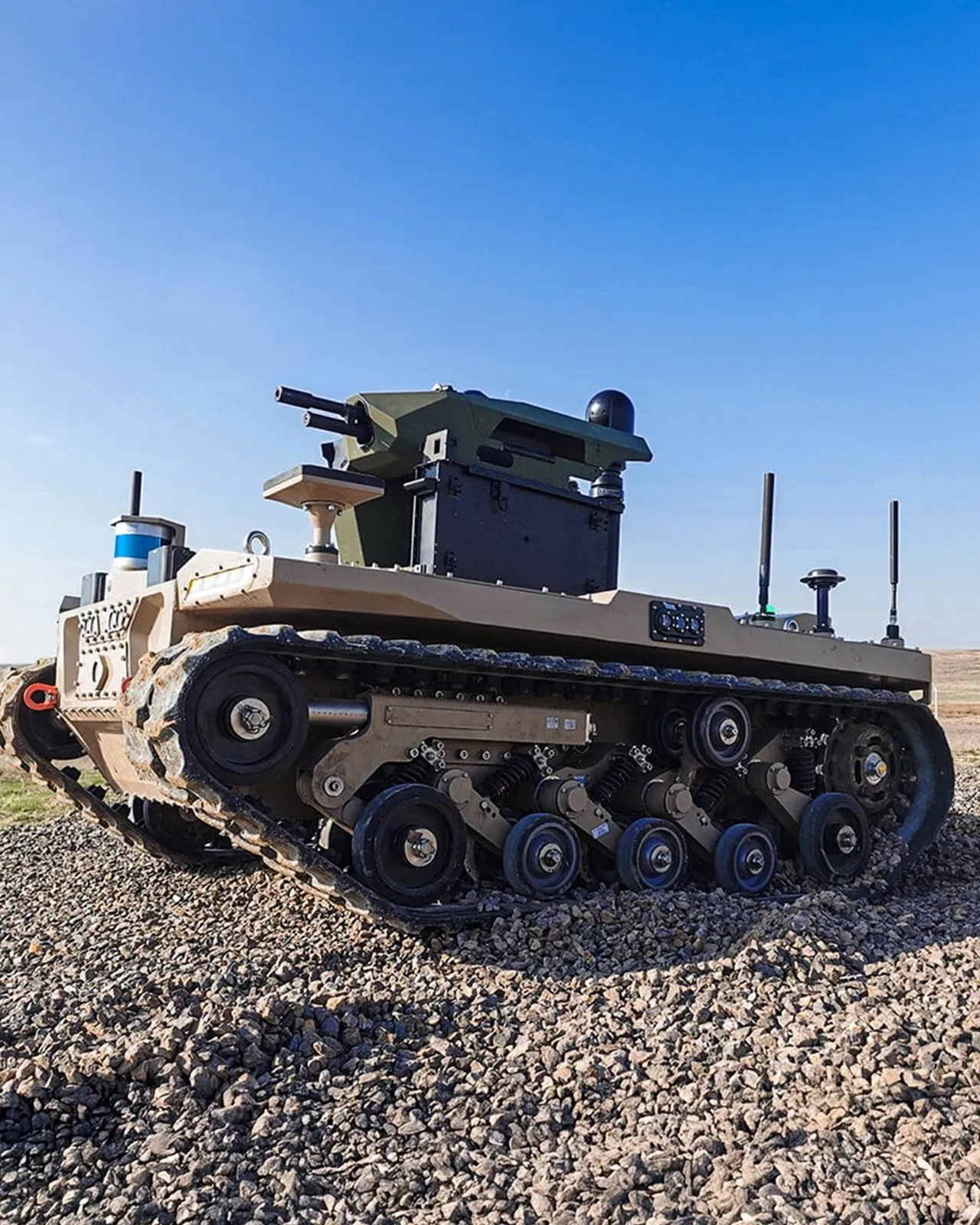
The vehicle has also been worked hard in exercises. During the Ateş Serbest-2026 live-fire exercise at the Polatlı training area near Ankara, which ran from 1 September to 22 October 2026, BARKAN engaged designated targets with an integrated 12.7 mm remote weapon station and was used for reconnaissance, surveillance, protection of logistics routes, three-dimensional mapping and fire support. That mix of roles, alongside HAVELSAN’s BULUT drone in the same exercise, is exactly how Turkish planners intend to use small robots: as scouts and guardians that go first.
Who operates BARKAN?
The confirmed operator is the Turkish Land Forces Command. No export contract for BARKAN itself has been announced, and DefenceMENA has found no foreign user. HAVELSAN has marketed the vehicle abroad since its early days: in October 2022 company chairman Hacı Ali Mantar said sales efforts were under way in Malaysia, Indonesia, Qatar, Kuwait, Saudi Arabia, Pakistan, Ukraine and Azerbaijan, according to TRT Haber. Those were marketing contacts, not orders, and they should be read that way.
The most concrete international step is in Egypt. In March 2025 HAVELSAN signed an agreement with Kader Factory for Developed Industries, part of Egypt’s Arab Organization for Industrialization (AOI), to co-produce unmanned ground vehicles at Kader’s facilities with Turkish engineering and licensing. HAVELSAN officials told Breaking Defense the Egyptian vehicle would not be a copy of BARKAN but a design tailored to regional conditions. The result, the 6×6 Aqrab, was unveiled at EDEX 2025 in Cairo in December 2025 and, according to Anadolu Agency, was produced in Egypt by HAVELSAN and AOI, can carry a remote-controlled weapon system and was designed for desert conditions. In practical terms, the know-how that went into BARKAN is now being applied on African soil, with an African state partner.
Can BARKAN go to Africa?
The case for a vehicle like BARKAN in Africa is driven by the threats African soldiers actually face. Roadside bombs and mines are among the leading causes of troop casualties in the Sahel, the Lake Chad Basin and Somalia, and convoys and static positions are the usual targets. A one-tonne robot that can drive ahead of a patrol, watch a perimeter with radar at night, carry ammunition forward or bring a wounded soldier back on a stretcher addresses that problem directly, because it puts a machine, not a person, in the most exposed position. DefenceMENA’s survey of unmanned ground vehicles in African armies found that no African force yet fields a serial combat UGV, which leaves room for an early, well-supported entrant.
Several factors favour BARKAN. Its radar and weapon combination suits forward operating bases and border posts, where a few soldiers must watch large arcs of ground. Its modular design means a buyer can start with surveillance and logistics modules and add weapons later, a sensible path for countries that want to build experience first. The Egypt programme gives HAVELSAN local production, local support and an Arabic-speaking partner on the continent, which matters for maintenance in the field. HAVELSAN also already has African customers: its BAHA drone was exported to an African country, and the company has a growing relationship with Nigeria, covered in DefenceMENA’s report on HAVELSAN’s ADVENT combat system and BAHA drones for Nigeria.
The most natural candidates are Egypt itself, where Kader production could bridge Turkish technology and a domestic order; Nigeria, whose army fights IEDs in the north-east daily and already works with HAVELSAN; and the Turkish-trained forces of Somalia and Libya, where Turkish equipment and training teams are already present. Morocco and the coastal West African states that guard long borders with the Sahel would be logical next markets for a radar-equipped surveillance robot. Turkish armoured vehicles are already widespread across the continent, as DefenceMENA has documented in its overview of Turkish systems in African service, and a robot that shares controllers and support chains with Turkish platforms fits naturally into those fleets.
The realistic constraints are about infrastructure rather than the vehicle: radio coverage in remote areas, operator training and spare parts. These are the points that the Egyptian co-production model is meant to solve, and they are where an early African customer would gain most from working directly with SSB-backed Turkish industry.
How it compares
Among the UGVs on offer to African buyers, BARKAN sits between small bomb-disposal robots and heavier eight-wheel combat UGVs such as HAVELSAN’s own KAPGAN. Estonia’s Milrem THeMIS, which Estonian troops took to Mali in 2019, is the best-known Western comparison in the same broad weight bracket. BARKAN’s selling points are its combination of radar and weapon on one platform, the stretcher and cargo modules, and the backing of a national programme that has already moved through three versions with a single customer, which reduces risk for a first-time buyer.
Frequently asked questions
What is BARKAN?
BARKAN is a medium-class, Level-1 unmanned ground vehicle (UGV) developed by HAVELSAN and procured by Türkiye’s Presidency of Defence Industries (SSB) for the Turkish Land Forces Command. It is a tracked, remotely operated robot of about 1,000 kg built for reconnaissance, surveillance and fire support, so that soldiers do not have to expose themselves to the most dangerous tasks.
What weapons and sensors can BARKAN carry?
SSB lists a remote weapon station, a radar system, a cargo basket, a perimeter surveillance system and a stretcher module. Trade press reporting on the BARKAN family mentions light stations such as TRAKON LITE and SARP 100/L, and a full-size 12.7 mm station or KARAOK anti-tank missiles on the heavier BARKAN 3.
How many BARKAN vehicles has SSB ordered?
According to SSB’s September 2026 status, acceptance of three BARKAN V2 vehicles is complete, two BARKAN V3 vehicles are in production, and a contract amendment has been signed for five more vehicles.
Does any African country operate BARKAN?
No African operator of BARKAN has been announced. The closest link is Egypt, where HAVELSAN and the Arab Organization for Industrialization’s Kader Factory are co-producing a separate, regionally tailored 6×6 UGV called Aqrab under a 2025 agreement that HAVELSAN describes as a gateway to Africa.
Related: Unmanned ground vehicles in African armies · HAVELSAN in Nigeria: ADVENT and BAHA · Turkish systems in African service