Six African countries have received the Dassault-Dornier Alpha Jet: Nigeria, Egypt, Morocco, Cameroon, Togo and Côte d’Ivoire. Egypt (45, mostly assembled locally) and Nigeria (more than 30 across several batches) bought the most, according to SIPRI. Nigeria is the only African air force still adding airframes. In 2025 it began receiving 12 ex-French Air Force jets, with six to be restored for flying and six used for spare parts. Morocco and Egypt are also reported to keep Alpha Jets in service, while the status of the West African fleets is unconfirmed.
Quick answer
Delivered (SIPRI): Egypt 45; Nigeria 12 + 12 new, 4 ex-US and 6 ex-French (plus 6 for spares); Morocco 24; Cameroon 7; Côte d’Ivoire 7; Togo 6. Most active user in 2026: Nigeria, flying ground-attack missions from Yola and Maiduguri. Replacement path: Nigeria’s Leonardo M-346 order, Egypt’s search for a new advanced trainer. Current totals: not officially published.
Last updated: 8 November 2026. SIPRI delivery data run to 2025; Nigerian fleet figures come from Nigerian Air Force statements reported by Janes and Military Africa. Other in-service figures are open-source estimates.
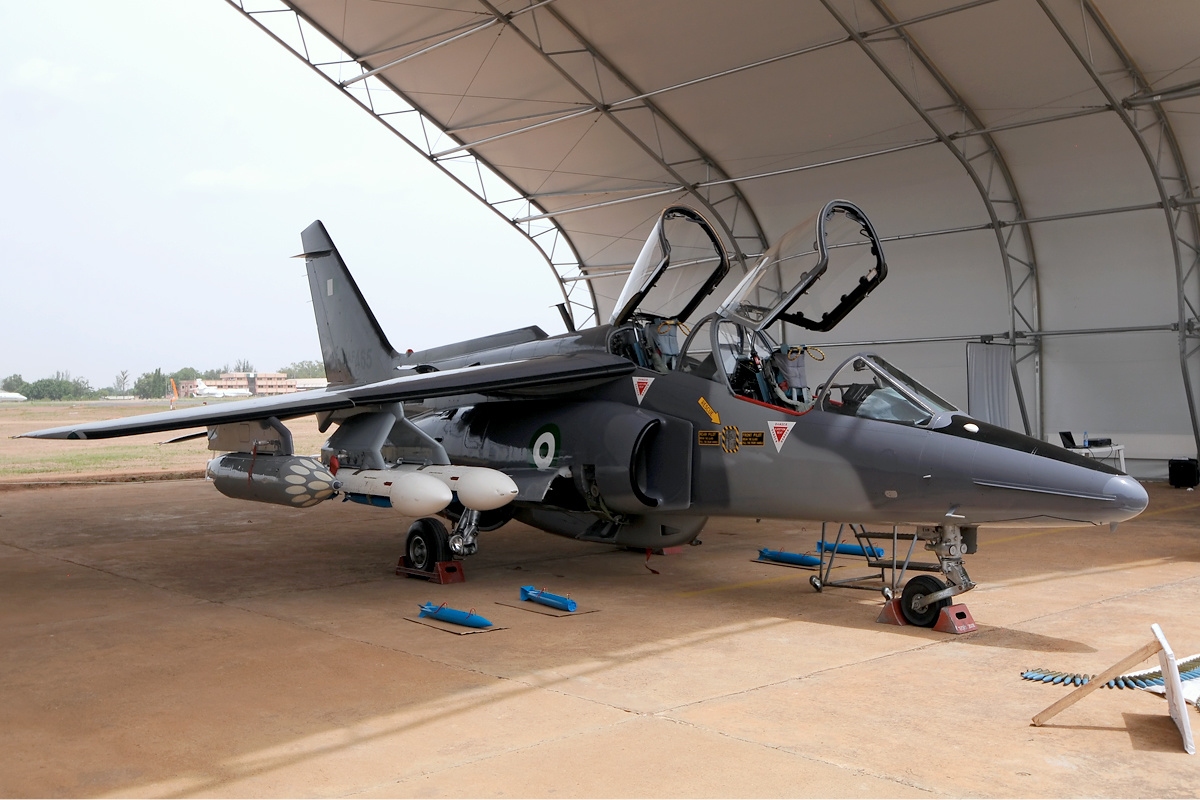
What is the Alpha Jet?
The Alpha Jet is a twin-engine, two-seat subsonic jet designed in the 1970s by France’s Dassault-Breguet and Germany’s Dornier. France used it mainly as an advanced trainer, Germany as a light attack aircraft. Export customers often wanted both roles. That flexibility still explains its place in Africa: one airframe can train pilots and also carry rockets, bombs and a gun pod against insurgents. SIPRI classifies all African Alpha Jets as trainer/combat aircraft.
African Alpha Jet operators
| Country | Version / supplier | Delivered | Years | Status, November 2026 |
|---|---|---|---|---|
| Nigeria | Alpha Jet-E (Germany); Alpha Jet-A ex-US; Alpha Jet-E ex-France | 24 new; 4 second-hand; 6 second-hand (+6 for spares) | 1981–1986; 2015–2018; 2025 | In service and in combat use |
| Egypt | MS-1 and MS-2 (France) | 45, incl. 37 assembled in Egypt | 1982–1985 | Reported in service; replacement sought |
| Morocco | Alpha Jet-E (France) | 24 | 1979–1981 | Reported in service (about 19 in open-source listings) |
| Cameroon | NGEA (France) | 6 + 1 | 1984; 1986 | Reported; serviceability unconfirmed |
| Côte d’Ivoire | France | 6 + 1 | 1980–1981; 1984 | Status unconfirmed |
| Togo | France | 5 + 1 | 1980–1981; 1991 | Status unconfirmed |
Source: SIPRI Arms Transfers Database (data to 2025). Totals are deliveries, not current fleets.
Nigeria: Africa’s busiest Alpha Jet fleet
Nigeria received 24 new Alpha Jet-Es from Germany between 1981 and 1986, a deal SIPRI values at DM150 million for the first dozen. Losses in training and operations have steadily reduced that fleet. Janes reported in December 2024 that the Nigerian Air Force (NAF) was fielding eight of the 28 Alpha Jets it had received since 1980, after the second-hand additions from the United States in 2015–2016. The NAF has since regenerated capacity in two ways: depot maintenance on stored aircraft, and a contract with the French firm SOFEMA. Under that contract, 12 ex-French Air Force jets were bought, six to be restored for operations and six to be cannibalised for spares. Military Africa reported in April 2025 that at least four had arrived, and that NAF Alpha Jets based in Yola and Maiduguri were flying combat missions.
Those numbers come from different dates and counting methods, so they cannot simply be added up. Nigeria’s longer-term replacement is the Leonardo M-346; see our Nigerian Air Force aircraft profile for the wider fleet.
Egypt and Morocco: the North African fleets
Egypt ordered 45 Alpha Jets in 1981 and SIPRI notes that 37 were assembled in Egypt, in two versions: 30 MS-1 trainers and 15 MS-2 attack aircraft. As our overview of trainer aircraft in African air forces explains, Egypt is looking for a successor, while the licence-built K-8E carries much of the intermediate training load. Morocco took 24 Alpha Jet-Es between 1979 and 1981. Open-source fleet listings put the current Moroccan fleet at about 19; that figure is aggregated rather than official.
Cameroon, Côte d’Ivoire and Togo
The three smaller West and Central African operators each bought six or seven aircraft between 1980 and 1991. SIPRI notes that Cameroon’s version was intended mainly for combat. In the sources reviewed for this guide, none of these three governments has published a current Alpha Jet count. They should be treated as historical or uncertain operators unless newer evidence shows the aircraft flying. Côte d’Ivoire’s present air arm is described in our Ivorian armed forces equipment guide.
Why the Alpha Jet has lasted so long in Africa
- Dual role: it trains fast-jet pilots and flies close air support, which suits small air forces that cannot buy separate fleets.
- Surplus supply: European air forces retiring the type have released second-hand airframes and spares. France is replacing its Alpha Jets with the Pilatus PC-21, which created the pool Nigeria bought from.
- Counter-insurgency fit: it is cheaper to fly than a supersonic fighter and carries enough ordnance for low-threat airspace.
The limits are age and spares. Every remaining African Alpha Jet was built in the 1970s or 1980s. Fleets that cannot buy surplus parts, as Nigeria has done, tend to shrink. For newer alternatives, see our comparison of light attack aircraft and armed trainers in Africa.
Frequently asked questions
Which African country has the most Alpha Jets?
Egypt received the largest single order (45, delivered 1982–1985). Nigeria has received more airframes in total across several batches, but many have been lost, and in December 2024 it was reported to field eight before the ex-French deliveries.
Did Nigeria buy Alpha Jets from France?
Yes. The Nigerian Air Force announced in December 2024 that it had bought 12 ex-French Air Force Alpha Jets through SOFEMA, six to be restored for flying and six for spare parts. At least four had arrived by April 2025.
Is the Alpha Jet still used in combat in Africa?
Yes. Military Africa reported in April 2025 that Nigerian Alpha Jets based in Yola and Maiduguri were flying missions against insurgents and bandits.
Does Morocco still fly the Alpha Jet?
Open-source fleet listings show about 19 Moroccan Alpha Jets in service. Morocco does not publish an official figure.
What will replace the Alpha Jet in Nigeria?
Nigeria has ordered the Leonardo M-346, which is expected to complement and eventually replace the ageing Alpha Jet fleet.
Sources
- Stockholm International Peace Research Institute (SIPRI), “SIPRI Arms Transfers Database, trade registers for African recipients (data to 2025)”, March 2026 release. https://armstransfers.sipri.org/ (accessed 6 November 2026 (local extract re-checked 8 November 2026)).
- Janes, “Nigeria acquires surplus French Alpha Jets”, December 2024. https://www.janes.com/defence-intelligence-insights/defence-news/defence/nigeria-acquires-surplus-french-alpha-jets (accessed 8 November 2026).
- Military Africa, “Nigeria operationalize additional Alpha jets”, 19 April 2025. https://www.military.africa/2025/04/nigeria-operationalize-additional-alpha-jets/ (accessed 8 November 2026).
- Military Africa, “French SOFEMA to deliver additional Alpha jets to Nigeria”, December 2024. https://www.military.africa/2024/12/french-sofema-to-deliver-additional-alpha-jets-to-nigeria/ (accessed 8 November 2026).
- Wikipedia (aggregated fleet table, low-medium confidence), “Royal Moroccan Air Force – aircraft inventory”, live page. https://en.wikipedia.org/wiki/Royal_Moroccan_Air_Force (accessed 8 November 2026).
Method: counts from SIPRI are deliveries recorded by SIPRI, not current inventories. Status labels distinguish delivered, reported in service, ordered and retired; where open sources disagree, the range is shown rather than a single figure.