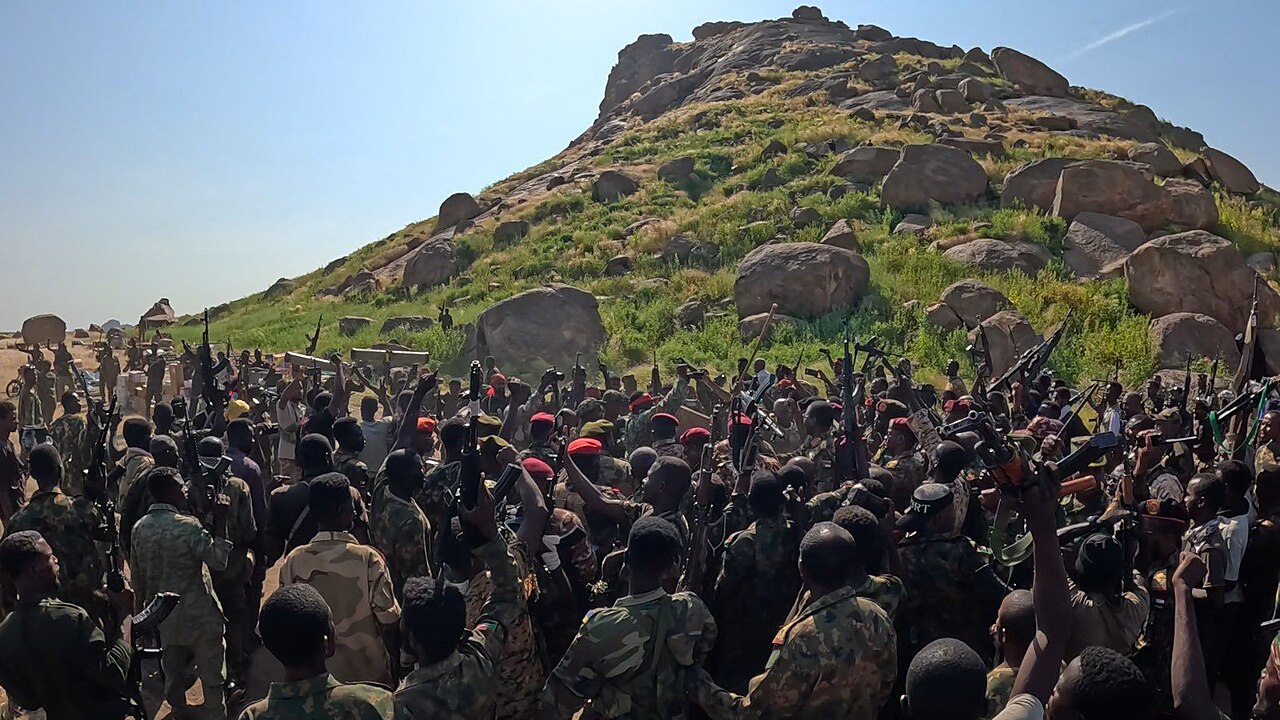
The Sudan Global Firepower ranking stands at 66th of 145 countries in the latest edition, with a power index of 1.3563, yet the index describes an army that has been fighting the Rapid Support Forces (RSF) since April 2023. This guide explains what the ranking counts, how the personnel, budget and equipment figures behind it should be read, and which parts of the war it cannot see. Each figure is labelled as an index estimate, a reported claim or a verified fact.
What the Sudan Global Firepower Ranking Shows
Global Firepower (GFP) compiles published and estimated data into a single index in which 0.0000 would be a perfect score, so a lower number is stronger (Global Firepower). The figures below are GFP’s, not Sudan’s. They do not net out wartime losses.
| Indicator | GFP figure |
|---|---|
| Global ranking | 66th of 145 countries |
| Power index | 1.3563 |
| Active personnel | 300,000 |
| Reserve personnel | 200,000 |
| Paramilitary | 17,500 |
| Defence budget | $394.7 million |
| Aircraft, all types | 183 |
| Tanks | 1,055 |
| Navy | 10 patrol vessels, no major combatants |
Treat the table as a ceiling. The sources reviewed give no verified count of what is serviceable today, and the site’s profile of Sudan military strength covers the competing headcount estimates for both armed forces.
How the Index Works and Where It Falls Short
An index of this kind blends manpower, equipment, finance and geography into one number. It is built for comparison between countries at peace, using published or estimated inventories. It does not model attrition, maintenance, ammunition stocks or whether a country is divided between two armed forces.
That matters in Sudan. The Sudanese Armed Forces (SAF) are the state army, air force and navy, while the RSF is a separate force that began as a paramilitary and is now its main opponent. The ranking counts the state’s inventory and says nothing about control of territory.
The ranking is therefore best used as a starting point. A reader who wants to know how Sudan compares with other African armies can use the Sudan Global Firepower ranking as a rough ordering, then check the underlying figures one by one.
Personnel: Active, Reserve and Paramilitary Figures
GFP lists 300,000 active and 200,000 reserve personnel, with 17,500 paramilitary. Other published estimates differ widely and several predate the war, so the active figure is best read as a nominal establishment rather than a count of soldiers present for duty.
The RSF is not part of these numbers. Its strength has not been verified and this guide gives no figure for it.
Casualties add to the uncertainty. Sudan’s army-led authorities report that 176 soldiers were killed and about 200 wounded in drone attacks between mid-February and 27 October, a claim made in a government report that Al Jazeera did not independently verify (Al Jazeera).
Budget: The $394.7 Million Estimate
GFP puts Sudan’s defence budget at $394.7 million. That is an index estimate, not a published budget line, and no official line-by-line defence budget was found in the sources reviewed. A verified multi-year spending trend could not be built from those sources, and this guide does not invent one.
Two factors make any Sudanese defence figure hard to interpret. Exchange-rate changes alter the dollar value of local-currency allocations. And much of the equipment used in the war arrives through transfers whose cost is never published. The separate guide to Sudan’s defence budget goes through the spending question in more detail.
Equipment: Tanks, Aircraft and Navy
The army is credited with 1,055 tanks, which makes it a large armoured force on paper. Reference works describe a fleet of older Soviet and Chinese-designed vehicles, but type-by-type serviceability is not public. Armoured fleets in a conflict of this kind are heavily attrited, so the number says little about combat readiness.
The air force is credited with 183 aircraft: 37 fighters, 36 attack aircraft, 13 transports, 33 trainers and 64 helicopters, of which 35 are attack helicopters. A class-by-class review with status labels is in the guide to Sudan Air Force aircraft. The count is a directory total, not a measure of flying aircraft.
The navy is the smallest arm. GFP records 10 assets, all patrol vessels, and no frigates, corvettes, submarines or mine warfare craft. The Red Sea coast makes the navy politically significant, but its fleet gives it coastal patrol capability only.
Regional Comparison: Where Sudan Sits in Africa
On the latest GFP measure, Sudan ranks behind Morocco at 56th and Ethiopia at 47th, and ahead of Libya, Chad and South Sudan (Global Firepower). The index blends several categories, so a country can rank high on manpower and low on equipment.
| Country | GFP rank | Power index |
|---|---|---|
| Egypt | 19 | 0.3651 |
| Algeria | 27 | 0.4849 |
| Nigeria | 33 | 0.6097 |
| Ethiopia | 47 | 0.8525 |
| Morocco | 56 | 1.0368 |
| Sudan | 66 | 1.3563 |
| Libya | 80 | 1.7872 |
| Chad | 85 | 1.8594 |
| South Sudan | 113 | 2.4645 |
The gap to Egypt, ranked 19th, is the clearest in the table. For what an established procurement pipeline looks like, see the profile of Egypt’s military strength.
What the Ranking Cannot See: Drones, Losses and Supply
Drones are now the defining weapon of the conflict, and no inventory index captures them well. Sudan’s army-led authorities say that between mid-February and 27 October they recorded 70 attacks involving 187 one-way attack drones, with 484 civilians killed or wounded. October alone accounted for 28 attacks by 97 drones, according to the same report. The site’s analysis of drones in the Sudan war follows the types and operators.
These are Sudanese government claims. The authorities accuse Ethiopia of hosting launch sites and have lodged complaints with the UN Security Council and the African Union’s Peace and Security Council, while Al Jazeera could not verify the footage. Al Jazeera also reported 18 strikes on Sudan’s electricity network in the past week, including three substations on 2 November, attributed to the RSF (Al Jazeera).
Supply chains are equally hidden. Amnesty International’s July 2024 investigation traced weapons reaching Sudan from China, Russia, Serbia, Turkiye, the UAE and Yemen. It found Chinese drone jammers, mortars and anti-materiel rifles used by both sides, Russian Tigr and Saiga-MK rifles sold to dealers with strong links to the army, and Turkish arms firm Sarsilmaz supplying the SAF. It also noted that the UN arms embargo covers only Darfur, which Amnesty called inadequate (Amnesty International).
On 29 October, an Abu Dhabi appeals court sentenced eight people to life in prison for arms trafficking and money laundering connected to supplying Sudan’s army. Sudan’s military has accused the UAE of arming the RSF, which the UAE denies (Al Jazeera). Reports of a Pakistani package of jets, drones and air defence worth about $1.5 billion were said to be on hold, and the sources reviewed could not confirm the contract status, so it is treated as reported and unverified.
Frequently Asked Questions
What is the Sudan Global Firepower ranking?
Global Firepower ranks Sudan 66th of 145 countries in its latest edition, with a power index of 1.3563. The index uses published and estimated data and does not account for wartime losses or the division of the country between two armed forces.
How many soldiers does Sudan have?
The index lists 300,000 active and 200,000 reserve personnel plus 17,500 paramilitary. The RSF is a separate force and is not counted. Other estimates vary and several predate the war, so the totals are nominal and unverified.
What is Sudan’s defence budget?
Global Firepower estimates it at $394.7 million. This is an index estimate, not a published budget line, and no official line-by-line defence budget was found in the sources reviewed. Wartime spending and arms transfers are not fully disclosed.
Who supplies weapons to the Sudanese army?
Amnesty International traced weapons from China, Russia, Serbia, Turkiye, the UAE and Yemen to the conflict, with some systems used by both sides. Several states deny or do not disclose supply to the army, and contracts are rarely published.
Sources
- Global Firepower: Sudan military strength
- Global Firepower: country ranking listing
- Amnesty International: Sudan, constant flow of arms fuelling relentless civilian suffering
- Al Jazeera: Sudan files complaints against Ethiopia with UN over deadly drone spree
- Al Jazeera: Drone attacks extend campaign targeting Sudan’s power system
- Al Jazeera: UAE sentences eight people to life over arms supplies to Sudan’s army