Military aircraft use four main engine types. Fighters use turbofans, older jets use turbojets, transport and trainer aircraft use turboprops, and helicopters use turboshafts. In Africa, the turboprop is by far the most common military aircraft engine bought in the past 20 years. SIPRI records Pratt & Whitney Canada PT6A and PW127 turboprops delivered to at least 20 African states, powering Super Tucano, Hürkuş, PC-7, T-6C and KT-1 trainers and C-295 and MA60 transports.
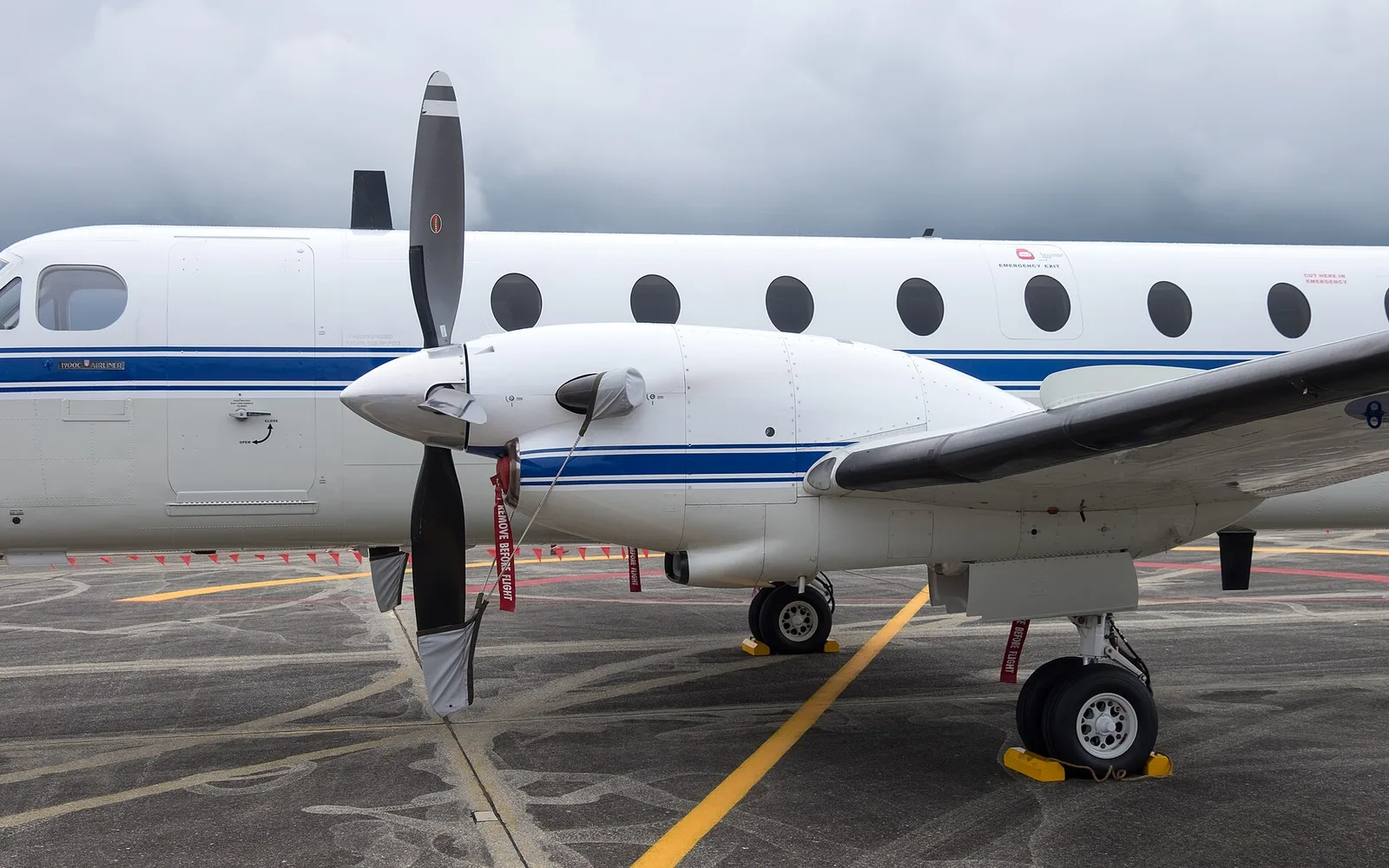
Photo: Pratt & Whitney Canada PT6A turboprop engine installed on a Beechcraft 1900C. Credit: 玄史生, CC0, via Wikimedia Commons.
The engine types, explained
- Turbine: the core of every gas-turbine engine. Air is compressed, mixed with fuel and burned, and the hot gas spins turbine blades. These drive the compressor and, depending on the engine type, a fan, a propeller or a rotor.
- Turbojet: all air passes through the core and thrust comes from the exhaust jet. It is simple and fast but thirsty. Older fighters such as the MiG-21 and its Chinese F-7 derivative use turbojets.
- Turbofan: a large fan at the front pushes extra air around the core (bypass air), which makes it more fuel-efficient. Military turbofans add an afterburner for extra thrust. Examples include the Rafale’s Safran M88, the F-16’s General Electric F110 or Pratt & Whitney F100, and the Su-30’s AL-31F.
- Turboprop: the turbine drives a propeller through a gearbox. It is efficient at low and medium speeds and operates from short, rough runways, which is why it dominates African transport and trainer fleets.
- Turboshaft: the turbine drives an output shaft instead of a propeller. In helicopters it turns the rotor, and the same engine type also powers ships and some tanks.
- Turbodiesel: a diesel engine with a turbocharger. This is the standard engine for armoured vehicles, trucks and many patrol boats.
- Electric motor and fuel cell: electric motors power submarines underwater and many small drones. Fuel cells generate electricity chemically and are used in air-independent propulsion submarines and some long-endurance drones.
- Propulsion system: the complete engine, transmission and propeller, rotor or jet arrangement that moves a platform.
Quick answer, verified 3 November 2026 (SIPRI engine deliveries since 2005)
- Most common military aircraft engine bought by African states: Pratt & Whitney Canada turboprops (PT6A and PW127 families)
- Turboprop trainers and light attack: Super Tucano (Angola, Burkina Faso, Mali, Mauritania, Nigeria), Hürkuş (Chad, Niger), T-6C (Morocco, Tunisia), KT-1 (Senegal), Mwari (DR Congo, Mozambique)
- Turboprop transports: C-295 (Egypt, Ghana, Mali, Senegal and others), C-27J (Chad, Kenya, Morocco, Tanzania, Zambia), MA60/MA600
- Turboshaft: CTS800 for Nigeria’s T129 and Algeria’s Super Lynx; T700 spares for Morocco’s AH-64E
| Engine | Type | Aircraft | African recipients (delivery years) |
|---|---|---|---|
| P&WC PT6A-68 family | Turboprop | EMB-314 Super Tucano | Angola (2013), Burkina Faso (2011), Mauritania (2012), Mali (2018), Nigeria (2021) |
| P&WC PT6A-68T | Turboprop | TAI Hürkuş | Niger (2023), Chad (2023) |
| P&WC PT6A-68 | Turboprop | Beechcraft T-6C | Morocco (2011–12), Tunisia (2022–23) |
| P&WC PT6A-62 / -25C | Turboprop | KT-1, PC-9, PC-7 | Senegal (2020), Chad (2006), Botswana (2013) |
| P&WC PT6A-66B | Turboprop | Paramount Mwari | Mozambique (2023); DR Congo (on order) |
| P&WC PW127G | Turboprop | Airbus C-295 | Egypt (2011–16), Ghana, Mali, Senegal, Burkina Faso, Côte d’Ivoire, Gabon, Mozambique, Angola |
| Rolls-Royce (Allison) AE2100D3 | Turboprop | Leonardo C-27J | Morocco (2010–11), Chad (2014), Zambia (2019), Kenya (2020); Tanzania (on order) |
| LHTEC CTS800-4N | Turboshaft | T129 ATAK; Super Lynx | Nigeria (2023–24); Algeria (2015–16) |
| GE T700-701D | Turboshaft | AH-64E Apache (spares) | Morocco (on order) |
Why turboprops dominate in Africa
Most African air forces operate from short or semi-prepared runways. They fly long patrol and transport sorties over large territories, often on limited budgets. Turboprops burn far less fuel than jets at these speeds and cost less to maintain. A single engine family, the PT6A, is shared by many trainers, light attack aircraft and utility aircraft. That shared base simplifies training and spares. See our guides to trainer aircraft, light attack aircraft and armed trainers and tactical transport aircraft in African air forces.
Turkish platforms and their engines
Two Turkish aircraft appear in the SIPRI engine data for Africa. One is the TAI Hürkuş trainer and light attack aircraft, powered by the PT6A-68T, which went to Niger and Chad in 2023. The other is the T129 ATAK attack helicopter, powered by twin CTS800-4N turboshafts, delivered to Nigeria in 2023–24. See Nigerian Air Force AKSUNGUR drones and T129.
Fighter turbofans
Africa’s fighter fleets use turbofans with afterburners. Examples include Egypt’s Rafales (Safran M88), the F-16s in Egypt and Morocco, and Algeria’s Su-30MKA fleet. These engines are bought with the aircraft, so they rarely appear as separate SIPRI entries. See fighter aircraft in African air forces.
Frequently asked questions
What is the difference between a turbofan and a turboprop?
A turbofan uses a ducted fan and jet exhaust for thrust, which suits high speeds. A turboprop uses the turbine to drive a propeller, which is more efficient at lower speeds and on short runways.
What engine does the Super Tucano use?
A Pratt & Whitney Canada PT6A-68 series turboprop, according to SIPRI’s records for African deliveries.
What is a turboshaft engine?
A gas turbine that delivers power through a rotating shaft rather than a jet or propeller. Helicopters use it to turn their rotors.
Sources
- SIPRI Arms Transfers Database – aircraft engine entries for African recipients, 2005–2025 (accessed 3 November 2026)
- Safran – M88 engine for the Rafale
- Pratt & Whitney Canada – PT6A engine family
Method: engine deliveries are SIPRI records, which list engines for aircraft assembled outside the engine maker’s country. Engine type definitions are general.
Last verified: 3 November 2026