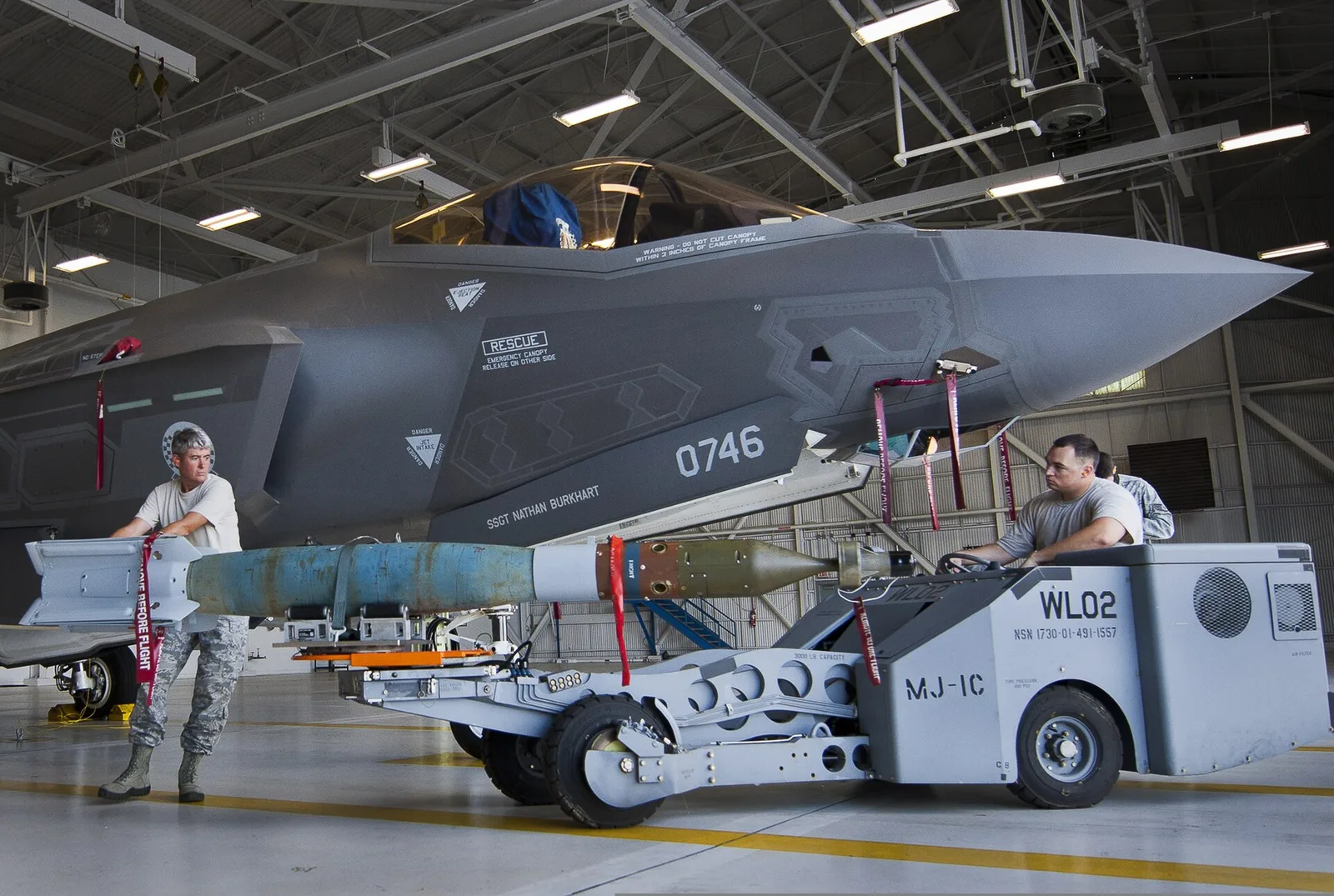
A guided bomb, often called a smart bomb, is an unpowered aircraft bomb fitted with a guidance kit that steers it onto a target with movable fins. The guidance usually comes from a laser seeker, satellite navigation (GPS/INS) or an electro-optical seeker. Most guided bombs are ordinary general-purpose bombs, such as the 500 lb Mk-82, converted with a bolt-on kit. In Africa, SIPRI and US government records show guided bombs delivered to at least ten air forces. Morocco and Egypt use American Paveway and JDAM kits, Nigeria uses Pakistani and US weapons, and Burkina Faso, Mali and Niger have received Turkey’s TEBER kit for their armed drones.
Photo: US Air Force armourers load a GBU-12 Paveway II laser-guided bomb, the 500 lb kit-converted bomb type delivered to Morocco, Egypt and South Africa, August 2013. Credit: U.S. Air Force, public domain, via Wikimedia Commons.
What is a guided bomb?
An unguided “dumb” bomb follows a ballistic fall once released, so its accuracy depends on the aircraft’s release point, speed and wind. A guided bomb adds a guidance kit. A nose section carries a seeker or navigation unit, and a tail or mid-body section carries control fins, a computer and a power source. The kit turns a stock bomb into a precision-guided munition (PGM) at much lower cost than a missile, because the bomb body and warhead stay the same. Guided bombs have no rocket motor. Their range comes from release altitude and speed and, on glide versions, from wings.
Main types of guidance kit
| Type | How it is guided | Typical examples | Weather limits |
|---|---|---|---|
| Laser-guided kit | Seeker homes on laser energy reflected from a target marked by the aircraft, a drone or ground troops | Paveway II/III (US), TEBER in laser mode (Türkiye), LS-6 laser versions (China) | Cloud and smoke can block the laser |
| Satellite/inertial kit | GPS or other satellite navigation corrects an inertial unit toward fixed coordinates | JDAM (US), HGK (Türkiye), LS-6 (China) | All-weather, but needs accurate coordinates |
| Dual-mode kit | GPS/INS for most of the flight plus laser for the final phase | Laser JDAM, TEBER, Paveway IV | Flexible |
| Winged glide kit | Pop-out wings add stand-off range, usually with GPS/INS | KGK (Türkiye), Longclaw/Umbani (South Africa), GBU-39 SDB (US) | All-weather |
| Electro-optical or TV-guided bomb | Camera or infrared seeker image used for lock-on | KAB-500Kr (Russia) | Needs a visible target |
The SSB defence terminology glossary lists separate Turkish terms for these: güdümlü bomba (guided bomb), akıllı bomba (smart bomb), güdüm kiti (guidance kit), hassas güdüm kiti (precision guidance kit), kanatlı güdüm kiti (winged guidance kit) and lazer güdüm kiti (laser guidance kit). In English they all fall under the precision-guided munition family. Turkish examples covered on DefenceMENA include ASELSAN’s KGK-84 wing guidance kit and Roketsan’s drone-launched MAM smart micro munitions.
Which African air forces have guided bombs?
| Country | Weapon | Supplier | Order / delivery | Platform | Status |
|---|---|---|---|---|---|
| Morocco | Paveway II/III (GBU-10, GBU-12, GBU-24) | United States | Ordered 2008; 280 delivered 2010–2011 | F-16 | Delivered |
| Morocco | JDAM and Laser JDAM | United States | 10 delivered 2013; about 90 delivered 2015–2017 | F-16 | Delivered |
| Morocco | AGM-154C JSOW (glide weapon) | United States | 40 approved April 2023 | F-16 | Approved; delivery not confirmed |
| Morocco | GBU-39B Small Diameter Bomb | United States | 500 approved December 2024 | F-16 | Approved; delivery not confirmed |
| Egypt | Paveway II | United States | About 50 delivered 2005 | F-16 | Delivered |
| Nigeria | Al-Battar-500 | Pakistan | About 25 delivered 2021 | JF-17 | Delivered |
| Nigeria | Paveway II GBU-12/GBU-58 kits, 1,002 Mk-82 bombs | United States | Approved August 2025 | Not specified | Approved |
| South Africa | Paveway II | United States | About 50 delivered 2011–2012, interim until local Umbani | Gripen | Delivered |
| Uganda | KAB-500/1500 | Russia | About 100 delivered 2011–2012 | Su-30 | Delivered |
| Ethiopia | KAB-500/1500 | Russia | About 25 delivered 2000 | Su-25T | Delivered (older) |
| Libya | KAB-1500 | Russia | About 40 delivered 2005 | Not specified | Historical |
| Zambia | LS-6-500 glide bomb | China | About 50 delivered 2016–2017 | L-15 | Delivered |
| Burkina Faso | TEBER | Türkiye | About 20 delivered 2024 | Armed drones | Delivered; publicly displayed April 2024 |
| Mali | TEBER | Türkiye | About 20 delivered 2024 | Bayraktar AKINCI | Delivered |
| Niger | TEBER | Türkiye | About 10 delivered 2025 | Aksungur | Delivered |
SIPRI quantities are estimates and are marked as such in the database. Approvals by the US Defense Security Cooperation Agency (DSCA) are possible sales notified to Congress, not signed contracts or deliveries.
Morocco: the most developed precision-strike stockpile
Morocco’s F-16 fleet has the deepest documented guided bomb inventory in Africa. SIPRI records 280 Paveway bombs delivered in 2010–2011 and about 100 JDAM-family kits, including Laser JDAM, from 2013. Since 2023, US notifications have added the AGM-154C JSOW glide weapon and, in December 2024, 500 GBU-39B Small Diameter Bombs. These give the F-16s stand-off options against defended targets. More: Morocco’s F-16 fleet and EDGE’s precision-weapons cooperation with Morocco.
Nigeria: from JF-17 bombs to Paveway
Nigeria received about 25 Pakistani Al-Battar-500 guided bombs for its JF-17 Thunders in 2021, according to SIPRI (JF-17 family explained). On 13 August 2025, DSCA notified Congress of a possible $346 million sale to Nigeria. The package includes 1,002 Mk-82 bombs, Paveway II guidance groups for GBU-12 and GBU-58 bombs, and 5,000 APKWS II laser-guided rockets. It follows an April 2022 notification for AH-1Z helicopters that included 2,000 APKWS guidance sections. See Nigerian Air Force aircraft.
Turkish kits on Sahel drones
Roketsan describes TEBER as a kit that turns Mk-81 and Mk-82 bombs into GPS/INS and semi-active laser-guided weapons, compatible with fixed-wing drones such as the Bayraktar AKINCI. SIPRI records TEBER deliveries to Burkina Faso and Mali in 2024 and to Niger in 2025. This marks a shift in the Sahel: precision bombing that once required a fighter jet is now done by the large armed drones these juntas bought from Türkiye. Operator background: Which African countries operate Bayraktar AKINCI.
South Africa: building its own
South Africa is the only African state that designs guided bombs. SIPRI notes that Paveway IIs bought for the Gripen were an interim solution until the local Umbani kit was available. Denel’s successor work continues with Rheinmetall Denel Munition’s Longclaw glide bomb, covered in RDM Longclaw glide bomb.
Frequently asked questions
What is the difference between a guided bomb and a missile?
A guided bomb has no engine and relies on its release height, speed and sometimes wings for range. A missile has its own rocket or jet propulsion.
What is the difference between JDAM and Paveway?
JDAM uses satellite and inertial navigation to hit fixed coordinates in any weather. Paveway uses a laser seeker that follows a laser spot on the target. Some variants, such as Laser JDAM, combine both.
Which African country has the most guided bombs?
Morocco has the largest documented transfers, based on SIPRI and US records. No African state publishes its stockpile.
Can drones drop guided bombs?
Yes. Large armed drones such as the AKINCI and Aksungur can carry guided bomb kits like TEBER, and smaller drones carry mini munitions such as MAM-L.
Sources
- SIPRI Arms Transfers Database – guided bomb entries for African recipients (accessed 3 November 2026)
- DSCA, 13 August 2025 – Nigeria: munitions, precision bombs and precision rockets
- defenceWeb, April 2022 – US approves possible AH-1Z Viper sale to Nigeria
- DSCA, December 2024 – Morocco: GBU-39B Small Diameter Bombs
- DSCA via GlobalSecurity, 11 April 2023 – Morocco: Joint Stand Off Weapons
- Roketsan – TEBER guidance kit brochure (PDF)
- TURDEF – Bayraktar AKINCI drops winged TEBER-82 guided bomb
Method: transfers come from SIPRI and official US notifications. Approvals are labelled separately from deliveries. Descriptions are kept at the level published by manufacturers and governments.
Last verified: 3 November 2026