Sudan Military Strength 2026: The SAF, the RSF and What the Numbers Show



Sudan military strength can no longer be measured as the strength of one army. Since April 2023 the country has had two armed forces, the Sudanese Armed Forces (SAF) and the paramilitary Rapid Support Forces (RSF), fighting for control of the state, and no outside tracker holds a verified headcount for either. This profile sets out what each side is reported to field, what is only estimated, which foreign suppliers are alleged or reported, and where the sources disagree. It takes no side in the war.
Quick answer
Sudan has no verified current headcount. Before the war the army was put at 120,000–200,000 and the RSF at 70,000–100,000 (EUAA, April 2023 baseline). A July 2026 Africa Center for Strategic Studies estimate gives about 205,000 for the SAF and 100,000–200,000 for the RSF core (ACSS, 2026). Global Firepower’s 300,000 “active” is a modelled, unofficial figure (GFP, January 2026).
Data as of 27 October 2026. Figures are open-source estimates; see “A note on the numbers”.
This page covers the Republic of the Sudan (capital Khartoum). South Sudan, independent since 2011, is a separate country and is not covered here.
| Indicator | Figure | Year / source / status |
|---|---|---|
| Armed forces in the war | SAF (the state’s regular forces) and RSF (formalised as a paramilitary in 2013), each with allied militias | EUAA, October 2026 |
| Personnel, SAF | 120,000–200,000 pre-war; about 205,000 mid-2026 (ACSS); 300,000 active in an unofficial index (GFP) | 2023, 2026 – Estimated; see personnel section |
| Personnel, RSF | 70,000–100,000 pre-war; 100,000–200,000 core mid-2026 (ACSS); 450,000 claimed by its own leader | 2023, 2026 – Estimated / claim, unverified |
| Military spending (last SIPRI year) | SDG 136.99 billion, about US$369 million, 0.93% of GDP, 9.5% of government spending. No SIPRI data for 2022–2025 | SIPRI, 2021 – see Sudan defence budget |
| Combat aircraft (fighters + attack) | 73 on paper (37 fighters, 36 attack), plus 64 helicopters; wartime losses unpublished | GFP, January 2026 – Estimated, pre-attrition; see Sudan Air Force aircraft |
| Main battle tanks | About 1,055 listed, with about 8,890 armoured vehicles of all kinds | GFP, January 2026 – Estimated, not independently verified |
| Navy | About 2,000 personnel; patrol-class craft only, no frigates or submarines | GFP, January 2026 – Estimated |
| Command | Lt Gen Abdel Fattah al-Burhan (Commander-in-Chief); Gen Yasir al-Atta, Chief of General Staff since 2 April 2026 | EUAA, October 2026; AFP, 2 April 2026 |
| Arms embargo | UN Security Council Resolution 1591 covers Darfur only; extended to 11 December 2026; a nationwide embargo was blocked | UN Security Council, October 2026 |
| Global Firepower rank | 66th of 145 militaries (power index 1.3563), a composite index rather than an inventory count | GFP 2026, unofficial |
Two armed forces, one war
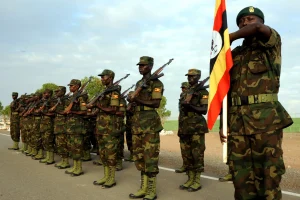
The SAF is Sudan’s regular military: army, air force and navy, together with Military Intelligence, the Central Reserve Police and the Border Guards, according to the EU Agency for Asylum’s October 2026 country report. Its headquarters are in Khartoum and its commander-in-chief is Lt Gen Abdel Fattah al-Burhan, the head of the Sovereignty Council. On 2 April 2026 the army named Gen Yasir al-Atta as chief of staff, replacing Gen Mohamed Othman al-Hussein, who had held the post since 2019, in what AFP called its biggest wartime shake-up. The RSF, led by Lt Gen Mohamed Hamdan Dagalo (“Hemedti”), grew out of the Darfur militias of the 2000s and was formalised as a paramilitary force in 2013. The war began on 15 April 2023 after the two leaders fell out over plans to integrate the RSF into the army.
As of mid-2026 the EUAA describes the SAF as holding most of the north, east and centre of the country and the RSF as holding most of Darfur and parts of Kordofan, after the RSF took El Fasher in late October 2025. The RSF’s allied Sudan Founding Alliance (“Tasis”) declared a parallel government in 2025, which the African Union and the UN Security Council have rejected. On 6 October 2026 al-Burhan said the army would pursue “every inch” of RSF-held territory and rejected negotiations, while a US envoy has called for a Sudanese-led national dialogue. The UN estimates about 13 million people have been displaced. Both the SAF and the RSF are accused by UN bodies of serious violations of international humanitarian law; those findings are summarised in the drone-war analysis and are not repeated here.
How many soldiers does Sudan have?
Nobody outside the two commands can say, and the commands do not publish. The table below shows every figure found, with its scope and its weakness. The pre-war ranges come from the EUAA’s compilation of earlier CIA, Reuters and Jamestown Foundation estimates; the 2026 figures are think-tank or index estimates and one combatant’s own claim.
| Force | Figure | Date and source | Status |
|---|---|---|---|
| SAF, around outbreak of war | 120,000–200,000 | April 2023; EUAA, citing earlier open-source estimates | Estimated |
| RSF, around outbreak of war | 70,000–100,000 | April 2023; EUAA, citing earlier open-source estimates | Estimated |
| SAF | About 205,000 | July 2026; Africa Center for Strategic Studies | Estimated |
| SAF-aligned groups | About 150,000 national armed groups; about 60,000 regional armed groups; 20,000–45,000 Islamist armed groups | July 2026; Africa Center for Strategic Studies | Estimated, wide uncertainty |
| RSF core | About 100,000–200,000 | July 2026; Africa Center for Strategic Studies | Estimated |
| RSF-aligned groups | About 20,000–40,000 tribal and communal militias; 20,000+ regional armed groups; about 400–500+ foreign fighters | July 2026; Africa Center for Strategic Studies | Estimated, wide uncertainty |
| RSF, leader’s own claim | “Grew from about 143,000 to 450,000” since April 2023 | Hemedti, 6 May 2026, reported by CGTN | Reported (unconfirmed); a party’s own claim |
| SAF total in an index | 300,000 active, 200,000 reserve, 17,500 paramilitary (517,500 total) | Global Firepower, 22 January 2026 | Estimated; modelled, unofficial |
Two points stand out. First, the RSF’s own claim of 143,000 fighters at the start of the war is higher than the 70,000–100,000 that outside estimates gave for the same date, so the claimed growth to 450,000 starts from a base the independent record does not support. Second, the Global Firepower total counts reservists and a notional wartime pool; it is a ranking input, not an order of battle. The EUAA quotes it only because nothing better exists. The 2023 pre-war SAF range of 120,000–200,000 and the 2026 estimate of about 205,000 are compatible, but neither measures the militias that the SAF now relies on.
Defence budget
SIPRI’s database holds Sudanese military, police and security spending for 2015–2021 and then nothing: SIPRI’s footnote says no military data has been available since the civil war. The last SIPRI year, 2021, shows SDG 136.99 billion, about US$369 million at that year’s exchange rate, 0.93% of GDP and 9.5% of government spending. The 2026 emergency budget was approved on 30 December 2025 and again at a joint Sovereignty Council and cabinet session in Khartoum on 21 January 2026, but its totals have not been published. The finance minister has said 40% of the 2025 budget went to the war effort, up from 36% in 2024, without giving amounts. With the pound trading at roughly SDG 10,000 to the dollar on the street in October 2026 against bank quotes of about SDG 4,200, any dollar conversion is unreliable. The full table, with every conversion caveat, is in Sudan’s defence budget.
Army
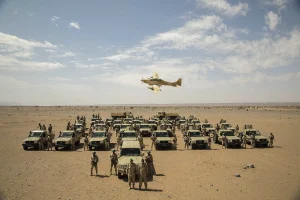
On paper the SAF’s land force is large. Global Firepower’s 2026 review lists about 1,055 main battle tanks, about 8,890 armoured vehicles of all kinds, about 100 self-propelled and 1,150 towed artillery pieces, with a stated readiness of roughly 55% for tanks. Those are modelled stock figures: they do not net out the equipment lost, captured or destroyed on either side since 2023, and the EUAA’s cover photograph for its October 2026 report shows a disabled Soviet-era T-72 in Khartoum. The inventory is Soviet and Russian, Chinese and domestic in origin. Sudan also has a state defence-industrial group, the Military Industry Corporation, and a domestic one-way attack drone programme covered in the drone-war analysis.
The newest reported addition is the Pakistani Mohafiz-V infantry mobility vehicle. Sudanese military sources told Sudan Tribune in August 2026 that about 100 had arrived in batches from July and were shown in a Khartoum convoy on 3 August; neither government has published contract terms. DefenceMENA’s separate Mohafiz-V report sets out the sourcing.
Air force
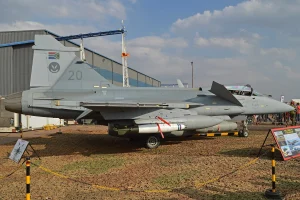
The SAF’s fixed-wing fleet is ageing and has been reduced by war. Global Firepower’s January 2026 count is 183 military aircraft of all types, including 37 fighters, 36 attack aircraft, 13 transports, 33 trainers and 64 helicopters, of which 35 are attack helicopters. Losses are documented only in part and no serviceable total has been published. The most significant change is the growing share of unmanned aircraft, from Iranian, Turkish-designed, Pakistani and domestic sources. The aircraft-by-aircraft table with status labels is in Sudan Air Force aircraft.
Navy
Sudan has a Red Sea coast but a very small navy. Global Firepower lists about 2,000 naval personnel and patrol-class craft only: no frigates, corvettes or submarines. In February 2025 Sudan’s foreign minister said a Russian naval facility on the Red Sea could go ahead once ratified; ratification has not been shown, and reports differ on whether the project is frozen or under revision. No foreign naval base in Sudan has been verified as operating.
Paramilitary and allied forces
The war has pushed both sides to rely on irregular and allied forces, which is why a single “Sudan army size” figure misleads. On the SAF side the EUAA lists the Popular Resistance (Mustanfareen), a militia of more than 70,000 formed after the June 2023 mobilisation call; the Sudan Shield Forces, estimated at 35,000–75,000; the Darfur Joint Forces, including the Sudan Liberation Movement led by Minni Minnawi and the Justice and Equality Movement, each around 35,000; the SPLM-N faction led by Malik Agar; and the Islamist Al-Baraa Bin Malik Brigade, whose strength is estimated anywhere from about 1,500 to 45,000 and which the US sanctioned in September 2025 and whose commander the EU sanctioned in January 2026. On the RSF side the EUAA describes a decentralised force dominated by Arab communities of Darfur and Kordofan, joined by allied militias, the SPLM-N faction led by Abdelaziz al-Hilu and, according to UN investigators and the Africa Center, foreign contractors and fighters. The EUAA reports signs of fracture inside the RSF and within the Tasis alliance as of June 2026.
Suppliers and foreign backing
Almost every external supply claim in this war is contested. The table separates what UN bodies have documented from what outlets report and what governments deny. A UN Security Council arms embargo covers only Darfur; in October 2026 the Council extended it for two months, to 11 December, after Russia and China opposed a US proposal to make it nationwide and Sudan’s government objected (see the embargo renewal).
| Country | Reported role | Side | Status and attribution |
|---|---|---|---|
| Pakistan | Mohafiz-V vehicles (about 100); wider package of about US$1.5 billion including K-8 aircraft and over 200 drones | SAF | Reported (unconfirmed); Sudan Tribune and Reuters, citing unnamed sources; no official contract terms |
| Türkiye | Bayraktar TB2 and Akıncı unmanned aircraft | SAF | Reported; UN investigators identified Akıncı features in imagery but did not establish the supplier; neither Ankara nor Baykar has confirmed |
| Iran | Mohajer-6 and Ababil-3 drones | SAF | Reported; Reuters and the EUAA; the army has not confirmed |
| Egypt | Diplomatic backing and material assistance | SAF | Reported; EUAA, citing BBC |
| Russia | Reported support; naval-facility understanding announced February 2025 | SAF | Reported; ratification not shown; status disputed |
| Saudi Arabia | Economic aid and diplomacy; reportedly brokered the Pakistan deal; cooperation agreement signed August 2026 | SAF | Reported; EUAA |
| United Arab Emirates | Alleged source of weapons, drones and funding | RSF | Alleged by the SAF, Amnesty International and the UN Fact-Finding Mission (which cites entities in the UAE, Chad, Libya and Somalia). The UAE says it “is not involved in the civil war in Sudan, nor has it provided arms or any related materiel to any party” |
| Ethiopia | Reported training camp for RSF fighters | RSF | Reported by Reuters, February 2026, per the EUAA; no Ethiopian confirmation found |
The UN Fact-Finding Mission for Sudan said in a report dated 1 September 2026 (A/HRC/63/23) that its investigation of external support to the SAF is still preliminary, but that the SAF has significantly expanded its drone capabilities since late 2023 through foreign-supplied systems. It also found reasonable grounds to believe that foreign-supplied drones and loitering munitions were used in attacks that struck civilian objects, including a market in Blue Nile. On the RSF side it verified wreckage consistent with Chinese-designed CH-95/FH-95 drones at several locations. China’s state manufacturers make those systems; the sources reviewed here do not allege direct supply by China.
What changed in the last 12 months
| Date | Event | Status |
|---|---|---|
| Late October 2025 | RSF takes El Fasher, the SAF’s last major position in Darfur | Confirmed (EUAA) |
| 30 December 2025 and 21 January 2026 | Emergency 2026 budget approved; government returns to Khartoum; totals unpublished | Approved |
| January 2026 | Reuters reports a Pakistani package of about US$1.5 billion for the SAF | Reported (unconfirmed) |
| 2 April 2026 | Gen Yasir al-Atta named SAF chief of staff | Confirmed (AFP) |
| 6 May 2026 | Hemedti says the RSF has grown to 450,000 | Claim, unverified |
| July 2026 | Africa Center publishes its armed-actor mapping (SAF about 205,000) | Estimated |
| Early August 2026 | About 100 Mohafiz-V vehicles reported delivered; displayed 3 August | Reported |
| 1–3 September 2026 | UN Fact-Finding Mission publishes A/HRC/63/23 on weapons, fighters and external support | Published |
| 9 October 2026 | UN Security Council extends the Darfur embargo to 11 December; nationwide embargo blocked | Adopted |
| 21 October 2026 | Pound reported above SDG 10,000 per dollar on the street | Reported |
Internal security context
This is not a conventional contest between two armies. The EUAA records that by May 2026 armed drones had become the leading cause of civilian deaths in the country, and the UN human rights office counted more than 1,000 civilian deaths from drone strikes between January and May 2026. Both sides use them. Fighting in 2026 has centred on the Kordofan states and Blue Nile, and the EUAA describes a war that has fragmented into several fronts with allied militias changing allegiance at different stages. These points belong to strength because they limit what any inventory can say: a force’s tanks and aircraft matter less than its drones, its militia partners and its supply lines, none of which are published.
How strong is Sudan’s military? Short answers
How strong is the Sudanese army?
The SAF is the larger and better-equipped of the two main forces, with an air force, heavy armour and the machinery of a state, and in 2026 it holds most of the populated north, east and centre. Its strength is nonetheless reduced and uneven: aircraft and vehicles have been lost, it depends on allied militias, and no independent audit of serviceable equipment exists. The Global Firepower rank of 66th of 145 is a composite index and does not capture any of this.
How many soldiers does Sudan have?
There is no verified current figure. See the personnel table: roughly 120,000–200,000 for the SAF before the war and about 205,000 in a July 2026 estimate, with another 200,000 or more in allied armed groups, and 100,000–200,000 for the RSF core.
Which is stronger, the SAF or the RSF?
They are strong in different ways and neither is dominant. The SAF has the state, the air force, most heavy equipment and the capital; the RSF is a mobile, decentralised force holding most of Darfur, which UN investigators say has received foreign-supplied drones and air defence. Territory has changed hands repeatedly since 2023, and neither side has been able to end the war militarily.
Are there foreign bases or troops in Sudan?
No foreign military base has been verified as operating. Russia and Sudan discussed a naval facility in February 2025 that has not been shown to be ratified. UN investigators found that foreign contractors supported the RSF, and some outlets report foreign military personnel supporting the SAF; those claims are denied or unconfirmed (see the supplier table).
How Sudan compares
For the continental picture see Africa’s strongest militaries in 2026 and which African country has the biggest army, which treats Sudan’s figure as a pre-war baseline only. Neighbouring Egypt, which the EUAA lists among the SAF’s reported backers, is profiled in Egypt military strength. Sudan’s military ranks are in Sudan army ranks, and the continental comparison is in African military ranks compared. Defence spending across the continent is ranked in African defence budgets ranked. The East Africa desk carries the running news.
A note on the numbers
Official figures: the SIPRI spending series to 2021, UN documents (A/HRC/63/23, Resolution 1591 renewals), the approval of the 2026 budget and the appointment of the chief of staff. Estimates: every personnel figure in this profile. The pre-war ranges are secondary compilations collected by the EUAA; the July 2026 figures come from a think-tank infographic that does not publish its method; the Global Firepower figures are modelled and are used here only for the composite rank and for class totals, labelled as such. Claims by combatants (the RSF’s 450,000 and either side’s battlefield claims) are shown as claims. Contradictions: Global Firepower’s 300,000 active personnel contradicts the 2023 range and the 2026 Africa Center figure; one aggregator gives about 104,000 active troops without a traceable source, and we have not used it. What we could not verify: the IISS Military Balance entry (paywalled), any serviceability or loss total for either side’s armour or aircraft, the content of the 2026 budget, and the contract terms of the Pakistani deliveries. We have deliberately left out unit locations, deployment detail and supply routes. Where a supplier is named, the source and any denial are shown. Turkish, Iranian, Pakistani, Emirati, Egyptian and Russian systems are treated with the same status labels.
Sources
- European Union Agency for Asylum, Country of Origin Information: Sudan, Security Situation (October 2026), accessed 27 October 2026
- EUAA, Sudan COI 2025: Major state and non-state armed groups, accessed 27 October 2026
- Africa Center for Strategic Studies, Armed Groups Active in Sudan Conflict (infographic table, August 2026), accessed 27 October 2026
- UN Independent International Fact-Finding Mission for the Sudan, Fuelling Sudan’s conflict: weapons, fighters and external support networks (A/HRC/63/23, advance version, 1 September 2026), accessed 27 October 2026
- SIPRI Military Expenditure Database 1949–2025, Sudan series and footnote 34, accessed 27 October 2026
- Global Firepower (unofficial index), 2026 Sudan Military Strength, accessed 27 October 2026
- AFP via Citizen Digital, Sudan army names new chief of staff in biggest wartime shakeup (2 April 2026), accessed 27 October 2026
- CGTN, RSF vow to continue conflict in Sudan amid stalled peace efforts (7 May 2026), accessed 27 October 2026
- Al Jazeera, Sudan’s al-Burhan rejects talks, vows to retake all territory from RSF (7 October 2026), accessed 27 October 2026
- The Defense Post, UN Renews Darfur Arms Embargo as Sudan-Wide Expansion Stalls (9 October 2026), accessed 27 October 2026
- The Defense Post, Sudanese Forces Expand Arsenal With Mohafiz Armored Vehicles From Pakistan (7 August 2026), accessed 27 October 2026
- The Defense Post, Pakistan to Sign $1.5B Arms Sale With Sudan (12 January 2026), accessed 27 October 2026
- The National, UN report finds Sudanese Armed Forces used foreign-supplied drones in attacks on civilian areas (3 September 2026), accessed 27 October 2026
- Military Africa, Sudan greenlights first Russian naval base in Africa (February 2025), accessed 27 October 2026
- Al Jazeera, The drones being used in Sudan: 1,000 attacks since April 2023 (3 February 2026), accessed 27 October 2026
- Sudan Ministry of Culture, Information and Tourism, joint meeting approves the 2026 emergency budget (22 January 2026), accessed 27 October 2026