US Air Force Weighs Sending Four Retired KC-10 Tankers to Morocco



The US Air Force has asked industry to assess reviving four retired KC-10 Extender tankers for transfer to a North African air force, and specialist reporting now points squarely at Morocco as the intended recipient.
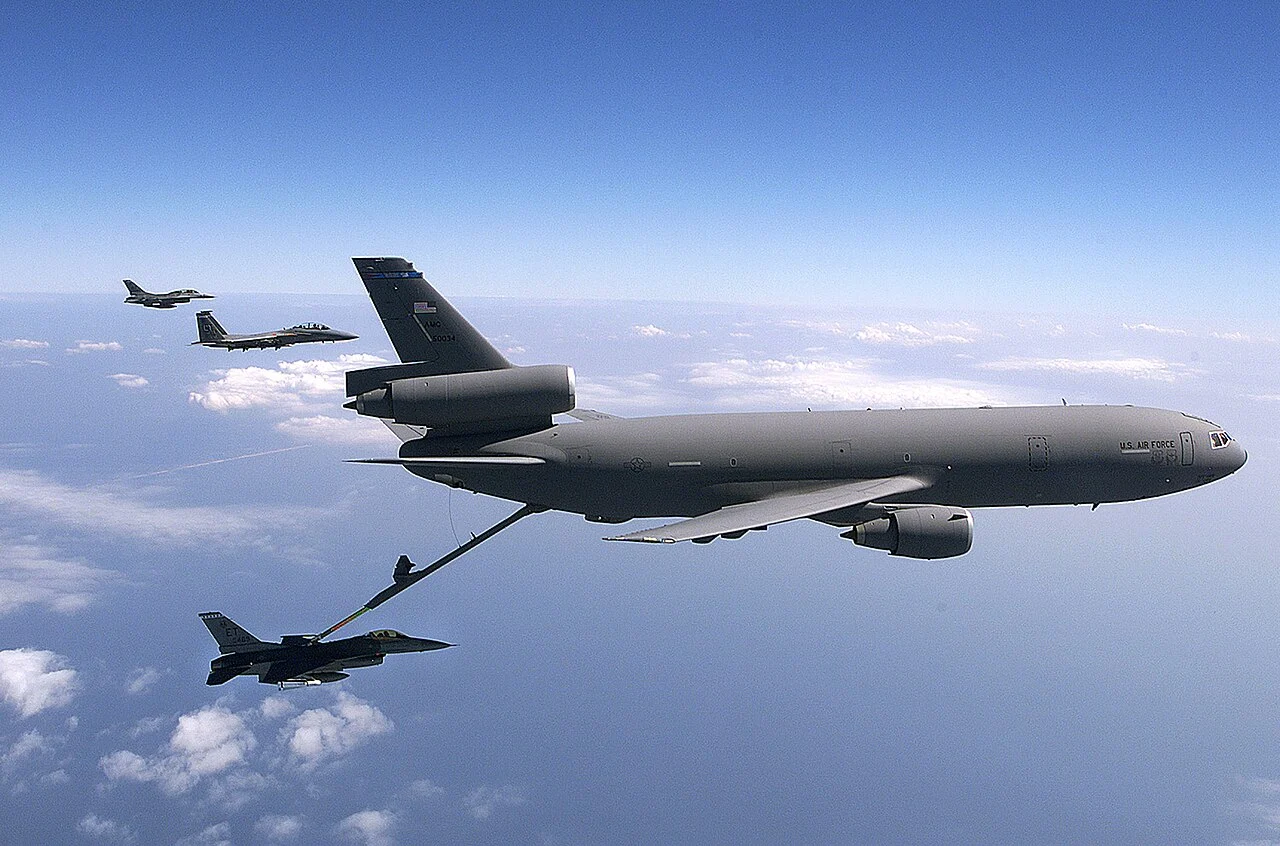
Photo: A KC-10 Extender refuels an F-16 Fighting Falcon during a US Air Force exposition. Credit: U.S. Air Force photo by Staff Sgt. Jerry Morrison, Public domain, via Wikimedia Commons
The Air Force Life Cycle Management Center published a market research notice, FA8625-27-R-B001, on 7 October 2026, asking contractors whether they could regenerate up to four KC-10 Extenders, return them to flying condition, provide a one-time ferry flight clearance, fly them to their new operator and then deliver several years of contractor logistics support and training. The notice is explicit that it is not a request for proposal and that the Air Force will not accept unsolicited offers; industry responses are due by 28 October 2026.
The aircraft would move under the US Excess Defense Articles programme, paired with a Foreign Military Sales case to cover the regeneration and support contract. The notice itself does not name the receiving country, describing it only as a partner nation in North Africa, but outlets including The Aviationist and The War Zone narrowed the field to Morocco or Egypt. Reporting on 19 October by Infodefensa, citing the Moroccan outlet Médias24 and sources close to the programme, said Morocco is now the most likely destination, with Egypt considered the only remaining alternative and Tunisia ruled out because its air force lacks the aircraft types the tankers are meant to support.
Morocco already turned this deal down once
This is not the first time Rabat has been offered KC-10s. According to Infodefensa and the Moroccan outlet Bladi.net, the Royal Moroccan Air Force received an earlier proposal for surplus KC-10s and declined it, put off by the cost of operating an aircraft whose engines and spare-parts lines have been wound down, and by the complexity of standing up a new heavy tanker fleet from scratch. The renewed interest follows the Air Force’s October notice, which effectively offers to have a contractor absorb much of that regeneration risk before the aircraft are handed over.
The KC-10, built by McDonnell Douglas (now part of Boeing) between 1979 and 1987, left US Air Force service in 2024 after the fleet’s retirement ceremony that September, replaced by the Boeing KC-46 Pegasus. Most of the retired airframes have gone into storage at the 309th Aerospace Maintenance and Regeneration Group boneyard at Davis-Monthan Air Force Base, Arizona, where their current condition is one of the open questions the Air Force’s notice is trying to answer.
Why the boom matters for Morocco’s F-16s
The KC-10’s rigid flying boom is the attraction. Morocco’s Mirage F1s and ageing F-5s can take fuel from probe-and-drogue systems, which the Royal Moroccan Air Force already operates from modified C-130 Hercules transports. Its F-16s cannot. Only a boom-equipped tanker can refuel the F-16 fleet in the air, and Morocco has had to rely on French or American tankers during joint exercises for that capability. Morocco’s F-16 fleet has been growing steadily: Rabat has taken delivery of F-16C/D Vipers under earlier contracts and has a further batch of Block 72-standard aircraft on order, a modernisation DefenceMena has tracked in detail (Morocco’s F-16 Fleet Explained and From F-5 Tiger II to F-16 Block 72: Morocco’s Fighter Transition).
Morocco has weighed organic jet-tanker capability before. Infodefensa’s reporting lists a string of past options that never closed: Boeing KC-135s considered in the late 1970s during tension with Algeria, a 2006 look at converting two C-130Hs (which would only have served the Mirage and F-5 fleets), surplus KC-135Fs ruled out on cost, a secondhand Boeing 707-3W8C that instead went to Israel, and the Airbus A330 MRTT, priced out of reach as the type’s most expensive option. The KC-10 notice is the first of these to come with a US government-backed path to delivery rather than an open-market purchase.
Egypt’s case, and why it looks weaker
Egypt is the other candidate named in Western reporting, and it has an unmistakable gap to fill: Cairo has no dedicated aerial-refuelling fleet, though it is separately acquiring two C-130J-30s fitted with tanker pods. Several analysts argue Morocco remains the stronger fit because its F-16 force is the clearest beneficiary of boom refuelling and because Rabat’s air force already operates the probe-and-drogue half of the mission, making a four-aircraft KC-10 fleet a complement rather than a first step into aerial refuelling from nothing.
Why it matters for Africa
If the transfer goes ahead, Morocco would become the only African air force operating a US-origin jet tanker, and only the second on the continent with any heavy jet refuelling capability after Algeria, which has flown around six secondhand Ilyushin Il-78s bought in the 1990s. South Africa operated Boeing 707-328C tankers until retiring them in 2007, and no sub-Saharan air force has replaced that capability since. A Moroccan KC-10 fleet would extend the reach of Rabat’s F-16s well beyond national airspace, relevant to the kind of long-range strike and surveillance missions Morocco has flown in the Western Sahara and to its growing role in joint exercises with US and European partners. It would also mark a new category of North African air power just as Algeria modernises its own fleet and the regional balance between the two rivals continues to be measured aircraft type by aircraft type.
For now this is market research, not a signed deal. The Air Force has stressed that responses to the October notice carry no commitment, and a further request for proposals, a formal congressional notification and contract award would all have to follow before any KC-10 reaches Moroccan soil. But the notice’s narrow geographic description, the 28 October response deadline and the flurry of Moroccan press interest make this one of the more concrete signs yet that Rabat is close to filling the one gap in its air force that F-16 deliveries alone cannot close.
Sources
- Infodefensa: “Marruecos rechazó hace unos meses la compra de aviones cisterna KC-10…”
- The Aviationist: “KC-10 Extender tankers could fly again for a North African partner”
- The War Zone: “Retired KC-10 Extender tankers could get a second life with North African mystery operator”
- Bladi.net: “Les États-Unis ressortent quatre avions militaires de leur retraite : le Maroc pourrait en bénéficier”
- Air Data News: “US Air Force seeks to transfer four retired KC-10 tankers to North Africa”