Nigeria’s T129 ATAK Fleet: What’s Actually Delivered, and Where It’s Deployed

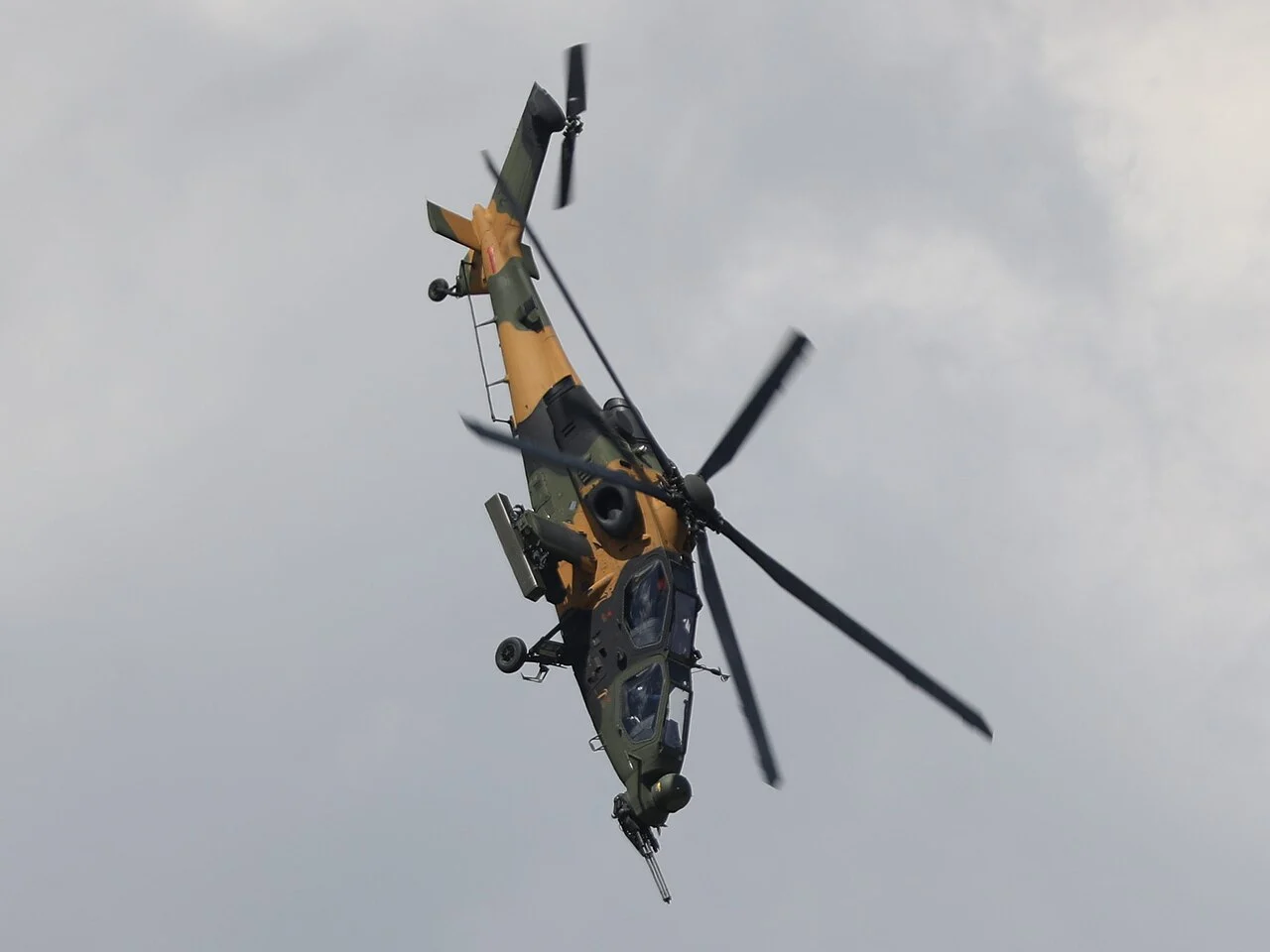


Nigeria is the first confirmed African air force to field the TAI T129 ATAK, and as of late 2026 it has four of the six attack helicopters it ordered in service, not the full fleet some social-media posts have claimed. The Nigerian Air Force (NAF) received the first pair at Makurdi in November 2023, inducted them into service in February 2024, and took delivery of a second pair around September 2024. Nigeria’s Chief of the Air Staff confirmed four T129s in NAF hands at the service’s 61st anniversary in May 2025. No dated, sourced confirmation of the remaining two airframes has surfaced since.
Photo: A TAI T129 ATAK attack helicopter on display at the Paris Air Show, 2019. This is a file photo of the type and does not show a Nigerian aircraft. Credit: New York-air, CC BY-SA 4.0, via Wikimedia Commons.
This file tracks what is actually confirmed about Nigeria’s T129 ATAK order against what has only been reported, estimated or claimed on social media — a gap that matters for a programme whose contract value, exact delivery count and technology-transfer terms have never been officially disclosed by either government.
| Item | Detail |
|---|---|
| Country | Nigeria |
| System | T129 ATAK attack helicopter |
| Manufacturer | Turkish Aerospace Industries (TUSAŞ/TAI), co-developed with Leonardo (A129 Mangusta lineage) |
| Origin | Türkiye |
| Variant | T129 ATAK export configuration; one Turkish trade report names it “T129B” — not independently confirmed |
| Quantity | 6 ordered; 4 confirmed delivered and in service (NAF statement, May 2025); 2 unconfirmed |
| Order year | 2022 (announced July 2022; underlying defence-industry pact signed October 2021) |
| Delivery | First pair November 2023; second pair ≈ September 2024; remaining two not confirmed as of October 2026 |
| Service status | IN SERVICE / OPERATIONAL — partial fleet (4 of 6 ordered) |
| Reported contract value | Not officially disclosed. Turkish trade press estimates of roughly $269–270 million total / $45 million per unit circulate but are unconfirmed by TAI or Nigeria |
What is the T129 ATAK, and why does Nigeria matter for it?
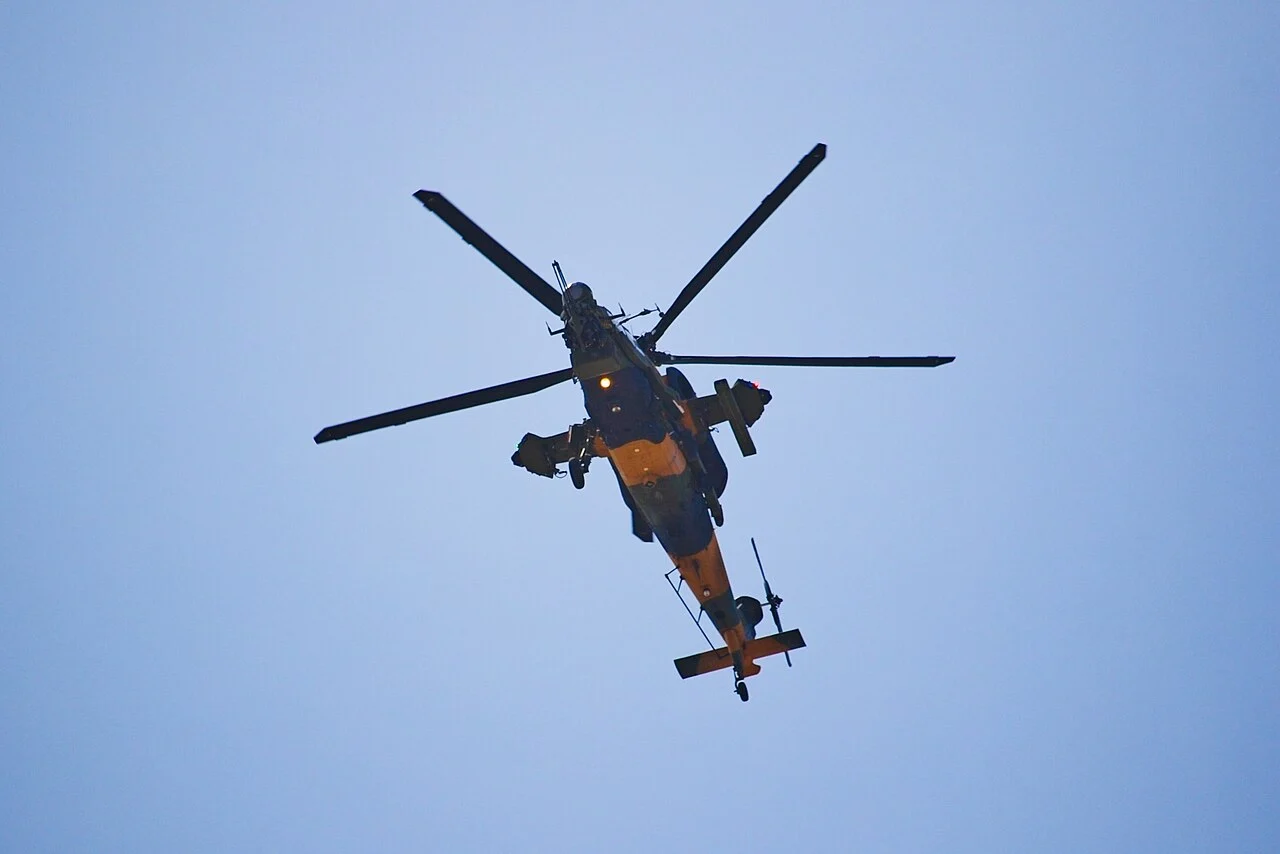
The T129 ATAK is a twin-engine, tandem-seat attack helicopter developed by Turkish Aerospace Industries with Leonardo, based on the airframe of the Leonardo (AgustaWestland) A129 Mangusta but rebuilt with new LHTEC CTS800-4A turboshaft engines, Turkish-made avionics and sensors, and an all-Turkish weapons fit. It is Turkey’s first indigenously marketed attack helicopter export, and the Nigerian Air Force’s order made Nigeria the second export customer after the Philippines and, on current evidence, the first confirmed operator in continental Africa — Somalia followed from 2025.
That makes the Nigerian file a genuine test case: whether a Turkish-built gunship, sold without the political strings the United States or European suppliers sometimes attach, can be sustained by an African air force with a mixed, ageing rotary-wing fleet and a security burden spread across two active internal conflicts. See DefenceMENA’s wider overview of Turkish defence companies active in Africa in 2026 and Nigeria’s own military-strength profile for context.
Why did Nigeria acquire it?
The T129 order followed a Defence Industry Cooperation Agreement that Nigeria and Türkiye signed in October 2021 during President Recep Tayyip Erdo&gcaron;an’s state visit to Abuja. Turkish Aerospace’s then chief executive, Temel Kotil, confirmed the sale of six T129s to Nigeria at the Farnborough International Airshow in July 2022, without disclosing the contract’s signing date or value. Reporting at the time described the Nigerian Air Force choosing TAI’s helicopter over competing bids reported from Airbus Helicopters and India’s Hindustan Aeronautics Limited, which had also offered attack-helicopter designs; no Nigerian government document explaining the selection criteria has been found. DefenceMENA’s separate explainer, Why Nigeria Bought the JF-17 Thunder, covers the fixed-wing side of the same period of Nigerian procurement.
The stated requirement, as reported at the time, was to reinforce the NAF’s rotary-wing attack capability for counter-insurgency against Boko Haram and the Islamic State West Africa Province (ISWAP) in the north-east. In practice, when the first operational deployment was announced two years later, the mission had shifted: Defence Minister Mohammed Badaru Abubakar said in November 2024 that T129s based at a new forward operating base in Katsina had been “specifically deployed to combat bandits and other criminal elements” in Nigeria’s north-west, under Operation Fansan Yamma. The gap between the original justification and the first confirmed combat role is itself part of this programme’s record.
When did Nigeria order it, and what has actually been delivered?
| Date | Event | Value | Status | Source |
|---|---|---|---|---|
| October 2021 | Nigeria–Türkiye Defence Industry Cooperation Agreement signed during Erdo&gcaron;an’s state visit | Not disclosed | Confirmed (framework) | Military Africa |
| July 2022 | TAI confirms sale of six T129 ATAKs to Nigeria at Farnborough Airshow | Not disclosed at announcement | Confirmed (announcement); exact signing date not published | Janes; Military Africa; Overt Defense |
| May 2023 | Around 26 NAF pilots and technicians begin T129 training in Türkiye | — | Reported | DefenseMirror |
| 1 November 2023 | First two T129s arrive at Makurdi aboard a Turkish Air Force A400M | — | Confirmed | Shephard Media; Janes satellite imagery |
| 6 February 2024 | First two T129s formally inducted into NAF service at Makurdi | — | Confirmed (official) | Nigerian Federal Ministry of Information |
| ≈ 3 September 2024 | Second pair of T129s delivered to Makurdi, bringing the reported total to four | — | Reported, single source chain | Military Africa / Military Periscope |
| 18 November 2024 | Two T129s shown deployed to the new 213 Forward Operating Base, Katsina, under Operation Fansan Yamma Sector 2 | — | Confirmed (ministerial visit) | Janes; Military Africa |
| 16 May 2025 | NAF Chief of the Air Staff states four T-129s delivered since 2024, among nine new aircraft received; follow-on acquisition plan for 49 more aircraft does not list additional T129s | — | Confirmed (official) | Nigerian Federal Ministry of Information; News Agency of Nigeria |
| Through October 2026 | No dated, sourced confirmation found of the remaining two T129s being delivered | — | Unknown / unconfirmed | — |
A January 2025 social-media post claimed the Nigerian Air Force had “received the entire delivery” of six T129s. That claim is not supported by the later, official 16 May 2025 statement from the Chief of the Air Staff, who put the confirmed total at four. This file treats the official NAF statement as the better-sourced figure and flags the social-media claim as superseded.
How much did it cost?
Neither Turkish Aerospace Industries nor the Nigerian government has published the contract’s value. Turkish trade press reported, without citing a primary source, a total contract figure of roughly $269–270 million and a per-unit estimate near $45 million; these figures have been repeated by several English-language outlets but have not been confirmed by TAI, by Nigeria’s Ministry of Defence, or by SIPRI’s arms transfer records. Türkiye has no DSCA-equivalent public notification system, so there is no official ceiling figure to cite as there would be for a US sale. A separate, single-sourced report from December 2024 described a $21 million, 14-month contract for 70mm rockets, CIRIT laser-guided rockets and 20mm cannon ammunition awarded to a Bulgarian broker to arm the T129 fleet; this has not been corroborated by a second outlet or by any government and should be read as unconfirmed. See DefenceMENA’s ranking of Nigeria’s biggest defence deals for how this contract compares with the country’s other confirmed and unconfirmed procurement values.
What does the helicopter carry, and how does it perform?
| Parameter | Value | Source |
|---|---|---|
| Crew | 2, tandem seating | DefenceWeb; TAI |
| Length | 14.5 m | DefenceWeb |
| Maximum take-off weight | Just over 5 tonnes | DefenceWeb |
| Engines | 2 × LHTEC CTS800-4A turboshaft, 1,373 hp each | DefenceWeb; TAI (manufacturer figure) |
| Maximum cruise speed | 280 km/h | DefenceWeb |
| Range | 537 km | DefenceWeb |
| Service ceiling | 4,570 m | DefenceWeb |
| Sensor | Aselflir-300T electro-optical/infrared gimbal with laser rangefinder and target designator | Army Recognition; TAI |
| Armament | 20 mm triple-barrel cannon; up to 8 UMTAS long-range anti-tank missiles; up to 16 CIRIT 70 mm laser-guided missiles; unguided 70 mm rockets; up to 8 Stinger air-to-air missiles | TAI product specification (manufacturer figures) |
Nigeria’s delivered aircraft have been photographed carrying CIRIT rocket pods, which Janes identified at the February 2024 induction ceremony — the clearest independent confirmation that Nigerian T129s carry Turkish-made precision munitions rather than an unarmed or partially armed configuration. Whether the full UMTAS anti-tank and Stinger air-to-air fit has been integrated onto Nigeria’s aircraft specifically has not been separately confirmed. DefenceMENA covers both munition families in more depth: see CIRIT Laser-Guided Missile Explained and Turkish Anti-Tank Missiles Explained, which covers UMTAS and OMTAS.
Is it suited to Nigeria’s operating environment?
TAI markets the T129 generically as optimised for hot-and-high and rough-terrain operations, and its engine supplier describes the CTS800 as delivering strong performance at altitude and temperature. No Nigeria-specific or Sahel-specific flight-test data, sand/dust filtration report or NAF maintenance assessment has been published. The aircraft’s two confirmed Nigerian operating bases — Port Harcourt in the humid south and the Katsina forward base in the semi-arid north-west — cover different climate extremes, but no public source has assessed how the airframe or engines have held up at either location over more than two years of service. This is a genuine gap in the open record, not a case of the type having been proven or disproven in Nigerian conditions.
How has it performed operationally?
Official Nigerian government statements: the Minister of Defence said in November 2024 that T129s deployed to Katsina were tasked to combat banditry and “other criminal elements” in the north-west under Operation Fansan Yamma Sector 2. No Nigerian government statement naming a specific T129 strike, engagement or target has been found.
Verified independent reporting: Janes and Military Africa have confirmed the aircraft’s presence and basing at Katsina and Port Harcourt through imagery and ministerial visits, but neither has reported a specific combat engagement with a named outcome.
Unverified OSINT and social-media claims: a widely shared video purporting to show a recent Nigerian helicopter strike was identified by the fact-checking outlet Dubawa as recycled footage from March 2026, not a new engagement. A separate June 2026 social-media claim that militants had shot down an NAF helicopter at Zungeru was traced by Dubawa to unrelated footage of a December 2023 Mi-17/171 crash. No credible report of a T129 loss, crash or combat damage in Nigerian service has been found.
What does it replace or complement?
The T129s supplement, rather than replace, the NAF’s existing Mil Mi-24V/P and Mi-35M/P “Hind” gunships — reported at roughly seven Mi-24V/P and seventeen Mi-35M/P as of 2023 — and its Agusta A109 Power light helicopters. The air force has begun retiring its oldest Mi-24V/P airframes (one was kept as a static display at Port Harcourt) while weighing the Russian Mi-35M, the Turkish T129 and the US AH-1Z Viper as the next generation of its attack-helicopter fleet. On the fixed-wing side, Nigeria’s twelve Embraer/Sierra Nevada A-29 Super Tucano light attack aircraft, delivered from 2021, operate in the same counter-insurgency campaign as a separate programme, with no documented link between the two acquisition decisions — see DefenceMENA’s five-year combat record of Nigeria’s Super Tucanos and its wider look at Mi-24 and Mi-35 helicopters in African service.
The clearest parallel acquisition is the AH-1Z Viper: the US approved a possible sale of twelve aircraft to Nigeria in April 2022 at an estimated programme value of $997 million, the Pentagon issued a firm contract notification in December 2023, and by late 2026 Bell Textron had been awarded an $18 million contract for a flight-training device, with full deliveries reportedly not expected before 2029. The Viper programme is larger in value and, on current timelines, several years behind the T129 in reaching Nigerian service — making the T129 the first new-generation attack helicopter Nigeria has actually fielded, even though it ordered the US type as well.
Strengths
- First to arrive. Of the two new attack-helicopter types Nigeria ordered in the same period, the T129 reached squadron service years before the AH-1Z Viper, which remains in production as of late 2026.
- Dedicated precision-guided fit. The CIRIT laser-guided rocket observed on Nigerian aircraft gives a lower-cost precision option against unarmoured and lightly armoured targets than full anti-tank missiles, relevant against vehicle-borne and dismounted militant and bandit groups rather than armour.
- Government-to-government relationship. The sale sits inside a broader Nigeria–Türkiye defence industry pact that has also brought ASELSAN, ROKETSAN and other Turkish suppliers into the Nigerian market, giving the T129 potential logistics and training continuity beyond a one-off airframe sale.
Limitations
- Incomplete, slow-moving fleet. More than four years after the contract was announced, only four of six ordered aircraft are confirmed delivered, and no public timeline exists for the remaining two.
- No disclosed technology transfer. Beyond general statements calling for closer industrial ties, no signed local-assembly, local-maintenance or technology-transfer agreement specific to the T129 has been published.
- Thin public maintenance and munitions record. The only reported dedicated munitions-resupply contract is single-sourced and unconfirmed, and no independent assessment of spares availability, mission-ready rates or environmental wear has been published.
- Small fleet against a large security burden. Four aircraft split between a south-eastern base and a north-western forward base, against conflicts spanning the north-east, north-west and Niger Delta, is a narrow margin with no reserve for attrition or maintenance downtime.
What do neighbouring and regional operators fly?
| Country | System | Variant | Status | Approx. quantity | Supplier | Order year | Delivery status |
|---|---|---|---|---|---|---|---|
| Nigeria | T129 ATAK | Export configuration | In service | 4 of 6 ordered | Türkiye (TAI) | 2022 | Partial, 2023–2024 |
| Nigeria | Mi-24V/P & Mi-35M/P | Hind family | In service, oldest being retired | ≈7 Mi-24V/P + 17 Mi-35M/P (2023 estimate) | Russia | Various, incl. 2015 | Delivered |
| Nigeria | AH-1Z Viper | — | Under contract, not delivered | 12 on order | United States (Bell) | 2022 (approved) | Not yet delivered as of late 2026 |
| Somalia | T129 ATAK | Not disclosed | In service (reported) | ≈3 (reported) | Türkiye (TAI) | 2024–2025 (reported) | Delivered, reported |
| Egypt | Ka-52 | Ka-52 | In service | 46 (reported) | Russia | 2020 | Delivered |
| Chad / Niger | Hürküş | Light attack/trainer, not T129 | In service | Not disclosed | Türkiye (TAI) | 2022 | Delivered |
Chad and Niger are sometimes mentioned alongside Nigeria as Turkish rotary-wing customers, but they bought TAI’s Hürküş light attack and trainer aircraft, not the T129, and should not be counted as T129 operators. Pakistan is also not a T129 operator: a 2018 contract for thirty aircraft, worth a reported $1.5 billion, was cancelled by Islamabad in January 2022 after the United States declined to issue an export licence for the T129’s US-origin LHTEC CTS800 engine, and Pakistan subsequently chose China’s Z-10ME instead. The Philippines, by contrast, received US engine-export clearance for its own six-aircraft T129 order — a reminder that the engine licence, not the airframe, has been the deciding factor in whether a T129 export goes through.
What are the closest alternatives?
Within the same class of dedicated attack helicopter, Nigeria’s own documented options were the AH-1Z Viper, now on order from the United States but not yet delivered, and bids reported from Airbus Helicopters and India’s Hindustan Aeronautics Limited, neither of which has published pricing or detailed terms for the Nigerian competition. Nigeria’s existing Mi-35M already fills a comparable role; other same-class types on the wider market — the Russian Ka-52, South Africa’s Denel Rooivalk and the Airbus/Eurocopter Tiger — have not been reported as evaluated by Nigeria specifically and are listed here only as realistic same-class designs, not as options Nigeria is known to have considered.
Is there a Turkish alternative?
This question does not apply in the usual sense: the T129 is itself the Turkish system in this category, and it already competes directly with the AH-1Z Viper and the Mi-35M inside Nigeria’s own inventory. Looking forward, Turkish Aerospace is developing the T629, a larger twin-engine attack helicopter built on the Gökbey utility airframe, as a longer-term successor design; no contract, offer or delivery to any African customer has been documented for the T629, so it is a programme to watch rather than a current option. ASELSAN and ROKETSAN, the two Turkish suppliers behind the T129’s sensor and munitions fit, are separately active across the continent — see ASELSAN in Africa and Which Countries Use ROKETSAN Missiles and Munitions.
What could extend or replace it?
The documented near-term path is completion of Nigeria’s own six-aircraft order and the parallel arrival of its twelve AH-1Z Vipers, expected by 2029 on current US contract timelines. Beyond that, no NAF statement has described a planned follow-on T129 order, and the service’s own May 2025 plan for 49 additional aircraft over two years did not list further Turkish attack helicopters.
Frequently asked questions
How many T129 ATAK helicopters does Nigeria have?
Nigeria ordered six. The Nigerian Air Force’s Chief of the Air Staff confirmed four delivered and in service as of May 2025. No sourced confirmation of the remaining two has been found through October 2026, despite a January 2025 social-media claim that all six had arrived.
How much did Nigeria pay for its T129 ATAK helicopters?
Neither Turkish Aerospace Industries nor the Nigerian government has disclosed the contract value. Turkish trade press estimates of roughly $269–270 million total, or about $45 million per aircraft, are unconfirmed.
What is the T129 ATAK used for in Nigeria?
It was acquired to reinforce counter-insurgency capability against Boko Haram and ISWAP in the north-east. Its first confirmed operational deployment, announced in November 2024, was instead to a forward base in Katsina to counter banditry and armed criminal gangs in the north-west under Operation Fansan Yamma.
Does Nigeria operate the T129 alone in Africa?
Nigeria was the first confirmed African operator, receiving its first aircraft in November 2023. Somalia has since been reported, by several independent outlets, to operate around three T129s from 2024–2025.
Is the T129 in Nigeria the same as Pakistan’s or the Philippines’ order?
No single order went through unchanged. Pakistan’s 2018 contract for thirty T129s was cancelled in 2022 after the United States refused to license the aircraft’s US-origin engine for that sale; the Philippines, Nigeria’s predecessor as an export customer, did receive US engine clearance for its six-aircraft order.
A note on the numbers
This file distinguishes between what Nigerian or Turkish officials have stated on the record, what credible trade and defence-journalism outlets have reported with named sourcing, and what has circulated only on social media. The contract value, the exact delivery date of the final two aircraft, and the terms of any technology-transfer commitment all remain undisclosed as of October 2026; this file will be updated if Nigeria, Türkiye or Turkish Aerospace Industries release further detail. Arabic-language coverage on DefenceArabia: a general T129 ATAK explainer comparing it with the Apache and Z-10 is available at defencearabia.com, though it is not Nigeria-specific.
Sources
- Shephard Media, “TAI delivers first Nigerian T-129 Atak helicopters,” 7 November 2023
- DefenceWeb, “First Nigerian T-129 helicopters delivered,” 6 November 2023
- Military Africa, “Nigeria takes delivery of T-129 ATAK helicopters from Turkey,” November 2023
- Military Africa, “Nigeria takes delivery of second batch of T-129 ATAK,” October 2024
- Nigerian Air Force, “HMOD, CAS in Türkiye to facilitate speedy delivery of attack helicopters to NAF,” 29 October 2023
- Janes, “Nigeria deploys new attack helicopters to the northwest,” November 2024
- Shephard Media, “Nigeria receives green light for AH-1Z attack heli,” 2022
- The Defense Post, “Bell Textron Wins $455M AH-1Z Viper Helicopter Contract for Nigeria,” 13 March 2024
- Overt Defense, “Turkish Aerospace Industries To Supply Six T-129 ATAK Helicopters To Nigeria,” 28 July 2022
- Key.Aero, “Nigeria to receive six T129 ATAK helicopters from TUSAŞ,” July 2022